Loading summary
Transcript24 lines
- [00:00]
Wix Advertiser
How many times have you wished you could be in two places at once? With wix, you practically can. Wix's website builder is packed with powerful AI tools to make running your business online easier. Build a full site just by talking with AI, get an AI agent to manage your sales and marketing, or work like a 10 person team even if it's just you. So you don't need superpowers to get everything done, you just need Wix. Try it out for yourself@wix.com Is it.
- [00:28]
Capella University Advertiser
Time to reimagine your future? The right business skills may make a difference in your career. At Capella University, we offer a relevant education that's designed to focus on what you need to know in the business world. We'll teach professional skills to help you pursue your goals like business management, strategic planning and effective communication. And you can apply these skills right away. A different future is closer than you think with Capella University. Learn more at Capella. Edu.
- [00:58]
William Lee Adams
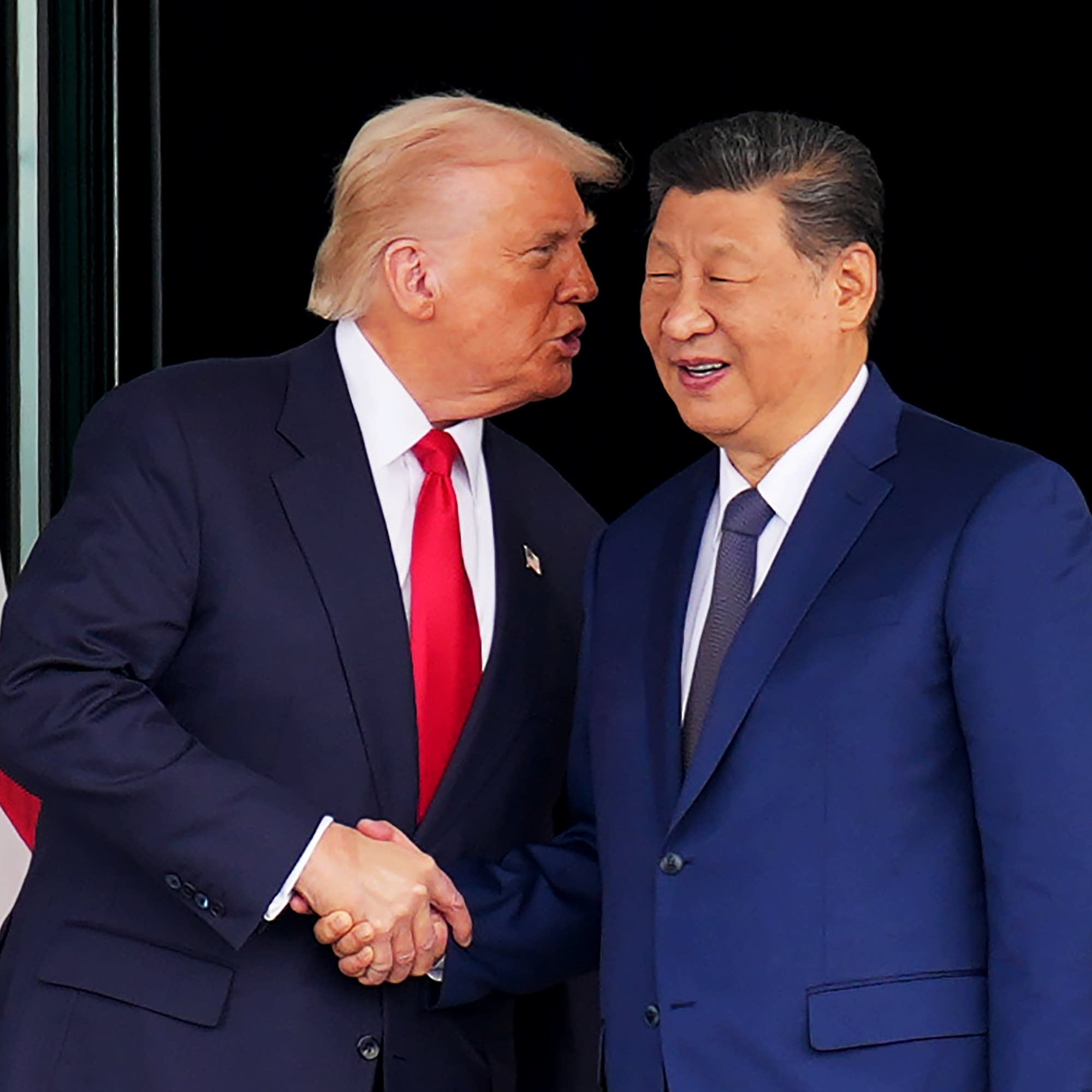
Is the US China Trade war finally cooling off? Live from the uk this is the Marketplace Morning report from the BBC World Service. I'm William Lee Adams. Good morning. It was a long anticipated meeting. The presidents of the world's two largest economies face to face for the first time since this year's tit for tat tariffs came into play. Now President Trump says the US can sign a trade deal with China pretty soon following the talks with Chinese President Xi Jinping in South Korea. The two leaders held a meeting in the city of Busan and President Xi told Chinese state media they'd reached a consensus on solving major trade issues. Both presidents were in the country ahead of the APEC meeting that's being held in the city of Kyungju. So what happens now? The BBC's Suranjana Tawari joins us from quite a noisy hotel at the APEC summit. Suranjana High hi there. President Trump sounded upbeat after the meeting, calling it a 12 out of 10. What exactly did the Americans gain from talks?
- [01:58]
Suranjana Tawari
Yes, he said he had an amazing meeting with China's President Xi Jinping. They did meet in a very insignificant building at Busan Airport as President Donald Trump was flying out and Xi Jinping was flying in for the APEC leaders summit. This comes against the backdrop of months and months of trade talks. And you know, Donald Trump's tariffs have really caused chaos not just for China, but other countries around the world. But it's the US China relationship that has been most frosty ever since. And we do understand that he has agreed to cut China's tariffs to 47% from 57%. And in return, China has agreed to keep rare earth exports flowing. Of course, China controls most of the rare earth's supply, and those critical minerals are used in everything from electric vehicles to smartphones and green energy appliances.
- [02:55]
William Lee Adams
We've been hearing a lot about soybeans in recent weeks. Was there any movement there?
- [02:59]
Suranjana Tawari
That's right. It seems that China has agreed to resume U.S. soybean purchases. And that is really significant because farmers over in the US have lost billions of dollars in sales. Farmers supported him in both of his elections and China hadn't been buying U.S. soybeans.
- [03:18]
William Lee Adams
President Trump was upbeat. What about Xi Jinping? Was he as effusive?
- [03:23]
Jahna
He did say that it's really important that these two economies work together because they are the two largest economies in the world. Having said that, Xi Jinping was fairly quick to say that the it wasn't a deal. They have come to a conclusion on a number of issues. It takes years to create a trade deal, especially when the economies are the size of the US And China. But the Trump administration is expecting these deals to be clinched within a matter of months. So it is a tall order and we'll see in the next hours or days if it does indeed lead to a trade deal.
- [03:57]
William Lee Adams
Sure. And Jahna, thanks for joining us on Marketplace.
- [03:59]
Suranjana Tawari
Thank you.
- [04:01]
William Lee Adams
Let's do the numbers. Markets in Asia reacted with caution to the news of a potential US China trade deal. MSCI's broadest index of Asia Pacific shares outside of Japan fell 0.5%. And over in Germany, Volkswagen reported its first quarterly loss in five years, $1.24 billion, as it struggled with U.S. tariffs. Now to the Netherlands, where thousands of homes and businesses are waiting to connect to its electricity grid and thousands more are waiting to inject power back into the system like solar panels. But the grid is struggling to cope with the transition to green energy. The BBC's John Lorenson reports from Rotterdam.
- [04:42]
John Laurenson
When we all use electricity at the same time, our power grid gets overloaded, explains this TV public service announcement. This can cause malfunctions, so use as little electricity as possible between 4 and 9, flip the switch, Transport, heating, cooking, the host of rechargeable devices we now use, the Netherlands is electrifying extremely fast. It has the highest number of electric vehicle charging points per capita in Europe, for example. As for electricity production, the Netherlands has replaced gas from its large North Sea reserves with wind and solar leading the way in Europe for the number of solar panels per person. But the grid can't cope Kesjan Ramo is the CEO of the Dutch energy producer and supplier Eneco, 70% of whose electricity is now solar and wind.
- [05:36]
Kiesjan Ramo
Grid congestion is like a traffic jam on the power grid. So it's caused by either too much power demand in a certain area or too much power supply. So too much power being put on the grid more than the grid and the transformers can handle.
- [05:53]
John Laurenson
The grid, he says, was designed when electricity was generated by a small number of big, mainly gas fired power plants.
- [06:01]
Kiesjan Ramo
Nowadays we're switching to renewable power, and that means that there's a lot of power also being injected into the grid in the outskirts of the grid, where there's only relatively small power lines. Here we're in the virtual power plant of Eneco.
- [06:18]
John Laurenson
At his company's head office in Rotterdam, Kiesian Ramo shows me a very large control panel. It's their virtual power plant that uses AI to help balance the grid. The Dutch have been skilful in managing challenges to the grid so far, largely avoiding blackouts. But for people and companies who want to scale up their use of electricity with a new or larger grid connection, that increasingly is just not possible. Eugene Byings is in charge of grid congestion with Tenet, the company that runs the national electricity grid.
- [06:50]
Eugene Byings
We have about 8,000 companies who want to feed in electricity and produce with either solar panels or wind farms. And we've got about 12,000 organizations, so factories and the bakery and the larger industries who want to take off and consume electricity off the grid. And for both categories, the grid is congested.
- [07:15]
John Laurenson
For some of the members of the Dutch Chemical association, for example, whose president.
- [07:19]
Ninka Homan
Is Ninka Homan, grid congestion is putting the future of the Dutch chemical industry at risk. And in other countries, it will be easier to invest.
- [07:28]
John Laurenson
Grid company Tenet says it'll need $230 billion of investment in the grid to make it fit for purpose by 2040. In the Netherlands, this is the BBC's John Laurenson for Marketplace.
- [07:42]
William Lee Adams
And in the UK, I'm William Lee Adams with the Marketplace Morning Report from the BBC World.
- [07:54]
Lulu Miller
Want to see a wilder world than the one we live in? A world with more beauty, more kindness, and more unbelievable superpowers.
- [08:01]
Wix Advertiser
Guess what?
- [08:02]
Lulu Miller
It's right here on planet Earth. And over on our podcast Terrestrials. Each episode we tell you stories about the strangeness waiting right here on Earth, hosted by me, Lulu Miller from Radiolab, along with a whole crew of amazing storytellers, animals and our song bud, Alan. Get curious with Terrestrials on the Radiolab for Kids podcast feed. Listen wherever you get your podcasts.