Loading summary
Transcript30 lines
- [00:00]
Firestone Auto Care Announcer
These days you've got two choices, buying a new car or making the one you've got run like new. That's why we have thousands of ASE certified technicians to help you get more out of your car. Firestone Complete Auto Care book now@firestoneauto.com Pretty backdrop, same issues.
- [00:19]
Nancy Marshall Genzer
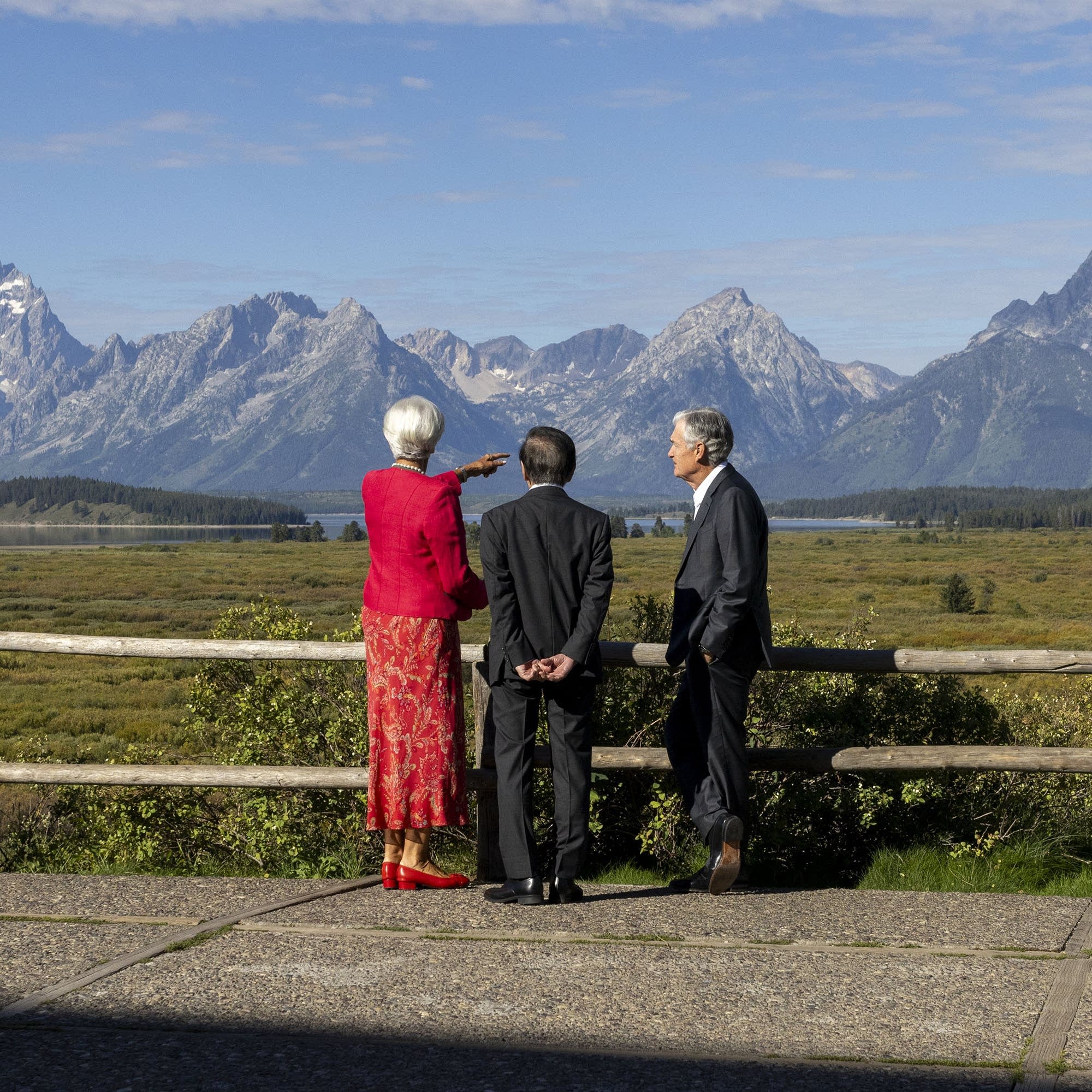
Fed Chair Jerome Powell heads to Jackson Hole this week. From Marketplace, I'm Nancy Marshall Genzer in for David Brancaccio. This is a big week for Federal Reserve watchers. Fed Chair Jerome Powell is scheduled to speak at a recent surge conference on Friday in Jackson Hole, Wyoming. Investors will be looking for hints on when the Fed might lower interest rates. Julia Coronado joins me now to discuss this. She's founder and president of Macro Policy Perspectives and a professor at the University of Texas, Austin. Good morning, Julia.
- [00:49]
Julia Coronado
Good morning.
- [00:50]
Nancy Marshall Genzer
So Fed Chair Powell has said he expects higher inflation from President Trump's tariffs this summer. What do you expect to hear from Powell on that and other issues this Friday?
- [01:02]
Julia Coronado
Usually the Jackson Hole speech is used to explore longer term themes. I think we will hear from Chair Powell that right now there are risks to both sides of their mandates, stable inflation, stable prices and maximum employment. And we've seen both some signs of inflation and tariffs pushing prices higher as well as the labor market weakening, which leaves the Fed kind of in a bind. What do they do? If they lower interest rates, that might help the job market but stoke inflation and vice versa. If they hold rates too high, that might keep inflation in check but hurt the labor market.
- [01:44]
Nancy Marshall Genzer
Yeah, I mean, the Fed really is being pulled in two directions here, isn't it? I mean, job creation has been weak. That would tend to tip the balance toward an interest rate cut. But inflation is still sticky, so rates need to stay higher to keep that under control. How is the Fed balancing those competing pressures?
- [02:04]
Julia Coronado
Very carefully. So so far they have balanced it by doing nothing and holding interest rates exactly where they are. They may go ahead with a rate cut in September. If they do so, we would expect it would probably be one and no promises of more. Just wait and see. Gather more data. See which risk is the greater risk.
- [02:27]
Nancy Marshall Genzer
Chair Powell does always say it depends on the data. So what data will come in between now and the Fed's September meeting on interest rates?
- [02:35]
Julia Coronado
The Fed will get another round of both inflation and employment data and it will be for August and they will be very important reports that will help inform which is the greater risk and what direction should interest rates go and how quickly.
- [02:51]
Nancy Marshall Genzer
One more question about Fed Chair Powell's speech on Friday he is expected to unveil the Fed's new policy framework. And this is the Fed's game plan for achieving its goals for inflation and employment. What do you think that's going to look like?
- [03:05]
Julia Coronado
I think without getting too deep in the weeds, it's likely to reaffirm the importance. And Chair Powell may use the opportunity to underscore the importance of having an independent central bank with a framework built for many different situations, and that they make those decisions judiciously and independently from political interference.
- [03:30]
Nancy Marshall Genzer
Julia Coronado, founder and president of Macro Policy Perspectives. Thank you.
- [03:35]
Julia Coronado
My pleasure.
- [03:56]
Nancy Marshall Genzer
The root vegetable cassava, maybe you know it as yucca, is one of the world's most versatile crops and a critical source of food security. But it's also a commodity under increasing global demand. Nigeria is the world's largest producer of cassava, but it doesn't export much of it to the global market. That's something Nigeria wants to change. Here's the BBC's Laura Hyten Ginseng.
- [04:22]
Laura Hyten Ginseng
This is Peckham, Southeast London, also known as Little Lagos for its big British Nigerian community. I'm heading to bim's African Food Store, a local institution.
- [04:37]
Interviewees (Various Nigerian Experts and Farmers)
And eat with chicken.
- [04:39]
Laura Hyten Ginseng
5, 6, 7 different cassava products. Besides the edible root, which is kind of like an elongated potato, cassava can be processed into a wide range of products, including starch, flour, a coarse grain called gary and a dough called fufu, as well as ethanol and even glue.
- [04:58]
Interviewees (Various Nigerian Experts and Farmers)
Thank you so much.
- [04:59]
Laura Hyten Ginseng
Lovely to meet you. Thank you. Cassava's importance to diets around the world is not to be underestimated. Professor Lateef Sani is a world leading expert on the crop.
- [05:09]
Interviewees (Various Nigerian Experts and Farmers)
In sub Saharan Africa, developing countries, lot of people eat cassava.
- [05:15]
Laura Hyten Ginseng
If you took cassava away, how would it affect its population?
- [05:20]
Interviewees (Various Nigerian Experts and Farmers)
I must tell you, if you take cassava away, it's like a third world.
- [05:25]
Laura Hyten Ginseng
War, World War three.
- [05:26]
Interviewees (Various Nigerian Experts and Farmers)
In terms of survival, it's going to be tough.
- [05:30]
Laura Hyten Ginseng
Defending against this kind of devastation is Nigeria's army of smallholder farmers who number in the millions and who do their work manually. Mrs. Kemi uses a machete on her cassava farm in Ogun State, southwestern Nigeria.
- [05:46]
Interviewees (Various Nigerian Experts and Farmers)
We labour a lot. Even at times we might not be able to complete the planting because of the stress and the hard labor. If we use machine planting work, agriculture will be very, very easy. But I don't have enough money to afford it because we cannot apply our whole capital on machine alone.
- [06:07]
Laura Hyten Ginseng
The global cassava export industry is worth about $3.5 billion. But Nigeria accounts for only about $1 million of that. Dr. Mustafa Bacano, head of the Nigeria Cassava Growers association, wants to turn things around.
- [06:24]
Interviewees (Various Nigerian Experts and Farmers)
We first need to know who are the farmers. By the time we're able to identify their farmlands, we are able to know what exactly is it they need and what exactly is the challenges.
- [06:33]
Laura Hyten Ginseng
His plan is to organize all smallholder farmers into clusters through which they can access bank loans to buy processing machinery, which they can later pay off due to their increased yields. Some clusters have already been set up, but aggregating millions of farmers is a gargantuan task. If the potential of cassava isn't in dispute, if successfully harnessed, it could transform the Nigerian economy. I'm the BBC's Laura Heitingens for Marketplace.
- [07:03]
Nancy Marshall Genzer
And I'm Nancy Marshall Genzer with the Marketplace Morning Report from apm, American Public Media.