Loading summary
Transcript28 lines
- [00:01]
Wix Advertiser
Running a business can be exhausting. Building your website shouldn't be. With Wix, you can express your ideas, give direction, then leave the heavy lifting to AI, from site creation to branded content and images. Have fun with the details, customize what you want the way you want, and manage your whole business from a centralized dashboard with expert AI tools. Build, scale and enjoy the incredible results. You can do it all yourself. On On Wicks we quilt this city with a comfy roll.
- [00:33]
Quilted Northern Advertiser
Quilted Northern is quilted with three cushy.
- [00:36]
Wix Advertiser
Layers for your comfort.
- [00:42]
Quilted Northern Advertiser
Keep it quilted with Quilted Northern with.
- [00:45]
Chris Lowe
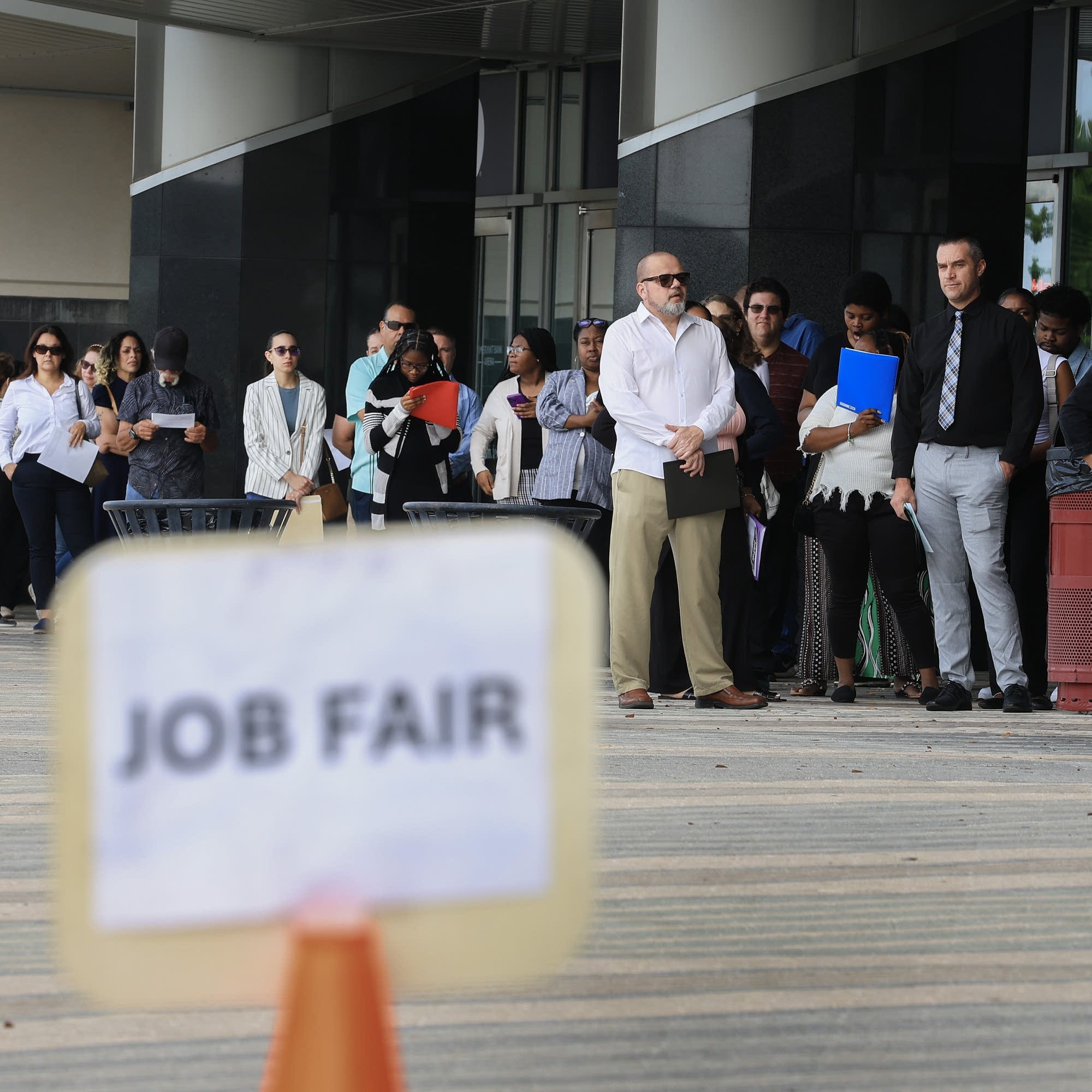
New feeble job data now, many will say the Fed should have lowered interest rates the other day. Fresh reports today show the job situation spring into mid summer was much weaker than we were told. Previous month's data has been revised sharply downward. We thought 125,000 more jobs were added in May. Wrong O It was just 19,000. We had been told 147,000 more people were on payrolls in June. The revised calculation is it was just 14,000. Today we're told there were 73,000 more jobs in July, less than expected. But might that get revised down? Chris Lowe is chief economist at FHN Financial.
- [01:24]
It's one of those shocking revelations where it's rare, but it happens. The anecdotal data, the survey data, turned out to be more accurate than what we characterize as the real data. Companies have been saying for months they weren't hiring. Turns out they weren't lying.
- [01:44]
And then in that unemployment number, you see a shrinkage of the workforce.
- [01:48]
Yeah, I think really the most astonishing thing about the July numbers was that the ranks of the unemployed increased by a quarter of a million people despite the fact that the labor force, which is the total number of people who actually want to work, the labor force fell and still unemployment went up. It tells me that the economy is barely growing.
- [02:17]
Market players are worried about a flagging economy now and higher tariffs. The dow is down 654 points, one and a half in early trading. The Nasdaq is down 2.2%. The bond market is way up given the weaker job market pulling the 10 year interest rate down to 4.25%. Now back to this new schedule of tariffs that start in a week or 35% tariffs for Canada starting today. Are those tariffs legal? Jess Bravin listened as the federal appeals court panel heard the arguments yesterday and he joins us now. Morning.
- [02:51]
Jess Bravin
Good morning.
- [02:51]
Chris Lowe
We learned in social studies class that Congress does the treaties, but the Trump strategy of bypassing Congress is derived from What a sense that the Trump people think they have an emergency on their hands.
- [03:05]
Jess Bravin
Well, Congress did give the president certain emergency powers. The idea being that Congress can't anticipate every little thing that's going to happen in the world. So if the president identifies certain circumstances, he can declare an emergency and bypass some of the laws Congress has enacted. And that's what. But President Trump has discovered and used quite liberally.
- [03:26]
Chris Lowe
Right. And small businesses suing, saying the tariffs hurt them. They question whether or not this is a legit emergency.
- [03:34]
Jess Bravin
Yes, they do. And not just that. They say that even if it is an emergency, at least even if President Trump has validly declared the longtime problem of the trade imbalance as an emergency, tariffs they say Congress reserved for itself through other laws. And this is just a bridge too far in responding to any kind of foreign threat.
- [03:58]
Chris Lowe
Now, you and a colleague did yeoman's work monitoring all of that federal court hearing yesterday. What do we learn?
- [04:07]
Jess Bravin
Well, we learned that this, you know, this court is skeptical. Some judges point out that this law has been on the books for 50 years and no president has ever invoked tariffs under it. The judges pointed out that the authority the president is claiming comes from provision that says in response to an unusual or extraordinary threat overseas, the president can regulate importation. The president has interpreted that to mean he can impose import taxes on goods coming into the United States. The judges were skeptical that the word regulate go so far as to allow tariffs.
- [04:43]
Chris Lowe
It's not impossible this ends up at the high court.
- [04:47]
Jess Bravin
It's not impossible that it ends up at the high court. In fact, I would say it's likely this ends up at the Supreme Court because whoever loses before this intermediate appeals court is going to be very unhappy. There are billions of dollars at stake and they're going to go down the road and file an appeal. The Supreme Court is not required to take that appeal, but it almost certainly will because this is such an important issue, especially if the government loses. Because when the loses at a lower court, the justices are particularly open to hearing the government's arguments.
- [05:19]
Chris Lowe
Wall Street Journal correspondent Jess Braven, thank you very much.
- [05:23]
Jess Bravin
Anytime, David.
- [05:37]
Chris Lowe
As of today, it is illegal to discriminate against someone in Minneapolis because they're seen as too short, too tall or too heav. That city follows New York, San Francisco and a patchwork of other places that have those protections that can affect housing, hiring and more. But discrimination based on body type is legal elsewhere. Marketplace's Savannah Peters has more.
- [05:59]
Quilted Northern Advertiser
The job market is not always kind to people with larger bodies. According to Natalie Boro, who studies weight bias at San Jose State University. There are more often denied promotions, less often hired in the first place. Research shows there's a wage penalty associated with having a bigger body, particularly for women. Height bias is more likely to impact men. There are obvious economic consequences of all of these things. But body size is not a protected class under federal law. And Minneapolis is joining a short list of just nine U.S. cities with legal protections against size discrimination, plus the states of Michigan and Washington.
- [06:41]
Wix Advertiser
And that's it.
- [06:42]
Quilted Northern Advertiser
Tigress Osborne heads up the national association to Advance Fad Acceptance. She says it's a tough political environment for the handful of other states where anti size discrimination bills are pending.
- [06:55]
Wix Advertiser
There's so much pushback against dei and people think of size acceptance as one of those issues.
- [07:02]
Quilted Northern Advertiser
Plus, employers tend to push back on any new regulations that could cost them money. In Minneapolis, organizers hope new protections will influence over a dozen Fortune 500 companies headquartered in the city. Kat Palovoda owns a plus size consignment store in Minneapolis. When someone learns like you can get fired for being fat most places, whether you live in a larger body or not, you're like, I don't think that's right, you know? Palovoda knows size discrimination can be hard to prove, but hopes the new protections can help shift the culture in her city. Savannah I'm Savannah Peters for Marketplace, and.
- [07:39]
Chris Lowe
In Los Angeles, I'm David Brancaccio. You're listening to the Marketplace Morning Report from apm, American Public Media.
- [07:50]
Savannah Peters
Summer's here and it's time for your kids to have fun in the sun. But it's also a great time to nurture growing minds. Million Bazillion, a podcast from Marketplace, teaches your kids about something that impacts all of us money. From a fun explainer on tariffs, yes, it's possible to why some athletes make so much money. Million Bazillion tackles big questions with easy to understand answers. Listen to Million Bazillion all summer long. Available wherever you get your podcasts.