Loading summary
Transcript38 lines
- [00:00]
Tractor Supply Representative
The rural way of life is about making everyone feel at home. Tractor supply chose advanced 5G solutions from T Mobile for Business to transform intelligent customer service. Together we put the power of AI to work across 2200 stores keeping things running seamlessly inside curbside and countryside. This is elevated customer experience. This is Tractor Supply with T Mobile for Business. Take your business further@t mobile.com now.
- [00:31]
Grainger Representative
For.
- [00:31]
Marketplace Reporter
The ones who get it done. The most important part is the one you need now and the best partner is the one who can deliver. That's why millions of maintenance and repair pros trust Grainger because we have professional grade supplies for every industry, even hard to find products. And we have same day pickup and next day delivery on most orders. But most importantly, we have an unwavering commitment to help keep you up and running. Call clickranger.com or just stop by Granger for the ones who get it done.
- [01:03]
David Brancaccio
There are new details of how the Senate wants to tax and spend, with an attempt to postpone a hotly contested matter involving deductions for state and local taxes. I'm David Brancaccio in Los Angeles. Republicans on the Senate Finance Committee have unveiled their version of the mega tax and spending bill. They did it last evening. This differs from the House passed version on some flashpoint issues. Marketplace's Henry Epp has an update.
- [01:29]
Henry Epp
Some tax breaks in the Senate committee version are less generous than those passed by the House. For example, the Senate proposes raising the child tax credit to $2,200 less than the House's 2,500. The Senate would also put limits on deductions for tipped income and overtime pay. And it would keep the cap on state and local tax deductions at $10,000, well below the House's proposed $40,000. The Senate version would also more aggressively cut medic limiting the provider tax set by states like the House. It would set work requirements for some Medicaid recipients. But the Senate would give green energy companies more time than the House to start projects that qualify for tax credits passed under former President Joe Biden, though it would more quickly end tax credits for buyers of new and used electric vehicles. And the Senate would raise the debt ceiling higher than the House to 5 trillion rather than $4 trillion. GOP leaders want to reconcile all these issues and pass the bill before the fourth of I'm Henry AP for Marketplace.
- [02:31]
David Brancaccio
The Washington Post is reporting the Trump administration has issued new directives to ICE agents to resume immigration raids on farms and hotels for a couple of days. President Trump and his administration had seen to be backing off farms and hotels, with Trump posting comments about immigrants providing important work in those sectors. The president has left the Group of Seven summit in Canada early for reasons that are unclear but possibly connected to the Israel, Iran military strikes are on financial matters, there was no US Trade deal announcement with Japan, but the US did sign off on a trade deal with Britain. The BBC's Chris Mason has more from the summit in Alberta, Canada.
- [03:10]
Chris Mason
Amid the tariff turbulence from the White House, a certain triumph up to a point for Downing street. The aerospace industry will see tariffs removed completely. There'll be a 10% levy on the car industry. One wrinkle is while UK government officials point out that Britain is the only country to be exempt from the global tariff of 50% on steel and aluminium, a 25% tariff does remain. Negotiations to remove this continue. This isn't the full fat US UK trade deal some once envisioned, and it's been reached in a rather unorthodox way. But amid his domestic political woes, it is an achievement for the prime minister on the international stage few other leaders can boast of.
- [03:57]
David Brancaccio
With reports Iran is seeking de escalation with Israel, the price of crude oil is up just modestly this morning, 1.3% in New York, $72.63 a barrel. Now that's about 7% higher than it was before Israel first launched its military strikes late last.
- [04:23]
Marketplace Reporter
Year.
- [04:27]
Zoe Saldana
Hi Zoe Saldana. Welcome to T Mobile. Here's your new iPhone 16 Pro on us.
- [04:31]
T Mobile Customer
Thanks. And here's my old phone to trade in.
- [04:34]
Zoe Saldana
You don't need a trade in when you switch to T Mobile. We'll give you a new iPhone 16 Pro. Plus we'll help you pay off your old Phone up to 800 bucks and you still get to keep it.
- [04:43]
T Mobile Customer
There's always a trade in.
- [04:44]
Zoe Saldana
Not right now. @ T Mobile.
- [04:45]
T Mobile Customer
I feel like I have to give you something in return for karma.
- [04:47]
Zoe Saldana
That's okay.
- [04:48]
T Mobile Customer
I don't really have much in my purse. Oh, let's see. Hand sanitizer. It's lavender.
- [04:53]
Zoe Saldana
I'm good. Seriously.
- [04:54]
T Mobile Customer
Let me check this pocket market. Oh, mints.
- [04:57]
Zoe Saldana
Really, I'm fine.
- [04:58]
T Mobile Customer
Oh, I have raisins. I'm a mom. Wait, wait one sec. I've got cupcakes in the car.
- [05:02]
Tractor Supply Representative
It's our best iPhone offer ever. Switch to T Mobile. Get a new iPhone 16 Pro with Apple Intelligence on us. No trade in needed. We'll even pay off your phone up to 800 bucks with 24 monthly bill credits.
- [05:15]
Grainger Representative
New line 100 plus a month on.
- [05:16]
Henry Epp
Experience beyond Finance Agreement 999.99 and qualifying.
- [05:19]
Marketplace Reporter
Ported for well qualified plus tax and.
- [05:21]
Henry Epp
10 connection charge payout via virtual prepaid card allow 15 days credits ended up balance due if you pay off early or cancel.
- [05:26]
David Brancaccio
See t mobile.com now to the business of rock and roll and lowering the impact of concert tours on the earth. Reverb, a nonprofit that works to create a more environmentally friendly music industry, has a new study that looks at the impact of traveling to music events. It finds a lot of interest among music lovers in more sustainable transportation options. Reverb's co founder and co executive director Adam Gardner joins us now. You might also know him as guitarist and singer for the band Guster. Adam, welcome back.
- [05:55]
Grainger Representative
Thanks for having me.
- [05:56]
David Brancaccio
I think about the impact of going to a concert and you know you see piles of trash at the ones that are not managed correctly. You can see mountains of single use water bottles. But really it's the travel. When you're looking for carbon footprint and you think that's a place where carbon could be saved.
- [06:13]
Grainger Representative
Yeah, it has to be. It's just by far the largest part of any concert's footprint. Which you know, if you think about it makes sense. But it's really a symptom of a larger infrastruct and transportation issue in our country. But music is a high profile industry and if there's a way for it to be a catalyst for change on a municipal level, when we're talking about public transit and cultural level, I'm talking about people actually using it. This is what we're excited about.
- [06:39]
David Brancaccio
And I was looking at the study, it was also striking. You just got a, a key part of this is letting people know that there are alternatives for getting there than necessarily driving alone in a car.
- [06:48]
Grainger Representative
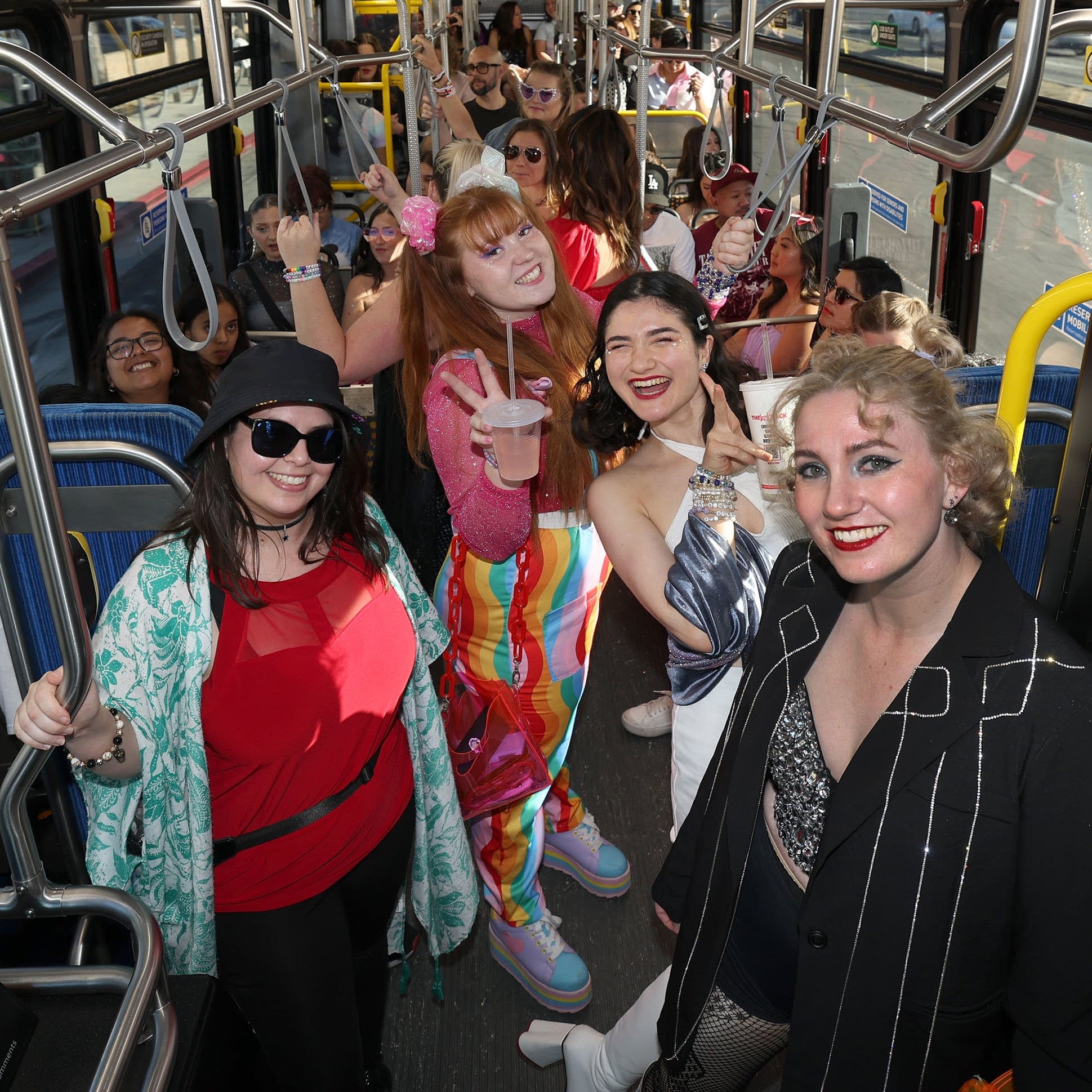
And they're not everywhere. And I don't want to place this responsibility all on fans because it isn't. I mean again, what's interesting is fans want this but they're not given the information or there isn't the infrastructure there. So it's a responsibility that's shared from the venues to the promoters of the concerts. The artists can be playing a huge role in communicating those options. And there's local business opportunities with party buses and shuttles and we've seen some solutions already starting to happen. This thing for me is it came out of a natural place. I think a lot of people who go to concerts can relate. When's the last time you've gone to a and at the end of the night you haven't had to make that decision between seeing the encore or leaving early so you didn't have to sit in traffic to get out of there.
- [07:28]
David Brancaccio
Is there a kind of underwriter's seal of approval for shows that are making an effort with regard to the environment?
- [07:36]
Grainger Representative
The artists are playing a big role in being the cheerleader, for lack of a better term. The good news is also coming out of the COVID shutdown, a lot more energy in the music industry is focused on sustainability in a real way. Before it was maybe when we get to it, but now people are starting to understand that there's a real demand not only from the artists that are playing these venues, but the fans that are attending. So we're very excited about that. I think again, it really comes down. We call the three I's information, infrastructure and incentive. That's what's going to move the needle with concert travel.
- [08:10]
David Brancaccio
Adam Gardner is co founder of the nonprofit Reverb that works on environmental issues as they impact the music industry and the concert industry. You can Read more about Reverb's concert travel study on our website marketplace.org Also, Adam sings and plays guitar, does a lot of things for the band. Guster, thank you for doing this.
- [08:31]
Grainger Representative
Thanks David. Thanks for having me.
- [08:33]
David Brancaccio
In Los Angeles, I'm David Brancaccio. You're listening to the Marketplace Morning Report from APM American Public Media.
- [08:48]
Marie Mejres
Personal finance isn't just about spreadsheets and investing. It's emotional. Talking to your partner about money, negotiating a raise. Even the smallest decisions, like splitting a bill, can bring up feelings of shame or anxiety. I'm Marie Mejres, host of this is Uncomfortable, a podcast from Marketplace about life and how money messes with it. In this season, we get into topics like workplace drama, tough financial trade offs, and the quiet tension that builds when love and finances collide. Listen to this Is Uncomfortable. Wherever you get your podcast.