Loading summary
Transcript29 lines
- [00:00]
A
Did you know? 39% of teen drivers admit to texting while driving. Even scarier, those who text are more likely to speed and run red lights. Shockingly, 94% know it's dangerous, but do it anyway. As a parent, you can't always be in the car, but you can stay connected to their safety with Greenlight Infinity's driving reports. Monitor their driving habits, see if they're using their phone, speeding and more. These reports provide real data for meaningful conversations about safety. Plus, with weekly updates, you can track their progress over time. Help keep your teens safe. Sign up for Greenlight infinity@Greenlight.com podcast.
- [00:32]
B
You've finally broken loose from work. Three friends, one tea time and then the text Honey, there's water in the basement. Not exactly how you pictured your Saturday. That's when you call us Cincinnati Insurance. We always answer the call because real protection means showing up even when things are in the rough. Cincinnati Insurance let us make your bad day better. Find an agent@cin fin.com.
- [01:03]
C
Might we soon look up into the night sky to see a crescent or round shaped economy?
- [01:10]
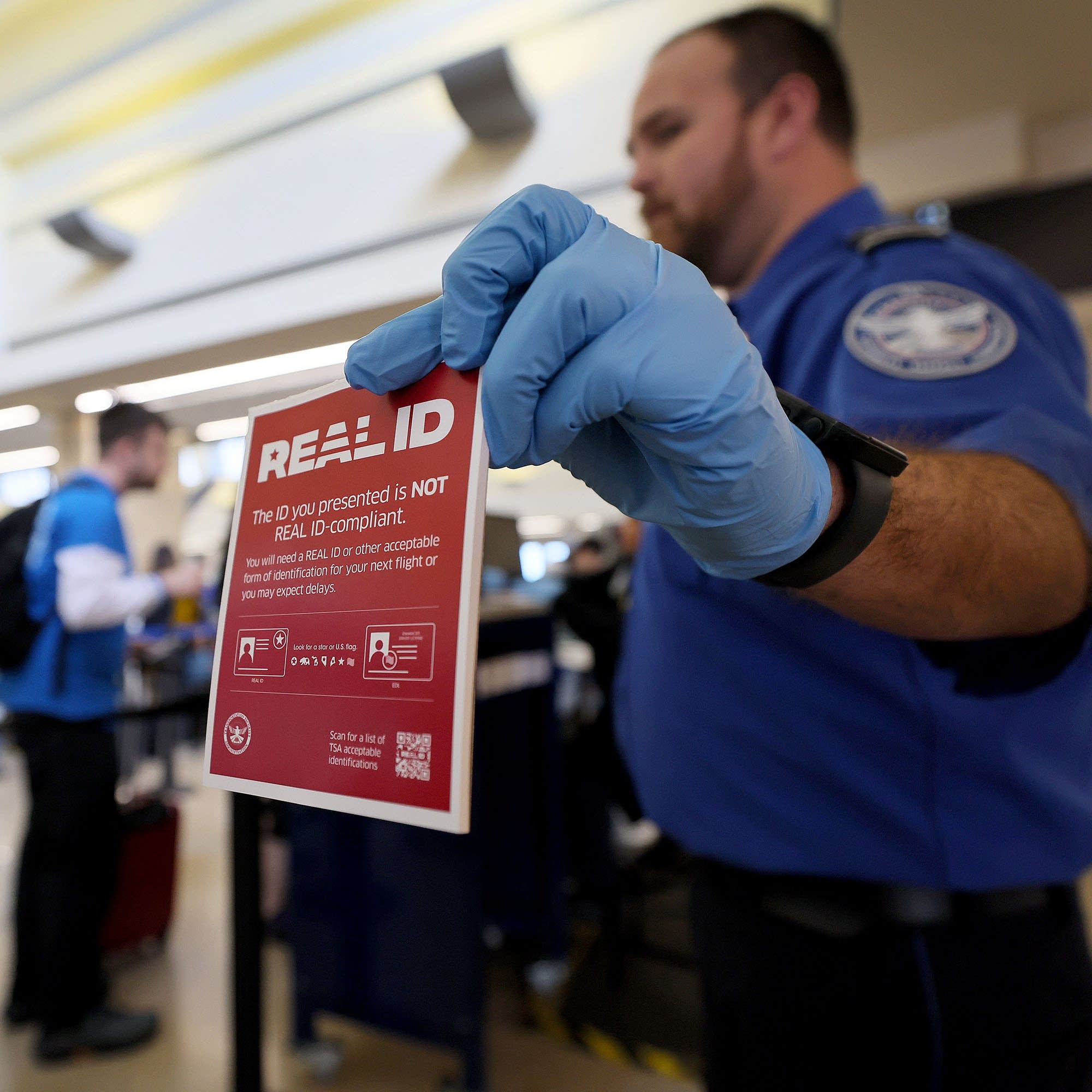
I'm David Brancaccio in Los Angeles. First, the front of your ID card, including driver's license. Does it have the little star shape indicating it's a real id? More today on TSA Airport security announcing people with an ID but without Real ID will soon have to pay a $45 fee for Marketplace's Kimberly Adams has more.
- [01:30]
A
Most current driver's licenses are Real IDs, which meet higher federal security standards.
- [01:35]
D
There have been 17 years for people to get compliant with Real ID.
- [01:39]
A
Janice Kephart is CEO of identity compliance firm Zipid and consulted on the 911 Commission that spawned the stricter identity requirements.
- [01:49]
D
It's only about 6% of people might not be presenting a real ID or a biometric equivalent at this point, so it's a pretty small percentage.
- [01:59]
A
And who are those folks? Mostly people who don't travel much by air, says Ifeanwa Davis of Louisiana Appleseed center for Law and Justice.
- [02:08]
D
This can also be really difficult or challenging for people who have missing birth records, for people who are dealing with the legality around their name change.
- [02:18]
A
Critics of the new fee say most people will probably just pay to finally get their real IDs rather than deal with the hassle, which is kind of the point, says the TSA Steve Lorenzo.
- [02:29]
C
For us, the big push is security. The big push is compliance. The big push is for people to get their real ID.
- [02:39]
A
But if they don't, starting February 1st, they'll either need to pay the fee online in advance or expect to spend even more time going through security at the airport. In Washington, I'm Kimberly Adams for Marketplace.
- [02:52]
C
The $45 fee will be good for 10 days of travel, so for trips longer than that, passengers with id, but not real ID would pay again. Passports are among a short list of documents that will still work at airport security without the fee. This is all come February. The Financial Times is reporting now that the US Stopped a plan to hit China's spy agency with sanctions in order to keep trade negotiations moving forward. The planned sanctions have been designed to respond to a massive cyber espionage campaign that had targeted top US officials. The FT's reporting suggest this was also about the US not disrupting imports of China's rare earth minerals.
- [03:52]
B
If you're an H Vac technician and a call comes in, Grainger knows that you need a partner that helps you find the right product fast and hassle free. And you know that when the first problem of the day is a clanking blower motor, there's no need to break a sweat. With Grainger's easy to use website and product details, you're confident you'll soon have everything humming right along. Call 1-800-GRAINGER clickgrainger.com or just stop by Grainger for the ones who get it done.
- [04:21]
E
This Marketplace podcast is supported by Superhuman. The world is buzzing with AI tools, but instead of making things easier, they've made your workflow overwhelming. You're stuck copying and pasting, context switching and juggling too many apps. There's now a better way that outsmarts the work chaos. Meet Superhuman, the AI productivity suite that gives you superpowers everywhere. You work with Grammarly, mail and coda working together, you get proactive help across your workflow, from writing to preparing for meetings, presentations, and so much more. Think of Superhuman as your AI dream team, proactively helping you go from to do to done faster. Superhuman knows what you might need and offers suggestions whether you're drafting emails, creating documents, or more. It guides you in the moment so you can sound like your best self and stay focused on what matters. There are even specialized agents designed to collaborate seamlessly and amplify your impact. Unleash your Superhuman potential today. Learn more@superhuman.com podcast that's superhuman.com podcast as.
- [05:22]
C
You gaze up at this evening's supermoon up to 14% larger seeming and 30% brighter. Don't get greedy. To quote Article 2 of the Outer Space Treaty of 1967, outer space, including the moon, is not subject to national appropriation by claim of sovereignty, by means of use or occupation, or by any other means. So you can't do a land grab up there, but you can conduct business on the moon. This week here, multiple views of an emerging moon economy, how it might work, and if it's even a good idea. Christina Guidi is assistant general manager for space technology and transportation at a nonprofit entity called the Aerospace Corporation. Among the many projects it coordinates how people and machines might communicate with each other on the Moon.
- [06:08]
D
What we are doing in partnership with NASA for their ARMIS missions is creating Lunanet, which is essentially a communications and navigation architecture or system that allows us to communicate to rovers, as you mentioned, also to orbiting spacecraft and astronauts on the surface of the moon, from Earth and to each other while they're on the lunar surface.
- [06:31]
C
What about knowing where you are on the moon? I think some of my listeners will be ahead of me on this. Right. But the GPS system that we use for our maps to work on our phone involve satellites around Earth. Probably not going to help you if you're on the Moon.
- [06:45]
D
That's what this Lunanet is going to help do is actually provide that situational awareness of where you are, your position, and allow for navigation of the different assets and astronauts as well. So it's a critical infrastructure that we need to put in place for Artemis to be sustainable.
- [07:02]
C
Yeah, I mean, the infrastructure would include, I don't know, structures building on the moon. It's a lot cheaper if you can build with stuff that's actually already on the moon. And what that mainly is is that lunar dirt. I guess there's promise there of turning that into usable stuff.
- [07:19]
D
That's a key area. In situ resource utilization includes using the lunar regolith to construct structures to convert the lunar regolith into water and air. There's a lot on the lunar surface that we could actually exploit. But you also have to think about we have to have power, right? Where are we going to get our power from? We need robotic or mobility devices that would actually push the regolith around to create a landing pad.
- [07:50]
C
I mean, on the side facing the sun. You can use solar, right?
- [07:55]
D
Absolutely, absolutely. But we're also looking at fission, fission, nuclear power sources. So we've got several companies actually developing systems that can actually be deployed on the lunar surface just for that reason, so that it can actually operate during the lunar night.
- [08:12]
C
Chris, I got a favor, though. When you're in meetings coordinating a lunar economy to come, can you tell them not to make a mess? I mean, there are environmental concerns?
- [08:21]
D
Oh, absolutely. But one thing we need to consider looking forward is how do we take the leftover materials or hardware and reuse it. So that would be a technology that needs to be developed across the community to repurpose material that is not used completely. That's something that needs to be considered in the future for sure.
- [08:43]
C
Christina Guidi is assistant general manager for the Space Technology and Transportation subdivision in the Human Exploration and Space Flight Division at Aerospace Corporation. Thank you for the conversation.
- [08:56]
D
Thanks for having me.
- [08:58]
C
Tomorrow here I'll speak to a professor of religion and science studies about ethical and environmental concerns if the moon were to be developed. All our interviews are accumulating at Market. We also have a new video up about what I learned about the stock market by building and launching big amateur rockets. Search Marketplace APM on TikTok, Facebook or Instagram In Los Angeles, I'm David Brancaccio, Marketplace Morning Report from apm, American Public Media. A moment now to say thank you Marketplace listeners. Your giving Tuesday support made a real impact in a moment when public media funding has been cut nationwide. Your support keeps Marketplace's independent reporting on the economy accessible for everyone. And if you didn't get a chance to donate, it's always a great time to become a Marketplace investor. Give now@marketplace.org or click the link in the show notes.