Loading summary
Transcript21 lines
- [00:00]
Rima Reyes
This Marketplace podcast is supported by Palo Alto Networks. Listen to threatvector, the Palo Alto Networks podcast, for in depth discussions with industry leaders and experts providing crucial insights for security decision makers. Whether you're looking to stay ahead of the curve with innovative solutions or understand the evolving cybersecurity landscape, ThreatVector equips you with the knowledge needed to safeguard your organization. Tune in and subscribe to threatvector wherever you get your podcasts.
- [00:29]
David Brancaccio
This Marketplace podcast is supported by Yubico, makers of the Yubikey Protecting the personal and business applications and accounts that people and companies rely on every day. The Yubikey stops AI powered cyber attacks, online identity scams, fraud and account takeovers. It provides powerful protection and it's easy to use.
- [00:51]
Rima Reyes
Simply tap your Yubikey to log in.
- [00:53]
David Brancaccio
Securely to everything from email to finance to productivity applications across all of your devices. Yubikey still undefeated, the original Passkey more@yubico.com.
- [01:08]
Nancy Marshall Genzer
Youm can hear the merger a blowin coming round the bend. I'm David Brancaccio in Los Angeles. Good morning to you first Trade negotiators for the US And China are meeting in Sweden for a second day of talks. This could lead to a presidential summit, Marketplace's Nancy Marshall Genzer reports.
- [01:25]
Erin Delmore
At the very least, the Sweden negotiations could lead to an extension of a truce in the U. S China trade war that paused triple digit tariffs until August 12th. There are much bigger issues on the table, though. US companies want more access to the Chinese market, the Trump administration wants more curbs on fentanyl ingredients made in China that end up in the US and is also concerned about Chinese purchases of Russian and Iranian oil. And China wants access to sophisticated computer chips made in the US that are used in AI. The Financial Times is reporting the Trump administration paused curbs on technology exports to China to help facilitate the trade talks and a possible meeting between President Trump and Chinese President Xi. In a social media post last night, Trump said he's not seeking a summit with Xi but may go to China. He says an invitation has been extended. I'm Nancy Marshall Genser for Marketplace.
- [02:24]
Nancy Marshall Genzer
The US has set a new deadline for Russia to make progress on ending its war in Ukraine or face new economic sanctions. Erin Delmore is following this for us.
- [02:35]
David Brancaccio
President Trump said on Monday that Russia will have 10 or 12 days to take steps toward ending its three and a half year old war in Ukraine or the country will face consequences. Namely, he's threatening sanctions on Russia and on the businesses and individuals that buy Russia's exports. It's a harder line than President Trump has taken in the past when he's shown hesitation to impose new sanctions. But now it seems that his patience with Russian President Vladimir Putin is wearing thin. He usually isn't shy about saying the two have a good relationship, but Monday he said he was disappointed in the Russian leader and so Trump is shortening a deadline he'd set earlier this month of 50 days. He said there was no reason to wait and that he didn't see any progress being made. Meanwhile, the US has reached a new tariff deal with the EU that's poised to help Europe move away from reliance on Russian energy. In the deal, the EU pledged to buy $750 billion worth of energy from the U.S. spread across three years. The EU has been buying more liquefied natural gas from the U.S. since Russia invaded Ukraine. European Commission President Ursula von der Leyen said the goal is to absolutely get rid of Russian fossil fuels and hailed the energy agreement with the US As a win.
- [03:43]
Nancy Marshall Genzer
Erin Delmore with our partners at the BBC there stock in UnitedHealth down 3.3% in pre market trading now after it said this morning its profit will be lower this year than previously suggested. Last week the insurer confirmed it's under investigation for civil fraud amid questions about how it bills for Medicare Advantage, a privatized version of Medicare S and p futures are up 3. 10%. Nasdaq futures are up 5/10 of a percent. The guardians of interest rates at the Federal Reserve kick off their two day meeting this morning. Among the predictions that Fed officials will not lower rates. We'll know that by about 2 Eastern tomorrow. A second prediction is that the Trump administration will not like that decision. Lower interest rates would ease the cost of borrowing, but given higher prices from higher tariffs, lowering rates prematurely could rekindle more general inflation.
- [04:49]
Kimberly Adams
This marketplace podcast is supported by Dell. Upgrade your learning experience during Dell Technologies Back to school event with AI PCs like the Dell 14 plus featuring an Intel Core Ultra processor starting at $749.99. Supercharge your studies with features like real time notes, transcription, AI accelerated hardware to run multiple apps without slowing down extended battery Life and more. That's the power of new AI PCs with Intel Inside. What's more, upgrade your school year setup with limited time deals on SEL monitors and more. Must have electronics and accessories. Don't wait. Discover a smarter way to learn@dell.com deals that's Dell.com deals.
- [05:38]
Rima Reyes
On WhatsApp. Your personal messages stay private between you and whoever you send them to, so things like the passport numbers for your honeymoon stay between you and your fiance, and that video call for your grand's 80th stays in the family. Even your streaming password stays between you and your college roommates, who still ask for it every week in your group chat. Because on WhatsApp, your personal messages are yours. No one else can see or hear them, not even us. WhatsApp message privately.
- [06:09]
Nancy Marshall Genzer
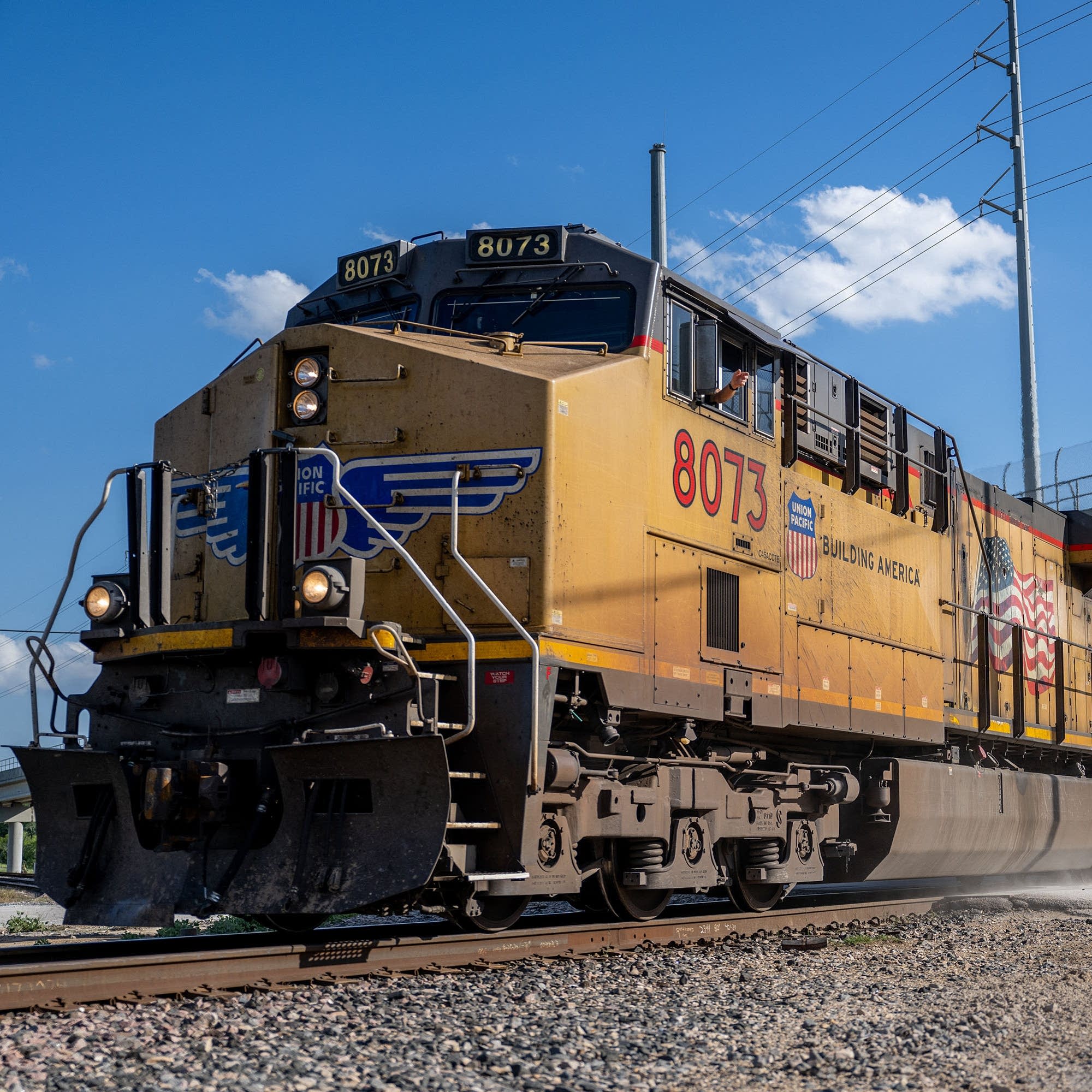
There'S news this morning the two huge haulers of freight by rail are joining forces. Union Pacific, Big in the west, is acquiring Norfolk Southern with Easterly for $85 billion. The deal creates the largest freight rail network in the country, which will attract the attention of antitrust regulators. Reporter Daniel Ackerman has more.
- [06:29]
Daniel Ackerman
If you want to ship something from LA to New York, you've got a couple options. You could pay an airline to fly it there or a trucking company to drive it. But one thing you can't do Pay a rail company to bring it by train. There's no single freight railroad with coast to coast service, which is something of a shame, says Ari Rosa, a logistics analyst at Citigroup. Railroads are more cost efficient for most items and are also more fuel efficient and more environmentally friendly. The merger would create the first true transcontinental freight rail that could incentivize shippers to send more stuff by rail by eliminating a major Midwest choke point in the system. Chicago is congested, railroad analyst Tony Hatch says. Chicago is one place railroads do something called interlining. Interlining, where you're connecting to the eastern carrier from a west or vice versa, requires often, you know, changing the locomotives, changing the crews. And while it's a chance for train operators to grab a hot dog and deep dish pizza, Hatch says interlining between networks isn't entirely efficient. So if you own the entire thing, you will move the assets where they make the most sense. You will save a lot of labor. You'll be much more reliable, you'll have more capacity overall, says Stuart Churls. With Freight Waves, it would be a.
- [07:44]
Nancy Marshall Genzer
Seamless one receipt transaction from coast to coast, which was envisioned, of course, when the transcontinental railroad was authorized under Abraham Lincoln.
- [07:55]
Daniel Ackerman
But Churls says there's a reason it hasn't happened yet.
- [07:58]
Nancy Marshall Genzer
Shippers have to be assured that they're going to be getting benefits of this kind of tie up, which is going to create a monolith of a railroad.
- [08:08]
Daniel Ackerman
A monolith that others might call a monopoly. In addition to antitrust concerns, Charles says, smaller mergers have led to costly traffic delays as railroads struggled to integrate their operations And Charles says, looking at this deal from a high level, nobody was.
- [08:23]
Nancy Marshall Genzer
Really clamoring for a coast to coast consolidation of the railroads except perhaps some CEOs and their bankers.
- [08:31]
Daniel Ackerman
Regulators have held up a high bar for railroad mergers in recent decades. This deal is a test of whether that's changed, says Citigroup's Ari Rosa. If the White House weighs in on this, I think it will be an indication of the extent to which the White House is comfortable with creating these mega companies. Rosa said it could take regulators more than a year to review any deal. I'm Daniel Ackerman from Marketplace.
- [08:55]
Nancy Marshall Genzer
Our producers are Tamar Fagan, Arianna Rosas and Erica Soderstrom. Our senior producer is Alex Schroeder. Our supervising senior producer is Meredith Garretts and Morby. In Los Angeles, I'm David Brankac. Marketplace Morning Report from APM American Public Media.
- [09:20]
Rima Reyes
Hey everyone, I'm Rima Reyes and I'm excited to join Kimberly Adams on Make Me Smart. Together we'll unpack the day's news, whether it's a tariff switch up, the latest on Trump's immigration policy, or the future of clean energy. Join us each weekday so we can make sense of it all together because none of us is as smart as all of us. Listen to Make Me Smart. Wherever you get your podcasts.