← Marketplace Morning Report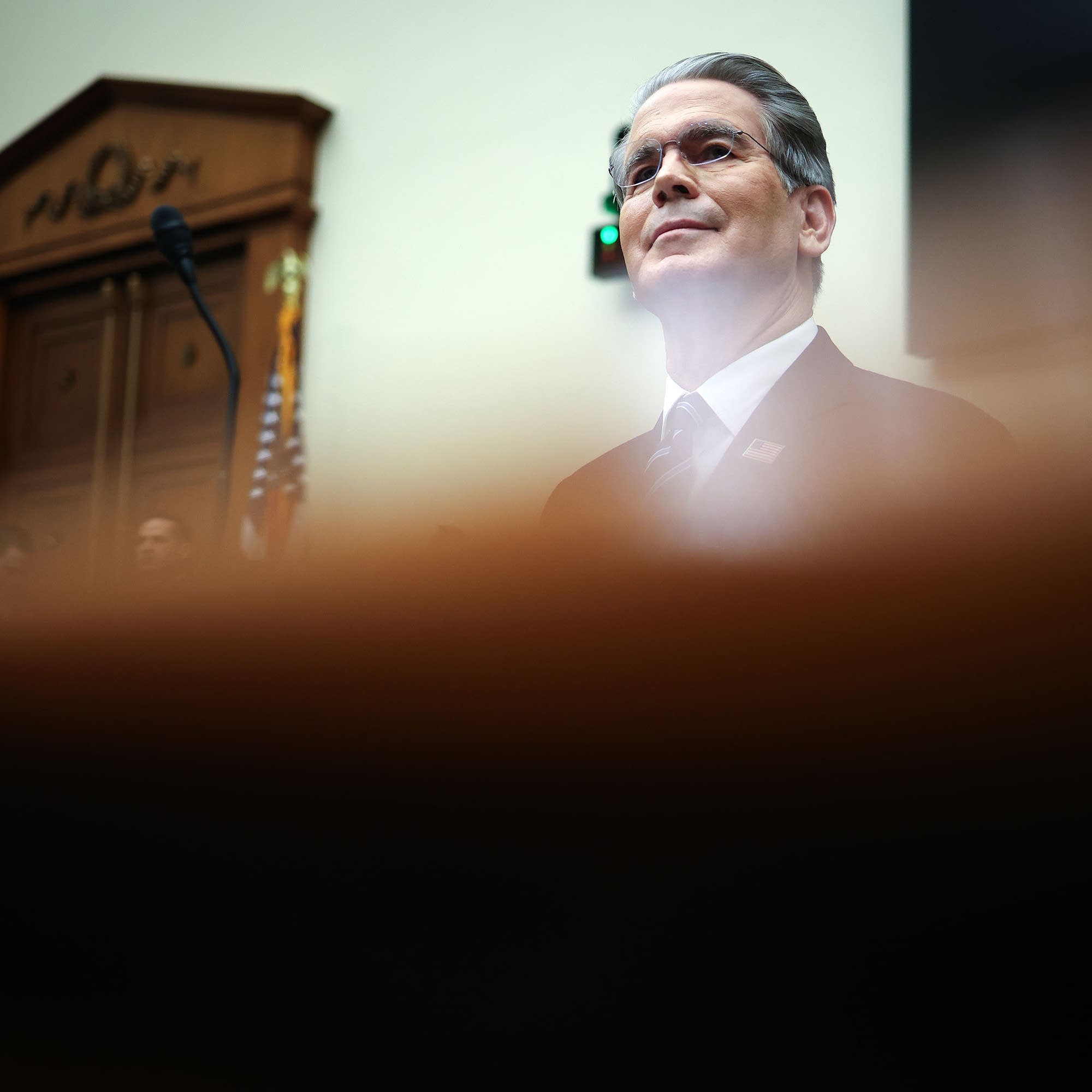
Loading summary
Transcript44 lines
- [00:01]
A
Hey, Sal. Hank, what's going on? We haven't worked a case in years. I just bought my car at Carvana and it was so easy. Too easy. Think something's up? You tell me. They got thousands of options, found a great car at a great price, and it got delivered the next day. It sounds like Carvana just makes it easy to buy your car, Hank. Yeah, you're right. Case closed.
- [00:25]
B
Buy your car today on Carvana. Delivery fees may apply.
- [00:31]
A
Raised voices at a hearing starring the Treasury Secretary. I'm David Brancaccio in Los Angeles. Treasury Secretary Scott Besant will be on Capitol Hill again today for a second day of questions, this time before the Senate Banking Committee. Yesterday, Bessant sparred with Democrats at a tense encounter before a House committee. Marketplace's Nancy Marshall Genzer reports.
- [00:53]
C
Officially, Treasury Secretary Bessen appeared before the House Financial Services Committee yesterday to talk about oversight of the US Financial system. But the hearing heated up right away with this fiery exchange between Besson and the ranking Democrat Maxine Waters of California, over whether tariffs cause inflation.
- [01:11]
B
Reclaiming my time, Reclaiming my time was a Massachusetts.
- [01:17]
C
Waters had asked Bessant about a letter to investors he co wrote when he was at Key Square Capital Management. In the letter, Besant says tariffs are inflationary. Besant was pressed again about the letter later in the hearing and said this.
- [01:31]
A
If I was mistaken, I want to correct it. And I was also mistaken when I said the tariffs could be inflationary.
- [01:37]
C
The sparring and personal insults got so intense that Democrat Emanuel Cleaver of Missouri started his questioning time off with this.
- [01:45]
A
This is an embarrassing kind of a hearing.
- [01:49]
C
Cleaver went on to ask Bessen if he believed in the independence of the Federal Reserve. The treasury secretary said he did, but he also believed in accountability. Asked what he meant, Bessant said this.
- [02:01]
A
The Federal Reserve lost the trust of American people when it allowed the greatest inflation of 49 years to ravage, ravage working people in this country.
- [02:11]
C
Bessant said he had no opinion on whether President Trump has the authority to fire a member of the Fed's Board of Governors. The Supreme Court heard arguments last month on Trump's attempt to dismiss Fed Governor Lisa Cook, I'm Nancy Marshall Genser for Marketplace.
- [02:27]
A
When America gets richer, our paychecks are not growing right along with that. It's a very long term trend. One marker of all this wages have been making up a shrinking share of the total income generated by this economy. Marketplace's Justin Ho explains.
- [02:41]
D
There are basically two kinds of income.
- [02:44]
A
The income gets paid out to profits. So, you know, payments to shareholders and the rest goes to employees.
- [02:49]
D
That's Preston Mooi, senior economist at the policy think tank Employ America. He he says the share that employees get as wages has been declining.
- [02:57]
A
It fell between 2020 and 2022 and it's remained flat since. And it's at its lowest level in the past 50 years or so.
- [03:06]
D
Labor's share of the country's income has been declining for decades.
- [03:10]
A
People have offered explanations like decreased competitiveness.
- [03:13]
D
In the labor markets, things like offshoring.
- [03:16]
A
The decline of unions.
- [03:18]
D
Another explanation is that over the last several decades, workers have become a lot more productive. Courtney Shoupert with the economic research firm Macro Policy Perspective says wage growth hasn't kept up with productivity growth.
- [03:30]
B
And I think part of that's because as industries have become more productive, they need fewer workers.
- [03:37]
D
Schupert says that's what happened in the oil and gas sector after the fracking boom of the mid-2000s. Companies poured money into new equipment and other infrastructure, which allowed them to boost output and rake in more profits.
- [03:48]
B
And then if you look at their productivity and employment levels after that initial productivity boom, oftentimes you saw declining levels of employment years after that initial productivity surge.
- [04:01]
D
Workers do benefit from a more productive economy. Peter Orazam, an economics professor at Iowa State University, says workers wages can buy more if productive companies can avoid having to raise prices.
- [04:12]
A
If you look at the long term trends in labor productivity, some of that.
- [04:16]
C
Converts into suppressing the rate of increase.
- [04:19]
A
In the prices of the goods that we consume.
- [04:23]
D
But if labor's share of overall income continues to fall, consumer spending, which accounts for about two thirds of this economy, is going to be increasingly propped up by people who rely less on paychecks and more on income from stocks, real estate and other investments. Nicole Servi is an economist with Wells Fargo.
- [04:40]
C
The folks who are more reliant on.
- [04:42]
A
Those are seeing, you know, pretty strong equity markets, decent rental income growth, and that means that their demand is is stable to growing.
- [04:52]
D
Survey says that means the spending gap between wealthier consumers and people with lower incomes will keep getting wider. I'm Justin Ho for Marketplace.
- [05:01]
A
Lisa Cook, the Federal Reserve governor President Trump wants out in what's become a test case for central bank independence, spoke this week suggesting inflation still too high to lower interest rates. Let's start there with our Thursday analyst, Diane Swonk, chief economist at kpmg. Good morning.
- [05:18]
B
Good morning.
- [05:20]
A
Lisa Cook, still at the Fed. She has spoken out about her view on the difficulty of setting interest rates these days. What did you learn, actually, it was.
- [05:31]
B
Really interesting as Lisa Cook argued, that although it is very hard with the labor market in the weakness that we've seen, the reality is inflation has proven to be remarkably sticky thus far. The Fed has not won the war on inflation. Inflation is a regressive tax. You cannot get full employment sustained until you derail inflation. And that means that from her perspective, the Fed is in no hurry for its next rate cut because you need to wait and see inflation come down more convincingly so that you can cut rates to hopefully make it easier on the overall economy.
- [06:09]
A
So Lisa Cook and other people at the Fed are not persuaded by all these layoff announcements that we had in January. There's a new report out today from Challenger Gray and Christmas said it was the worst week month for announced layoffs since I was like a kid 2009. A lot of it is Amazon layoffs and UPS, but it's a lot of layoffs which would normally suggest maybe we.
- [06:32]
B
Need lower interest rates that normally, under different circumstances, without inflation, might suggest that. There is, though, many structural things underway, everything from the uncertainty triggered by tariffs to tariffs themselves, to also the effects of AI on the economy going forward. Most people don't employ AI and adopt it at a rate that it is actually lifting overall productivity growth in the US Economy. But the bottom line is a more productive economy actually justifies higher, not lower, neutral rates by the Federal Reserve. And that's because the economy can grow more rapidly without stoking inflation. All else equal. Now, the problem is the, with this particular situation is we're now seeing some employment losses due to the new technology. That happens a lot, and oftentimes the jobs they trigger do not occur till later. But it really is an important point to understand is that the productivity growth we've seen thus far has not derailed inflation.
- [07:39]
A
Analysis from Diane Swonk, chief economist at kpmg. Thank you.
- [07:43]
B
Thank you.
- [08:00]
A
The Equal Employment Opportunity Commission said it's investigating sportswear giant Nike over allegations that it discriminated against white workers. The agency has taken the matter to court, asserting that Nike failed to provide all the records requested on layoffs and the use of race and ethnicity data. Michelle Fleury is with our partners at the BBC. The agency is also examining a number of internal programs it says may have restricted mentoring or career development on the basis of race. This comes amid a broader push by the Trump administration to scrutinise workplace diversity programs. Nike responded, calling the court action a surprising and unusual escalation. The company said it takes the matter seriously had already provided thousands of pages of information information and will continue to cooperate with the agency. Nike stock closed up more than 5% yesterday, but it's down about 2% now. I'm David Brancaccio, Marketplace Morning Report from APM American Public Media. Have you ever kept a financial secret from a partner? I'm Marie Mag Reis, and this week on this Is Uncomfortable. I sit down with a divorce lawyer who shares some pretty extreme cases of financial secrecy.
- [09:16]
B
They had a forensic account, went through the numbers, and they calculated that he spent $250,000 in a year on strip clubs.
- [09:24]
A
And I also chat with a couples counselor about how financial issues in a relationship are often really about trust and power. I find that like a lot of dudes typically are like, I know how to spend the money the right way. I should be the one that has all the control over it. And you with your girl brain, don't understand. Listen to this Is Uncomfortable on your favorite podcast. Apparently.