Loading summary
Transcript35 lines
- [00:00]
Narrator/Advertiser for Puerto Rico Investment
Advanced manufacturing demands Precision aerospace demands trust. In Puerto Rico, companies like Honeywell, Lufthansa Technik and Collins Aerospace deliver complex engineering and high value production within a US jurisdiction. That means federal regulatory alignment, strong IP protections and fast access to the US mainland, plus competitive tax incentives and a STEM trained workforce. From aerospace to advanced manufacturing, the infrastructure is proven and and the talent is here. It's not what's next, it's where puerto Rico. Visit investpr.org the Jack Welch Management Institute
- [00:41]
Strayer University Advertiser
at Strayer University helps you go from I know the way to I've arrived with our top 10 ranked online MBA. Gain skills you can learn today and apply tomorrow. Get ready to go from make it happen to made it happen and keep striving. Visit strayer.edu Jack Welchmba to learn more. Strayer University is certified to operate in Virginia by Chevin as many campuses including at 2121 15th Street north in Arlington, Virginia.
- [01:10]
Sabri Benishore (Marketplace Correspondent)
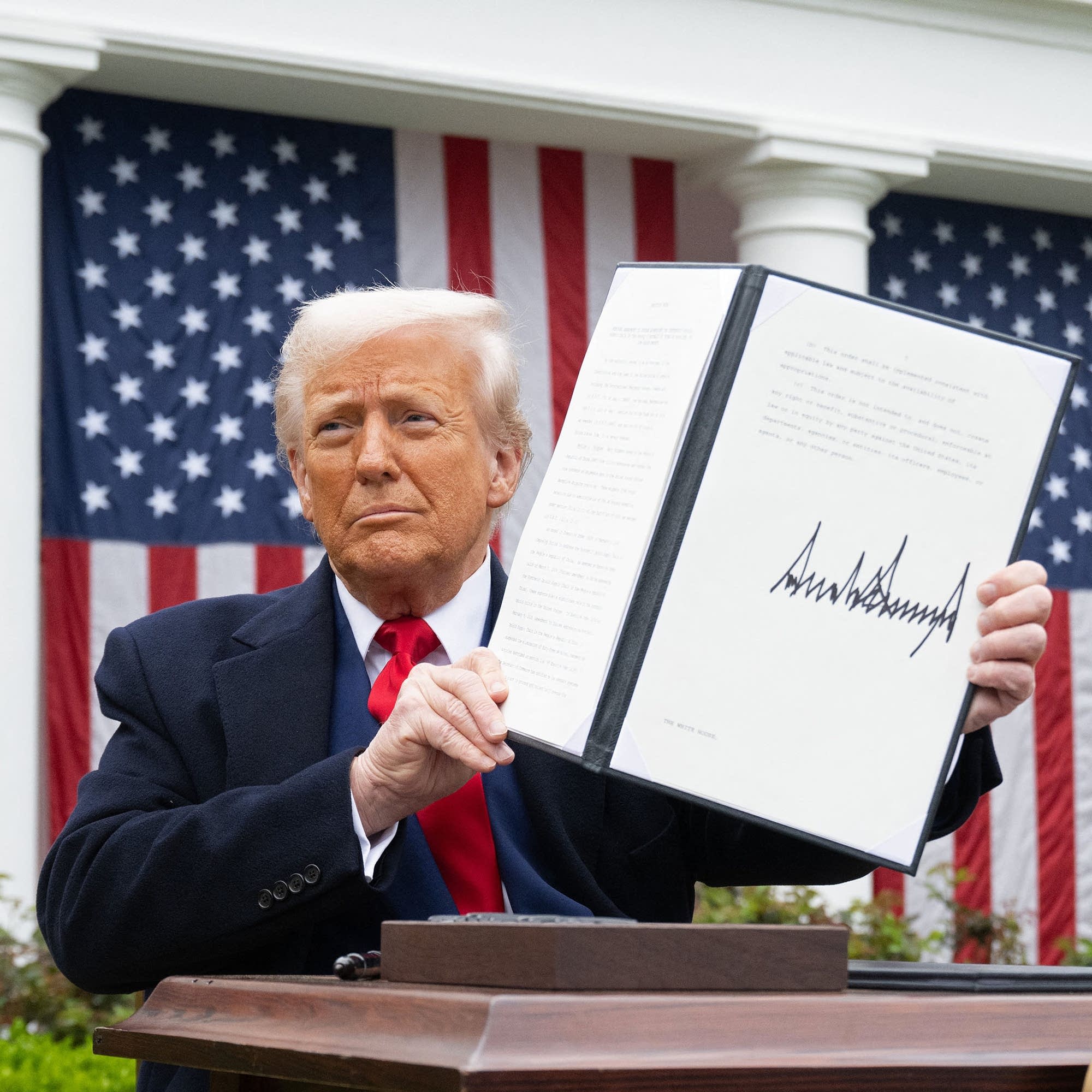
The year in Tariffs from Marketplace I'm Surrey Ben ashore in for David Brancaccio. A year ago today, the President pulled out a chart in the now paved over Rose Garden lawn and unleashed chaos onto global supply chains. He announced a so called Liberation Day tariffs, which would go on to change a bunch of times before being struck down as unconstitutional by the Supreme Court earlier this year. Marketplace Senior Washington correspondent Kimberly Adams has more on what the year in tariffs has meant for the economy.
- [01:40]
Kimberly Adams (Marketplace Senior Washington Correspondent)
The tariffs were mostly paid by US Consumers and small businesses. Justine Kahn is founder and CEO of Botnia, a skin care company based in California. She's been dealing with pricier essential oils from France, packaging from Spain, herbs from
- [01:56]
Sabri Benishore (Marketplace Correspondent)
Tibet, and so what used to cost,
- [01:59]
Tomas Peskorsky (Columbia Business School Professor)
you know, if we placed a $10,000 order now costs us $15,000 and so
- [02:04]
Sabri Benishore (Marketplace Correspondent)
that has really impacted our business.
- [02:07]
Kimberly Adams (Marketplace Senior Washington Correspondent)
When I ask economists about the broader
- [02:10]
Narrator/Advertiser for Puerto Rico Investment
economic impact, it's thankfully not been an utter disaster.
- [02:16]
Kimberly Adams (Marketplace Senior Washington Correspondent)
Ryan Young is with the Competitive Enterprise
- [02:18]
Sabri Benishore (Marketplace Correspondent)
Institute because the enacted tariff rates were
- [02:22]
Narrator/Advertiser for Puerto Rico Investment
roughly half of what the president threatened
- [02:25]
Sabri Benishore (Marketplace Correspondent)
at the Rose Garden press conference, but
- [02:28]
Narrator/Advertiser for Puerto Rico Investment
it's still been pretty bad.
- [02:30]
Kimberly Adams (Marketplace Senior Washington Correspondent)
Higher prices for businesses and consumers across many sectors, bruised relations with our allies, and very few if any of the economic benefits the Trump administration promised. But one industry has gotten a boost, says Scott Lincecome at the Cato Institute.
- [02:47]
Sabri Benishore (Marketplace Correspondent)
The offer of exemptions and and the prospect of new tariff protection has led to a dramatic rise in lobbying on
- [02:58]
Kimberly Adams (Marketplace Senior Washington Correspondent)
trade in Washington, a six fold increase, according to Lincecome. As just about every industry affected by tariffs looks for a way to get out of paying them in Washington. I'm Kimberly Adams for Marketplace.
- [03:28]
Dell Advertiser
Dell PCs with Intel inside are built for the moments that matter. For the moments you plan and the ones you don't. Built for the busy days that turn into all night study sessions. The moment you're working from a cafe and realize every outlet's taken. The times you're deep in your flow and the absolute last thing you need is an auto update throwing off your momentum. That's why Dell builds tech that adapts to the way you actually work. Built with long lasting battery so you're not scrambling for the closest outlet. And built in intelligence that makes updates around your schedule, not in the middle of it. They don't build tech for tech's sake, they build it for you. Find technology built for the way you work. @dell.com Dell PCs built for you
- [04:21]
Strayer University Advertiser
At Strayer University we help students like you go from Will I to why not? For over 130 years we've been innovating higher education to make it more affordable, accessible and attainable so you can reach your goals. Go from thinking can I? To Yes I can and keep striving. Visit Strayer. Edu to learn more steps. Strayer University is certified to operate in Virginia by Chev and its many campuses, including at 2121 15th Street north in Arlington, Virginia.
- [04:53]
Sabri Benishore (Marketplace Correspondent)
You know how banks give out loans to businesses? Well, they are not the only ones that do that. Increasingly, private firms that are not banks have gotten into the business of loaning money to businesses. This is what we call private credit and it has been causing some anxiety recently because these firms that are acting like banks are not regulated by banks and some of them are looking a little shaky. Columbia Business School professor Tomas Peskorsky reviewed 1200 private credit funds covering most of the market. And in a recent paper he argues we may not actually need to worry just yet. Tomas, good morning.
- [05:28]
Tomas Peskorsky (Columbia Business School Professor)
Good morning.
- [05:29]
Sabri Benishore (Marketplace Correspondent)
Whose money is in these companies? Like who or what are the investors?
- [05:36]
Tomas Peskorsky (Columbia Business School Professor)
They are primarily financed by equity pulled from limited partners. Typically these limited partners are institutional investors. Think about pension funds, money managers, family office, university endowments. But recently there is also push to bring more retail investors into private credit space.
- [05:56]
Sabri Benishore (Marketplace Correspondent)
Some of these private credit firms have told their investors, you cannot take all of your money out right now, which sounds very sketchy. How much trouble is this sector in private credit?
- [06:10]
Tomas Peskorsky (Columbia Business School Professor)
Funds are structured very differently. They use long term capital in the form of these equity investors. So when there is a trouble and investor want to withdraw money, they cannot do it quickly. It's not necessarily good for investors, but it increases the stability of the system because these funds do not have to liquidate the assets quickly and it limits the potential of the run. Like the random banks we've seen in
- [06:34]
Sabri Benishore (Marketplace Correspondent)
2023, people think back to the great financial crisis. Why not be worried about it in that way?
- [06:43]
Tomas Peskorsky (Columbia Business School Professor)
Private credit funds are much more conservatively structured. 65 to 70% of the capital comes from these limited partners, the equity holders and the banks. The traditional banking sector has exposure to these private credit funds, but they only finance about 30 to 35% of the operations. For a typical bank to suffer a loss on the private credit fund loan, the assets of these funds would have to decline 60, 70% compared to only 10% for a regular bank. In other words, to put it in layman terms, the private credit funds just have much less debt use and much less leverage. And leverage is an important propagator of financial crisis.
- [07:29]
Sabri Benishore (Marketplace Correspondent)
On a. On a scale of 1 to 10 of of anxiety or worry where 1 is no anxiety and then 10 is like great financial crisis level anxiety, where should we be?
- [07:40]
Tomas Peskorsky (Columbia Business School Professor)
Regarding the private credit funds themselves, I would put it at 4 to 5.
- [07:45]
Sabri Benishore (Marketplace Correspondent)
Is there anything that could happen in private credit that would raise your anxiety level?
- [07:52]
Tomas Peskorsky (Columbia Business School Professor)
So I could imagine a situation when we have what I would call a valuation contagion. The fact that these private credit funds will start seeing outflows of limited partners and equity investors from them. That could result in general perception that quality of credit in the entire market outside of private credit too is not great. What worries me more is the state of the banking sector in US the banks are still very heavily levered. They have exposure to rising interest rates and interest rates are sticky. They're not going down. So I think the system is not fully stable. And especially in the banking sector, there are a lot of hidden risks.
- [08:35]
Sabri Benishore (Marketplace Correspondent)
Tomas Piscorsi is professor of Finance and Real Estate at Columbia Business School. Thank you so much.
- [08:41]
Tomas Peskorsky (Columbia Business School Professor)
Thanks for having me.
- [08:43]
Sabri Benishore (Marketplace Correspondent)
In New York, I'm Sabri Benishore with the Marketplace morning report. From APM American Public Media.
- [09:01]
David Brancaccio (Marketplace Host)
Hey, David Brancaccio here. I hope you're well and that your passport is up to date because I am hosting a trip to Italy this fall and you, you are invited stay at a world class Tuscan villa. Step into the world of the Medici, the formidable family whose influence and power helped give rise to the Renaissance and the art we still celebrate today, not to mention the banking system. We're going to visit the world's oldest bank, swim in the thermal spa waters in Montecatini and take in the art of the Uffizi all of this, and then we'll try to put it all into context with great conversation over even better meals and wine tasting. Please join me and know this Buying into this trip will provide essential support for public media. Discover more about this fall's tuscany adventure@marketplace.org travel to reserve your spot today, that's marketplace.org travel.