← Marketplace Morning Report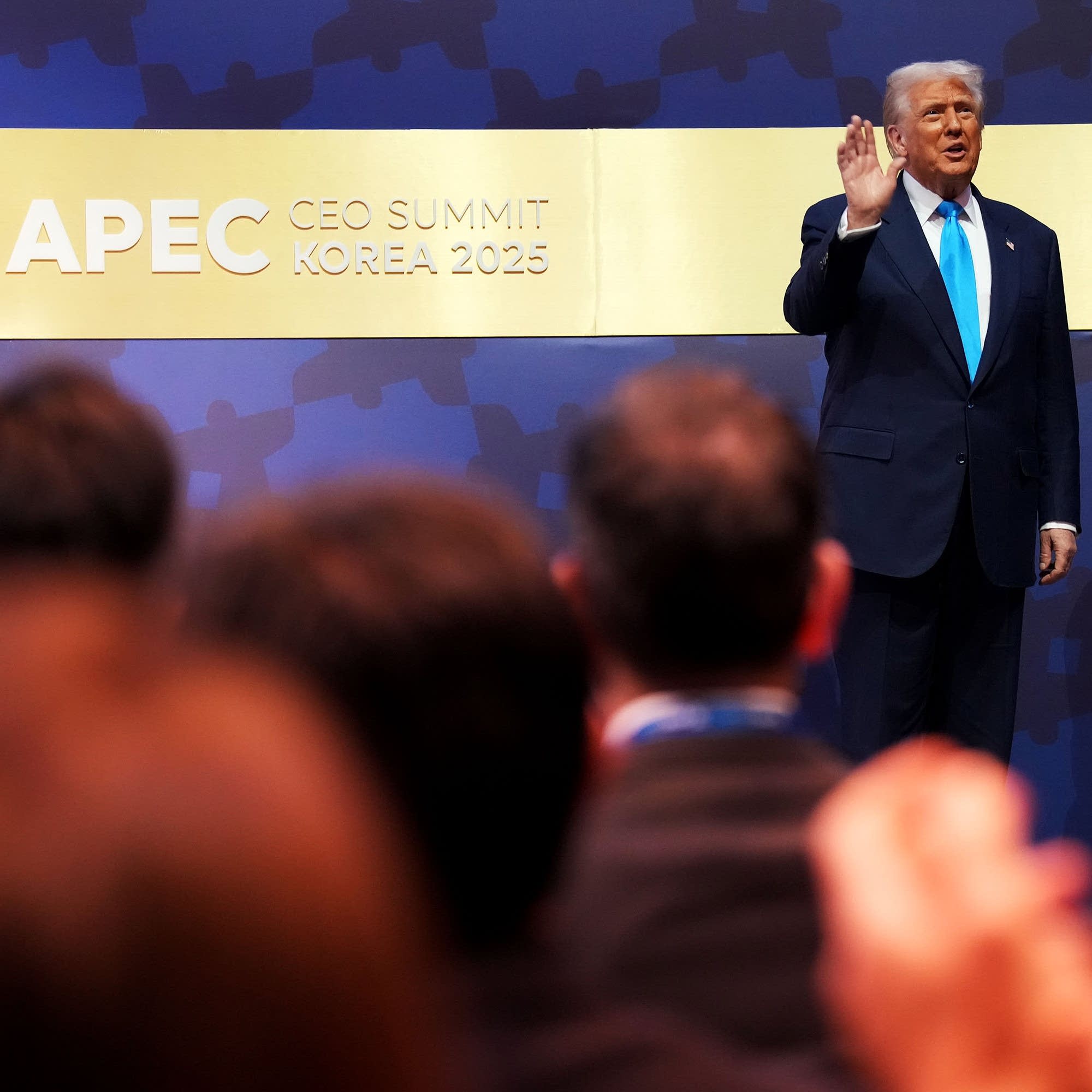
Loading summary
Transcript34 lines
- [00:01]
Marine Corps Recruiter
Our nation has always counted on us to win, to fight for what better could be, to secure our future together. We are Marines. We were made for this.
- [00:15]
Rubrik Agent Cloud Advertiser
AI agents are everywhere, automating tasks and making decisions at machine speed. But agents make mistakes. Just one rogue agent can do big damage before you even notice. Rubrik Agent Cloud is the only platform that helps you monitor agents, set guardrails and rewind mistakes so you can unleash agents, not risk. Accelerate your AI transformation@rubrik.com that's R u b r-I k.com South Korea hosts President.
- [00:48]
William Lee Adams
Trump as Trade Tensions Linger Live from the UK this is the Marketplace Morning report from the BBC World Service. I'm William Lee Adams. Good morning. President Trump is in South Korea for the Asia Pacific Economic Cooperation Forum or apec, in the city of Kyungju. His upcoming meeting with China's leader Xi Jinping looms large over the summit. But Mr. Trump has already met with South Korea's President Lee Jae Myung. The BBC's Yuna Coup is at APEC and can tell us more.
- [01:17]
Yuna Coup
Yoona hi, thanks for having me.
- [01:19]
William Lee Adams
So negotiations between Seoul and Washington have been deadlocked for a few months now, but President Trump has sudden said that a deal will be finalized very soon. What's changed?
- [01:31]
Yuna Coup
South Koreans have been hoping to finalize the trade negotiation because it has been putting a lot of pressure on South Korea's economy. President Trump mentioned that it will soon be finalized. However, when I talked to the high ranking official from the presidential office, they were very much pessimistic that they will finally reach a deal.
- [01:55]
William Lee Adams
And what are the sticking points in these negotiations?
- [01:58]
Yuna Coup
So back in July, South Korea and the U.S. agreed to cut reciprocal tariffs and auto tariffs from 25% to 15% in exchange for South Korea's $350 billion worth investment in the U.S. but there's still some disagreements over how that money will be invested and how the profits will be shared. So it's a tough spot for Seoul because putting up 350 billion in cash as Trump demands would be huge burden considering the size of South Korean economy. And as an export driven economy, South Korea cannot afford to keep facing these 25% tariffs for so long.
- [02:37]
William Lee Adams
What does success look like for South Korea's President Lee Jae Myung in these negotiations?
- [02:43]
Yuna Coup
First of all, whether he could cut down the reciprocal tariff, especially the auto tariff, is very critical to South Korean economy because it is the top export item. But at the same time, many South Koreans are worried about if the $350 billion is provided at Once that will degrade the status of South Korean economy. So how can President Lee balance between the cash payment and the future payment would be another focus point for us.
- [03:17]
William Lee Adams
Yoona, thanks for joining us on Marketplace.
- [03:19]
Yuna Coup
Thank you.
- [03:21]
William Lee Adams
Let's do the numbers. Amazon will invest another $5 billion in South Korea to build new AI data centers. The new centers will be built through to 20. And copper jumped to a record of over $11,140 a ton. Amid growing optimism the US and China will dial down trade tensions. The co founder of Ben and Jerry's Ben Cohen says he's launching a new Palestinian themed melon flavored sorbet. Previous attempts to produce it under the brand's name were blocked by its owner, British consumer goods giant unilever. Here's the BBC's Nick Marsh.
- [03:55]
Nick Marsh
He's been wanting to launch this special Palestinian themed flavor. Ben Cohen says that the parent company of Ben and Jerry's Unilever, huge conglomerate, they blocked that. That has actually been confirmed by Magnum, the ice cream division of this big conglomerate. They said that now is not the time. So Ben Cohen has said, well, I'm going to go ahead and make a protest batch in my own kitchen under my own private brand, which is called Ben's Best.
- [04:21]
William Lee Adams
Nick Marsh there. Now to Syria. In hospitals across the country, vital machines like ventilators and baby incubators often lie unused because spare parts aren't available. But the charity Field Ready is trying to change using 3D printing. Here's the BBC's Craig Landgren.
- [04:37]
Aymad Nasir Nyam
My name is Aymad Nasir Nyam. I'm from Aleppo, northwest Syria.
- [04:42]
Craig Landgren
Aleppo University Hospital had six incubators for newborn babies, but none of them were working. So Emad and his team had a light bulb moment. What if they could make the replacement parts themselves?
- [04:54]
Aymad Nasir Nyam
The doors of these baby incubators are loose, so we cannot close them. So it means that we cannot put a baby in. We said, so what if we bring a new door only for this? They said, we tried but we couldn't. We said, what if we design and bring new one for you? They said, that would be perfect, but we don't know if you can do that.
- [05:16]
Craig Landgren
When Emad showed me pictures and videos of his workshop on a video call, it became clear just how they operate. A workshop equipped with 3D printers, laser cutters and traditional tools that only gets electricity for around two hours a day running entirely on solar panels.
- [05:36]
Aymad Nasir Nyam
So we start the design from zero. The team start working on the drawing to make sure that the sizes are right. Then we use the 3D printer to start printing.
- [05:53]
Craig Landgren
It's trial and error really, but when they finally delivered the repaired incubators back to the hospital, the reaction was immediate.
- [06:01]
Aymad Nasir Nyam
So they were really shocked. And when they checked them and they are closing very well, they told us that they really look better than the original doors.
- [06:11]
Craig Landgren
And crucially, Airmad Solution is affordable.
- [06:14]
Aymad Nasir Nyam
It costs us about $150 and this baby incubator itself is from $8,000 and more.
- [06:23]
Craig Landgren
Hospitals can report broken equipment through a mobile app and then Emad and his team assess each case, design the parts, print them and train the hospital staff to maintain them.
- [06:33]
Aymad Nasir Nyam
In the last months, we have fixed 20 machines.
- [06:37]
Craig Landgren
They've seemingly tackled everything from X ray cooling systems that were wasting thousands of litres of water every day to ventilators, ultrasound machines, any sort of surgical equipment.
- [06:48]
Aymad Nasir Nyam
Our role here was really different, like we could save lives through engineering interventions. I just imagine how when we are going to fix this incubator and I just imagine how babies will benefit from these incubators and that we can save their lives.
- [07:09]
Craig Landgren
The fall of the Assad regime back in 2024 has opened up new possibilities too. Suddenly, Ahmad's team can access the whole country and they're training local engineers to carry this work forward. And in the meantime, his designs are available online, open source for anyone who might want to have at fixing a broken bit of hospital equipment.
- [07:31]
William Lee Adams
Craig Landgren. Reporting in the uk, I'm William Lee Adams with the Marketplace Morning Report from the BBC World Service.
- [07:43]
Amy Scott
Imagine a future where chocolate and coffee are rare and expensive, where cheap nutritional staples like corn and wheat are threatened. Sounds unpleasant, doesn't it? Well, we could be heading there if we don't recognize that the climate crisis is also a food crisis.
- [08:02]
Marine Corps Recruiter
I've seen yields drop because of drought and believe me, boy, have I seen them drop.
- [08:10]
Yuna Coup
We have had dry spells that have lasted years.
- [08:13]
Amy Scott
I'm Amy Scott. This season on How We Survive, we investigate how the climate crisis is threatening our most vital food systems and how scientists are racing to develop alternatives that will shape the future of food. Listen to this season of How We Survive on your favorite podcast. Apparently.