Loading summary
Transcript43 lines
- [00:00]
A
Running a business is hard enough, so why make it harder with a dozen different apps that don't talk to each other? Introducing Odoo, the only business software you'll ever need. It's an all in one fully integrated platform that makes your work easier from CRM, accounting, inventory, e commerce, and more. And the best part, Odoo replaces multiple expensive platforms for a fraction of the cost. This is why over thousands of businesses have made the switch. So why not you try Odoo for free@odoo.com that's o d o o.com this.
- [00:31]
B
Marketplace podcast is supported by Viking. Committed to exploring the world in comfort. Journey through the heart of Europe on an elegant Viking longship with thoughtful service, destination focused dining and cultural enrichment on board and on shore. And every Viking voyage is all inclusive with no children and no casinos. Discover more@viking.com what does one of the country's most environmentally friendly homes look like 18 years later? I'm David Brancaccio in Los Angeles. First, there's news. 130,000 more people were on America's payrolls last month. That's more than twice what was expected. Also, the separate survey of households finds the unemployment rate ticking down a sliver 4.3% now. But this is also the moment each year when the government does revisions for previous months, and that shows a year that might earn a beginning B or C for hiring. Economist Julia Coronado is founder of Macro Policy Perspectives. Morning, Julia.
- [01:30]
C
Good morning.
- [01:31]
B
So first of all, that's nice. More people getting on payrolls.
- [01:35]
C
Yes, a very strong number for January. We have to look at it with some caution. They warned us that winter weather reduced the response rate to the survey, and we have sort of a wild jump in healthcare hiring, more than 130,000 jobs. That seems a little suspect, but the unemployment rate tells us that it is still a decent job market.
- [01:59]
B
We were due for the big yearly revision today, and it looks like all those other months were revised downward. I get by 862,000 people we thought had jobs didn't.
- [02:11]
C
It's not a huge surprise, but it's a confirmation that the hiring rate in the US has really stepped down pretty dramatically.
- [02:20]
B
So how would the Fed process this, do you think, in trying to determine is it time to lower interest rates?
- [02:25]
C
Well, the Fed is going to take its cue from the unemployment rate. The lower hiring rate reflects the immigration policy that has really restricted the growth of the labor market, which really had driven strong gains over the prior years. The unemployment rate at 4.3%, that's a decent unemployment rate that tells the Fed that you know the labor market isn't falling apart. They don't need to be in a rush to lower interest rates.
- [02:52]
B
Economist Julia Coronado is also professor at UT Austin. Thank you so much.
- [02:57]
C
My pleasure.
- [03:14]
A
Running a business is hard enough, so why make it harder? With a dozen different apps that don't talk to each other, introducing Odoo, the only business software you'll ever need. It's an all in one fully integrated platform that makes your work easier from CRM, accounting, inventory, e commerce, and more. And the best part, Odoo replaces multiple expensive platforms for a fraction of the cost. This is why over thousands of businesses have made the switch. So why not you try Odoo for free@odoo.com that's o d o o.com this.
- [03:45]
B
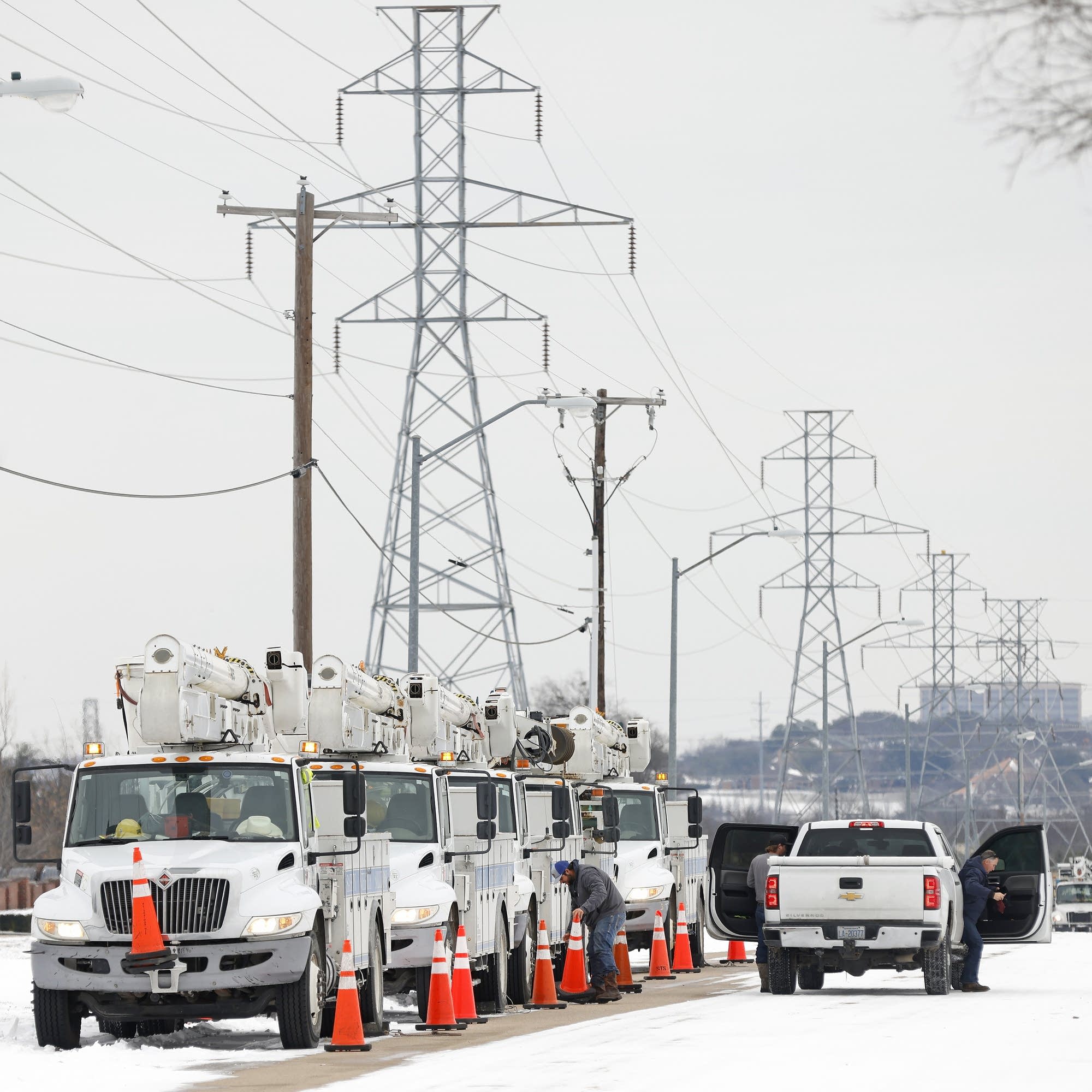
Marketplace podcast is supported by Viking, committed to exploring the world in comfort. Journey through the heart of Europe on an elegant Viking longship with thoughtful service, destination focused dining and cultural enrichment on board and on shore. And every Viking voyage is all inclusive with no children and no casinos. Discover more@viking.com it's been five years since a winter storm turned off power and heat across a lot of Texas, causing fatalities and billions of dollars in losses. Marketplace's Elizabeth Troval reports now from Houston on the big investments in energy infrastruct that followed.
- [04:23]
D
When winter Storm Yuri hit five years ago, Ed Herz with University of Houston was at his apartment, lost power for.
- [04:30]
B
More than four hours straight.
- [04:32]
A
And then for the next four days.
- [04:34]
B
You know, average maybe four hours of electricity per day.
- [04:39]
D
Millions of Texans had cranked up the heat, spiking demand. At the same time, we lost about.
- [04:45]
A
Half of our power plants during that time.
- [04:47]
D
That's Joshua Rhodes with UT Austin.
- [04:50]
B
And no grid is resilient to losing.
- [04:52]
A
Half of its generation capacity.
- [04:54]
D
The cold knocked off power that was being produced by natural gas, coal and nuclear plants and wind turbines. Now a lot of that infrastructure has been winterized and we have a lot.
- [05:07]
A
More things like energy storage.
- [05:09]
B
We have a lot more solar, a lot of resources that don't rely on a fuel supply chain.
- [05:13]
D
Buddy says there are still questions about whether companies who produce and deliver natural gas have sufficiently weatherized their infrastructure. And Ed Hur says that the structure of Texas unique market means there's less incentive to build up a cushion of extra electricity.
- [05:31]
B
It doesn't pay to add capacity, doesn't pay to add reliability.
- [05:35]
D
Buddy says that cushion can save lives when extreme weather hits. I'm Elizabeth Troval for Marketplace in A.
- [05:44]
B
World where energy prices are so unpredictable. During the huge storms and chill. Just the other week, natural gas prices soared more than 60%. What is the right house for the next hundred years? This old House Radio hour and Marketplace have a one hour special on the way called Building Tomorrow. It's out this weekend on many public radio stations. One segment was prompted by a visit I made many years ago to a renovated duplex in the Boston area. There, a physicist had tried tried to make her home as environmentally friendly as her budget and the technology of the time could make. Is insulation.
- [06:19]
E
It's ground up blue jeans. Oh, it's also totally harmless. It was easy to install. I did that installation.
- [06:27]
B
It was the winter of 2008. I was on assignment for PBS television. We didn't know the great financial crisis was coming later that year, but we did know the climate crisis was unfolding. And look at these lights. This is a cool light fixture. What are we looking at here?
- [06:43]
E
That's an LED down light. It's a brand new item. We had to convince the electrical supply house to order it. And these things will stay on for 20 to 30 years before you have to change a bulb.
- [06:55]
B
Back then, a recessed low energy LED ceiling fixture was a hard to find item. I remember her paying $800 for each 18 years ago. But now you can get one at the hardware store for $26 in change.
- [07:08]
E
Hi. Are you okay with dogs? This is Nuke.
- [07:15]
B
When we contacted Dr. McGavi all these years later, she was still in the house, the bones of which have just turned 100 years old. And what we found is proof that you don't have to build new to be cutting edge. What comes next year is from a fresh tour of the place.
- [07:31]
E
That sound is actually the guys banging the pipes on the geothermal well as they pull out their casing.
- [07:38]
B
The day of the recent visit, a crew was taking her house to the next level of energy efficiency, connecting its heating and cooling system to an underground geothermal well.
- [07:48]
E
The best moment of a gas boiler approaches 98, 99% efficiency with a geothermal heat pump. For a single building, it's four or five times. So it's like a 400 or 500% efficiency.
- [08:01]
B
McGavi in the intervening years has become head of a nonprofit that works with utility companies to put in networked geothermal for whole neighborhoods, even towns. Now it was her turn.
- [08:12]
E
We're in the basement next to the mechanicals for the hot water distribution system, currently providing hot water which gets pumped in and through these radiators. The same hot water and radiators will work equally well with the geothermal heat pump swapped out for the gas boiler.
- [08:30]
B
Dig four to six feet into the soil even during a chilly New England winter, and there's a fairly constant moderate temperature that can be used to make a house warmer or cooler without much energy. Through the magic of thermodynamics. When she first renovated, she'd thought to put in an air distribution system into the walls that could be adapted to new technology as it becomes available. And now here it is with the.
- [08:54]
E
Geothermal coming on and also with much hotter summers since we began this, the stuff's in the walls already and all we have to do is install the equipment. I certainly approached this home as a forever home, as a place I wanted to invest in, not just for myself, for my kids, for the community. And I was really trying intentionally to build a home for the future.
- [09:19]
B
You can hear more of our reporting for Building Tomorrow, this weekend's special program on the future of American housing from Marketplace and this old House Radio Hour on many public radio stations nationwide. As for the rebuilding of my own house, lost in the big California fires last year, we have fire resistance, sustainability and cost in mind. Could a chunky kind of wood could be our answer, even in a fire zone? That's in the special, and my ongoing stories are@marketplace.org in Los Angeles. I'm David Brancaccio. From APM American Public Media. Want even more Marketplace? Sign up to receive weekly tips from our editorial team to help you make the most of your money. Plus, you'll also be the first to know about exclusive Marketplace merchandise and local events. Text Marketplace to 80568 to sign up.