Loading summary
Transcript29 lines
- [00:00]
Invest Puerto Rico Representative
Reshoring to the US Is a strategic decision and where you land matters. In Puerto Rico, Companies like Amgen, AbbVie and Boston Scientific run advanced manufacturing and life science operations serving global markets. As a US Jurisdiction, Puerto Rico offers regulatory alignment, strong IP protections, seamless access to the mainland, competitive tax incentives, and a deep bench of STEM trained bilingual talent that helps build resilient supply chains. See why industry leaders are already here? It's not what's next, it's where Puerto Rico. Visit investpr.org@strayer University we help students like
- [00:42]
Strayer University Representative
you go from is it possible? To anything is possible by offering access to up to 10 no cost gen Ed courses so you can reach your goals affordably and fast. Visit Strayer. Edu to learn more. No cost Gen Ed is provided by Strayer University affiliate sofia. Eligibility rules apply. Connect with us for details. Strayer University is certified to operate in Virginia by Chev and has many campuses, including at 2121 15th Street north in Arlington, Virginia.
- [01:10]
Sabri Benishour
Markets are hopeful, but the fighting continues. From Marketplace, I'm Sabri Ben ashore in for David Brancaccio. President Trump says the war with Iran could be over in a couple of weeks and plans to address the nation tonight. Pakistan and China are also trying to broker a ceasefire. The price of oil fell from a high of $119 a barrel yesterday down to $102 a barrel this morning. Stocks rallied yesterday and this morning. Meanwhile, the fighting very much continues. Bradley Saunders joins us for more. He's North America economist at Capital Economics. Welcome.
- [01:43]
Bradley Saunders
Hi. Thanks for having me.
- [01:45]
Sabri Benishour
So yesterday the major stock indices here went up by the most they have in 10 months. Markets have been criticized for not taking the weight of the consequences for energy markets seriously enough and also for sort of being overly optimistic when we get de escalatory language. What do you think?
- [02:05]
Bradley Saunders
Yeah, I think it's an interesting one. I think given it's not solely commentary from the Trump administration at this point, it's also from Iran. We had the Iranian president saying that Iran was ready to bring an end to the conflict also. But provided that you, you know, would look for concessions in the form of guarantees there'd be no US Israeli aggression in future. But I think this de escalatory language, as you say, from both sides, is what's given markets a bit of confidence and led to some of the growth we've seen over the past 24 hours.
- [02:36]
Sabri Benishour
The price of oil went up 63% in the month of March. It has come down today compared to yesterday sharply. If there is real progress towards a ceasefire. Do oil prices just keep on falling slowly from here?
- [02:51]
Bradley Saunders
I think that oil price would trend downwards if we saw a ceasefire, given that some of the rise in the price is a risk premium which would shrink. Whether it would return to pre war levels is another matter entirely. And that depends a lot on the fortunes for ships in the Strait of Hormuz that will create knock on effects.
- [03:12]
Sabri Benishour
Is there not though a decent amount of damage to oil infrastructure around the Gulf that that's going to take a while to fix? Like how long do oil supply chains take to repair themselves?
- [03:21]
Bradley Saunders
There has been some energy infrastructure damage, as you say. I think most of the damage has come in natural gas in particular. But it is the case that a lot of oil extraction and refining infrastructure in the area was closed as a safety measure. And that will still take time to come back online. There's also the Bab El Mandab Strait, which is the Houthis have been striking. That's, you know, potentially another bottleneck.
- [03:47]
Sabri Benishour
Bradley Saunders, North America economist at Capital Economics. Thank you as always.
- [03:52]
Bradley Saunders
Thanks very.
- [04:09]
Noah Smith
Much.
- [04:11]
Sabri Benishour
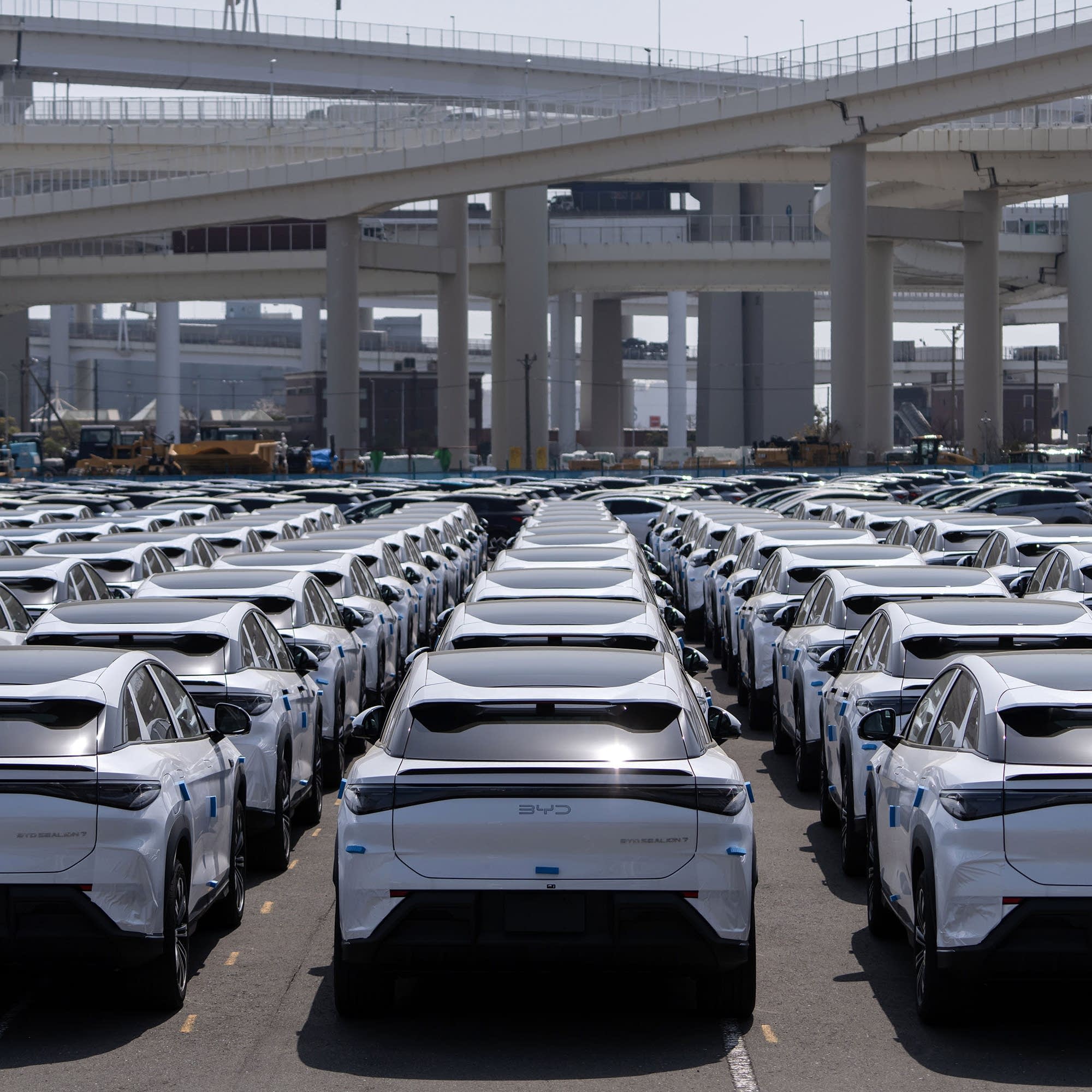
Chinese electric vehicle maker BYD told analysts it is confident it can sell one and a half million vehicles outside of China this year. That's about what Tesla's forecast to sell globally. Chinese EVs are advanced, they are affordable, and that has made them increasingly popular in the global auto market. Countries that were uneasy about letting the cars into their markets are starting to come around. That cannot be said though, for the U.S. america is still effectively shutting out Chinese EVs with a 100% tariff. This is in part to protect the American auto industry. There is though a case for letting the Chinese EVs in. And economist and writer Noah Smith makes that case and joins us to talk about it. Hi, Noah.
- [04:55]
Noah Smith
Hey.
- [04:56]
Sabri Benishour
Chinese manufacturing has gutted one US Industry after another, starting with the low tech. And over the years that, you know, the competition is becoming more and more high tech. There was apparel, then magnets, rare earths, solar panels. Why expose US Automakers to that competition when it has gone so badly for so many other industries?
- [05:17]
Noah Smith
The reason is basically that our own automakers have decided that electric cars are not the future and they're not going to make them. The rest of the world is shifting to electric cars. Therefore this is killing battery demand.
- [05:29]
Bradley Saunders
Now.
- [05:29]
Noah Smith
Batteries are increasingly important in manufacturing everything. Batteries are taking over in robots, of course. All kinds of appliances, all kinds of installed machinery. Storage data centers have huge batteries to smooth out electricity use. So basically we need more demand for batteries. I want American industry to be able to make cutting edge stuff with good technology that really works. And the only way we're going to do that is if we make batteries. Batteries, batteries. And Chinese electric cars use batteries. And therefore battery factories will go up and up and up all over America if you have the demand locally from the Chinese electric car companies.
- [06:03]
Sabri Benishour
So it's not necessarily about protecting the US Auto industry. It's about creating a bunch of other industries like batteries that would benefit.
- [06:14]
Noah Smith
That's exactly right. The idea is that, you know, physical technologies are converging toward a basic package of things. You have energy from a battery, you have control from chips. You have also some other kinds of chips called power electronics that help you like move the power around the thing and then you have motion from a motor. Everything is converging on this one tech stack, one unified tech stack. Basically we need that tech stack. Trying to preserve this sort of antiquated combustion car tech stack as this tiny little orphaned thing cut off from the rest of manufacturing is, is not going to help us manufacturing, it's going to hurt it.
- [06:51]
Sabri Benishour
What does the US Economy as a whole stand to lose if we do not let the Chinese cars in?
- [06:58]
Noah Smith
The answer is manufacturing industries of the future. We're purposefully sticking ourselves in the past with these combustion cars that are an obsolete technology. And if we cut ourselves off from the technology of the Future, which are EVs, we, we will be behind in physical technologies, we will be behind in manufacturing. Protecting an obsolete technology and keeping out an advanced technology is bad for your manufacturing ecosystem.
- [07:27]
Sabri Benishour
Noah Smith, economist, writer, author. Over at the no Opinion blog, thank you so much.
- [07:32]
Noah Smith
Thanks for having me on.
- [07:35]
Sabri Benishour
In New York, I'm Sabri Benishour with the Marketplace Morning Report.
- [07:39]
Noah Smith
Foreign.
- [07:46]
Sabri Benishour
Public Media.
- [07:48]
Maggie Smith
Poetry is one of the greatest tools we have. It offers a way to better understand our own lives and the lives of others. I'm Maggie Smith, poet and host of the Slowdown. Every weekday I share one poem and a few minutes of reflection. Five minutes to breathe, to notice, to begin again. It's an easy ritual you can take anywhere. Your kitchen, your neighborhood, or your morning commute. Start a new daily practice and listen to the Slowdown wherever you get your podcasts.