Loading summary
Transcript26 lines
- [00:01]
Grainger Announcer
If you're the purchasing manager at a manufacturing plant, you know having a trusted partner makes all the difference. That's why hands down, you count on Grainger for auto reordering. With on time restocks, your team will have the cut resistant gloves they need at the start of their shift and you can end your day knowing they've got safety well in hand. Call 1-800-GRAINGER Click grainger.com or just stop by Grainger for the ones who get it done.
- [00:32]
Nova Safo
Traders are sending precious metal prices through the roof. We'll explain why for Marketplace. I'm Nova safffo in for David Brancaccio. Prices for gold, silver and other precious metals are hitting records. While the dollar is losing value, Spot prices for Silver are up 150% this year. Gold is up more than 70% and it's on track for its biggest annual gain since 1979. What's driving these shifts? I posed that question to Diane Swonk, chief economist at the audit tax and advisory firm kpmg.
- [01:03]
Diane Swonk
Just about everything you can imagine is behind it. Everything from the uncertainty that we saw spike in the wake of the April announcements about tariffs to uncertainty about where the US Is and its role in the world. What we've seen is both central banks increase their holdings of gold instead of US Treasuries trading out of US Treasuries and metals on their balance sheet because they want to be less dependent on the the US Dollar in this precarious time where uncertainty about geopolitical tensions to trade tensions is still very high and escalated.
- [01:40]
Nova Safo
And yeah, and so we are seeing the dollar also hovering around two month lows now, you know, kind of in the doldrums. Do you expect that to continue moving forward?
- [01:50]
Diane Swonk
You know, it's always hard to predict where a currency will go, but the dollar was really overvalued going into this year. So it's not too surprising that it's coming down a bit. But also it really depends on how much policy uncertainty there is going forward. We've seen that this has been a major factor in the US Economy, affecting the labor market and prices more than overall growth. It keeps giving us an economy that adds up on paper to look better than it feels to most Americans. And that's going to be hard to decouple until we get more certainty on exactly where the course of policy is.
- [02:28]
Nova Safo
Diane Swank, chief economist at kpmg. Thank you very much.
- [02:32]
Diane Swonk
Thank you.
- [02:33]
Nova Safo
Nvidia has agreed to license technology from an AI chip company called Groq that's spelled G R O Q Not to be confused with Groq with a K, which is Elon Musk's AI Company. Leaders at Grok with a Q will go to work for Nvidia, but this is not a traditional corporate acquisition, as Marketplace's Henry App explains, as Silicon Valley.
- [02:55]
Henry App
Giants race to invest in artificial intelligence technology, deals like this are becoming more common. Here's how they generally work. A large tech company takes an interest in a startup, but instead of buying up the whole company, which could require approvals from government regulators, it licenses the startup's technology or makes a large investment and hires away its leaders. But the startup technically remains a separate company. Meta Microsoft and Amazon have all made deals like this with smaller companies in the last few years. Nvidia's agreement with Grok is the latest example. In a post on its website, Grok calls this a non exclusive licensing agreement for its chips designed to power AI inference. Inference is what AI models do when they pull from data they've been trained on to generate an answer to a user's question. Grok was founded in 2016. It was valued at just under $7 billion earlier this year. I'm Henry App for Marketplace Foreign.
- [04:07]
Grainger Announcer
If you're a maintenance supervisor for a commercial property, you've had to deal with everything from leaky faucets to flickering light bulbs. But nothing's worse than that ancient boiler that's lived in the building since the day it was built 50 years ago. It's enough to make anyone lose their cool. That's where Grainger comes in. With industrial grade products and dependable, fast delivery, Grainger can help with any challenge, from worn out components to everyday necessities. Call click grainger.com or just stop by Granger for the ones who get it done.
- [04:38]
Nova Safo
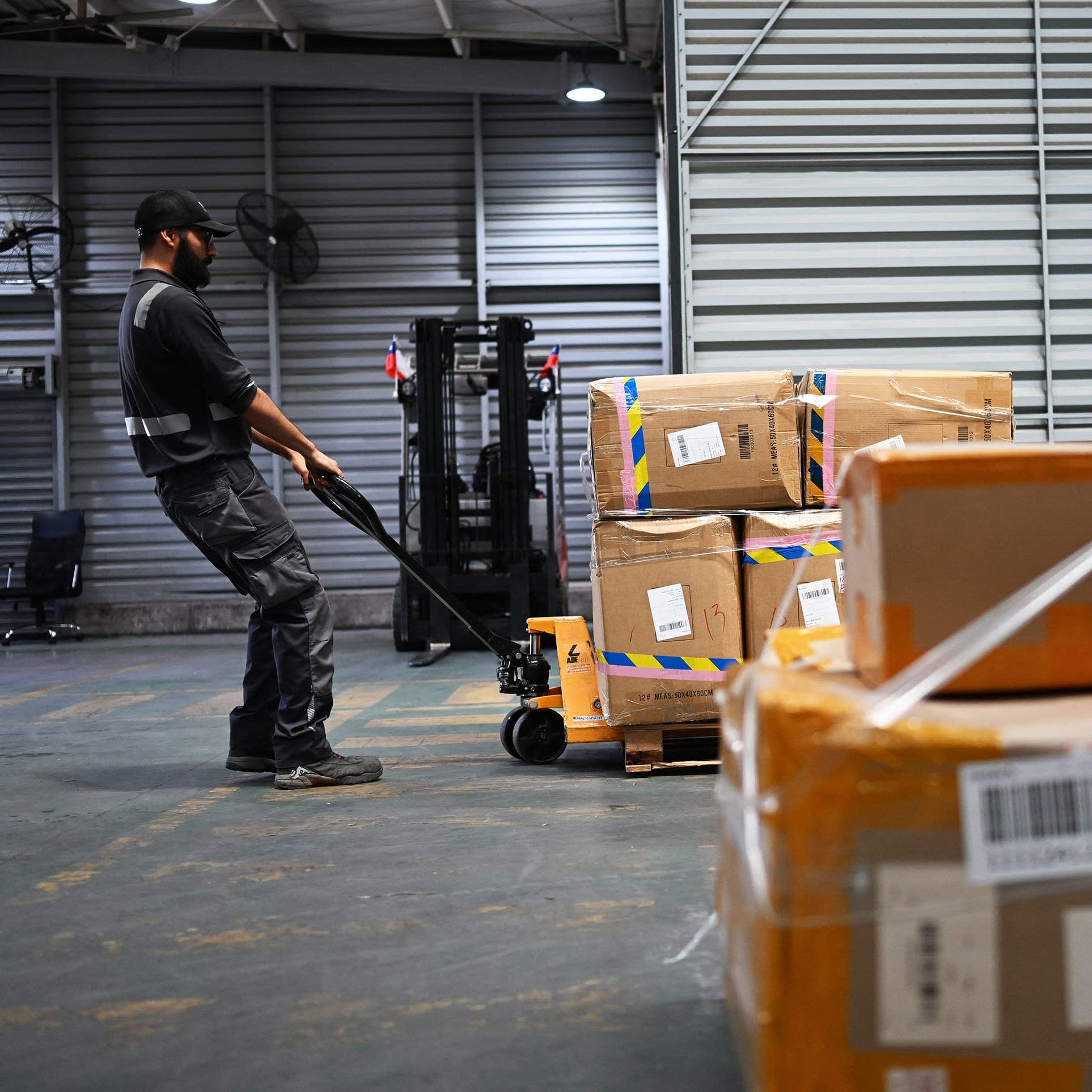
When we think back on the Trump administration's major trade policies of the year, we of course think tariffs. But the White House also ended the tax exemption on packages shipped to the US which are valued under 800 doll. This was the so called de minimis exemption. It came to an end at the end of August. How are businesses at home and abroad faring? 4 months on the BBC's William Lee Adams reports.
- [05:01]
William Lee Adams
Until August, anyone could send a parcel to the United States tariff free, so long as the value of the item was less than $800. Businesses from around the world took advantage of the rule. Almost 1.4 billion packages entered the US duty free last year, with two of China's largest online retailers, Shein and Temu, each sending hundreds of millions of parcels to the states annually. The de minimis rule found itself in the sights of President Trump.
- [05:27]
Howard Lutnick
It's a big scam going on against our country, against really small businesses.
- [05:32]
William Lee Adams
U.S. commerce Secretary Howard Lutnick explained why the tax exemption had to go Foreign.
- [05:37]
Howard Lutnick
Countries were sending in little packages for free and knocking out our mom and pop businesses across America.
- [05:44]
William Lee Adams
The most immediate impact was on businesses outside of the U.S. here's Jess Van Dan, a jewelry maker based in Australia.
- [05:51]
Jess Van Dan
30 to 40% of my jewelry business was in the US and now I've had to stop that entire part of my business. And I'm not the only one.
- [05:59]
William Lee Adams
In removing the tax exemption, the White House said it wanted to level the playing field for US Companies. So have they seen a difference since the changes? Madeleine Knudson, who runs a mail order business out of Minot in North Dakota, says she's much more careful about where she buys her products from.
- [06:15]
Madeleine Knudson
I tend to look where they're shipping from because that impact has caused us to raise our prices for things. People are definitely looking at prices more.
- [06:25]
William Lee Adams
Since the de minimis exemption was abolished, the number of parcels coming into the US worth less than $800 has fallen by 54%. That's according to the Universal Postal Union, a United nations agency. One sector that has done well out of the changes is the logistics business. DHL is one of the world's leading courier companies and, and Oscar De Bock leads its global forwarding division.
- [06:47]
Oscar De Bock
2025 has been a super complex year. Every time that something new got announced, then shippers were making sure that their products would be shipped before this new tariff would come. So we got high seasons, many of them, throughout the year.
- [07:03]
William Lee Adams
Back to the effect on the consumer, here's Madeleine Knutson again.
- [07:06]
Madeleine Knudson
Across the board, prices are just higher. You know, with a bigger business they're able to like beat the cost a little bit more to keep it less expensive. Expensive where we, you know, we're just a little like mom and pop shop so we can't eat all the extra costs.
- [07:22]
William Lee Adams
As the flow of tax free goods slows, it seems it may be us producers and customers who are covering the costs. I'm the BBC's William Lee Adams for Marketplace.
- [07:32]
Nova Safo
And I'm Nova Safo with the Marketplace morning Report. From APM American Public Media.
- [07:44]
Rima Jerez
Hey everyone, you already listened to Marketplace podcasts, so you know that it's important to understand how economic forces shape our lives. And that feels especially important now as we're all trying to make sense of the latest headlines. I'm Rima Jerez host of Marketplaces. This Is Uncomfortable, a show that explores how money bumps up against our relationships, our choices, and the parts of life we don't always say aloud. And starting January 15th, we are back every single week. New stories, new questions, and the kind of conversations that make you feel less alone in this quickly changing economy. We're tackling questions like should I turn my hobby into a money making side hustle? How do I deal with layoff anxiety? Or what do we owe our parents financially? Don't miss an episode. Subscribe to this is Uncomfortable from Marketplace. Wherever you get your podcasts.