Loading summary
Transcript20 lines
- [00:00]
LifeLock Advertiser
The New year brings new health goals and wealth goals. Protecting your identity is an important step. Your info is in endless places that could expose you to identity theft leading to lost funds. LifeLock monitors millions of data points per second. If your identity is stolen, our restoration specialists will fix it, guaranteed or your money back. Resolve to make identity, health and wealth part of your New year's goals. With LifeLock, save up to 40% your first year. Visit LifeLock.com SpecialOffer terms apply.
- [00:31]
William Lee Adams
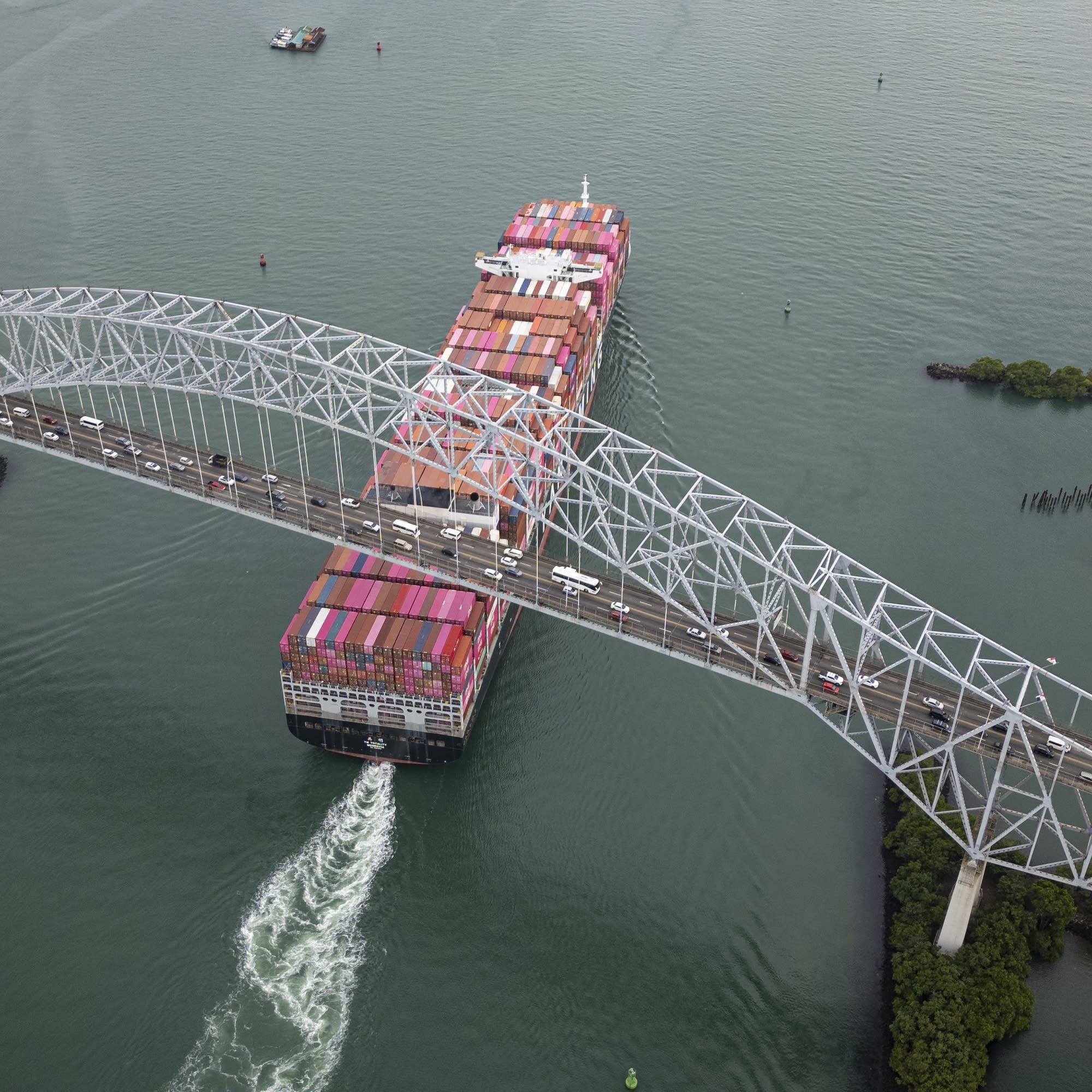
Panama Panama's top court makes a key ruling on China's involvement in the country's famous canal Live from the UK this is the Marketplace Morning report from the BBC World Service. I'm William Lee Adams. Good morning. The Panama Canal handles about 5% of global trade, allowing ships to pass between the Atlantic and Pacific oceans. It's been a focus for President Trump, who previously threatened to bring the canal back under American control. Now the Supreme Court in Panama has annulled a concession that's allowed a Hong Kong based company to operate two of the five containers. Reports on the canal. Ian McWilliam has more.
- [01:07]
Ian McWilliam
Panama's Supreme Court has found that the laws allowing the giant Hong Kong conglomerate C K Hutchinson to operate two of the canal's five ports were unconstitutional. It's unclear what will happen next. The ruling could disrupt the company's plans to sell its interests in ports worldwide to a consortium involving the American investment firm BlackRock. President Trump, at the start of his second term, threatened to reimpose US Control over the Panama Canal and as he said in effect, China was operating it. The two powers are involved in a growing rivalry over control of global trade routes.
- [01:39]
William Lee Adams
Ian McWilliam There China's foreign Ministry has said the country will take all necessary measures to resolutely safeguard the legitimate rights and interests of Chinese enterprises. Meanwhile, Venezuela's parliament has passed a new bill that will pave the way for more private investors in its oil industry. That was one of the key demands of the US after it seized the country's president, Nicolas Maduro and carried out strikes on the capital. The Trump administration has also eased sanctions on Venezuela's oil industry to allow new American investment. The country has the biggest reserves in the world. The BBC's Gideon Long has more.
- [02:14]
Gideon Long
It should be said this is heavy crude oil. It's relatively inaccessible in the Orinoco belt in the east of the country, and also the Venezuelan oil infrastructure has been so run down in recent decades that there's a lot of work to actually bring it up to scratch. And I think it's become apparent in recent weeks that that many of the certainly the US Oil companies and it sounds as though they've been telling the US President this. They are rather reluctant to go back into Venezuela just because they realize what a big job it is to get the oil industry back onto its feet in Venezuela.
- [02:48]
William Lee Adams
Gideon Long Venezuela was a key ally of Cuba supplying most of its oil that has been choked off by the recent US intervention. Now President Trump has signed an executive order enabling tariffs to be imposed on any country that sells oil to Cuba. The order accuses Havana of supporting what it calls trans transnational terrorist groups such as Hamas and Hezbollah. Here's the BBC's Will Grant.
- [03:11]
Will Grant
The intention appears to be to warn off Mexico from replacing Venezuela as the principal energy supplier. The island is currently experiencing its worst economic and energy crisis since the end of the Cold War. Earlier this week it was reported that the Mexican state run energy firm Pemex had chosen not to send a tanker of crude earmarked for Cuba. A move which President Claudia Sheinbaum described as a sovereign decision by Pemex Will Grant.
- [03:37]
William Lee Adams
Okay, let's do the numbers after that decision. In Panama, CK Hutchinson's Hong Kong listed shares closed down 4.6%. Elsewhere, Donald Trump has threatened to impose tariffs of up to 50% on Canadian made aircraft, escalating trade tensions between the neighboring countries. Madagascar recently opened the first stretch of its first ever highway. Authorities are hoping that it will spur economic development by speeding up trade in a country where road conditions are often difficult. But campaigners are concerned about the impact it could have. The BBC's Andre Lombard reports.
- [04:14]
Andre Lombard
Life in the driving seat isn't always easy in Madagascar. Twice a week, Reika makes the long return journey between the capital Antananarivo and the country's biggest port, Toro Messina, a trip he says can take up to 16 hours. All this in a country the IMF says has some of the worst roads on the continent.
- [04:37]
Will Grant
The current road is really bad.
- [04:39]
Andre Lombard
It's very narrow and there are loads of trucks. It makes me very worried. But that could all be about to change. The first 8km of a new highway that links the two cities together has been inaugurated. Eventually it will stretch 240km, budgeted to cost a billion dollars. Some of that money will be recouped in tolls and but it's hoped the main payday will come through the increased trade the road will bring. Journey times are predicted to reduce to around two and a half hours. And certainly as we turn onto the new road, its smooth tarmac is a big Change from the rough and ready current road. So we've just stopped off. We're here to meet Nenny Farah. The 70 year old has farmed rice and pineapples here all her life, with her family owning the land for generations. But now that could all change. She shows me towards a red post that appeared near her land overnight, which marks the route the new highway will take.
- [05:40]
Nenny Farah
It hurts me. I feel like I've been stabbed in the back. It's hard because no one has been in touch with us about the proposition of the highway.
- [05:48]
Andre Lombard
The highway was initially approved by the presidency of Andrii Rajelina, who was deposed in a military coup in October. The new government has said it will continue with the motorway project. The environment Minister at the time of the start of the highway construction was 29 year old max Fontaine. He tells me that the country is getting the balance of protecting its heritage and environment with its economic development rights.
- [06:12]
Nenny Farah
It changes everything for the agriculture, for.
- [06:15]
William Lee Adams
The water, for the transport, for everything.
- [06:19]
Andre Lombard
It's certainly true that economic progress is sorely needed here. Three quarters of people live in poverty. However, environmental campaigners say it will actually do the opposite, opening access to illegal mining and logging, leading to food and water insecurity for locals. Whatever the rights and wrongs, it does look like the road will go ahead, changing the face of this unique country forever.
- [06:43]
William Lee Adams
That's Andre Lombard reporting and in the UK for the last time, I'm William Lee Adams with the Marketplace morning report from the BBC World Service. On behalf of the entire team, thanks for listening.
- [07:04]
Rimaj Reis
For second and third generation kids, holding on to your family's culture can be difficult and expensive. I'm Rimaj Reis and this week on this Is Uncomfortable, I talk with author and journalist Ayman Ismail about how passing down his Egyptian roots to his kids has become a line item in his monthly budget.
- [07:22]
Ayman Ismail
I don't want to have kids who can't speak Arabic or read Arabic. This is the only chance I get to do this right. When they're really, really young, I won't get another chance to help guide them and like help them learn Arabic for the sake of them being connected to this massive heritage that they're inheriting.
- [07:41]
Rimaj Reis
Listen to this is Uncomfortable on your favorite podcast app.