Loading summary
Transcript37 lines
- [00:00]
Mackenzie
My name is Mackenzie and I started a GoFundMe for the adoptive mother of a nonverbal autistic child. The mother had lost her job because she wasn't able to find adequate care for this autistic child. So she really needed some help with living expenses, paying some back bills. So I launched a GoFundMe to help support them during this crisis. And we raised about $10,000 within just a couple of months. I think that the surprising thing was by telling a clear story and just like really being very clear about what we needed, we had some really generous donations from people who were really moved by the situation that this family was struggling with.
- [00:47]
GoFundMe Announcer
GoFundMe is the world's number one fundraising platform, trusted by over 200 million people. Start your GoFundMe today at gofundme.com that's gofundme.com gofundme.com this podcast is supported by GoFundMe.
- [01:00]
Odoo Advertiser
Running a business is hard enough, so why make it harder? With a dozen different apps that don't talk to each other? Introducing Odoo, the only business software you'll ever need. It's an all in one, fully integrated platform that makes your work easier, from CRM, accounting, inventory, e commerce, and more. And the best part, Odoo replaces multiple expensive platforms for a fraction of the cost. This is why over thousands of businesses have made the switch. So. So why not you try Odoo for free@odoo.com that's o-o o.com President Trump expressed
- [01:33]
David Brancaccio
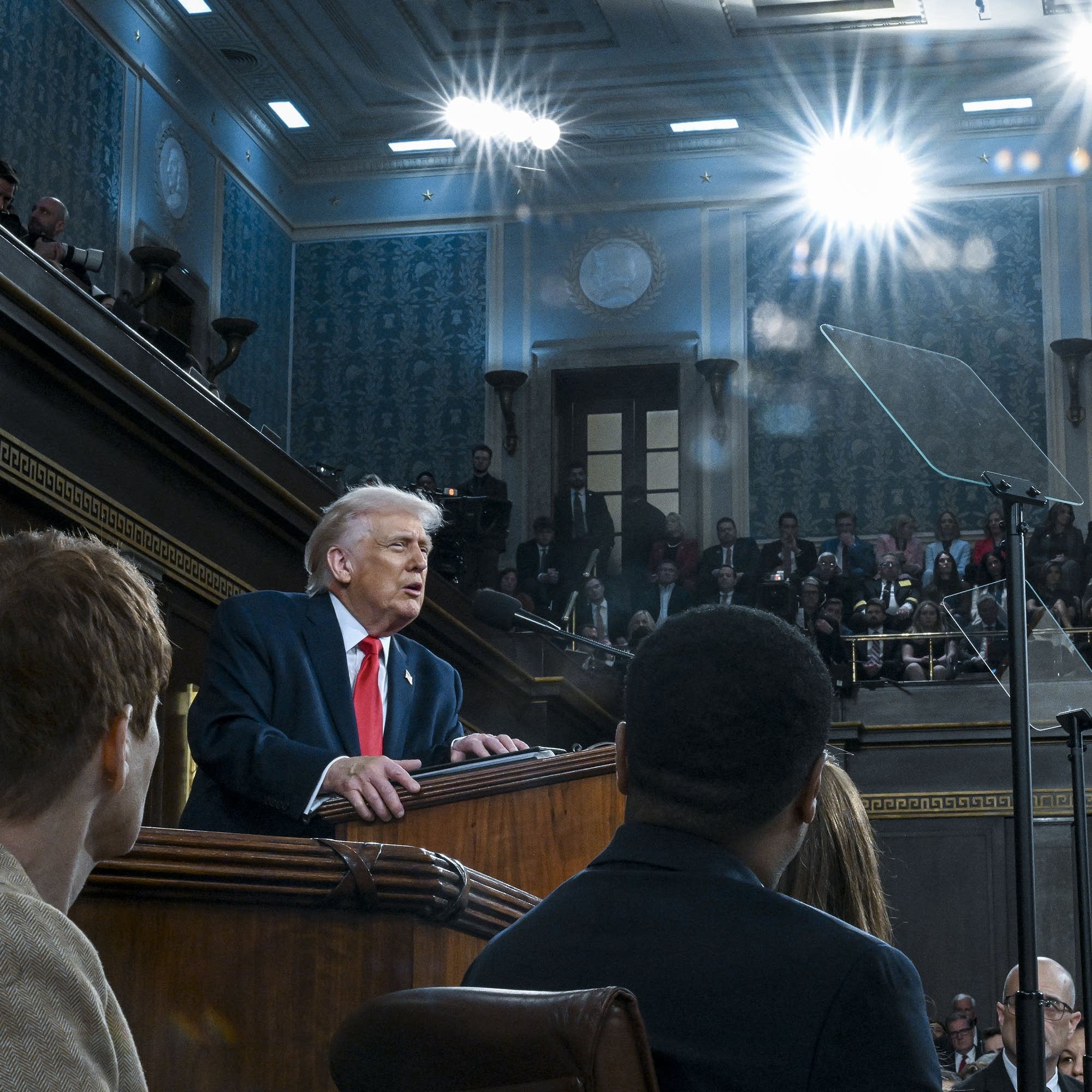
hope last night that import taxes will someday replace income taxes. I'm David Brancaccio in Los Angeles. One piece of last night's State of the Union address. President Trump defending unpopular taxes on imports. His much higher tariffs, many of which were found to be illegal by the Supreme Court last week. Marketplace's Nancy Marshall Genzer has more on that.
- [01:55]
Nancy Marshall Genzer
With four Supreme Court justices sitting just feet away, President Trump condemned what he called the court's unfortunate involvement in last week's tariff case when it declared that his sweeping reciprocal tariffs are illegal. The President said that now he'll just use his remaining powers to impose import taxes, insisting that, quote, almost all countries and corporations want to keep the deal that they already made. The President also claimed that tariffs will replace income taxes and that Congress doesn't have a role to play in the tariff laws he'll now rely on.
- [02:27]
Matt Bryson
They're a little more complex, but they're actually probably better, leading to a solution that will be even stronger than before. Congressional action will not be necessary. It's already time tested and approved, but
- [02:41]
Nancy Marshall Genzer
Trump will need lawmakers support. Last week, The President imposed 10% global tariffs under a part of the trade law he hasn't used before, known as Section 122. Trump says he'll raise those tariffs to 15%, but the Section 122 duties will expire after 150 days unless Congress extends them. Earlier this month, there were bipartisan votes against Trump's tariff policies. I'm Nancy Marshall Genser for Marketplace.
- [03:09]
David Brancaccio
Imagine if you had invented a new and improved bicycle pump, which sold nicely just to bike owners. Then the world changes when bicycle pumps are found to be the power source driving the whole economy. That's what happened to chip maker Nvidia of California. It made nice microchips to speed up the graphics for computer games. Then, lo and behold, versions of those chips turned out to be a great way to power the ARC artificial intelligence revolution. Nvidia stock is up 1,300% over five years and later today, Nvidia reveals quarterly results. And as Daniel Ackerman reports, it sees growth opportunities outside of AI data centers.
- [03:46]
Daniel Ackerman
Nvidia started out designing graphics chips that powered high end PCs for things like video games. The company then figured out those chips could be adapted for AI.
- [03:56]
Matt Bryson
It just had the right technology at the right time.
- [03:59]
Daniel Ackerman
Jacob Bourne is an analyst with Emarketer.
- [04:02]
Matt Bryson
I mean, Nvidia has just crushed the AI data center market. That is really what has pushed it to become the world's most valuable company.
- [04:11]
Daniel Ackerman
And while the AI boom has been very, very good for Nvidia, Matt Bryson, managing director of hardware and semiconductors at Wedbush securities, says investors are starting to wonder, is there the potential that competition changes? That dynamic competition from, say, amd, another chip maker that announced a partnership with Meta this week. Google and Amazon are designing data center chips of their own. So Nvidia is trying to stay ahead by looking beyond data centers, says Angela Zino, senior equity analyst with CFRA Research.
- [04:44]
Angela Zino
As AI evolves, I think you're going to see an increasing amount of of compute necessary at the edge level.
- [04:52]
Daniel Ackerman
The edge as in actual devices that people use, not data centers. Running AI locally can speed up some computations, zeno says. That's mission critical for things like robots or autonomous vehicles.
- [05:05]
Angela Zino
You're going to really need to react instantaneously and you're going to need to have the compute power right at the device level.
- [05:13]
Daniel Ackerman
And for those users who don't plan to let AI drive them through busy streets or local computing can have benefits even on your standard laptop computer, says eMarketer's Jacob Bourne.
- [05:23]
Matt Bryson
First of all, security, he says.
- [05:25]
Daniel Ackerman
Users working with sensitive information like healthcare or financial data can more easily keep it private.
- [05:31]
Matt Bryson
Not sharing it through the cloud, but keeping it on your device, he says.
- [05:35]
Daniel Ackerman
Nvidia wants more of its chips on those devices as data center competition heats up. I'm Daniel Ackerman for Marketplace.
- [06:00]
David Brancaccio
This Marketplace podcast is supported by Viking, committed to exploring the world in comfort. Journey through the heart of Europe on an elegant Viking longship with thoughtful service, destination focused dining and cultural enrichment on board and on shore. And every Viking voyage is all inclusive with no children and no casinos. Discover more@viking.com this episode is sponsored by
- [06:24]
Morgan Stanley Announcer
Morgan Stanley's Thoughts on the Market. Today's financial markets move fast. Morgan Stanley moves faster with their daily podcast Thoughts on the Market. Thoughts on the Market covers daily trends across the global investment landscape with actionable insights from Morgan Stanley's leading economists and strategists. And with most episodes under five minutes long, staying informed has never been easier. Listen and subscribe to thoughts on the Market wherever you get your podcasts.
- [06:54]
David Brancaccio
For the second day in a row, the average 30 year fixed rate mortgage has been just below 6%, according to Mortgage News Daily's calculation. This is a milestone for home buyers who haven't seen below six for nearly three and a half years, Marketplace's Carla Javier reports.
- [07:10]
GoFundMe Announcer
These rates are pretty close to historical averages, says Joel Kahn at the Mortgage Bankers Association.
- [07:16]
Matt Bryson
Higher than where they were last decade, but still lower than where they were
- [07:20]
David Brancaccio
in 22 and 23.
- [07:22]
GoFundMe Announcer
Mortgage rates have already come down a lot over the past year, says Chen Zhao at Redfin.
- [07:28]
Joel Kahn
The reason why we're seeing lower mortgage rates in the first place is because the economy has gotten weaker and more uncertain.
- [07:35]
GoFundMe Announcer
Usually when mortgage rates come down, Zhao says, demand increases.
- [07:39]
Joel Kahn
What can happen is that if you do get more demand, that means that home prices can start to go up at the same time.
- [07:45]
GoFundMe Announcer
But this time, she says, might be different.
- [07:48]
Joel Kahn
Those same forces that's bringing down mortgage rates, it's causing demand to also falter in the housing market.
- [07:54]
GoFundMe Announcer
Buyers could come back, she says, if the economy strengthens this year with tax cuts and if the labor market stabilizes. For those buyers, Orfe Divungi at Zillow says there's some good news.
- [08:06]
Angela Zino
Bargaining power has kind of shifted a little bit in favor of buyers over the past year, and so that ought to really support potential home buyers who had kind of been sidelined.
- [08:16]
GoFundMe Announcer
Especially, he says, buyers who were outbid during the pandemic or who got stuck when rates jumped to more than 7%. I'm Carla Javier for Marketplace.
- [08:26]
David Brancaccio
On a mortgage of, say, $500,000, the payment would be $293 a month. Cheaper now, year ago, just under $3,000 a month. In Los Angeles, I'm David Brancaccio, Marketplace Morning Report from APM American Public Media. America's housing system is under strain. From natural disasters to the rising cost of shelter, the challenges we face and the solutions we embrace will shape how we live for the next hundred years. I'm David Brancaccio, host of the Marketplace Morning Report, and I've been working with this old house radio hour on a special podcast episode that explores how Americans are reimagining housing in this changing world. It's called Building Tomorrow. From wildfire resistant houses in California to tiny home communities in Texas to a super duper energy efficient house in the Northeast, this special blends innovation, new business models and personal stories to explore how resilience, affordability and our climate reality are redefining what home looks like. To listen, go to Marketplace Morning Report in your podcast. Apparently.