Loading summary
Transcript32 lines
- [00:00]
Choice Hotels Spokesperson
Choice hotels get you more for your money so you can maximize any road trip. And as your vacation maximizationer, I'm gonna make sure you hear the maximum sizzle of Comfort Inn's free hot breakfast. Let's get real close. Maximum apple. Now that is fresh crispamazation. Maximum waffle. Hear that crunch? And that's maximum coffee. Oh, yeah, that's the pour I'm talking about.
- [00:24]
Audience Member
Mmm.
- [00:25]
Choice Hotels Spokesperson
Breakfast maximized before hitting the road. Check into more book direct to ChoiceHotels.com.
- [00:33]
David Brancaccio
Art Meets Tariffs. I'm David Brancaccio in Los Angeles. First, there's been a slight adjustment down in the cost of home loans. 30 year fixed rate mortgages, not much from 6.8% a month ago to about 6.6%. Something to write home about? Don't think so. Here's Marketplace's Justin Ho.
- [00:52]
Justin Ho
Mortgage rates have come down, but not that much. You know, that's not a game changer for the majority of people in the housing market. Mark Fleming is chief economist with First America. He says the vast majority of homeowners are sitting on mortgages with rates well below where they are right now. And that means that most of them will still experience the lock in effect or the financial penalty if they were to move. Fleming says anyone who does buy a home is going to do so because of a life event like landing a new job. But job creation has been slowing down over the last few months.
- [01:24]
Choice Hotels Spokesperson
China.
- [01:24]
Justin Ho
Charlie Doherty is senior economist with Wells Fargo.
- [01:27]
Kai Ryssdal
You know, we've transitioned from a generally.
- [01:29]
Savannah Peters
Strong labor market to one that's more, you know, weak.
- [01:33]
Kai Ryssdal
I think that's causing some folks to kind of rethink home purchases.
- [01:38]
Justin Ho
Meanwhile, housing prices are still out of reach for many people because there aren't many houses for sale. Chris Duncan, senior loan officer at La Salle State bank in Illinois, says in his market, home construction has slowed to a crawl.
- [01:51]
David Brancaccio
Any inventory that does become available, properties are selling at extraordinarily high prices.
- [01:57]
Justin Ho
Duncan says mortgage demand at La Salle State bank is slightly higher than it was last year, but it's still below where it was before the pandemic. I'm Justin Ho for Marketplace.
- [02:07]
David Brancaccio
It has been five years, but India and China will now restart direct flights. Here's the BBC's Davina Gupta.
- [02:15]
Audience Member
Flights between India and China were halted during the pandemic and remained suspended after the deadly border clash in the Himalayan and region of Ladakh in 2020. Before the ban, over 500 flights operated every month. But the restrictions, along with tight visa rules, hit airlines, passengers and trade hard. Now with pressure mounting from US Tariffs, Delhi and Beijing are trying to reset ties. During Chinese Foreign Minister Wang Yi's visit to Delhi this week, both sides agreed to finalize on air services agreement to start direct flights at the earliest ease visa rules and continue border talks. China is still India's second largest trading partner, and resuming direct air connectivity is seen as a step towards normalizing economic relations between the two Asian giants.
- [03:18]
Choice Hotels Spokesperson
Choice hotels get you more for your money so you can maximize any road trip. And as your vacation maximizationer, I'm going to make sure you hear the the maximum sizzle of Comfort Inn's free hot breakfast. Let's get real close. Maximum apple. Now that's fresh crispomization. Maximum waffle. Hear that crunch? And that's maximum coffee. Oh yeah, that's the pour I'm talking about. M breakfast maximized before hitting the road, check into more book direct@ChoiceHotels.com.
- [03:51]
David Brancaccio
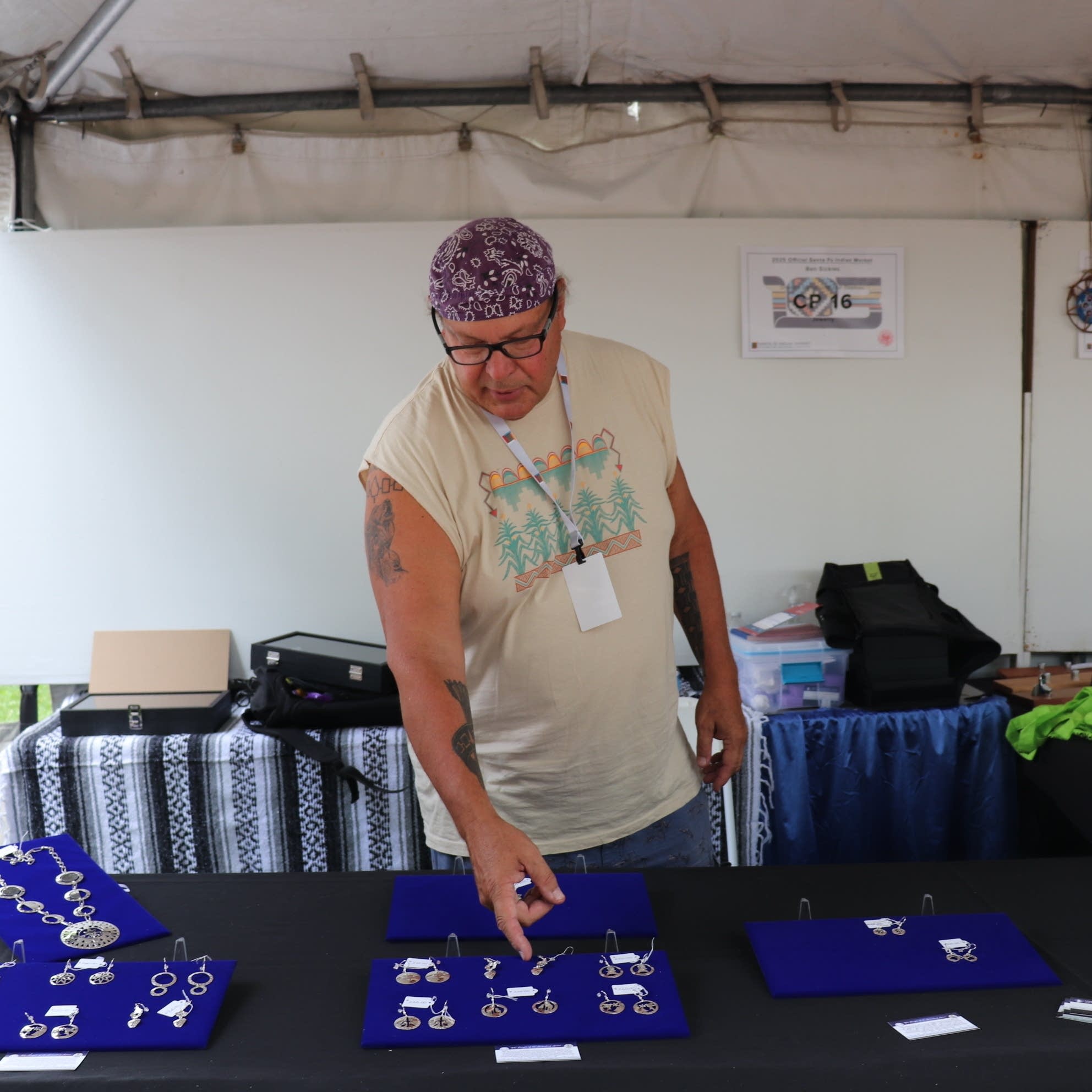
The acclaimed Santa Fe Indian Market draws over 1,000 indigenous artists from more than 200 tribal nations every year, including many from Canada. But this year, the trade war is a complication. Here's Savannah Peters.
- [04:03]
Savannah Peters
Oneida silversmith Ben sickles traveled over 4,500 miles to Santa Fe Indian Market, all the way from Nova Scotia. He's known for his earrings and cuffs, made in the Eastern Woodlands tradition.
- [04:15]
Interviewee / Artist
It's derived from the trade silver that came from Europe in the 1760s, traded for furs and other goods.
- [04:21]
Savannah Peters
But these days, Sickles pays cash for his silver, and it doesn't come from Europe.
- [04:26]
Interviewee / Artist
Well, I have to import it all from New Mexico because Canada doesn't really have what we need.
- [04:33]
Savannah Peters
And since March, his orders have been slapped with a 25% tariff. On top of that, global uncertainty has sent silver prices surging.
- [04:42]
Interviewee / Artist
It's almost impossible stay in business.
- [04:45]
Savannah Peters
Now Sickles picks up a small pair of silver earrings. A year ago, he would have priced them around $80. He's had to raise that to 100, and his sales are down.
- [04:56]
Interviewee / Artist
Everybody's hurting, right? You can't fill a bag of groceries for 100 bucks. So they look at my jewelry and that's a bag of groceries a few booths down.
- [05:06]
Savannah Peters
Inuit painter Jessica Winters isn't making many sales either, but some American curators are interested in commissioning her paintings of crafters at work, just scenes from normal life in an Inuit community. Winters isn't sure if those deals will be complicated by tariffs, but says the trade war has disrupted her business in another way. I have a printmaker who's this guy who just works out of his basement he's been doing it for 50 years but had to close shop because of tariffs on his paper imported into Canada from the U.S. winters is looking for a new partner to make prints of her work. So far as she's striking out, it could be worse. I think at least I'm still Canadian. These Canadian artists didn't pay a tariff when carrying their work across the border thanks to a carve out for handmade art. That's according to a consultant they worked with. Wendy Diltz. I can tell you a bigger concern was traveling to the US early this year. Diltz was working with a dozen Canadian Canadian artists who planned to exhibit in Santa Fe. In the end, only five made the trip. She advised them to keep their plans under wraps. Normally I would have reached out to museums or buyers, but we didn't want anything out there prior to their entry to avoid drawing the attention of U.S. customs and Border Protection. Mixed media artist Shane Perley Dutcher is Maliseet from New Brunswick. His tribe's traditional territory straddles what's now the U.S. canada border.
- [06:36]
Interviewee / Artist
Yeah, being the color I am, I have to worry crossing the border.
- [06:39]
Savannah Peters
But Santa Fe Indian Market is a can't miss opportunity to grow his business.
- [06:43]
Interviewee / Artist
I mean, this is such a big, big support to the artists that we have to come here, right?
- [06:48]
Savannah Peters
And the trip paid off. Pearly Dutcher went back to Canada with two first place ribbons for his metal woven baskets and some big sales in Santa Fe. I'm Savannah Peters for Marketplace at Target.
- [07:02]
David Brancaccio
Sales are down, but quarterly results today beat forecasts. Still, the Stock is down 8.5% now. Target was once known for stylish offerings, which shoppers now complain it's gone Blah. Some avoid Target because it was quick to cancel some of its diversity, equity and inclusion initiatives. Today the chain announced a new CEO will take over, but not until February. The current chief operating officer in Los Angeles, I'm David Brancaccio. It's the Marketplace morning report from APM American Public Media.
- [07:34]
Kai Ryssdal
Hey everybody. I'm Kai Rysdal, the host of Marketplace. I'm going to join Amy Scott on September 9th. She's the host of How We Survive and also science writer Elizabeth Kolber. For a conversation about the economic consequences of our climate crisis. We're going to break down how the acceleration of climate change is going to disrupt jobs and entire industries, even our daily lives. But it's not all doom and gloom. We're also going to dive into the solutions that are giving us hope right now. Thanks so much to Odoo. For sponsoring this free webinar, and you can sign up today@marketplace.org climate.