Loading summary
Transcript26 lines
- [00:02]
A
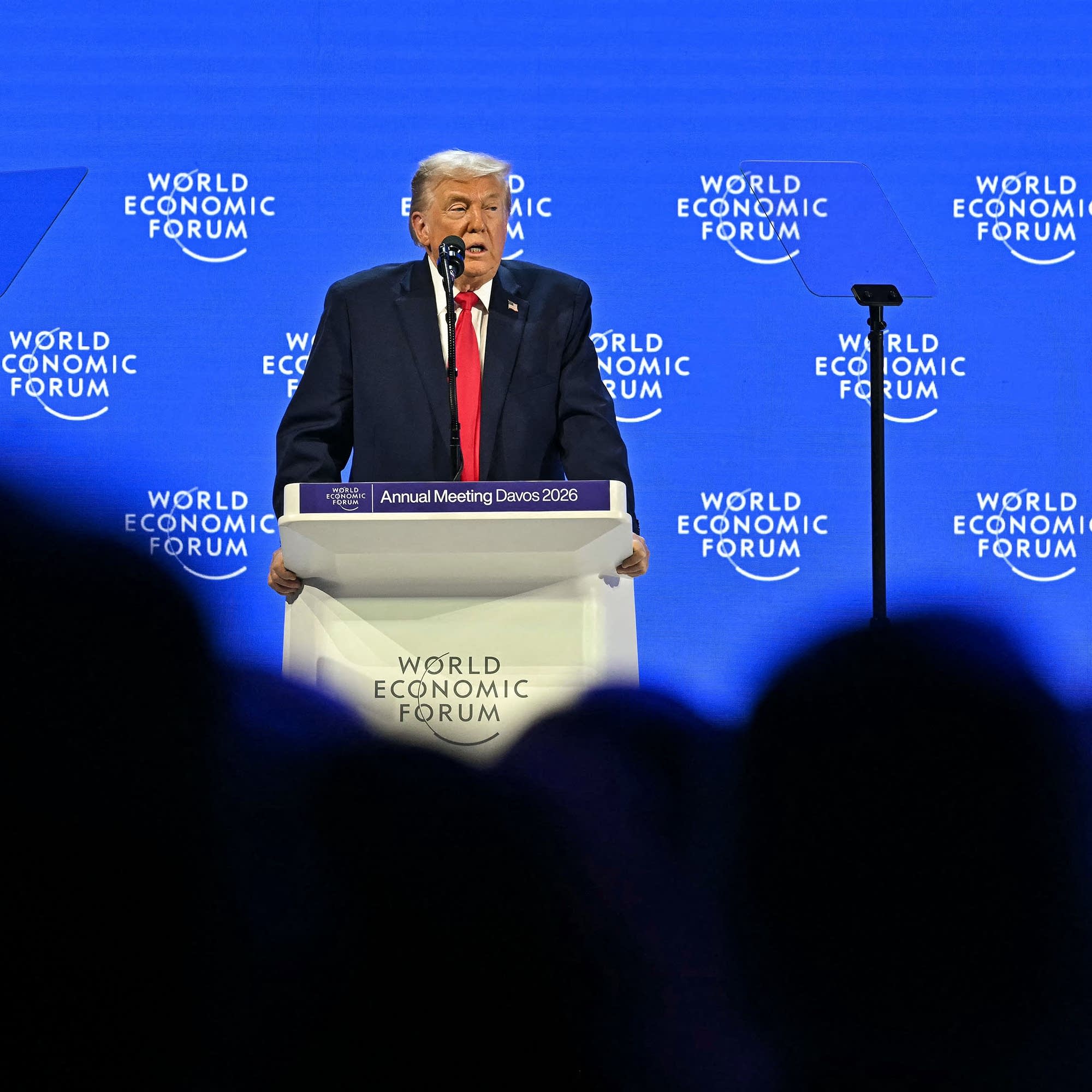
Markets inflect as the president speaks beyond ruling out using force to acquire Greenland from Denmark, President Trump right now is touting his use of tariffs to disrupt the global trading system as a win win for the world. He's speaking now to business and political leaders gathered at the Swiss ski resort of Davos, now referring to outlines of trade deals with, for instance, Japan, South Korea and the European Union.
- [00:27]
B
And these agreements raised growth and caused stock markets to boom, not only in the US but virtually every country that came to make a deal. Because as you've learned, when the United States goes up, you follow those deals.
- [00:44]
A
Are outlines with final details still in flux. In fact, European Union lawmakers today froze discussions on the US EU trade deal after Trump's threats to raise tariffs on some EU countries who oppose his Greenland aspirations. Trump also just said Greenland is not about its rare minerals.
- [01:02]
B
And this, to get to this rare earth, you got to go through hundreds of feet of ice. That's not the reason we need it. We need it for strategic national security and international security.
- [01:18]
A
Yesterday there was a sell off in stocks with the NASDAQ dropping 2.4%. And also in the bond market, pushing the 10 year interest rate to its highest level since last summer. The average 30 year fixed rate mortgage mortgage moved up sharply from 6.07 to 6.21%. Using Mortgage News Daily's calculation. Guy Laba is chief fixed income strategist at Janney Montgomery Scott.
- [01:42]
C
I think the risk is that on the margin they choose to diversify into other government bonds a little bit. And each little bit matters. Treasury Department is issuing trillions of dollars of debt each year. And so a little bit of swing in demand can really change the cost of how the US Government finances itself.
- [02:01]
A
In the financial world. I'm hearing more talk of what's a bit cynically dubbed a return to the Sell America trade. What is that? And it sounds like you don't really see that happening on a significant scale yet.
- [02:17]
C
The Sell America trade is something that was probably more obvious in the stock markets, particularly around the tariff announcements. Last April, there was a movement by lots of investors both in the US and overseas to reduce their holdings of US Dollar assets and invest in things like European assets and Japanese assets and others as well. Now, has it affected the bond markets? Briefly, but it wasn't in any sustained MANNER because the U.S. bond markets did pretty well last year.
- [02:50]
A
All right, so you're urging us to be a little bit careful thinking about the Greenland issue, causing US Consumers to pay higher credit card and maybe home loan rates. I mean, it is a much more complicated world.
- [03:04]
C
It is extraordinarily complicated and really the biggest risk, and it's still, in my view, a modest one, is about how the United States government borrows money, not about credit cards, not directly. It could affect mortgage rates. And mortgage rates, ironically, have gone up since some of the announcements several weeks ago to try to bring them down, in large part because of this geopolitical tension.
- [03:29]
A
Guy lebat, chief fixed income strategist at Janney Montgomery Scott, thank you so much.
- [03:33]
C
Thank you, David.
- [03:35]
A
Right now, the Dow Jones Industrial average is up half a percent, 247 points, with Trump saying the US is the only country that can guarantee Greenland's security, but that he won't take it by force. The S And P also up 5. 10%. The NASDAQ is up 3. 10 of a percent.
- [04:06]
D
This marketplace podcast is supported by Fundrise. Billion dollar investors don't typically park their cash in high yield savings accounts. Instead, they often use one of the premier strategies for institutional investors, private credit. Now, the same passive income strategy is available to investors of all sizes thanks to the Fundrise Income Fund, which has more than $600 million invested and a 7.97% distribution rate. With traditional savings yields falling, it's no wonder private credit has grown to be a trillion dollar asset class. Learn more@fundrise.com marketplace. The fund's total return in 2025 was 8%, and the average annual total return since inception is 7.8%. Past performance does not guarantee future results. Current distribution rate as of 12312025 carefully consider the investment material before investing, including objectives, risks, charges and expenses. This and other information can be found in the Income Fund's prospectus@fundrise.com income. This is a paid advertisement.
- [05:06]
A
New data show the portion of airspace where there's armed conflict below is at the highest level since World War II. An official from the German airline Lufthansa told our partners at the B that Russia's war on Ukraine, for example, is adding time to flights, which means more fuel burned and higher costs. The BBC's Rick Kelsey reports.
- [05:27]
E
I'm currently flying over the top of the world. The flight is from Tokyo to London, and this route going over Alaska is common again, like it was in the 1970s when it stopped to refuel. But now it's often to avoid Russian airspace due to the Ukraine war. And this is not the only route that's changed.
- [05:49]
F
Certainly you know, if you have 4.9% of, you know, the world of the six permanently inhabited continents, territory in conflict. That's significant areas of the world where there is a decision to be made of whether it is safe to fly over those zones.
- [06:04]
E
Hugo Brennan is from risk intelligence company Verisk Maplecroft, who put together the latest Conflict Intensity Report, which maps global conflict. The report shows that areas affected by armed fighting have grown by 89% over the past five years. Each additional minute of flight time leads to an average increase in passenger fares of US$1 50, according to Aviation experts at the German Aerospace Center. The BBC has now heard from Lufthansa, one of the world's biggest flight operators, who say their long haul journeys are growing by up to two hours and, and it must now continually adjust its network planning to keep its schedule stable. But it's not only cost, it's also emissions. Dr. Victoria Ivanikova is assistant professor in Aviation Management at Dublin City University.
- [06:58]
G
If we will look on the flight radar 2024, we can see that aircraft are flying Russian airspace, Ukrainian airspace, and there are some points with conflict in the Middle east. And the total area of closed or restricted in use airspace currently is around 18 million square kilometers.
- [07:21]
E
That's almost 11 million square miles, which.
- [07:24]
G
Is the biggest airspace segregation since the Second World War.
- [07:28]
E
Most Western airlines are now banned from flying over Russia, which pushes up the costs. Gilbert Ott runs God Save the points who help people get low price airfares.
- [07:38]
F
You know, an airline you could say would be less likely to make a seat available with points because there's so much more pressure to create that profitability rather than kind of break even with these changes. With these restrictions in airspace, figures suggest.
- [07:52]
E
That until recently, airfares have changed little when taking into account inflation over 10 years. So you can still get deals, but the destination might be further away. I'm the BBC's Rick Kelce for Marketplace.
- [08:07]
A
And we're from APM, American Public Media.
- [08:13]
H
This week on this Is Uncomfortable. We have two new episodes exploring our relationship with money and work. First up, we've all been told that money can't buy happiness. But also I think I have a personal convulsion that happens inside of me. When people say, like, money doesn't make you happy. I'm like, oh, you've never been poor? And then why? The job market these days can really shake your confidence. People who may have been looking for a job two years ago and were getting interviews, getting responses are now confronting something totally different, which is that there's this sense that there's really not the kind of opportunity that there was before. Don't miss an episode. Listen to this is Uncomfortable on your favorite podcast app.