← Marketplace Morning Report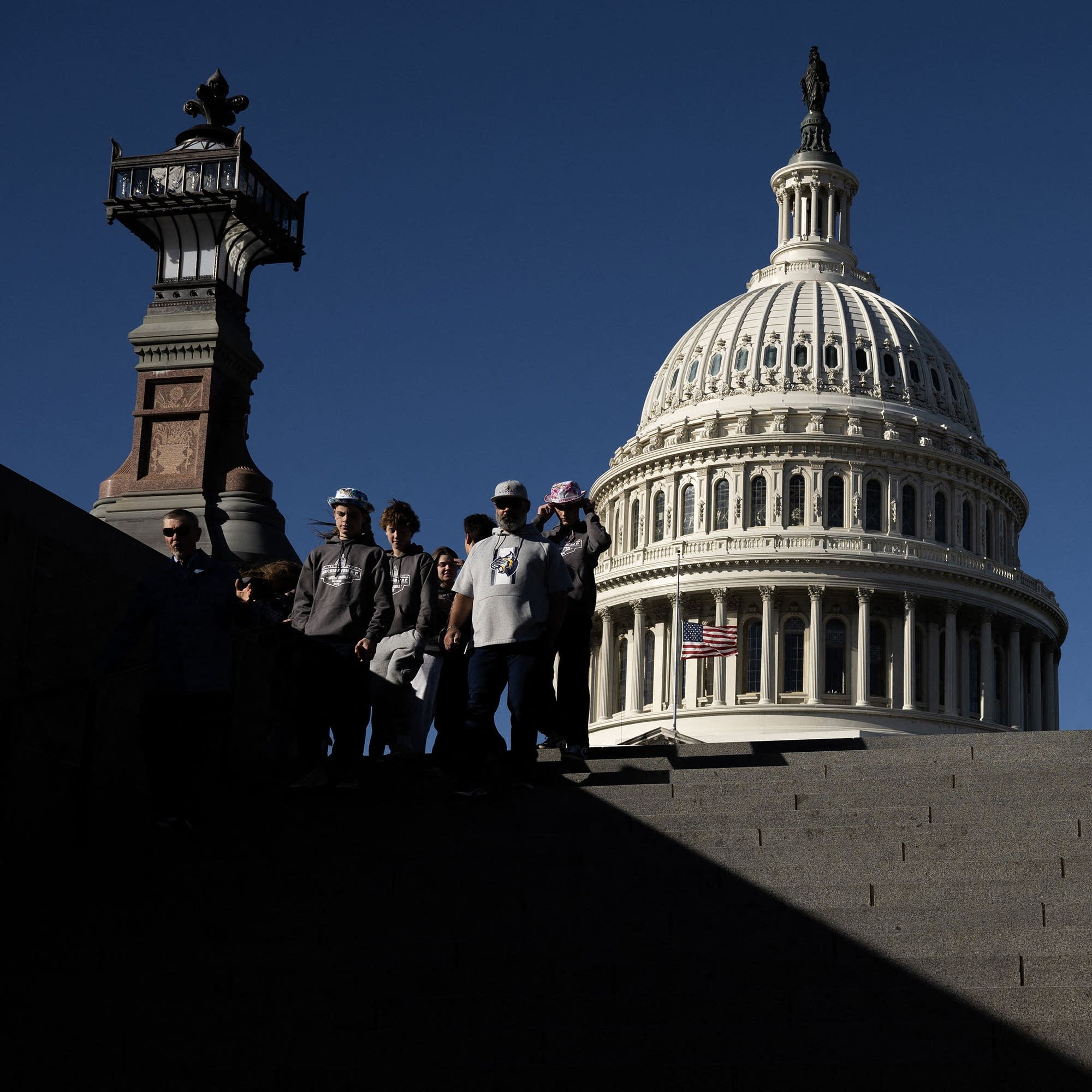
Loading summary
Transcript31 lines
- [00:00]
Capella University Announcer
At Capella University. Learning the right skills could make a difference. That's why our business programs teach you relevant skills you can take from the course room to the workplace. A different future is closer than you think with Capella University. Learn more@capella.edu.
- [00:17]
David Brancaccio
What else is in the legislation to reopen the government? A lot. I'm David Brancaccio in Los Angeles. We've been going through the legislation that reopened the federal government last night. It's good through the end of January and the various bills that are now law. Also military construction, farms and a lot more. Marketplace's Nancy Marshall Genzer is going through the line items.
- [00:39]
Nancy Marshall Genzer
There's plenty of money for lawmakers pet projects or earmarks in the appropriations bill for military construction, funding for an army dining facility in Alaska and flight control towers in Alabama. The Agriculture Department will be able to restart loan processing for farmers. There are earmarks here, too. Money for a rice research center in Arkansas and a center for Technical Innovation in Hawaii. There are also appropriations for rural broadband, telemedicine and rental assistance. And the FDA funding bill allows the agency to destroy imported counterfeit tobacco products like vapes. I'm Nancy Marshall Genser for Marketplace Context.
- [01:20]
David Brancaccio
Now on a Wall Street Journal report that the White House might limit the power of firms that suggest to shareholders how to vote on corporate matters, here's Marketplace's NovaSafo.
- [01:30]
Nova Safo
If you want to hear JPMorgan Chase CEO Jamie Dimon launch into a tirade, just ask him about proxy advisory firms.
- [01:39]
Sam Grouet
Anyone who uses them. Shame on you.
- [01:40]
Capella University Announcer
I thought you were.
- [01:41]
Sam Grouet
I mean, shame on you.
- [01:43]
Nova Safo
That's Dimon at a Semaphore forum in March. Yeah, they certainly got under his skin. And that's Robert Bartlett, faculty co director of the Rock center for Corporate Governance at Stanford. The they he's talking about are two dominant proxy advisory firms, Institutional Shareholder Services and Glass Lewis. Bartlett says they're often involved in advising large firms like mutual fund managers on how to vote on various corporate issues, from who should be on the board of directors to reducing carbon footprints. Management is relying on shareholders to approve various items. And when ISS and Glass Lewis advise against voting for management supportive shareholder items, that obviously makes life difficult. So should the White House issue new limits on proxy firm recommendations in order to curb their influence? Tao Li, finance professor at the University of Florida, worries such limits could be counterproductive. Having proxy advisors advising the largest institutional investors in general is working really well. Without any recommendations, how would people vote? Lee says there could even end up being fewer shareholders voting at all, leaving company insiders with more power. I'm Nova Safo for Marketplace and a.
- [03:03]
David Brancaccio
Difference of opinion on some numbers. The Starbucks union says baristas at 65 locations in 40 cities are striking today on what the chain had promoted as Red Cup Day. The company says it isn't that many.
- [03:32]
Capella University Announcer
Is it time to reimagine your future? The right business skills may make a difference in your career. At Capella University we offer a relevant education that's designed to focus on what you need to know in the business world. We'll teach professional skills to help you pursue your goals like business management, strategic planning and effective communication. And you can apply these skills right away. A different future is closer than you think with Capella University. Learn more at capella.
- [03:59]
David Brancaccio
Edu when world leaders gathered in Malaysia for the association of Southeast Asian nations or ASEAN Summit last month, Canadian Prime Minister Mark Carney pitched his country as a quote energy superpower. He was touting increased energy exports to Asia in that context, but historically, much of Canada's oil and natural gas has been sent to the U.S. but given trade tensions, where does that leave Canada's energy exports? The BBC's Sam Grouet has the story from the port of Vancouver.
- [04:29]
Sam Grouet
It's a real hive of activity here. There are forklifts whizzing around, giant orange cranes lifting and stacking shipping containers. And in the distance, those big cargo ships, several hundred of which leave from here every year carrying lumber, grain and minerals. But increasingly, what's fueling this port and the country's ambitions is energy.
- [04:53]
David Brancaccio
We will be up to 50 million tonnes annually of LNG by the end of this decade.
- [04:57]
Sam Grouet
In July, Canada's first cargo export of liquefied natural gas, or lng, left the west coast bound for Asia. It's cooled to a liquid and shipped rather than transported as gas via pipelines.
- [05:11]
Heather Exner Perrot
We have the LNG Canada terminal now operating, now shipping across Asia. We have two other LNG terminals currently under construction and two other very significant LNG terminals that have received approval from both the British, Colombia and the Canadian governments. And now we're looking for a final investment decision, hoping to secure those long term contracts with those Asian allies.
- [05:31]
Sam Grouet
For Heather Exner Perrot from Canadian think tank the McDonald Laurier Institute, expanding LNG exports by targeting orders from Asia is a no brainer amid US Trade tensions.
- [05:44]
Heather Exner Perrot
There's not a lot of bright spots in the Canadian economy these days, but LNG and investment in natural gas is one of those where you're really seeing growth and you're really seeing foreign interest. And the obvious answer to that is Asia.
- [05:56]
Sam Grouet
Some environmentalists oppose LNG and see any increase in natural gas production as harmful for long term climate goals. Others, like conservative opposition leader Pierre Poliev, want to see an expansion of Canada's oil exports, something supported by Deborah Yedlin, president of the Calgary Chamber of Commerce in the oil rich province of Alberta.
- [06:19]
Amy Scott
From an economic standpoint, this is a.
- [06:21]
Amanda Stevenson
Very, very important part of our economic opportunity. And so why not pull that lever and increase the access to new markets via pipeline?
- [06:31]
Sam Grouet
But more oil could be a hard sell for Prime Minister Carney. As Reuters Canada energy reporter Amanda Stevenson.
- [06:39]
Amanda Stevenson
Explains, oil pipelines are not unanimously supported in Canada. Far from it. So I think that Mark Carney, if he is interested in such a proposal, he's going to have to, you know, kind of balance the interests of environmentalists and the economy. And I'm not sure you know, how easy that's going to be.
- [06:58]
Sam Grouet
This balance, Amanda says, will be a hurdle in whether Canada can become an energy superpower.
- [07:04]
Amanda Stevenson
What is clear is that Canada has abundant energy resources and the potential to tap those resources even further. Energy demand globally continues to rise. However, there are climate concerns. There are political concerns. Though whether or not Canada can truly become an energy superpower, that remains to be seen.
- [07:27]
Sam Grouet
Canada may call itself an energy superpower, but proving it will take much more than words. In Vancouver, I'm the BBC's Sam Grouet for Marketplace.
- [07:39]
David Brancaccio
And in Los Angeles, I'm David Brancaccio. This is the Marketplace Morning Report from apm, American Public Media.
- [07:51]
Amy Scott
Imagine a future where chocolate and coffee are rare and expensive, where cheap nutritional staples like corn and wheat are threatened. Sounds unpleasant, doesn't it? Well, we could be heading there if we don't recognize that the climate crisis is also a food crisis.
- [08:10]
David Brancaccio
I've seen yields drop because of drought, and believe me, boy, have I seen them drop. We have had dry spells that have lasted years.
- [08:21]
Amy Scott
I'm Amy Scott. This season on How We Survive. We investigate how the climate crisis is threatening our most vital food systems and how scientists are racing to develop alternatives that will shape the future of food. Listen to this season of How We Survive on your favorite podcast.
- [08:40]
Amanda Stevenson
Apparently.