Loading summary
Transcript28 lines
- [00:00]
Wix Advertiser
You set the gold standard for your business. Your website should do the same. WIX puts you at the helm so you can enjoy the creative freedom of designing your site just the way you want. Want someone to bounce your ideas off? Talk with AI to create a beautiful site together. Whatever your business, manage it from one place and tie it all together with a personalized domain name. Gear up for success with a brand that says you best you can do it you yourself on wix. This is the story of the one.
- [00:31]
David Brancaccio
As a quality technician in a food processing center, she knows that making the right call is the best way to avoid a recall.
- [00:39]
Wix Advertiser
That's why she trusts Grainger's world class.
- [00:41]
David Brancaccio
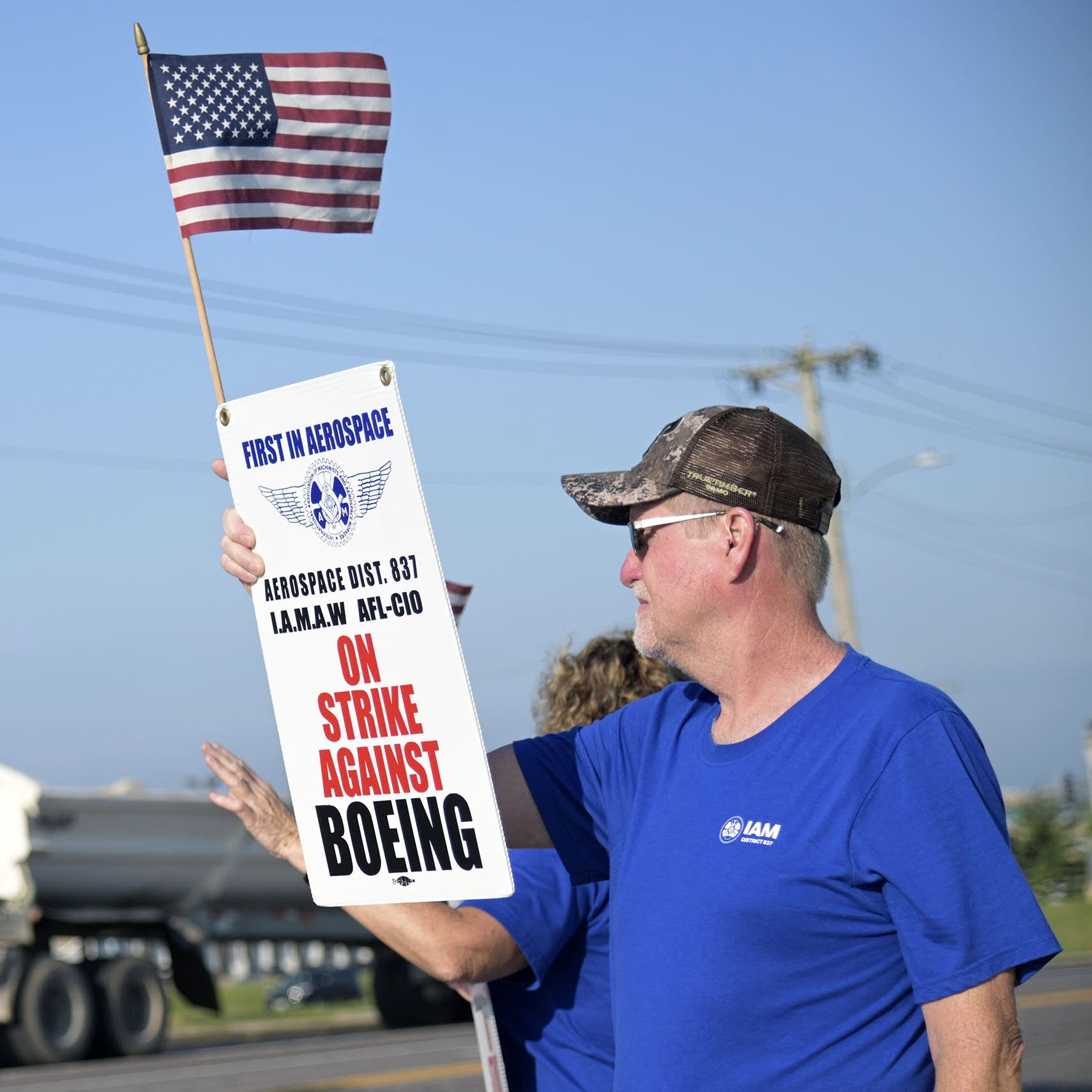
Supply chain to deliver the high quality supplies she needs to help keep her production line, her equipment and her customers happy and healthy. Call 1-800-GRAINGER clickgranger.com or just stop by Granger for the ones who get it done. ChatGPT as a money making device I'm David Brancaccio in Los Angeles. First more than 3,000 Boeing machinists are striking for a third day here, pushing for better pay, benefits and scheduling. These workers make fighter jets and weapons systems at plants in Illinois and Missouri. The dispute comes as Boeing was supposed to be turning a corner. Daniel Ackerman reports.
- [01:24]
Daniel Ackerman
Boeing had a rough few years at the start of the pandemic. There were safety issues, late aircraft deliveries stranding astronauts in space for eight months. But Sam Engel, an aviation consultant with icf, says more recently, the vibe coming.
- [01:38]
David Brancaccio
Out of the company seems to be one of turning upward.
- [01:41]
Daniel Ackerman
Boeing CEO Kelly Ortberg has touted this as the firm's turnaround year. Deliveries of commercial planes are up. President Trump's new trade deal with the EU includes a tariff exemption for aircraft and and Engel says the firm just won a $20 billion contract to make fighter jets for the U.S. the Trump.
- [01:59]
David Brancaccio
Administration in some ways has made for smoother sailing for Boeing.
- [02:02]
Daniel Ackerman
And with defense spending up, Boeing's workers sense opportunity, says Richard Abulafia of Aerodynamic Advisory.
- [02:09]
David Brancaccio
This is the first time in literally decades that labor has actually had power because, well, the markets want their aircraft now.
- [02:17]
Daniel Ackerman
But exercising that power was never going to be easy, says Abulafia. The current labor dispute is just the latest in a string of them.
- [02:24]
David Brancaccio
For Boeing, they've got a rich tradition, several decades of really bad labor relations. For a time back in the 2000s and 2000s, it seemed like the CEO's highest priority was to basically break organized labor, abulafia says.
- [02:40]
Daniel Ackerman
With Ortberg, the current CEO things were on track to improve last year. Machinists in Boeing's commercial aircraft division won a 38% wage increase over four years.
- [02:50]
David Brancaccio
But sometimes old habits die hard.
- [02:52]
Daniel Ackerman
The defense workers who went on strike this week are still feeling the pain of negotiations more than a decade ago, says Jake Rosenfeld, who researches labor at Washington University.
- [03:02]
David Brancaccio
Back in 2014, they handed over steep.
- [03:05]
Jonathan Head
Concessions, accepting buyouts, a pension freeze in order to keep work in the St. Louis region.
- [03:11]
Daniel Ackerman
More broadly, Rosenfeld says this strike is something of a return to form for the labor movement nationwide.
- [03:17]
Jonathan Head
We had a couple years of kind of heightened labor activity that kind of quieted down in the first, you know, five, six months of 2025, he says.
- [03:27]
Daniel Ackerman
That's because with slowing economic growth, employers seem to be gaining the upper hand.
- [03:32]
Jonathan Head
You see this across all sorts of dynamics, including, you know, return to office policies.
- [03:37]
Daniel Ackerman
But Rosenfeld says the Boeing strike shows that the heightened worker expectations for the last few years haven't gone away. I'm Daniel Ackerman for Marketplace.
- [03:47]
David Brancaccio
The ChatGPT company OpenAI was set to do artificial intelligence in the public interest. It was set up that way, but it's taking another step to become a cash generating machine. It's considering a stock sale for its current and former employees that would value the company at a half trillion dollars. Marketplace's Henry Epp has that not only are other tech giants investing heavily to create AI products to rival ChatGPT, they're also now competing for some of the top talent. Facebook owner Meta especially has made headlines for offering nine figure salaries to some top AI researchers. It's poached workers from OpenAI and Apple. According to Bloomberg, OpenAI's stock sale could entice some talent to stay at the firm. It also comes as OpenAI works to overhaul its corporate structure. Currently, it's overseen by a nonprofit. It could eventually seek an initial public offering. I'm Henry Epp for Marketplace.
- [04:54]
Wix Advertiser
So you've got a business, but what about a brand? The difference? More of you. Wix gives you the freedom to create your website, own your brand and do it on your own exactly how you envisioned it. Experience limitless customization. Boost your creativity and efficiency with AI tools for every part of your business journey. Scale up with built in SEO, e comm and scheduling features. Put more of you in your business. Go to wix.com and do it all yourself.
- [05:23]
David Brancaccio
This is the story of the One. He's responsible for keeping a leading healthcare facility clean and safe. And he trusts Grainger's high quality H Vac cleaning and safety Products combined with their world class supply chain to consistently deliver, ensuring he's covered inside and out so he can focus on keeping his facility clean. To help protect the health of everyone inside. Call 1-800-GRAINGER clickranger.com or just stop by Grainger for the ones who get it done. Thailand is among the countries that was able to get a deal on US tariffs ahead of last week's deadline. Import taxes on Thai products are now down to 19% instead of the 36% President Trump had talked about. But. But even that will bite into products that Thailand exports, including machinery and electrical components. The BBC's Jonathan Head filed this report for us.
- [06:16]
Jonathan Head
I'm standing now in a large room filled with machinery that is stamping circuit boards, little tiny components, bits of solder being imprinted on these typically green circuit boards and passing down to be inspired expected. This one factory is part of an enormously complicated supply chain that stretches across Asia and eventually to the US and Europe. Quality is critical, but so is cost, which is why the imposition of President Trump's steep tariffs poses such a challenge. But the US has been making tough demands in return for cutting tariffs, in particular access to Thailand's agricultural market. Pig farmers like Worawat Sirupun have been lobbying their government hard not to lift barriers to US pork. American farmers produce on a much larger scale than us, he told me, and their costs are much lower. We can't survive if we allow their pork into Thailand. Richard Han is the CEO of Hanna Microelectronics. Even with a deal, he says there's still too much he doesn't know to make any plans to invest or move production to another country. We're seeing a pattern here where Trump wants to announce the world very top line. We've got a deal and this is the key elements. 40%, 20%, whatever it is. But because there's no detail, then it's not really a deal because there's so many details that need to be part of that deal. If they're not thrashed out and agreed, and I don't know how long it would take, then how can we actually implement the so called deal? This is a point those involved in the tariff talks have often echoed. These deals have been so rushed that all the usual minute detail that goes into trade agreements, which typically take years to finalise, is missing. In fact, these deals are essentially just verbal agreements on a few big numbers, which could easily change again if President Trump has a mind to do so.
- [08:34]
David Brancaccio
In Bangkok, that's Jonathan Head with our newsroom Partners, the BBC in Los Angeles. I'm David Brancaccio. It's the Marketplace Morning report from apm, American Public Media.
- [08:48]
Wix Advertiser
Running a business can be exhausting. Building your website shouldn't be. With wix, you can express your ideas, give direction, then leave the heavy lifting to AI. From site creation to branded content and images. Have fun with the details, customize what you want the way you want, and manage your whole business from a centralized dashboard with expert AI tools. Build, scale and enjoy the incredible results. You can do it all yourself on wix.