Loading summary
Transcript33 lines
- [00:00]
A
This podcast is supported by Odoo. Some say Odoo business management software is like fertilizer for businesses because the simple, efficient software promotes growth. Others say Odoo is like a magic beanstalk because it scales with you and is magically affordable. And some describe Odoo's programs for manufacturing, accounting, and more as building blocks for creating a custom software suite. So Odoo is Fertilizer Magic Beanstalk building blocks for business Odoo exactly what businesses need. Sign up@odoo.com that's o d o o.com.
- [00:30]
B
This is the story of the As a maintenance supervisor at a manufacturing facility, he knows keeping the line up and running is a top priority. That's why he chooses Grainger, because when a drive belt gets damaged, Grainger makes it easy to find the exact specs for the replacement product he needs, and next day delivery helps ensure he'll have everything in place and running like clockwork. Call 1-800-GRAINGER click granger.com or just stop by Granger for the ones who get it done.
- [01:02]
C
Economists can draw a line between new hire prices and tariffs I'm David Brancaccio in Los Angeles. Consumer inflation is moving the wrong way. There's news this morning. The consumer price index rose by a bit more than expected in August, up 4/10 of a percent. That means prices went up 2.9% in a year versus 2.7% according to the previous reading. Let's get this analyzed. Diane Swonk is chief economist at the audit, tax and advisory firm kpmg. Morning.
- [01:32]
D
Good morning.
- [01:34]
C
I mean, this looks like prices are running a little hot to me. How do you read it as a professional?
- [01:40]
D
Well, we are seeing prices accelerate and that is really hard. We're seeing prices that are the most sensitive to tariffs go up the most. We saw durable goods prices go up. Those are those big ticket durable goods items and most sensitive to the first rounds of tariffs. Those rose at their fastest pace since November of 2022. That was back when we were still dealing with worst of the pandemic induced inflation.
- [02:05]
C
Now our central bankers are meeting next week and the betting had been definitely they're going to lower interest rates a little bit middle of next week. Do you think this inflation news might change their calculation in any way?
- [02:18]
D
It doesn't change their calculation, but it keeps the debate within the Fed heated. So we could see a quarter point cut with descents in both directions, some dissenting for a more aggressive half percent cut and others dissenting in favor of no move whatsoever by The Federal Reserve.
- [02:37]
C
Well, we'll try to have a ringside seat next week for all this. Diane SWONK, Chief Economist, KPMG. Thank you.
- [02:43]
D
Thank you.
- [03:00]
E
Dr. India woods here. As a veterinarian, I demand a lot of my scrubs on the job. That's why whether I'm at the clinic or visiting a four legged friend out in the field, I show up in figs. Figs are made for the sometimes crazy situations I find myself in. It doesn't matter if I have to squat, sit, bend, or even chase after one of my patients. FIGS moves with me and keeps me comfortable in the highest pressure situations. Figs are designed specifically for healthcare professionals and have a lot of pockets and zip compartments that never snag. So I can carry a ton of necessities like treats, gloves, instruments and more. Figs are also liquid repellent and never fade after the wash. One of the best moments is taking a fresh pair out of the dryer before a long shift. As a vet, I spend a lot of my time worrying about my patients and the people who love them. And it's not always easy. FIGS gives me one less thing to worry about and even help me feel a little more confident on the job. If my patients could talk, they'd tell you to hurry up and get some figs. Show up in figs, get 15% off your first order by visiting where figs.com and use code figs rx at checkout. That's wherefigs.com code figs rx.
- [04:07]
C
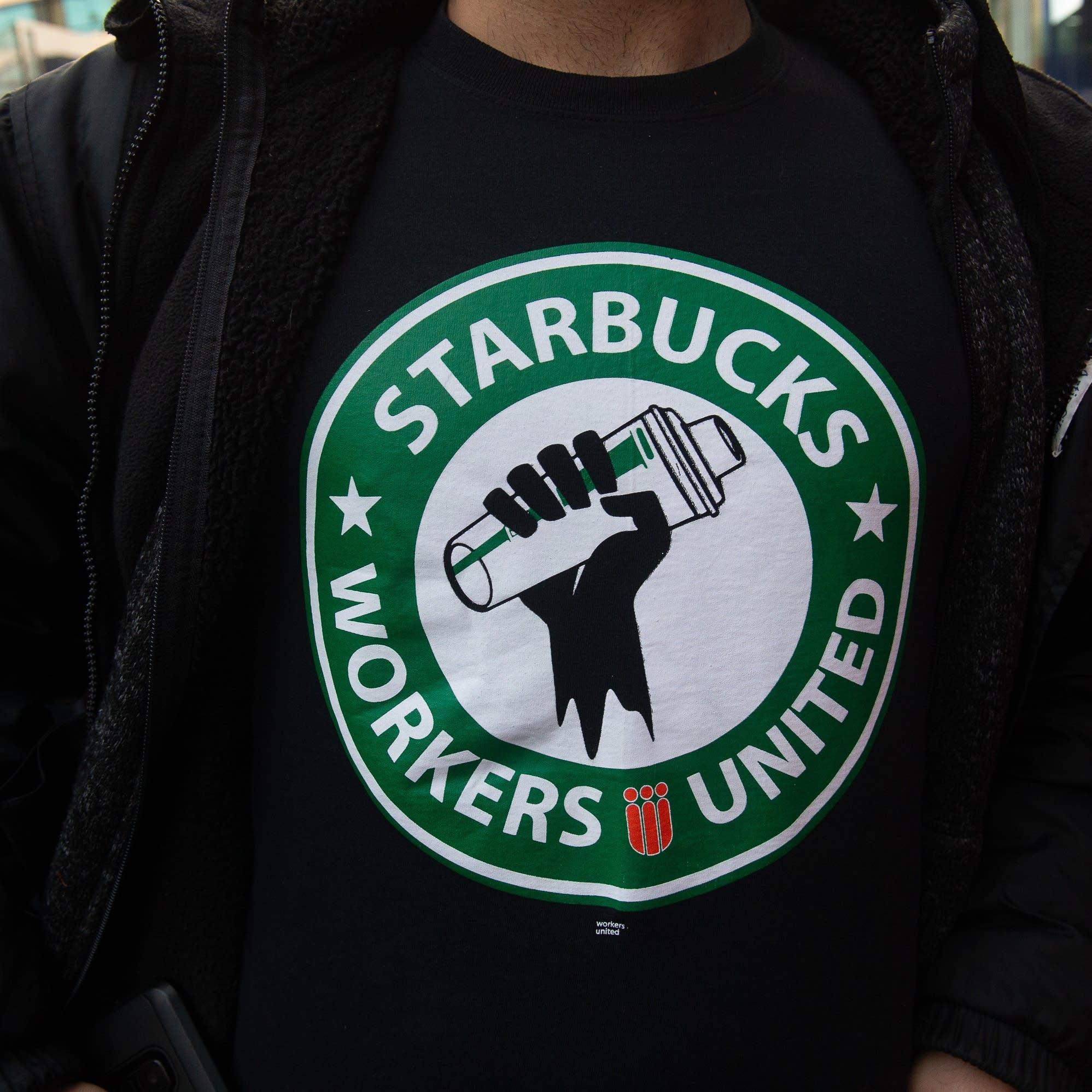
Time for the marketplace Economic pulse. Views of the economy from a range of perspectives. Today, a voice from organized labor. Michelle Eisen is a founding member of a union representing workers at Starbucks. Starbucks Workers United. She had worked as a barista for 15 years. Ms. Eisen, welcome.
- [04:25]
F
Thank you. It's great to be here.
- [04:27]
C
So where are we here? 12,000 people who are working at Starbucks have voted for a union at about 600 Starbucks outlets in recent years. How many right now are working under a union contract? I think I know the answer.
- [04:42]
F
That would be zero are currently working under a union contract. But we are very, very close.
- [04:47]
C
You're making some progress.
- [04:48]
F
I mean, we were making significant progress under the previous. We were actually bargaining with the company for a solid nine months and making significant progress in solidifying this first contract. And unfortunately, under this current CEO, that has stalled out.
- [05:05]
C
Yeah, you and I are talking one year really to the date since a new CEO took the chair. Brian Nicol. I think I've read stuff from Mr. Nickel saying he recognizes that working conditions can be a challenge at Starbucks. Is he changing those conditions for the better?
- [05:23]
F
I think that's very interesting that he recognizes the issues that baristas are facing. The folks who run these stores every single day and bring in those billions of dollars of profit. But all of the policy changes, at least that I've witnessed since he came into this role a year ago, have only made those conditions worse.
- [05:40]
C
What are some of the frustrations that come to mind?
- [05:43]
F
Staffing and hours that baristas are given, which allows those stores to be staffed appropriately and deal with the volume of customers it centers around take home pay. The fact that these are baristas who are working for a multibillion dollar corporation headed by a CEO who made $96 million in the first four months of his employment with Starbucks, who are barely making enough take home pay to pay their bills.
- [06:09]
C
So where does it stand? I mean, are the two sides even talking right now?
- [06:14]
F
They're not. We have made consistent requests, invitations for Brian himself to join negotiations so that we can get this ball rolling again. Look, we know that the company is dealing with a lot of issues. Failing to settle this union contract with their unionized staff is just one. But this is an easy solve. You know, like they could solve this tomorrow and it would be one less thing that the company was having to deal with. It could be settled for less than a single day's earnings.
- [06:40]
C
Now, for customers going into Starbucks, I'm sure there's a percentage that care deeply about the working conditions of the people serving them, but many of them want, you know, a decent cup of coffee and they don't want to wait on a long line. Do you think resolving the unionization issue might help with, for instance, wait times?
- [07:01]
F
I absolutely think that it would. It is an issue that baristas have been facing for a number of years. It was one of the chief things that we organized around. It was the fact that we don't feel like we're being supported in a way that allows us to serve the customers the way the company would like us to serve the customers and the way we would like to serve the customers. And we have offered viable solutions in the bargaining process that focuses specifically on getting workers enough hours to allow the stores to be staffed appropriately. And, you know, they're essentially falling on deaf ears. The company has yet to respond in any way to those proposals. We are here because we want the company to do well. We want things to be better. Otherwise there'd be no point in sticking around.
- [07:44]
C
Michelle Eisen, organizer with Starbucks Workers United, which represents baristas in more than 600 Starbucks outlets in the U.S. thank you very much.
- [07:53]
F
Thank you so much.
- [07:55]
C
A Starbucks spokesperson told us changes at the company under CEO Nicol are improving the store experience for workers and employees, quote retail partner turnover and is at record lows and about half the industry average. The company also told us the union has presented its members with incomplete contract frameworks to vote on and walked away from the bargaining table on multiple occasions, quote, effectively undermining our collective progress. We posted the full statements from Starbucks on our website, marketplace.org meanwhile, a union representing striking Boeing workers says there's now a tentative contract agreement there, pending a vote by members. Boeing workers who make planes and other hardware for the military have been striking since early August. There are few details out yet on this tentative deal, but raises and a signing bonus are among the features. In Los Angeles, I'm David Brancaccio. It's the Marketplace Morning Report from apm, American Public Media.
- [08:53]
F
America is changing, and so is the world.
- [08:58]
C
But what's happening in America isn't just the cause of global upheaval.
- [09:02]
F
It's also a symptom of disruption that's happening everywhere. I'm Asma Khalid in Washington, D.C. i'm.
- [09:08]
C
Tristan Redmond in London, and this is THE Global story.
- [09:12]
F
Every weekday, we'll bring you a story from this intersection where the world and America meet. Listen on BBC or wherever you get your podcasts.