Loading summary
Transcript42 lines
- [00:00]
Optum Narrator
Okay, let's get real about healthcare for a second. I think we can all agree it doesn't always work the way it should. If you've ever waited on a prescription refill or had a hard time getting the care you needed, you know what I mean? The system should just work better for everyone. That's exactly what the people at Optum are trying to do every day. They're a healthcare company linking patient care and pharmacy services and using data and technology to drive the whole system. So care is connected, not complicated for patients and providers. Things like making it easier to get care that looks at the whole person. From primary care doctors to mental health support, and even in home care. And then using technology to make sure they all work together. Technology designed to help doctors spend less time on busy work and more time with their patients and those prescriptions. Optum is bringing costs down, saving patients money and making it easier to get refills. Little by little, Optum is helping make healthcare work as one for everyone. Head to business.optum.com to see how.
- [01:00]
Marketplace Host
This podcast is supported by Raymond James, a financial firm offering wealth management, banking and capital market services that are inspired by people before Raymond James. Financial Advisors build plans, they build relationships so they can craft individual strategies designed to achieve priorities and and pursue what's possible. That's the power of personal disclosures@raymondjames.com Raymond James and Associates Inc. Member NYSE SIPIC
- [01:31]
Sabri Ben-Achour
oil is flowing again. How long till it really hits the pump though? From Marketplace, I'm Sabri Ben Assure in New York in for Kimberly Adams. OPEC over the weekend voted to increase or and usually it does this to lower oil prices. But the price of oil is already way down from its wartime highs. Brent crude is at $72 a barrel. one point during the war, it was briefly at $126 a barrel. So as oil production comes back online, what can we expect at the gas pump? Julia Coronado is here to talk about that and more. She's founder of Macro Policy Perspectives and a professor at UT Austin. Hi Julia.
- [02:10]
Julia Coronado
Good morning.
- [02:11]
Sabri Ben-Achour
You know, prices are already falling. Oil prices. Why increase output of oil now?
- [02:19]
Julia Coronado
Well, there's always the announcement effect. It's sometimes symbolic with OPEC because there's not always follow through. But it's an indication of the intention to keep supply rolling and to keep prices in the range that we've seen
- [02:35]
Sabri Ben-Achour
them fall to recently because there's still a major backlog. You know, a lot of ships, a lot of oil backed up that still need to get out of the strait increasing production, can that really make a difference in the short term?
- [02:48]
Julia Coronado
Makes somewhat of a difference. We're seeing oil futures land at a level that is still higher than before the conflict, but certainly a lot better than at the peak of the war. So it's expected that it's going to take some time for for oil supply to normalize and even then it will be subject to tolls and more volatility. So I don't think we're going all the way back to where we were, but we're certainly seeing some normalization in future. So expectations that that flow is going to be improved for a while, but again, we probably won't get all the way back down to pre war levels of gas prices.
- [03:29]
Sabri Ben-Achour
Julia Coronado, Founder and President of Macro Policy Perspectives thank you so much as always.
- [03:34]
Julia Coronado
My pleasure.
- [03:57]
Optum Narrator
Okay, let's get real about healthcare for a second. I think we can all agree it doesn't always work the way it should. If you've ever waited on a prescription refill or had a hard time getting the care you needed, you know what I mean? The system should just work better for everyone. That's exactly what the people at Optum are trying to do every day. They're a healthcare company linking patient care and pharmacy services and using data and technology to drive the whole system so care is connected, not complicated for patients and providers. Things like making it easier to get care that looks at the whole person, from primary care doctors to mental health support and even in home care. And then using technology to make sure they all work together. Technology designed to help doctors spend less time on busy work and more time with their patients and those prescriptions. Optum is bringing costs down, saving patients money and making it easier to get refills. Little by little, Optum is helping make healthcare work as one for everyone. Head to business.optum.com to see how economists
- [04:59]
Sabri Ben-Achour
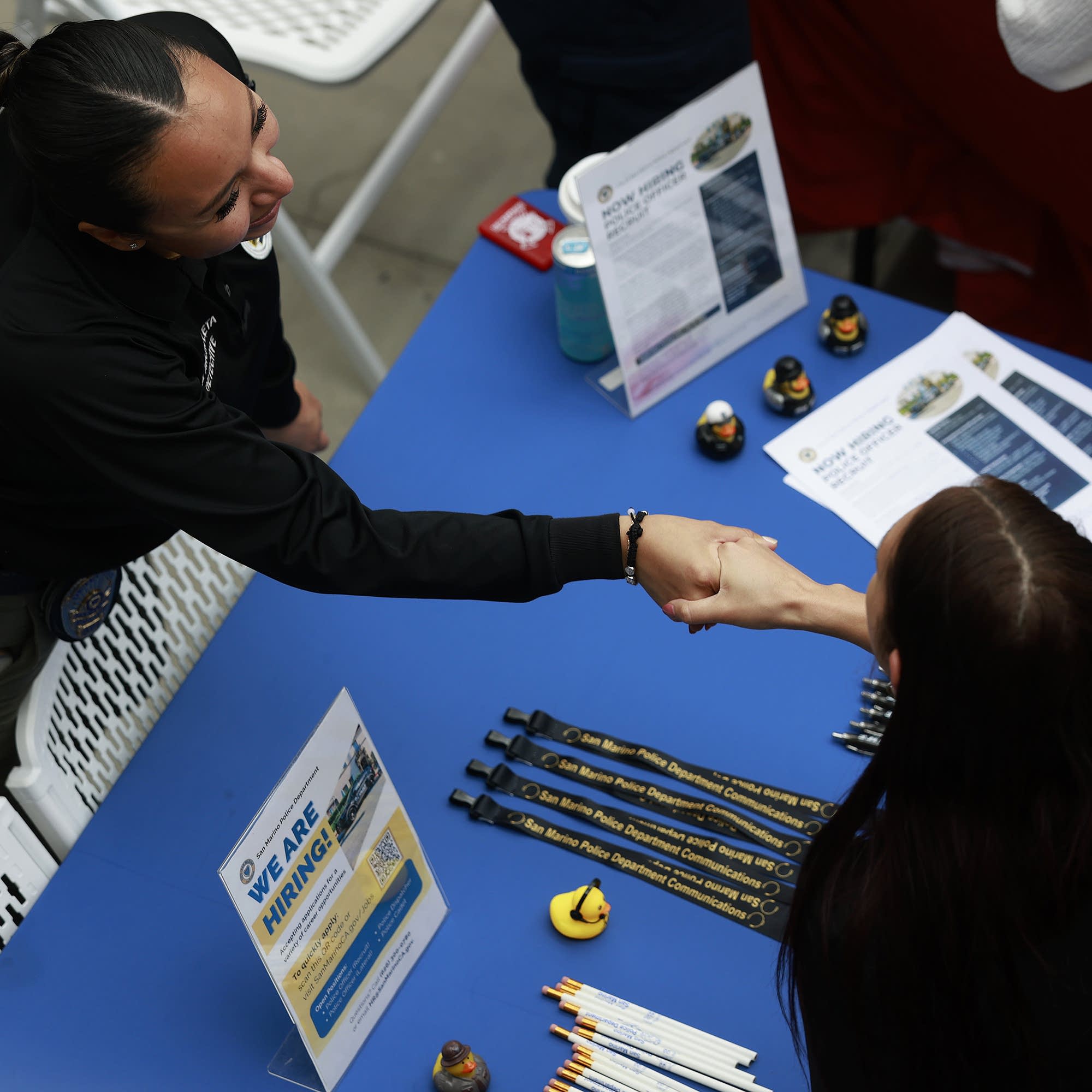
call it the low hire, low fire job market. Everyone else probably has more colorful language for it, but bottom line, if you have a job, you're probably good. Knock on wood. Companies aren't firing that much on the whole, but they're not hiring that much either. So if you're looking for a job, man, it is rough out there. Look no further than the jobs report for June. Just 57,000 jobs added, less than half of pre previous month's numbers has been particularly hard for recent college grads and entry level workers. And hovering over all of this is anxiety around artificial intelligence and whether it has already started taking those jobs. As Marketplace's Samantha Fields reports The data suggests we're not quite there yet actually, but that does not mean we shouldn't be planning for it.
- [05:47]
Samantha Fields
Contrary to what some headlines might have you believe, there is no evidence in federal data that AI is eliminating entry level jobs or any jobs en masse, at least not yet. Sean McGowan doesn't see evidence of that either in his work at Carnegie Mellon University's Career and Professional Development Center.
- [06:05]
Marketplace Host
When I look at the macro, I haven't seen a change of like, there's less students getting jobs and things like that. It's been still very strong.
- [06:12]
Samantha Fields
If anything, he sees more students getting AI related jobs.
- [06:16]
Marketplace Host
We are seeing a shift to like AI engineers, AI scientists, AI researchers.
- [06:21]
Samantha Fields
It is still early days of AI adoption. ChatGPT hasn't even been around for four
- [06:26]
Molly Kinder
years yet, but we're probably underestimating how transformative it will be in the medium to long term.
- [06:33]
Samantha Fields
Molly kinder researches AI in the labor market.
- [06:36]
Molly Kinder
When I look out at the next five to 10 years, I have a lot of concern that AI could be
- [06:42]
Samantha Fields
extremely disruptive, especially when it comes to entry level work. Already in certain fields, like her world of research, she says AI can do the work of an intern or a research assistant.
- [06:54]
Molly Kinder
I don't know what a young person who's a current college student who has no work experience could possibly do for me that AI couldn't do itself.
- [07:01]
Samantha Fields
And kinder says this is true or could be soon of entry level work in lots of fields. Finance, consulting, coding.
- [07:08]
Molly Kinder
Our whole model of training people is going to collapse if we don't intervene. And as a society, and especially in Washington, we are woefully underprepared for this.
- [07:20]
Samantha Fields
She thinks the government, colleges and companies all need to be more proactive in coming up with big ideas and potential solutions to get young people early work experience. Kenneth Henderson, chancellor of learning at Northeastern University in Boston, is thinking about this all the time.
- [07:36]
Marketplace Host
It's on us as educators to ensure that we adapt very quickly, not in decades, but actually in weeks and months.
- [07:46]
Samantha Fields
Northeastern already does things differently than most colleges. It has a co op model where students in all majors spend a chunk of their time in school working at different companies. And he says lots of students get jobs out of co op with higher starting salaries than the average college graduate.
- [08:01]
Marketplace Host
And that is very much related to the students are coming out with actually a year, maybe 18 months of experience before they start the job.
- [08:09]
Samantha Fields
Over the years, Henderson says other colleges have reached out periodically to learn more about the co op model, but but
- [08:16]
Marketplace Host
these days the door is getting knocked on on basically a daily basis. No question. There's way more interest in this space than there has been ever in the past, and I think AI is accelerating that.
- [08:28]
Samantha Fields
AI is also pushing Northeastern to think beyond co, op, he says, and incorporate more experiential learning inside the classroom. These are the kinds of approaches Molly kinder thinks more schools need to be experimenting with. But she also says the onus shouldn't just be on colleges to reimagine their early career ladder.
- [08:47]
Molly Kinder
My big idea is white collar careers should look toward the medical residency model, which is just a completely different way of developing talent.
- [08:54]
Samantha Fields
And just as medical residents get paid while they're training, she says, these entry level workers should too, with funding coming from philanthropy, the government and private companies. I'm Samantha Fields for Marketplace, and in
- [09:09]
Sabri Ben-Achour
New York, I'm Sabri Benishore with the Marketplace Morning Report. From APM American Public Media.
- [09:22]
Samantha Fields
I'm Amy Scott, host of How We Survive, a podcast about the messy business of climate solutions. To a lot of people, geoengineering might seem like a dangerous, outlandish way to play God, but some are embracing this sci fi inspired approach as a solution to the climate crisis.
- [09:44]
Sabri Ben-Achour
We're gonna launch some balloons and send
- [09:45]
Marketplace Host
them into the stratosphere.
- [09:47]
Sabri Ben-Achour
A constellation of sunshades would cast an
- [09:50]
Marketplace Host
even dimming of shade across the entire earth.
- [09:54]
Sabri Ben-Achour
Investing that much in building anything in
- [09:56]
Marketplace Host
space creates a whole space economy.
- [09:59]
Samantha Fields
Listen to How We Survive on your favorite podcast.