Loading summary
Transcript23 lines
- [00:01]
Progressive Boat Insurance Announcer
Support for this podcast comes from Progressive America's number one boat insurer. We've all made mistakes on the water, but there's one mistake you shouldn't being uninsured. With Progressive Boat Insurance you can choose coverage for most mistakes you or other boaters could make helping you float carefree all season long. Quote Today Progressive Casualty Insurance Company and affiliates number one rating based on 2024 filings with state departments of insurance.
- [00:25]
Odoo Software Announcer
Running a business is hard enough, so why make it harder with a dozen different apps that don't talk to each other? Introducing Odoo, the only software you'll ever need. It's an all in one fully integrated platform that makes your work easier from CRM, accounting, inventory, e Commerce, and more. And the best part, Odoo replaces multiple expensive platforms for a fraction of the cost. This is why over thousands of businesses have made the switch. So why not you try Odoo for free@odoo.com that's o d o o.com as
- [00:56]
Sabri Ben Assure
if rising gas prices weren't enough, interest rates could be going up too this year. From Marketplace, I'm Sabri Ben Assure in New York. We got the notes from the Federal Reserve's last big interest rate meeting. A lot of folks there think the economy might could need higher interest rates this year to fight inflation. That could be a tough pill to swallow for consumers. Diane Swonk is here to talk about it. She's chief economist at kpmg. Hi Diane.
- [01:26]
Diane Swonk
Good morning.
- [01:27]
Sabri Ben Assure
So we got the notes from the Fed's last meeting and it turns out a majority of Fed officials are open to the idea that interest rates might actually have to go up this year at least once. Why is that?
- [01:40]
Diane Swonk
That's because what we're seeing is the underlying inflation numbers are not improving enough to get us back to the Fed's target, let alone what anyone considers price stability. To everyday consumers out there, it really just means that you're not thinking about trade offs every day because some prices are going up and you need to maximize your budget and make specific trade offs in your grocery cart or in any other car that you're buying. And that's not the case right now. Consumers have prices front of mind and that's the problem for the Federal Reserve.
- [02:11]
Sabri Ben Assure
Now with normal inflation, you know, you raise interest rates, makes borrowing more expensive, the economy cools down, inflation falls. But this inflation is from higher gas prices and raising rates doesn't make gas cheaper. So why do it?
- [02:25]
Diane Swonk
That's a good question. And what the problem is is this is more than an energy shock. There is the energy shock that we see first and that really affects consumers. But it's, it's a shock layered on top of other shocks. We've seen everything from tariffs to the pandemic itself, and it's roiling supply chains the world over. All of that is going to show up over time in the overall price of goods and everything we buy, and in services too. So all of these things do show up over time, but it's much more than just an energy shock. It's a supply chain shock that has an echo effect, much like the pandemic. Not as bad, but piling on top of a pandemic induced inflation that we never fully derailed. And whether or not the Fed can single handedly do that with just one rate hike alone is questionable. But at the end of the day, inflation is like a disease. Over time it can get worse if you don't treat it, even if the cure is painful.
- [03:23]
Sabri Ben Assure
Diane Swonk, chief economist at kpmg. Thank you so much.
- [03:27]
Diane Swonk
Thank you.
- [03:28]
Sabri Ben Assure
Kevin Warsh, speaking of the Fed, begins his term as chair of the Federal Reserve today. He's set to take the oath of office at the White House, first time the swearing in has been done there in almost 40 years. And President Trump abruptly canceled plans to sign a new executive order on AI. It would have had the government vet new artificial intelligence systems for national security risks. The President said that in the end, he didn't want to do anything that would hamper the US's lead over China. Shares of Alphabet, owner of Google's Gemini AI, is down 7, 10%.
- [04:21]
Three Day Blinds Announcer
The Marketplace Morning Report podcast is supported by three Day Blinds. We shop for everything at home now. Why can't we shop for blinds at home too? We can now with three day Blinds. Instead of wandering around a store, three Day Blinds sends a professional design consultant straight to you. They bring all the samples, help you see what actually works in your space, take expert measurements, and even handle the installation. We've all bought something that looked great in store and terrible once we got it home. With three day Blinds, you see everything in your actual light with your actual furniture before you commit. Plus, whether you're at home or away, you can control your window treatments with the three Day Blinds app. So for a free no charge and no obligation consultation, head to threedayblinds.com Morning for our buy one, get one 50% off deal. That's the number 3D a Y blinds.com Morning.
- [05:15]
Assured Guaranty Announcer
Are you looking to invest in municipal bonds for extra protection? Buy bonds insured by Assured guaranty. It guarantees 100% of your principal and interest will be paid when due. Assured Guaranty has demonstrated its reliability and financial strength for nearly four decades. That's why the bonds they back are one of the safest investments you can make. Visit assuredguaranty.com assured guarantee a stronger bond
- [05:43]
Sabri Ben Assure
in an economy that is getting more automated, you might think a hotel housekeeper's job would be relatively safe. AI can't make beds or scrub sinks yet. But as Rebecca Pleven of nonprofit Newsroom Proof News reports, some automation is already here for hotel cleaning crews.
- [06:00]
Rebecca Plevin
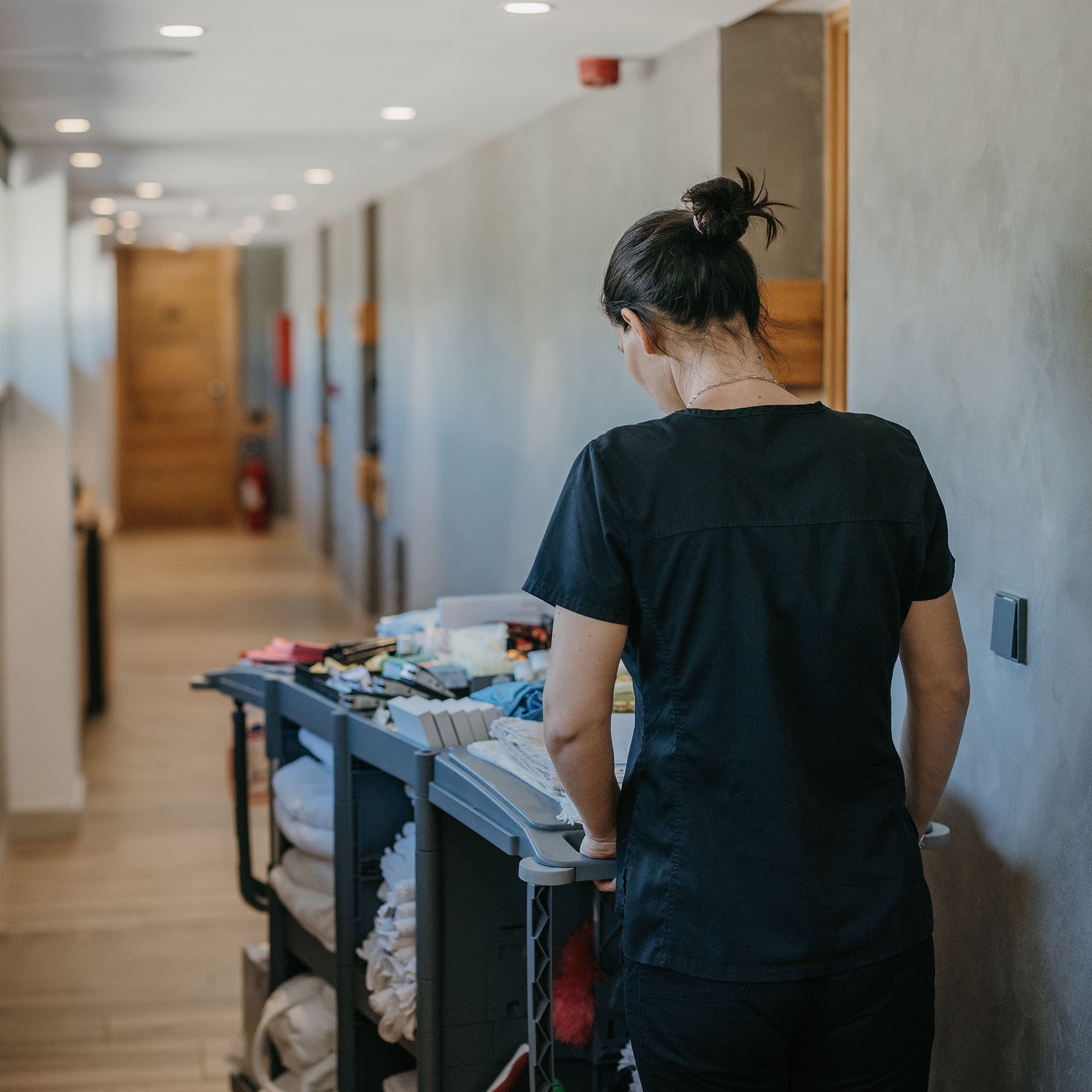
Elsa Roldan is a housekeeper at a luxury hotel on the Las Vegas Strip. She used to have near complete control of the order of the room she cleaned. She checked off her progress on a clipboard. That changed in 2019 when her employer rolled out a software called the Hotel Service Optimization System, or Hot Sauce. It uses an algorithm to rank which rooms to clean. Next.
- [06:24]
Hotel Housekeeper (Elsa Roldan or Luce Nunez)
You have a device like telling you move here, move there, like if you were a robot.
- [06:31]
Rebecca Plevin
The app is from Spanish tech company Amadeus. In 2021, it said hot sauce was used by more than 70% of global hotel brands in 70 countries. It promises to speed room turnover and boost worker productivity. But Roldan told me the app sent her zigzagging around the massive hotel with her bulky cart.
- [06:51]
Hotel Housekeeper (Elsa Roldan or Luce Nunez)
We literally can waste more than 20 minutes in the travel time. Elevators are busy. The cart is slow.
- [07:00]
Rebecca Plevin
It also tracks her progress throughout the day, clocking when she starts and finishes each room. I asked Amadeus about worker dissatisfaction, but no one responded. Roldan is part of a union of 60,000 hotel workers in Nevada. Soon after Hot Sauce was introduced, the union started negotiating more autonomy from the app. In 2022, it won.
- [07:21]
Hotel Housekeeper (Elsa Roldan or Luce Nunez)
Yes, we go with the instructions, but also if we see that a room is available to clean, we can do it.
- [07:33]
Rebecca Plevin
Unions are, in many cases using bargaining to establish basic protections against AI and automation in the workplace. But just 10% of the country's workers are union members, resulting in a patchwork of protection. I met housekeeper Luce Nunez at a resort near Palm Springs in California. She said the app makes her job more stressful. She's not represented by a union. She has a daily quota, and managers can use Hot Sauce to monitor her productivity. She says. If you don't change the bed, they give you 20 or 25 minutes, and if you take longer than that, they'll ask you, why did you take so long? Most days, she logs a 10 minute break but keeps working, fearing she won't reach her quota. Instead, she tries to take it a little easier. She says she doesn't sit down or anything. Rather, she works a little slower. Then she picks up her pace again, ready for the algorithm to serve up another room to clean. In Palm Springs, I'm Rebecca Plevin for
- [08:33]
Sabri Ben Assure
Marketplace, and in New York, I'm Sabri Benishour with the Marketplace Morning Report from APM American Public Media.
- [08:43]
Rima Grace
I'm Rima Grace, host of the weekly Marketplace podcast. This is Uncomfortable. And this week on the show we're talking about doom spending. You know, that impulse to spend when the future feels uncertain, like maybe I'll never be able to retire or buy a home anyway, so why not book that vacation or buy that fancy gadget? When we ask ourselves, what's the point of saving? We're just going to die or whatever, I think that's the wrong question. I think the more important thing to ask is, is spending that money even actually making you feel better? Be sure to listen to this Is Uncomfortable. Wherever you get your podcasts.