Loading summary
Transcript43 lines
- [00:00]
Nancy Marshall Genser
This is a call to the leaders.
- [00:02]
David Brancaccio
Who want to redefine their impact. Tackle our world's greatest challenges with a powerful network of global business leaders at MIT Sloan School of Management.
- [00:13]
Unknown
This Marketplace podcast is supported by Dell Introducing the new Dell AI PC. Powered by the Intel Core Ultra processor, it helps you do your busy work for you so you can fast forward through editing images, designing presentations, generating code, debugging code, summarizing meeting notes, finding files, managing your schedule, responding to long emails, leaving all the time in the world for the things you actually want to do. Get a new Dell AIPC starting at 749.99@dell.com AI PC how those ahead? Stay ahead.
- [00:46]
David Brancaccio
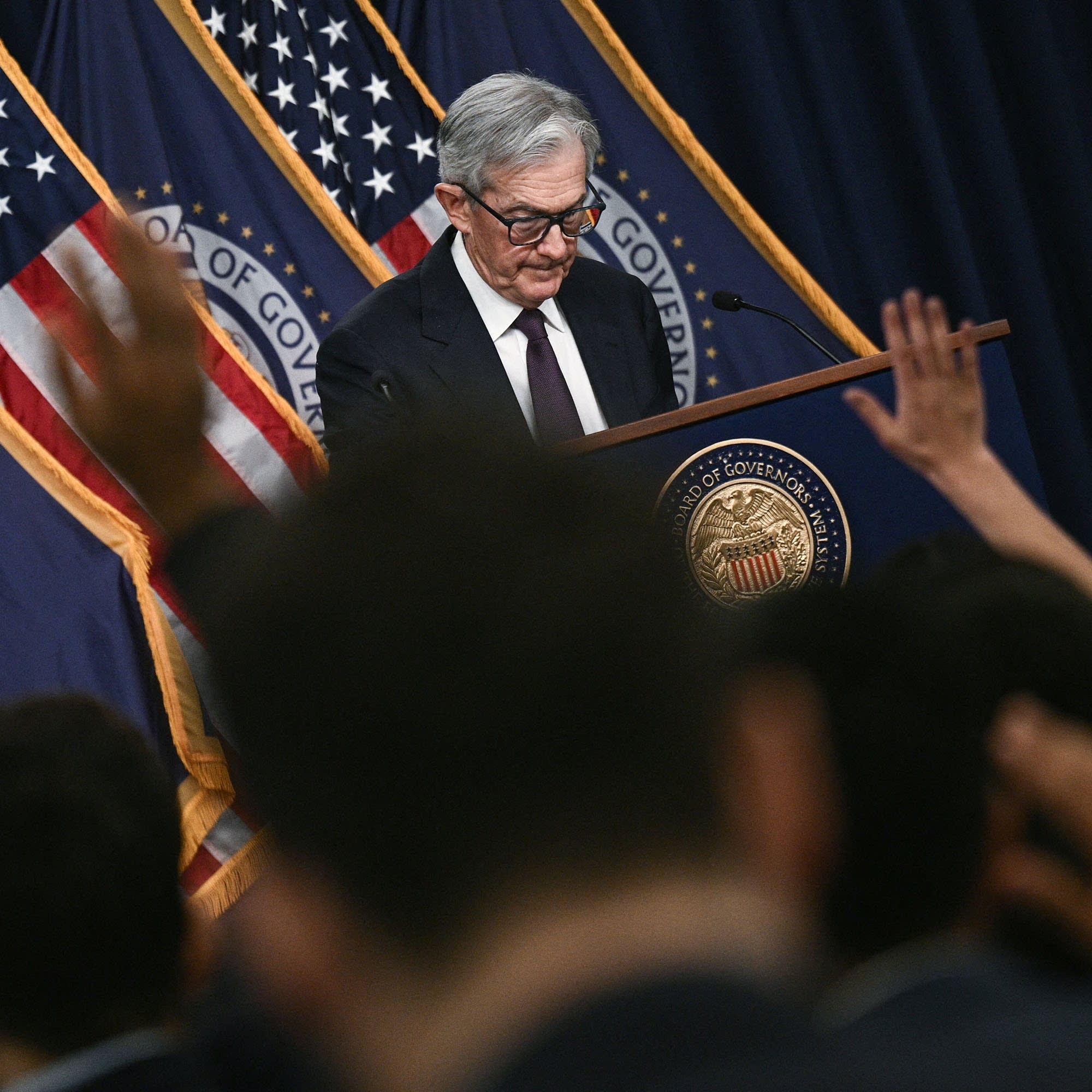
President Trump moves markets in part by calling America's central banker names. I'm David Brancaccio. In Los Angeles. A published report is moving financial markets that President Trump could announce a successor to, but not yet replace, the powerful chair of the federal reserv. Jerome Powell's term isn't over until next year. Marketplace's Nancy Marshall Genser has more.
- [01:08]
Nancy Marshall Genser
President Trump has made no secret of his displeasure with Fed Chair Jerome Powell. He wants the Fed to lower interest rates right away. Yesterday at a NATO press conference, he had this to say about Powell I.
- [01:20]
David Brancaccio
Think he's a very stupid person.
- [01:21]
Nancy Marshall Genser
Actually, the president added that he's narrowed his pick to replace Powell down to three or four people. Powell's term as chair ends next spring, but Brian Rehling, head of global fixed income strategy at Wells Fargo Investment Institute, says that makes it easier for Powell to resist Trump's pressure campaign.
- [01:39]
David Brancaccio
Obviously, he is extremely unlikely to be renominated, so, you know, I'm not sure he feels a lot of pressure from the political rhetoric.
- [01:48]
Nancy Marshall Genser
In congressional testimony this week, Powell said the Fed is in good shape to wait on an interest rate cut. He wants to see how Trump's tariffs affect the economy and says they could start driving up prices this summer. I'm Nancy Marshall Genser for Marketplace.
- [02:04]
David Brancaccio
The US Dollar index versus other currencies is down a full percentage point since the latest Trump attack on Powell. That's in part a bet the U.S. economy could get weaker. The dollar is down 10% this year. The flip side is a weaker dollar makes US Exports cheaper, easier to sell. In foreign countries, the cost of health care is ever growing, and new government estimates show it will go from 17 to 20% of total US economic output within eight years. This says Republican lawmaker deeply they want to cut health care programs like Medicaid as part of the big tax cutting and spending plan. The House version of the bill means 11 million people could lose health insurance Marketplace's Elizabeth Troval looks at why the tab for health care keeps getting bigger.
- [02:49]
Elizabeth Trovall
Health care spending is expected to outpace GDP growth in the coming years, at least through 2033, according to new estimates by the Centers for Medicare and Medicaid Services. One reason why we do see the baby boomers retiring. Benjamin Uckert with Texas A and M University says as the Silver Tsunami ages.
- [03:12]
Elisabeth Braugh
People will utilize more health care.
- [03:14]
Elizabeth Trovall
Treatment is also getting pricier and you have to factor in the cost of health innovation, says MIT's Jonathan Gruber.
- [03:23]
David Brancaccio
We're just inventing cool new stuff that costs more money.
- [03:26]
Elizabeth Trovall
Gruber says growth in healthcare spending isn't necessarily a bad thing. It drives employment and can lead to new life saving cures for disease. The problem is that society is unwilling.
- [03:38]
David Brancaccio
To pony up to pay those costs.
- [03:40]
Elizabeth Trovall
Consider the current debate over cuts to Medicaid spending proposed by Republican lawmakers.
- [03:46]
David Brancaccio
The kick people off health insurance will.
- [03:48]
Elizabeth Trovall
Spend less on health care and people will die.
- [03:50]
David Brancaccio
And that's a trade off that I think the US Voter needs to recognize.
- [03:55]
Elizabeth Trovall
That these politicians are making one way or the other, he says. When it comes to their health, Americans will have to pay. I'm Elizabeth Trovall for Marketplace.
- [04:22]
Unknown
This podcast is brought to you by lhh, the global talent solutions and advisory company. What does work really mean? For many, it's just transactional functional. But LHH believes it can be more. Work isn't just about tasks and deadlines. It's about passion, people and possibilities. With the right guidance and vision, incredible things can happen at work. Finding the perfect hire, Nurturing talent. Making the ordinary extraordinary. LHH doesn't just find beautiful moments at work. LHH creates them. Recruitment, development, career transition. LHH a beautiful working world. Learn more at lhh.com beautiful this Marketplace.
- [05:07]
Podcast is supported by Greenlight. As a listener of Marketplace, you're likely already building smart money habits for you and your family, trying to instill important lessons on saving and spending and the economy overall and the younger folks in your life. But what about the older generation? Your parents, grandparents, aunts and uncles? As they age, they may need more support in managing their finances too. With Greenlight's Family Shield, you can take the next steps by protecting your senior loved ones from scams and financial fraud. Family Shield offers account monitoring, real time alerts and coverage including up to $100,000 for deceptive transfer fraud and $1 million for identity theft so you can keep your whole family financially safe and sound and with added safety tools like SOS and crash alerts, along with location sharing, you can keep an eye on both your family's wallet and their well being. Take care of your whole family, from kids to grandparents with family Shield from Greenlight Sign up today@greenlight.com marketplace a group.
- [06:08]
David Brancaccio
Of tanker ships used largely by Iran and Russia to sell oil on the global market to get around international sanctions is growing in size. The shadow fleet is now 17% of all international tankers, according to a report from Allianz. Reporter Daniel Ackerman has more.
- [06:24]
Elisabeth Braugh
In the early 2010s, the west slapped big sanctions on Iran's energy exports, so to keep its oil revenue flowing, Iran turned to the so called shadow fleet, says Elisabeth Braugh, senior fellow at the Atlantic Council. I spoke with her and other experts at a conference on the topic this week.
- [06:40]
Unknown
It really began as a way for Iran to export and import because it was under so many sanctions, she says.
- [06:47]
Elisabeth Braugh
Russia now also uses shadow vessels to sell its oil. The country was sanctioned for invading Ukraine in 2022, and Bra says the size of the international shadow fleet has more than doubled since then.
- [06:59]
Unknown
They are essentially like a tumor on the global shipping system.
- [07:02]
Elisabeth Braugh
These shadow vessels use all kinds of shadowy tactics. They spoof gps, for example, to claim they're loading oil at an Iraqi port when they're actually in Iran. They carry fake insurance documents and they transfer their cargo from one ship to another to another, just to confuse anyone watching by satellite. And Bras says these vessels aren't exactly in ship shape.
- [07:24]
Unknown
They are often old. They should really be scrapped. An old vessel that is poorly maintained poses significant risks of accidents and incidents, just like an old car.
- [07:34]
Elisabeth Braugh
There have already been some minor collisions and oil spills caused by Shadow fleet ships. Tomer Renan, a maritime risk analyst at Lloyds List Intelligence, fears that a major environmental disaster could be next.
- [07:46]
David Brancaccio
It's a massive accident that's waiting to happen.
- [07:48]
Elisabeth Braugh
And because these ships are underinsured at best, cleanup costs aren't borne by the operators of the shadow vessels, says Joshua Tallis with the center for Naval Analyses.
- [07:59]
David Brancaccio
All of those costs are going to fall on the international community and most likely quite heavily off the coast of whatever country that accident actually happens on.
- [08:06]
Elisabeth Braugh
And the continued growth of these risks shows that Western sanctions just haven't had their desired effect, says Ian Ralby, CEO of the maritime consultancy IR Concilium.
- [08:17]
Ian Ralby
No amount of sanctions have put Russia, Iran, North Korea or anyone out of business. Iran in particular has been very successful in finding ways of using the maritime space to continue to move oil and fuel illegally.
- [08:30]
Elisabeth Braugh
He says intercepting these Shadow ships isn't a great option because that would go against the principle of freedom of navigation on the high seas.
- [08:38]
Ian Ralby
Most Navy's coast guards and marine police forces around the world are not going to have an impetus to try to take on this kind of situation, particularly given the extreme political blowback that would accompany any kind of interdiction.
- [08:50]
Elisabeth Braugh
So for now, the Shadow fleet keeps on sailing. I'm Daniel Ackerman for Marketplace and we've.
- [08:57]
David Brancaccio
Been following President Trump's family company taking orders for a mobile phone service offering a US Made smartphone. We reported on experts doubting a Made in the USA phone was possible anytime soon. Now the publication the Verge noticed the promised T1 8002 phone is no longer being touted as US manufactured. The Made in the USA banner is gone from the Trump Mobile website. Now the promise is, quote, designed with American values in mind. The phone screen is now a bit shorter and the amount of onboard RAM first listed as 12 gigs is now a mystery. In Los Angeles, I'm David Brancaccio, Marketplace Morning report from APM American Public Media.
- [09:43]
Elizabeth Trovall
This Old House has been America's most trusted source for all things DIY and home improvement for decades. And now we're on the radio and on demand.
- [09:52]
David Brancaccio
I think you're breaking into this wall. Regardless. I was hoping you wouldn't say that. I need to go and get some. Some whiskey.
- [09:58]
Elizabeth Trovall
I think I would get the whiskey for sure. Subscribe to this Old House Radio hour from LAS Studios. Wherever you get your podcasts.