Loading summary
Transcript28 lines
- [00:01]
A
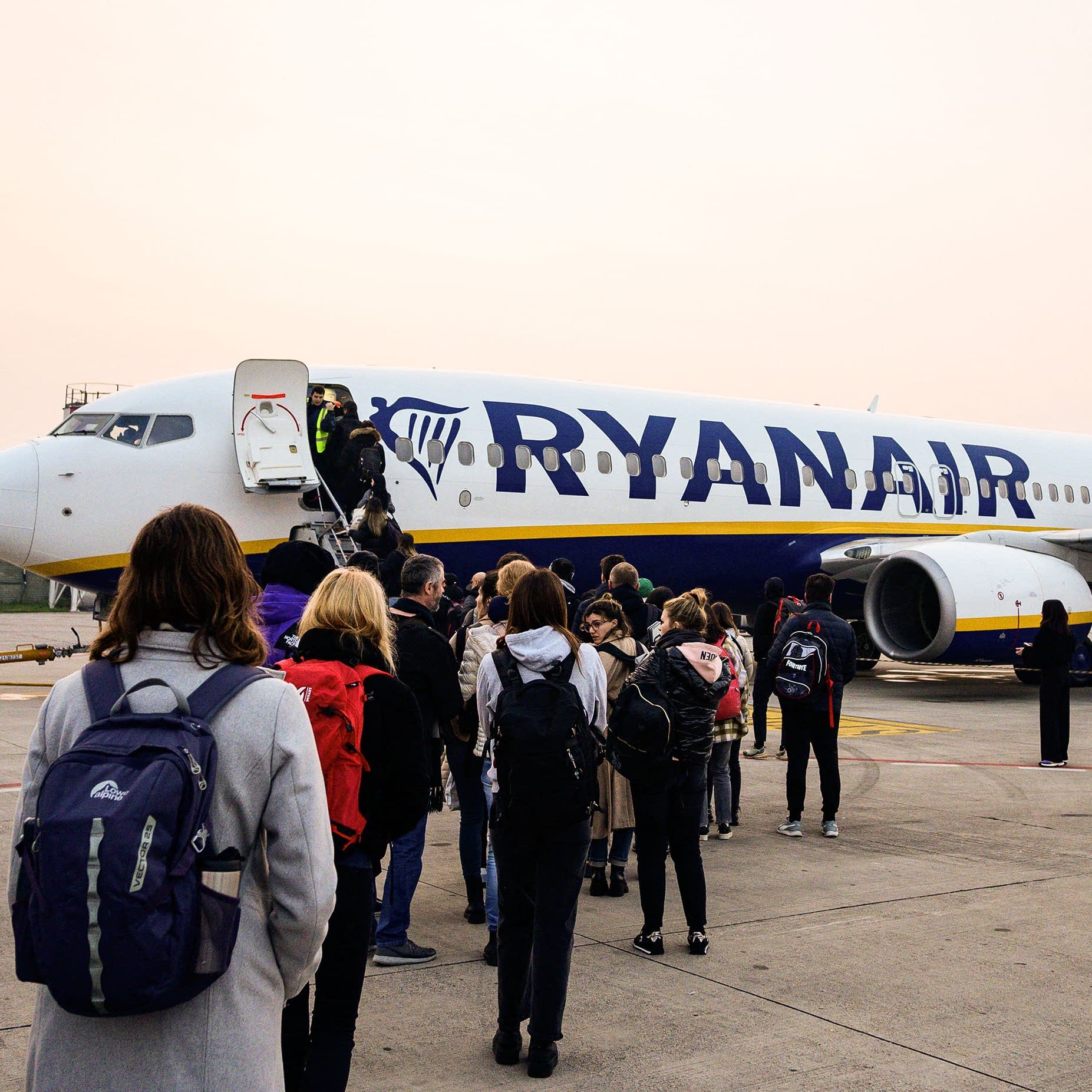
Will Elon Musk buy Europe's biggest budget airline? Live from the uk, this is the Marketplace Morning report. From the BBC World Service, I'm William Lee Adams. Good morning. Tech billionaire Elon Musk has picked another fight. This time it's with Michael o', Leary, the chief executive of Ryanair, Europe's largest airline. Based on passenger numbers, Mr. O' Leary said that Ryanair wouldn't be offering Mr. Musk's Starlink satellite services on the airline's planes. Then he called Elon Musk an idiot. Responding on platform, Mr. Musk floated the idea of buying Ryanair himself. In the Last few minutes, Mr. O' Leary has been speaking at a press conference in the Irish capital, Dublin.
- [00:42]
B
Look, there would clearly be a demand for WI FI on board our aircraft if it was free. You know, other airlines, mainly long haul carriers like Aer Lingus, like Lufthansa and others, are talking about installing WI FI on board as a facility and giving it out for free. But their average fares, particularly on the long haul, are over €1,000. Our average fares are €45.
- [01:03]
A
So what's this row really about? With me in the Studio is the BBC's international business correspondent, Theo Leggett. Theo, Hi. Hi. So why doesn't the Ryanair boss want to use Starlink?
- [01:16]
C
Okay, so Michael o' Leary says he doesn't want to use Starlink, which is an Internet system, on the grounds that it would be too costly because it would require his planes to be fitted with external antennas, which he says would cause aerodynamic drag on the planes, increase his fuel bills to a level that would not be economically viable.
- [01:35]
A
And do we have any numbers with that?
- [01:37]
C
He says it would entail about a 2% increase in drag and would cost about a euro per passenger, which would ultimately increase his fuel bill by about 250 million euros a year. And he says that's not sustainable.
- [01:49]
A
Mr. Musk has floated the idea of buying the airline. How realistic is that threat?
- [01:55]
C
Yeah, he's floated that one a few times. And he's actually said he could replace Mr. O' Leary with somebody who's actually called Ryan. I mean, that's the level that this conversation has descended to, really. But he'd face two obstacles. So first of all, he'd have to raise some $44 billion, which even for the world's richest man, is a lot of ready cash. And then, crucially, there are also ownership rules to consider. So European airlines have the right to fly around Europe pretty much without restriction, provided their majority owned by nationals of the EU. And Mr. Musk, as a South African American, Canadian, clearly is not.
- [02:33]
A
And Theo, some really strong words exchanged there.
- [02:36]
C
Yeah. So, I mean, the strong words really started when Michael o' Leary did an interview on an Irish radio station in which he referred to Elon Musk as a very wealthy idiot. And, you know, the response to that was Elon Musk saying that Michael o' Leary should be sacked. Ryanair then responded by launching what it calls a big idiot seat sale featuring a caricature of Elon Musk. So there's a level of humor in all of this, but it's pretty low.
- [03:03]
D
Humor isn't.
- [03:04]
A
Well, Theo, we will leave it there. Thanks for joining us on Marketplace.
- [03:07]
C
It's been a pleasure.
- [03:09]
A
All right, let's do the numbers. European markets are down again after US Threats to acquire Greenland kept investors on edge ahead of President Donald Trump's Davos speech later. But in South Korea, shares in Hyundai Motor Co. Surged 15% amid optimism over its robotics initiatives. The South Korean carmaker has overtaken General Motors to become the world's fourth most valuable carmaker. One of the world's largest airline groups has told the BBC that airspace closures due to war zones are now forcing substantial rerouting of flights. Lufthansa says the ban on using Russian and Ukrainian airspace is having a measurable cost impact on its long haul network with typical detours of one to two hours. It comes as research suggests the amount of airspace over conflict zones is the highest since World War II. The BBC's Rick Kelsey has more.
- [04:00]
E
Currently flying over the top of the world. The flight is from Tokyo to London. And this route going over Alaska is common again, like it was in the 1970s when it stopped to refuel. But now it's often to avoid Russian airspace due to the Ukraine war. And this is not the only route that's changed.
- [04:21]
D
Certainly, you know, if you have 4.9% of, you know, the world of the six permanently inhabited continents, territory and conflict, that's significant areas of the world where there is a decision to be made of whether it is safe to fly over those zones.
- [04:36]
E
Hugo Brennan is from risk intelligence company Verisk Maplecroft, who put together the latest conflict intensity report, which maps global conflict.
- [04:47]
D
Ukrainian attacks on Russia, particularly on Russian energy infrastructure. That's, you know, using some of the Western supplied weaponry, you've seen a really big increase in kind of Russian territory. That was one notable takeaway.
- [04:59]
E
The report shows that areas affected by armed fighting have grown by 89% over the past five years. Each additional minute of flight time leads to an average increase in passenger fares of US$1.50, according to Aviation experts at the German Aerospace Center. The BBC has now heard from Lufthansa, one of the world's biggest flight operators, who say the their long haul journeys are growing by up to two hours and it must now continually adjust its network, planning to keep its schedule stable. But it's not only cost, it's also emissions. Dr. Victoria Ivanikova is assistant professor in Aviation management at Dublin City University.
- [05:41]
F
If we will look on the flight radar 2024, we can see that aircraft are flying Russian airspace, Ukrainian airspace, and there are some points with conflict in the Middle east and the total area of closed or restricted in use airspace currently is around 18 million square kilometers.
- [06:04]
E
That's almost 11 million square miles, which.
- [06:07]
F
Is the biggest airspace segregation since the Second World War.
- [06:11]
E
Most Western airlines are now banned from flying over Russia, which pushes up the costs. Gilbert Ott runs God Save the points who help people get low price airfares.
- [06:22]
D
You know, an airline you could say would be likely to make a seat available with points because there's so much more pressure to create that profitability rather than kind of break even on a flight with these changes, with these restrictions in airspace because you have to care so much about each flight going out with the maximum profitability.
- [06:41]
E
Figures suggest that until recently, airfares have changed little when taking into account inflation over 10 years. So you can still get deals, but the destination might be further away. I'm the BBC's Rick Kelsey for Marketplace.
- [06:56]
A
And in the UK, I'm William Lee Adams with the Marketplace Morning Report from the BBC World Service. On behalf of the entire team, thanks for listening.
- [07:12]
G
This week on this Is Uncomfortable, we have two new episodes exploring our relationship with money and work. First up, we've all been told that money can't buy happiness. But also I think I have a personal convulsion that happens inside of me when people say, like, money doesn't make you happy. I'm like, oh, you've never been poor? And then why? The job market these days can really shake your confidence. People who may have been looking for a job two years ago and were getting interviews, getting responses, are now confronting something totally different, which is that there's this sense that there's really not the kind of opportunity that there was before. Don't miss an episode. Listen to this is Uncomfortable on your favorite podcast.
- [07:56]
D
APPLAUSE.