
Podcast
Math! Science! History!
Hosted by Gabrielle Birchak · EN
Math! Science! History! is about the history of people, theories, and discoveries that have moved our scientific progress forward and spurred us on to unimaginable discoveries. Join Gabrielle Birchak for a little math, a little science, and a little history. All in a little bit of time.
11episodes
Episodes
Newest firstAll episodes
Haunted Machines: The Engineer Proximity Effect and Pauli’s Curse
Oct 2800:35:22Tap to summarizeIn this Halloween-special episode of Math! Science! History!, your host Gabrielle Birchak explores the strange world where superstition meets science. We dive into why machines sometimes bow to the mere presence of an engineer (the “Engineer Proximity Effect”) and how one of the greatest physicists of the 20th century, Wolfgang Pauli, became the subject of an odd legend: wherever he went, lab equipment failed (the “Pauli Effect”). Join us for a spooky, fun, and surprisingly rational journey into the magical aura of tech support and haunted machines. Three Take-aways Why machines seem to fix themselves when the engineer enters the room, and the psychological and procedural forces behind the so-called Engineer Proximity Effect. The story behind the Pauli Effect, the absurd, amusing, and true folklore of Wolfgang Pauli and failing lab apparatus when he was nearby. How you can use a “spellbook for engineers” to break the cycle of tech gremlins, practical, science-based “spells” you can actually use to feel like you’re doing a bit of Halloween magic while being perfectly logical. Useful Links & Resources The Pauli Effect: Institute of Physics Spark overview iop.org ETH Library: Wolfgang Pauli & the Pauli Effect anecdotes library.ethz.ch WIRED article: “The Strange, Totally Not-True Story of a Cursed Physicist” wired.com Explore more on our website: mathsciencehistory.com To buy my book Hypatia: The Sum of Her Life on Amazon, visit https://a.co/d/g3OuP9h 🌍 Let’s Connect!Bluesky: https://bsky.app/profile/mathsciencehistory.bsky.social Instagram: https://www.instagram.com/math.science.history Facebook: https://www.facebook.com/mathsciencehistory LinkedIn: https://www.linkedin.com/company/math-science-history/ Threads: https://www.threads.com/@math.science.history Mastodon: https://mathsciencehistory@mathstodon.xyz YouTube: Math! Science! History! - YouTube Pinterest: https://www.pinterest.com/mathsciencehistory Enjoying the Podcast? ☕ Support the Show: Coffee!! PayPal Leave a review! It helps more people discover the show! Share this episode with friends & fellow history buffs! Subscribe on your favorite podcast platform Check out our merch: https://www.mathsciencehistory.com/the-store Music: All music is public domain and has no Copyright and no rights reserved. Selections from The Little Prince by Lloyd Rodgers Modular Ambient by Zen Man Mystical Music Box by Vira Miller Cinematic Suspense Mystery by Luis Humanoide 🎵 Audio Editor: Podcast mixed by David Aviles and Gabrielle Birchak Until next time, carpe diem!
Transcribe →
FLASHCARDS! Conserving Our Oceans
Oct 2400:09:42Tap to summarizeIn this Flashcard Friday episode of Math! Science! History!, Gabrielle explores how everyday choices can make a real difference for our oceans. From reducing single-use plastics to supporting sustainable seafood and climate-friendly habits, this episode uncovers the math, science, and history behind ocean conservation, and the powerful impact of small changes. Plastic pollution isn’t just a problem for sea turtles and coral reefs, it’s a problem for us. Every year, about 11 million metric tons of plastic enter the ocean, leaching chemicals and breaking down into microplastics that end up in fish, sea salt, and even human blood. But with awareness, advocacy, and action, we can help turn the tide. Three Things You’ll Learn: The science behind ocean resilience , how oceans regulate Earth’s climate and what happens when that balance is disrupted. What plastic really does to marine life , and the startling evidence of microplastics in fish and even in human systems. Practical steps you can take today , from rethinking single-use plastics to supporting legislation and sustainable brands. Resources: Pew Charitable Trusts, Breaking the Plastic Wave: pewtrusts.org United Nations Environment Programme, Why Are Coral Reefs Dying?: unep.org WWF UK, Coral Reefs and Climate Change: wwf.org.uk Ocean Conservancy, Plastics in the Ocean: oceanconservancy.org NCBI / ScienceDirect, Microplastics in Seafood and Human Exposure Studies: ncbi.nlm.nih.gov | sciencedirect.com Call to Action: If today’s episode inspired you, take a minute to make one change, carry a reusable bottle, skip the plastic bag, or share this episode with a friend who loves the ocean. Together, we can protect the blue heart of our planet. Subscribe to Math! Science! History! on Spotify, Apple Podcasts, or wherever you listen, and leave a review to help more curious minds find the show! Explore more on our website: mathsciencehistory.com To buy my book Hypatia: The Sum of Her Life on Amazon, visit https://a.co/d/g3OuP9h Let’s Connect!Bluesky: https://bsky.app/profile/mathsciencehistory.bsky.social Instagram: https://www.instagram.com/math.science.history Facebook: https://www.facebook.com/mathsciencehistory LinkedIn: https://www.linkedin.com/company/math-science-history/ Threads: https://www.threads.com/@math.science.history Mastodon: https://mathsciencehistory@mathstodon.xyz YouTube: Math! Science! History! - YouTube Pinterest: https://www.pinterest.com/mathsciencehistory Enjoying the Podcast? If you love Math, Science, History, here’s how you can help:🌟 Leave a review! It helps more people discover the show!📢 Share this episode with friends & fellow history buffs!🔔 Subscribe on your favorite podcast platform ☕ Support the Show: Coffee!! PayPal 🛍 Check out our merch: https://www.mathsciencehistory.com/the-store 🎵 Music: All music is public domain and has no Copyright and no rights reserved. Selections from The Little Prince by Lloyd Rodgers Until next time, carpe diem!
Transcribe →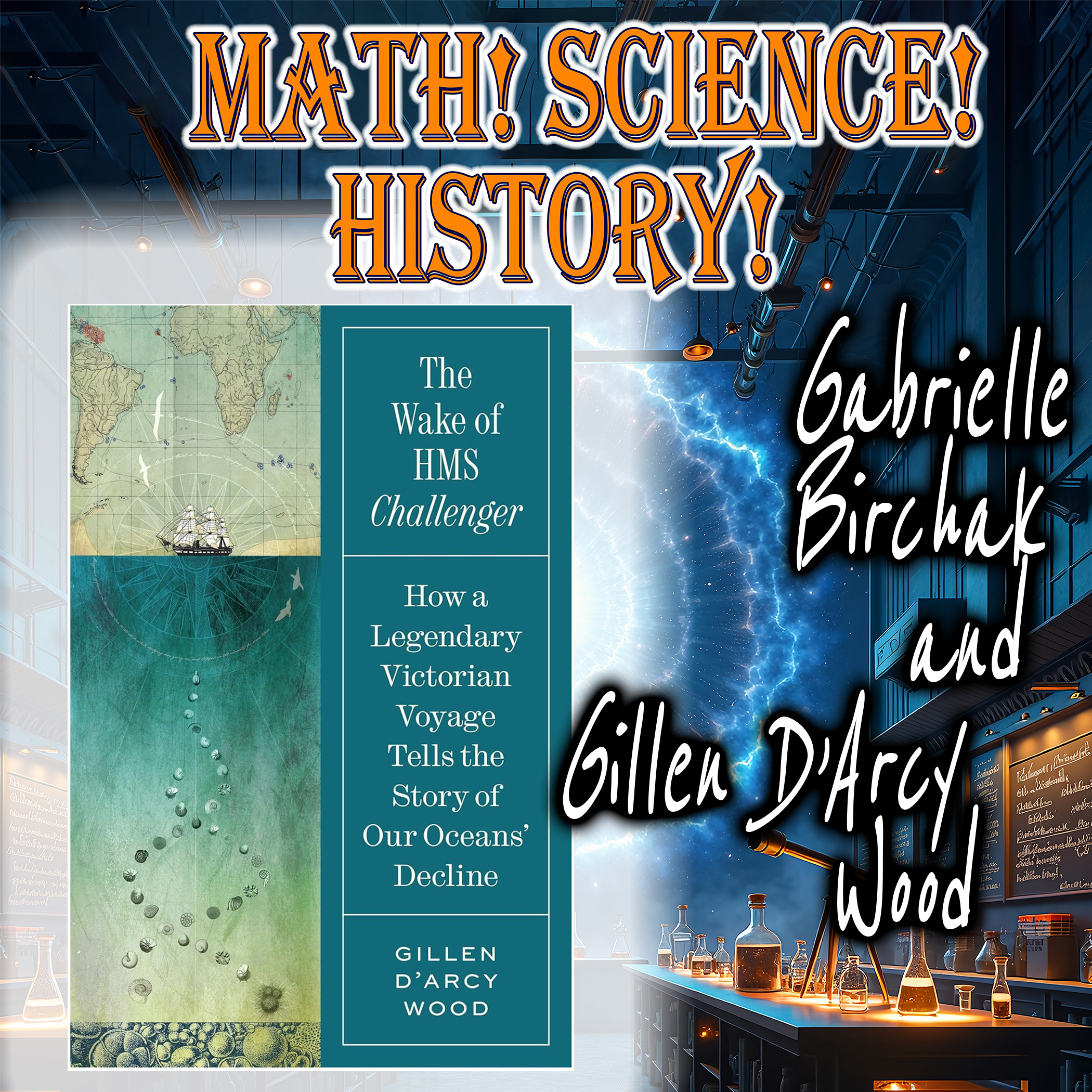
Interview with Gillen D’Arcy Wood - The Wake of HMS Challenger
Oct 2100:37:33Tap to summarizeIn this episode of Math! Science! History!, Gabrielle Birchak speaks with Professor Gillen D’Arcy Wood, author of The Wake of the HMS Challenger: How a Legendary Victorian Voyage Tells the Story of Our Ocean’s Decline. Together, they uncover how a nineteenth-century Royal Navy warship transformed into a floating laboratory and gave humanity its first global snapshot of the oceans. From discovering thousands of new species to inspiring NASA’s Challenger shuttle, the expedition shaped modern oceanography and continues to inform today’s conservation science. Wood’s biocentric storytelling reminds us that to save our planet, we must first fall in love with it again, to be, as he says, re-enchanted by the living ocean that sustains us all. Three Things Listeners Will Learn How the HMS Challenger (1872–1876) became the first global oceanographic expedition, collecting temperature, depth, and biological data still used today. Why Gillen D’Arcy Wood’s “biocentric” approach reframes history through the perspective of marine life rather than human explorers. What the voyage teaches us about modern ocean crises: from overfishing and warming seas to microplastics—and how species like the green turtle show that recovery is possible. BUY THE BOOK! The Wake of the HMS Challenger by Gillen D’Arcy Wood - HarperCollins Publishers Explore more on our website: mathsciencehistory.com To buy my book Hypatia: The Sum of Her Life on Amazon, visit https://a.co/d/g3OuP9h Let’s Connect!Bluesky: https://bsky.app/profile/mathsciencehistory.bsky.social Instagram: https://www.instagram.com/math.science.history Facebook: https://www.facebook.com/mathsciencehistory LinkedIn: https://www.linkedin.com/company/math-science-history/ Threads: https://www.threads.com/@math.science.history Mastodon: https://mathsciencehistory@mathstodon.xyz YouTube: Math! Science! History! - YouTube Pinterest: https://www.pinterest.com/mathsciencehistory Enjoying the Podcast? ☕ Support the Show: Coffee!! PayPal Leave a review! It helps more people discover the show! Share this episode with friends & fellow history buffs! Subscribe on your favorite podcast platform Check out our merch: https://www.mathsciencehistory.com/the-store Music: All music is public domain and has no Copyright and no rights reserved. Selections from The Little Prince by Lloyd Rodgers Smooth Piano by Universefield Musinova - Travelling And Discovering (Marimba World Percussion) Documentary-Nikita Kondrashev Audio Editor: Podcast mixed by David Aviles Until next time, carpe diem!
Transcribe →
FLASHCARDS: Science Paw-thorship
Oct 1700:10:39Tap to summarizePublish or Purrish: The Cat Who Co-Authored Physics Episode Overview: In this episode of Math! Science! History!, we uncover the remarkable story of F.D.C. Willard, the Siamese cat who became a published co-author in a world-renowned physics journal. What began as a workaround for rigid authorship conventions turned into a beloved legend in science history. But Willard wasn’t alone. We also take a closer look at other non-human co-authors, from a dog in immunology, to a hamster in physics, and even bonobos in language research, while exploring what these unusual stories reveal about the culture of scientific publishing and the pressures of the “publish or perish” system. Three Takeaways: The real physics behind Willard’s paper and why the study of helium-3 was serious science, not just a playful prank. Other cases of animals as authors—including a dog, a hamster, and three bonobos—and what those choices meant. The bigger issue of authorship in science and how conventions and pressures shape who gets credit, and why. Resources and Further Reading: Wikipedia: F.D.C. Willard Hetherington, J.H. & Willard, F.D.C. (1975). Two-, Three-, and Four-Atom Exchange Effects in bcc ³He. Physical Review Letters, 35(21), 1442–1444. Matzinger, Polly & Galadriel Mirkwood. (1978). In a fully H-2 incompatible chimera, T cells of donor origin can respond to minor histocompatibility antigens in association with either donor or host H-2 type. Journal of Experimental Medicine, 148(1), 84–92. Geim, A.K. & H.A.M.S. ter Tisha. (2001). Detection of Earth rotation with a diamagnetically levitating gyroscope. Physica B: Condensed Matter, 294–295, 736–739. Savage-Rumbaugh, S., Kanzi, Panbanisha, & Nyota. (2007). Welfare of Apes in Captive Environments: Comments on, and by, a Specific Group of Apes. Journal of Applied Animal Welfare Science, 10(1), 7–19. Explore more on our website: mathsciencehistory.com To buy my book Hypatia: The Sum of Her Life on Amazon, visit https://a.co/d/g3OuP9h Let’s Connect!Bluesky: https://bsky.app/profile/mathsciencehistory.bsky.social Instagram: https://www.instagram.com/math.science.history Facebook: https://www.facebook.com/mathsciencehistory LinkedIn: https://www.linkedin.com/company/math-science-history/ Threads: https://www.threads.com/@math.science.history Mastodon: https://mathsciencehistory@mathstodon.xyz YouTube: Math! Science! History! - YouTube Pinterest: https://www.pinterest.com/mathsciencehistory Enjoying the Podcast? If you love Math, Science, History, here’s how you can help:🌟 Leave a review! It helps more people discover the show!📢 Share this episode with friends & fellow history buffs!🔔 Subscribe on your favorite podcast platform ☕ Support the Show: Coffee!! PayPal 🛍 Check out our merch: https://www.mathsciencehistory.com/the-store 🎵 Music: All music is public domain and has no Copyright and no rights reserved. Selections from The Little Prince by Lloyd Rodgers🎵 Sound Editor: David Aviles Until next time, carpe diem!
Transcribe →
The Wild Ride of Math: From Goats to Rockets
Oct 1400:36:15Tap to summarizeFrom tallying goats to launching rockets, this episode takes you on a fast-paced, lighthearted journey through the complete history of mathematics. Inspired by D.E. Smith’s The History of Mathematics, this is the espresso version — goats, Greeks, calculus cage matches, infinity, and beyond. 3 Things Listeners Will Learn: How early humans counted goats, stars, and time with sticks, pebbles, and sky-watching. Why Newton and Leibniz’s feud over calculus was the most brutal “cage match” in math history. How modern math evolved into the language of infinity, chaos, quantum physics, and AI. Resources Mentioned: The History of Mathematics by David Eugene Smith Euclid’s Elements Explore more on our website: mathsciencehistory.com To buy my book Hypatia: The Sum of Her Life on Amazon, visit https://a.co/d/g3OuP9h 🌍 Let’s Connect!Bluesky: https://bsky.app/profile/mathsciencehistory.bsky.social Instagram: https://www.instagram.com/math.science.history Facebook: https://www.facebook.com/mathsciencehistory LinkedIn: https://www.linkedin.com/company/math-science-history/ Threads: https://www.threads.com/@math.science.history Mastodon: https://mathsciencehistory@mathstodon.xyz YouTube: Math! Science! History! - YouTube Pinterest: https://www.pinterest.com/mathsciencehistory Enjoying the Podcast? ☕ Support the Show: Coffee!! PayPal Leave a review! It helps more people discover the show! Share this episode with friends & fellow history buffs! Subscribe on your favorite podcast platform Check out our merch: https://www.mathsciencehistory.com/the-store Music: All music is public domain and has no Copyright and no rights reserved. Selections from The Little Prince by Lloyd Rodgers Dionisio Aguado by Trygve Larsen from Pixabay Sneaky by Emmraan from Pixabay Flute, Oriental, Japan Shakuhachi Music by Lobsang Karma from Pixabay Audio Editor: Podcast mixed by David Aviles Until next time, carpe diem!
Transcribe →
FLASHCARDS! Do Math-Believe Science-Learn History
Oct 1000:09:24Tap to summarizeIn this Flashcard Friday follow-up to Tuesday’s interview with Dr. Kanisorn Wongsrichanalai of the Massachusetts Historical Society, we revisit the numbers that changed the course of history. During the Revolutionary War, smallpox was more dangerous to the Continental Army than the British. By comparing mortality rates, George Washington made a bold, science-driven choice: inoculate his troops. The math was simple but profound, 30% risk of death without inoculation versus just 2% with it. This decision helped save the Revolution. In this episode, we reiterate Dr. Wongsrichanalai’s quote: “do the math, believe the science, and learn your history.” From spotting misleading anecdotes to recognizing reliable sources, and from Washington’s decision to Edward Jenner’s breakthrough, today’s lesson is that evidence and history are our best guides when confronting fear and misinformation. Three Things You’ll Learn How arithmetic saved an army — Why the difference between 30% and 2% mortality mattered more than opinions. How to vet science today — Which sources are reliable and why consensus matters more than a single flashy headline. What history teaches us about vaccines — From smallpox inoculation to global eradication, the past shows us how trust in evidence safeguards survival. Resources Mentioned Massachusetts Historical Society World Health Organization (WHO) European Centre for Disease Prevention and Control (ECDC) Public Health Agency of Canada (PHAC) Explore more on our website: mathsciencehistory.com To buy my book Hypatia: The Sum of Her Life on Amazon, visit https://a.co/d/g3OuP9h Let’s Connect!Bluesky: https://bsky.app/profile/mathsciencehistory.bsky.social Instagram: https://www.instagram.com/math.science.history Facebook: https://www.facebook.com/mathsciencehistory LinkedIn: https://www.linkedin.com/company/math-science-history/ Threads: https://www.threads.com/@math.science.history Mastodon: https://mathsciencehistory@mathstodon.xyz YouTube: Math! Science! History! - YouTube Pinterest: https://www.pinterest.com/mathsciencehistory Enjoying the Podcast? If you love Math, Science, History, here’s how you can help:🌟 Leave a review! It helps more people discover the show!📢 Share this episode with friends & fellow history buffs!🔔 Subscribe on your favorite podcast platform ☕ Support the Show: Coffee!! PayPal 🛍 Check out our merch: https://www.mathsciencehistory.com/the-store 🎵 Music: All music is public domain and has no Copyright and no rights reserved. Selections from The Little Prince by Lloyd Rodgers Until next time, carpe diem!
Transcribe →
Washington, Adams, and Smallpox: An MHS Interview
Oct 701:02:37Tap to summarizeIn this episode of Math! Science! History!, Gabrielle Birchak speaks with Dr. Kanisorn Wongsrichanalai of the Massachusetts Historical Society about the hidden epidemic that shaped the American Revolution. While battles raged, smallpox quietly threatened to destroy the Continental Army and colonial communities. From George Washington’s controversial order to inoculate his soldiers to Abigail Adams’s letters describing her family’s ordeal, this conversation reveals how trust in science, courage, and collective action helped secure America’s future. Three Things Listeners Will Learn: How smallpox ravaged North America during the Revolutionary War and why it was considered more dangerous than the battlefield. Why George Washington’s decision to inoculate the Continental Army may have saved the Revolution. How Abigail and John Adams’s letters reveal the fears, risks, and resilience of ordinary families facing inoculation. Resources & Further Reading: Massachusetts Historical Society Massachusetts Historical Society – Adams Family Papers Mount Vernon – George Washington and Smallpox Inoculation Centers for Disease Control (CDC) – History of Smallpox WHO – Eradication of Smallpox 🔗 Explore more on our website: mathsciencehistory.com 📚 To buy my book Hypatia: The Sum of Her Life on Amazon, visit https://a.co/d/g3OuP9h 🌍 Let’s Connect! Bluesky: https://bsky.app/profile/mathsciencehistory.bsky.social Instagram: https://www.instagram.com/math.science.history Facebook: https://www.facebook.com/mathsciencehistory LinkedIn: https://www.linkedin.com/company/math-science-history/ Threads: https://www.threads.com/@math.science.history Mastodon: https://mathsciencehistory@mathstodon.xyz YouTube: Math! Science! History! - YouTube Pinterest: https://www.pinterest.com/mathsciencehistory 🎧 Enjoying the Podcast? ☕ Support the Show: Coffee!! PayPal Leave a review! It helps more people discover the show! Share this episode with friends & fellow history buffs! Subscribe on your favorite podcast platform Check out our merch: https://www.mathsciencehistory.com/the-store Music: All music is public domain and has no Copyright and no rights reserved. Selections from The Little Prince by Lloyd Rodgers 🎵 Audio Editor: Podcast mixed by David Aviles Until next time, carpe diem!
Transcribe →
FLASHCARDS FRIDAY: The Physics You Use!
Oct 300:11:56Tap to summarizeThink physics only lives in textbooks and science labs? Think again. In this episode, we break down how physics is baked into your everyday life, from the way you walk and sip your coffee to how your phone works and why doors are designed the way they are. No jargon, no equations, just real-world science you already use, without realizing it. If you've ever opened a faucet, turned a steering wheel, or spilled your latte, congratulations: you're a physicist in disguise. Tune in and learn how the universe is quietly working with you, every step of the way. 🔍 In This Episode, You’ll Learn: Why walking without falling is a physics masterpiece, and what inverted pendulums have to do with it. The science behind everyday things like sloshing coffee, door handles, and boiling water. How your smartphone uses physics every time you swipe, tilt, or tap. 🔗 Resources Mentioned: Physics Classroom – Real-World Applications of Newton's Laws How Stuff Works – How Touchscreens Work Veritasium: Why It’s Hard to Walk on Ice (YouTube) MinutePhysics: The Physics of Sloshing Coffee 🔗 Explore more on our website: mathsciencehistory.com 📚 To buy my book Hypatia: The Sum of Her Life on Amazon, visit https://a.co/d/g3OuP9h 🌍 Let’s Connect! Bluesky: https://bsky.app/profile/mathsciencehistory.bsky.social Instagram: https://www.instagram.com/math.science.history Facebook: https://www.facebook.com/mathsciencehistory LinkedIn: https://www.linkedin.com/company/math-science-history/ Threads: https://www.threads.com/@math.science.history YouTube: Math! Science! History! - YouTube Pinterest: https://www.pinterest.com/mathsciencehistory 🎧 Enjoying the Podcast? If you love Math, Science, History, here’s how you can help:🌟 Leave a review! It helps more people discover the show!📢 Share this episode with friends & fellow history buffs!🔔 Subscribe on your favorite podcast platform ☕ Support the Show: Coffee!! PayPal 🛍 Check out our merch: https://www.mathsciencehistory.com/the-store 🎵 Music: All music is public domain and has no Copyright and no rights reserved. Selections from The Little Prince by Lloyd Rodgers🎵 Sound Editor: David Aviles Until next time, carpe diem!
Transcribe →
Ludwig Boltzmann: Entropy, Atoms, and Mental Health
Sep 3000:31:32Tap to summarizeWhat does it cost to carry a brilliant idea? Ludwig Boltzmann gave us the statistical foundations of entropy and the famous S = k log W, yet his life was marked by relentless skepticism, isolation, and personal struggle. In this episode, we weave Boltzmann’s story with the modern mental health crisis in academia, where anxiety, depression, and burnout affect scientists at alarming rates. We’ll explore how probability explains not only the arrow of time, but also why community, resilience, and care are essential for science to thrive. 3 Things Listeners Will Learn: How Ludwig Boltzmann’s statistical mechanics shaped modern physics and why his ideas met fierce resistance. The scale of today’s mental health crisis in academia — from graduate students to faculty. Practical tools like cognitive behavioral therapy (CBT) and community support that can help foster resilience in science. Resources & Further Reading: 988 Suicide & Crisis Lifeline (U.S.) International Association for Suicide Prevention Global Helpline Directory Evans, T. M., et al. “Evidence for a mental health crisis in graduate education.” Nature Biotechnology (2018). Stanford Encyclopedia of Philosophy – Boltzmann’s Work in Statistical Physics Nobel Prize: Jean Perrin’s Nobel Lecture (1926) 🔗 Explore more on our website: mathsciencehistory.com 📚 To buy my book Hypatia: The Sum of Her Life on Amazon, visit https://a.co/d/g3OuP9h 🌍 Let’s Connect! Bluesky: https://bsky.app/profile/mathsciencehistory.bsky.social Instagram: https://www.instagram.com/math.science.history Facebook: https://www.facebook.com/mathsciencehistory LinkedIn: https://www.linkedin.com/company/math-science-history/ Threads: https://www.threads.com/@math.science.history YouTube: Math! Science! History! - YouTube Pinterest: https://www.pinterest.com/mathsciencehistory 🎧 Enjoying the Podcast? ☕ Support the Show: Coffee!! PayPal Leave a review! It helps more people discover the show! Share this episode with friends & fellow history buffs! Subscribe on your favorite podcast platform Check out our merch: https://www.mathsciencehistory.com/the-store Music: All music is public domain and has no Copyright and no rights reserved. Selections from The Little Prince by Lloyd Rodgers 🎵 Audio Editor: Podcast mixed by David Aviles Until next time, carpe diem!
Transcribe →
FLASHCARDS: Ahmed Zewail - The Scientist Who Captured Molecules in Motion
Sep 2600:09:30Tap to summarizeWhat if you could watch molecules move in real time? Nobel Prize-winning chemist Ahmed Zewail made that possible by pioneering femtochemistry, capturing chemical reactions in quadrillionths of a second. In this Flashcards Friday episode, Gabrielle Birchak uncovers Zewail’s remarkable journey: from his modest childhood in Egypt, to facing challenges as an immigrant scientist in the U.S., to transforming the very foundations of chemistry. Along the way, we explore how his resilience, persistence, and vision helped him rise above obstacles and leave a legacy that continues to inspire scientists across the globe. Three Things You’ll Learn How Ahmed Zewail invented femtochemistry and why it transformed our understanding of chemical reactions. What adversities Zewail overcame as a Sunni Muslim scientist from Egypt working in the U.S. and navigating skepticism. Why resilience matters in science — and how Zewail’s persistence can inspire your own path. Resources & Further Reading Ahmed Zewail – Facts - NobelPrize.org Laser femtochemistry - PubMed – By Ahmed Zewail Ahmed Zewail, 1946–2016 - www.caltech.edu Ahmed Hassan Zewail. 26 February 1946—2 August 2016 | Biographical Memoirs of Fellows of the Royal Society 🔗 Explore more on our website: mathsciencehistory.com 📚 To buy my book Hypatia: The Sum of Her Life on Amazon, visit https://a.co/d/g3OuP9h 🌍 Let’s Connect! Bluesky: https://bsky.app/profile/mathsciencehistory.bsky.social Instagram: https://www.instagram.com/math.science.history Facebook: https://www.facebook.com/mathsciencehistory LinkedIn: https://www.linkedin.com/company/math-science-history/ Threads: https://www.threads.com/@math.science.history YouTube: Math! Science! History! - YouTube Pinterest: https://www.pinterest.com/mathsciencehistory 🎧 Enjoying the Podcast? If you love Math, Science, History, here’s how you can help:🌟 Leave a review! It helps more people discover the show!📢 Share this episode with friends & fellow history buffs!🔔 Subscribe on your favorite podcast platform ☕ Support the Show: Coffee!! PayPal 🛍 Check out our merch: https://www.mathsciencehistory.com/the-store 🎵 Music: All music is public domain and has no Copyright and no rights reserved. Selections from The Little Prince by Lloyd Rodgers 🎵 Sound Editor: David Aviles Until next time, carpe diem!
Transcribe →