Loading summary
Transcript5 lines
- [00:02]
A
If your firm feels one good decision away from a breakthrough, then this is for you. We're hosting our first mastermind of 2026 in Phoenix on February 26th and 27th, and it's two days designed to actually move your firm forward and grow who you are as a leader. Day one is a full day of hot seats where you break into groups and work through the real problems in your business. Day two is our wellness workshop, featuring sessions that help you boost your energy, lower stress and think more clearly. We have Jocelyn and Erin Freeman, host of a top 10 marriage podcast and masters in psychology, teaching relationship skills that you'll use at work and at home. A lunch and learn on habit formation with Tyson and more. View the full event details and grab your seat@maxflawevents.com.
- [00:53]
B
This is Maximum Lawyer with your host, Tyson Mutrix. Foreign.
- [01:02]
A
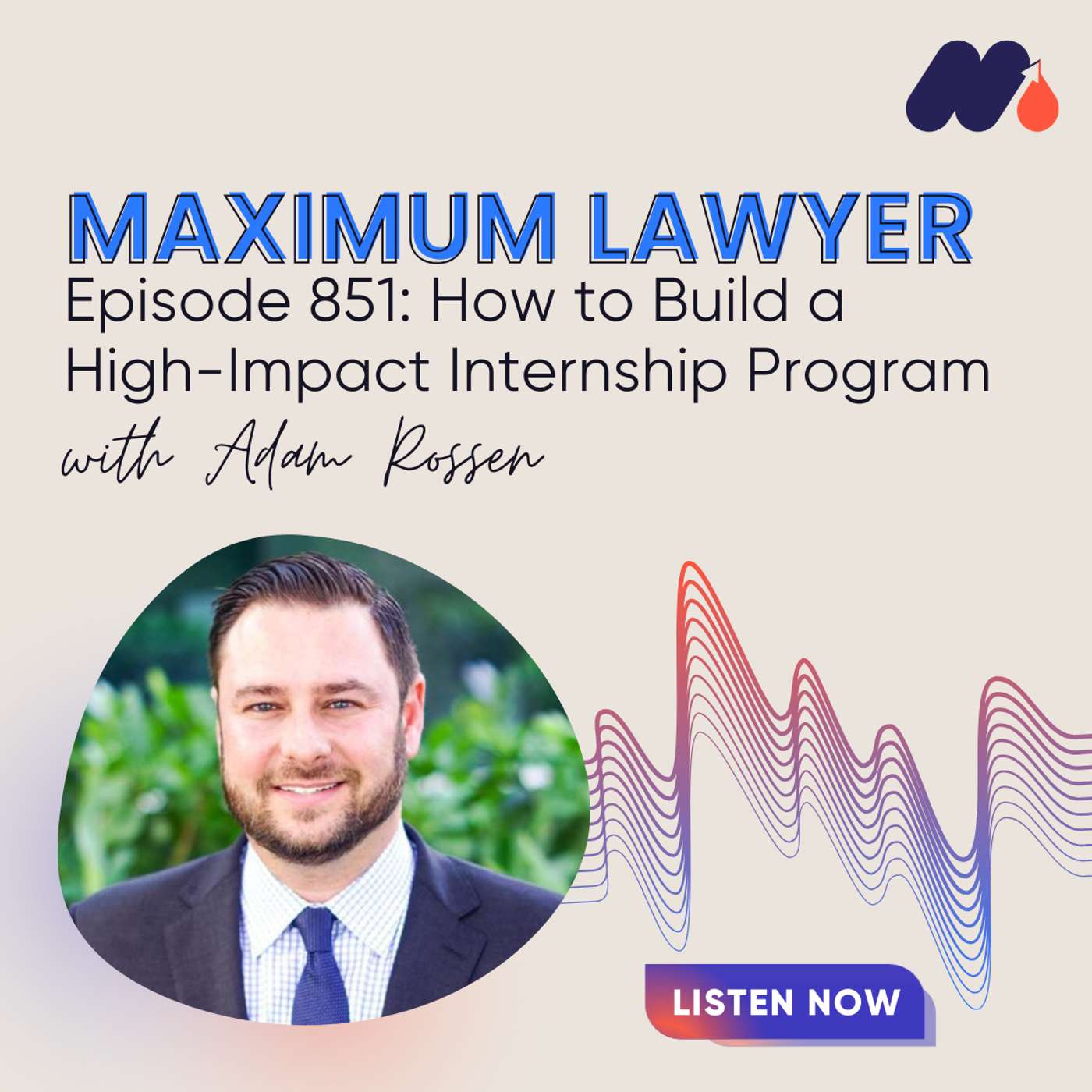
Welcome back to the Maximum Lawyer Podcast. Today's episode is straight from the stage of MaxLaucon 2025 and it shares that one of the best growth moves in your firm isn't about another hire or another tool. It's about building a pipeline of future talent. Today's episode features Adam Rossen, law firm owner who has spent years turning an internship into a structured curriculum based program that has created real impact for students and real leverage for his law firm. In this talk, Adam shares how his internship program evolved over the last 15 years, how he made it intentional and repeatable, and how interns can support meaningful projects like content systems and long term relationship building without creating chaos for your team. This is Adam Rawson's Max Locon session, how to build a High Impact internship program.
- [01:52]
B
All right. Hey guys, so I'm going to talk about our internship program. I was on the podcast about six, eight months ago. I had it about an hour to talk with Tyson about it. This is the 20 minute version, but also I'm going to make this a lot more tactical for most of you guys. What I want you to take away from this is you don't have to build what we have at my firm today in the very first summer that you do it. Just take some action, pick some things and you guys will be well on your way. Because this took 15 years to build with some intentionality and thinking behind it. But I want everybody to leave here. If you want to do something like this, you absolutely can. Okay, so this is. This is the firm stuff. A little bit about me. We can skip this. Actually, as of January 1st, I'll be the only lawyer out of this group that's still here. That's a different talk for a different day, though. And when Jim's here talking about failures and everything, I'm like, oh, God, Jim, you always seem to speak to me so. But it's, you know, it is what it is. All right, so that's me. Fun stuff. So let me have you guys go through just the history of this. I started my firm at 26 years old in 2008. I was only a prosecutor for a year and a half, and I loved it, but I also hated it. So I said, screw it. I'm going to start my own firm. And as soon as you become a lawyer, well, guess what happens. People go, hey, you're a lawyer. My cousins, brothers, uncles, daughters is going to be in law school. They need an internship. Can you help them out? And one thing that I didn't realize until I became a lawyer is that the legal profession is a very giving profession. It really is. All of us here, we help each other all the time. Right. We. We're here. You know, we come to conferences, whether it's legal or business, and we're always looking to help each other. And mentors have really shaped my life. A bunch of my mentors are here, and I've been able to do that and always wanted to give back. So version 1.0 of the internship was come hang out. Sure. You know, Can I help your friend? Absolutely. Come hang out. What are they gonna do? I don't know. Cause I don't have a program. Just come hang out. Right. See what it's like to carry the briefcase every single day. Okay. And there's a lot of value in that. But that's the way it started. Watch Court, maybe do some small projects, work on a little discovery, and just have one intern at a time. Raise your hand if you've had an intern. And that's what your internship has been. Anybody? Right. Okay. Yeah. And you're providing a great experience for somebody, but how can you get it and make it better? And that's what I'm going to talk about a little bit at the end. Then comes, well, fun fact. We stopped the internship, I want to say, for about a year or two. And the reason we stopped the internship was because in 2014, one of the interns became my future wife. Okay. Little scandalous here for Max Law. Little scandalous. And so my wife. Yes, yes. It was a. Well, kind of sort of. My wife and I, our grandparents were best friends, and they kind of put us together. But that's how it started with my granddaughter's got it Needs an internship. And then I remember her, her grandmother pulled me aside, she goes, and she's gorgeous. You know, I had a live in girlfriend at the time, but the old yes. Yeah, hey, it was a great story for our wedding. We've been married 10 years. But my wife's like, you know, at the time, she's like, and this program's gotta stop, right? So now we just make sure we have a lot of interns so there's witnesses so I don't get in trouble. No, I'm kidding, I'm kidding. Yeah. So anyway. But no. And my wife's a gang unit prosecutor in Palm beach, so she's pretty tough. But that's the way the internship started. Okay. And then in 2018, 2019, I'm building the firm. I'm out, I'm speaking, and I remember I'm speaking to a local high school's criminal law club. And I'm telling them about, you're 16, 17 years old. How do you know what you want to do in life? Go intern. Go work at a law firm. Maybe you know, take a gap year between college and law school. Intern your summers. You have no idea if you even want to be a lawyer. You're 16, 17 years old. And then so this little tiny girl comes walking up to me and she goes, hey, so you said we should intern at places. I'm third in my class out of 700 students. I want to intern with you. I was like, oh, shit. You know, I'm like, damn, I can't say no. Alright, so come on. And we had three or four interns and then it grew to that. But 2018, 2019 was just more of the same, except we really started taking on two or three at a time. And again, this is the time that I'm going to masterminds law firm growth companies. I'm learning, I'm developing mentors. And here we are, we get to Covid. And one thing that I really learned from some of my mentors is if you believe that at my firm, we want to have a community impact. We're very big in the community here. We have a counter up in our office. That's every time we close a case, it goes up. We do it every week. And we're at over 3200 cases closed. And we say that is the impact because that's how many people's futures we've helped, that's how many families we've helped. And if we are the community and the relationship builders, and if we are the pillars in the Community, then it's our job and responsibility to take on interns. So Covid happens. And I've made a lot of mistakes in my life. I truly, genuinely believe in making mistakes, taking action, failing forward. But I made some smart decisions in Covid. And during COVID what happened was everybody's freaking out. I joined the guild. The guild just got up and running. We're having, like, everybody, you know, weekly meetings. I'm making all these great friends online. We're kind of, like, figuring out what to do. And I said, everybody's summer is ruined. Judicial internships, law firm internships, everything, right? Their summer is ruined. Well, if we are the community builders and pillars that we say we are, then it's our moral and ethical obligation to say yes to everybody. Screw it. I'll do whatever. And Crazy me took on 13 interns. Back then, when we were a firm of six people, we had just grown from three to six people. We had twice as many interns as people in the firm. But, you know, I genuinely believe that, that it's our job and responsibility to, you know, to have an impact. And we did it on Zoom. And I'm in South Florida and Fort Lauderdale, and Miami was all. Zoom didn't really open up at all. Palm beach opened up a lot faster. But here we are, and we had time on our hands. There were two lawyers, me and another attorney. And so we're starting to take depositions on zoom. Well, great. We're going to. We're going to have a little strategy with them. They're going to be on the depots, and then we're going to debrief after with them. We're going to have them on Zoom Court. You know, we're going to do a lot of things. And it really gave me time to think how many of us are so busy every day that before we know it, we wake up and we go, oh, my God, it's October 9th. What? What? Right? Or it's, wait, it's 2025. Where did the last three years go? Where did the last five years go? So Covid gave me just an amazing opportunity to sit and think, and I said, all right, how can we make this interesting for them? Well, the George Floyd murder happened Memorial day weekend of 2020. Okay, I'm going to use this, and we're gonna turn it into a project. So we gathered everybody up virtually, and I said, all right, next Wednesday from 1:30 to 5:30, you guys are mine. We have a project. I'm not telling you what it is. I got the Jury instructions in Minnesota. I got the police reports for what happened, and we got the autopsy. I think the initial autopsy, like the first, I don't know, 20 pages or whatever came out, and they all came on zoom. And I said, all right, here's the deal. We're gonna do a law school exam. We've been chosen to represent Derek Chavin. I'm taking the unpopular opinion. Here's the law, here's what he's charged with. Here's the police reports, and here's the medical examiner's reports. Write me an essay. Write me a law firm memo. Four hours of how we're gonna win this case. Because I'm not gonna let you take the easy road out and say, well, we've all seen it on video. It's horrific. He's guilty. And I said, I'm gonna rank you and grade you against each other, just like law school. And we had high school, college, and law students. And you know what? Number one was a law student. Two and three were high schoolers. Okay? We graded them and we gave feedback. My wife helped me with it. It was tons of fun. And the next year, in 2021, we did Bill Cosby's trial as the same project. And we used it as an opportunity to turn them into SEO writers. I had this great SEO project that I wanted to do. We went through, and we had 30,000 words of content. We went from February 2020 about getting 600 hits a month on our site to 30,000 during COVID Now. We wrote three articles that were like, co. Covid, criminal related, kind of just to ride the wave. And that bumped us. But once those died off, we were consistently at about 10,000 views a month. And this is one of maybe the three or four key factors that allowed me to triple my firm in 2021 in revenue and double in size. We went from 6 to 13, and then the following year to from 13 to 20 employees. But a lot of it was this SEO project that we had our interns work on. And so I'm like, well, wait a minute. We got something. This is a really cool, fun experience. Yeah, I'm a little crazy, but what can we do to make it even better? So now we're in the. This is a program. Okay. 2022, we said, we're creating a program. So it's curriculum based. It's a formal program. We get speakers from all across the country. This is a federal judge down in Miami in the middle. We've taken them to federal court. They're in state court every Week we book club a book on criminal justice. There's a book written by a federal judge in Southern District of New York called why the Guilty. Let's see why the Innocent Plead Guilty and the Guilty Go Free. And it's a harsh rebuke of the federal criminal justice system. So there's an academic component, a curriculum, book, book club. And we had the judge, Judge Jed Rakoff this summer, we got him to speak to our interns. So it was amazing. And we pair them with our lawyers, so they're in it every single day. We've gone and had ocis, and I just was like, you know, I want my lawyers to go back to their law school as being there on the other end at OCIS for this. How cool. How amazing. And so I'm like, well, how do I do it? I don't know. Just call the career people. And I called them, called them an email and said, we want to do ocis. We want to do ocis. We have your alums here. And we do. We go back to our old schools, our local law schools in South Florida, and we have it through a formal application process. So this has been, you know, as we've evolved, this is how it's evolved. But then this year we did something different. We niched down even more. Oh, we have a summer award now where the intern of the summer, we wanted to make it competitive, so our intern of the summer gets that award. And we have a plaque in the office with nameplates for every year so they can live forever, you know, in the history of the firm. And so it was the same as last version, but we wanted to niche down further, not just criminal law. At first it was, oh, you want to go to law school? Maybe you check this off your box, maybe you get inspired. Then it really went to criminal law. Criminal law. Maybe you want to be a prosecutor. Well, that can benefit me as well because at least we can have an influence in some prosecutors and let them know that we're good people and know what it's like to represent good people. But now it's criminal justice. And what we've done is we've partnered with criminal justice organizations in South Florida and around the country. And as you all know, by niching down, niches create riches. And. And so now we've been able from an SEO and a digital marketing play to get backlinks from hyper local and nationwide criminal justice organizations that link back to our site and our program. We've had media and PR based on this. I've been on Their podcast, they've been on mine. We've created more relationships that are spreading by niching down into this. It's helped our branding. Back when I started, I could not care about branding. Now, with 25 people in the firm trying to get to obviously be bigger, branding is a big, important thing. And I want us known as a law firm that really stands up for people and social justice initiatives. It's very important to me, and it's helped us get better interns. Interns that really know what they want to do. And so we really focused on this last summer. What we do is we open up applications every year in January, and January through April is really. Is when we do it. And we have our program. Oh, that's not gonna work. Okay, let's see if this works. But we have our program that's run May through first week in August. This is a little video. I only wanted to play about a minute of it, but my marketing team put this together, and it's on our site. And again, it's you. When we're trying to make connections with other organizations, and it's used to create hype and promote the firm. Let's see. Yeah, I think that there was some Internet issues where it wasn't gonna work. Okay, well, it's on the site, and you guys can look it up. All right. And one of the things that I realized with talking with a lot of these criminal justice organizations is, look, my internship is elite. It is elitist. It's high academic. We have Duke Law, Cornell Law, Miami, Florida. And what we do is we split. We only take three undergrad students from one local private school in South Florida, American Heritage, where I have a deep connection with. And then it's college and law students. And you either need to have a tie to South Florida or have the money or both to be able to work an unpaid internship for the entire summer. This past summer, we had two law students move here, move to South Florida. They live together, one from Penn State Law and the other from Duke Law. Okay. It requires a certain financial stability to do that. We know that. We get it. But I wanted. And I wanted to add something else on while still keeping the internship separate. So through talking with the criminal justice organizations, next year, we're going to offer a new program. This is going to run September through or through April, so it's not going to conflict. And this is going to be. It's really a mentorship program. It's a paid mentorship program where we will pay somebody to come work at the firm. Right. Okay, obviously an employee, but somebody maybe with no experience, somebody who maybe was a high school dropout and got his or her ged, maybe went to a technical school, maybe had a criminal case. And maybe they want to be a lawyer. Maybe they want to work at the clerk of the courts or the public defender's office, you know, as a support staff role. Maybe they want to be a paralegal, a legal assistant, but no one will ever give them a chance because of their criminal record or because of their lack of education. So we're doing this where it's a one hire one at a time for that period. Hands on experience, learning. Best case, they come and become a full time employee with us. Worst case, they now have, have new skills and we, they have it on their resume and we can help open the door for them. Maybe not at the fancy prosecutor's office because they're kind of judgy, but maybe at the clerk of the court, maybe at the public defender's office, and they can move into a great career. And so that was something that just came from talking with these, with these organizations. So what can you folks do? And this is something I talked to Tyson a lot about over the past few months because he's like, adam, I want you to, yes, your program is nice and you built it over 15 years, but here are some things that everybody here can do right now, today. If you want to do something like this, and you can start with one intern, but make it intentional, have an actual plan. Who's managing, what is the day to day gonna look like? Because the worst thing for an intern is just to come hang out and be bored. Unless they want you to be their future husband. Okay, then it works. No, but to find the work, right, create the experiences, be creative. We are all so creative at our cases. Our casework, whether it's criminal defense, personal injury, estate planning, and trust, are some of the most creative. And tax lawyers, some of the most creative lawyers I know. So why can't you just think, be deliberate, think, and let's give them great experiences. Okay? You want to onboard well, because the last thing is somebody, they're coming in and they're just bored or they feel like they're a bother. You don't want that at all. And you can do it. Keep it simple, go slow, be intentional, and everybody here can have a great program. Okay? It's really pretty easy. That's all I have for you guys. So if you want to stay in touch, okay, my LinkedIn's here. I'm getting big in LinkedIn, so let's hang out. And I think I have like three minutes. So am I allowed to do a Q and A? Anybody want to hear any jokes? No. Is there any questions? Right, so that's a great question. And it's because we have the curriculum. Okay. This is, there's an academic component to it. All right? So it is curriculum based now, and that's important. We have weekly meetings, we teach, we book club, we have the speakers there. Right. And these interns, I mean, a lot of the feedback we've gotten is like, we want more, we want more, give us more. I mean, we had 300 applicants for this summer. 300. Now, we're really good on SEO, but we also put it out on Wisehire. And we were, I mean, just applicants and we were doing. We had to do group interviews for the first round because I couldn't do them all. So people really, really, really want this. One thing that I've thought about, one thing that really bothers me is the hypocrisy of law school, that they won't give school credit for this. So. So I'm considering starting a non profit and seeing then if we can either get funds to pay through the nonprofit or at least get credit, school credit from the nonprofit. Because it really frustrates me because we lost like three good candidates this summer because they wouldn't get credit. No, we didn't give them credit. I mean, the same as like an agency or a vendor and we edited a lot. But no, I didn't think we needed. I think we had them sign an agreement saying they were going to do that, you know, five years ago. So. Yeah, the handsome young gentleman in the front. Yeah. And then we had a happy hour. Right. And one of our interns from this summer, her best friend's older sister, was our intern two summers ago. Yeah. And so that happens. And we've had people now become prosecutors from my internship. We've had people now at the public defender's office and there are one or two superstars that I can't wait until they're ready to come home and come join the firm. So it's been very helpful for all of those things. And Bill was so gracious and generous to come on down, talk, you know, it was amazing. So if there's anything I can do, text me, call me, I'm around, follow me on LinkedIn. Like, I'd love to help because I'm very passionate about this. I. I think all of us, we can and should have that responsibility to help others and really show that being a lawyer is amazing. Running a law firm is amazing. How many people do we know where they, you know, they'll talk to a young person and say, well, don't be a lawyer. Don't be a lawyer. Right? Get that. Young people get that all the time now. This is amazing. What we do creates so much value. So thank you guys very much.
- [23:30]
A
Before you go, quick shout out to Becca's list if you've ever hired a vendor for your law firm and immediately thought, yeah, that wasn't it, this exists for you. Becca's list is a curated list of companies that work with law firm owners. No paid placements, no random recommendations. Just real reviews from law firm owners who have already learned the hard way. If you want to see what's working for other firms and help us grow becaslist to the largest place for law firms to find trusted answers, head to beccaslist co and leave your first review today.