← Mayim Bialik's Breakdown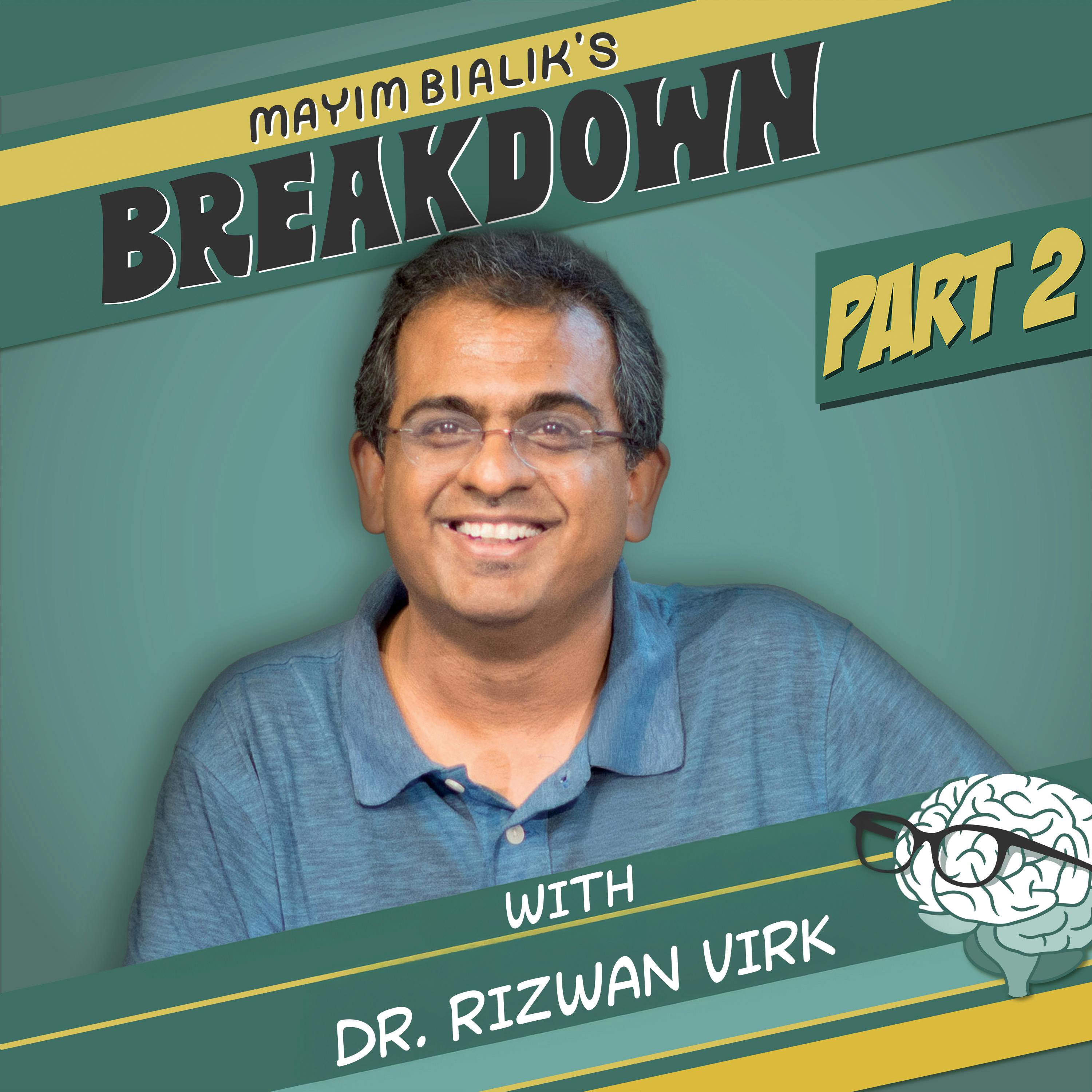
Mayim Bialik's Breakdown
PART TWO: How Quantum Physics, Religion, & NDEs are Linked By A Theory That’s Growing in Popularity. MIT Scientist Explains Simulation Theory.
00:59:31
Loading summary
Transcript257 lines
- [00:05]
Mayim Bialik
Abercrombie denim is everything right now. Denim should feel like this. Confident, easy, like your butt has never looked better. If you didn't know Abercrombie's Curve Love Denim went viral in 2019 for eliminating waist gap, and it's still a game changer. Between that and their classic fits with a straighter line from waist to hip, the perfect denim does exist. Shop Abercrombie Denim in the app online and in store.
- [00:34]
Jonathan Cohen
This Labor Day at.
- [00:35]
Dr. Rizwan Virk
Lowe's Shop Member only Doorbuster deals for a limited time save $50 on an.
- [00:40]
Jonathan Cohen
Ego string trimmer now $169 plus get.
- [00:44]
Dr. Rizwan Virk
50% off select Holland Pavers Not a rewards member.
- [00:47]
Jonathan Cohen
Sign up for free today but hurry.
- [00:50]
Dr. Rizwan Virk
Labor Day Doorbuster deals won't last long.
- [00:53]
Jonathan Cohen
Loaves we help you save valid through.
- [00:56]
Dr. Rizwan Virk
91 while supplies last Program subject to terms and conditions details@lowe's.com terms subject to.
- [01:01]
Mayim Bialik
Change hi, I'm Mayim Bialik.
- [01:04]
Jonathan Cohen
I'm Jonathan Cohen and welcome to part.
- [01:06]
Mayim Bialik
Two of our conversation with Dr. Rizwan Virk, the author of Simulation Hypothesis. Dr. Virk got his degrees at MIT and Stanford University, recently got his PhD. He's a venture capitalist, successful entrepreneur and video game pioneer who's lived in the world of Silicon Valley, but also dips a deep toe into the worlds of mysticism and AI and how all of this might fit into a gigantic simulation that we may be living in. In part two of our conversation with him, we're going to talk about who might be behind a simulation. Is it God? Is it aliens? We're going to get to all of it.
- [01:42]
Jonathan Cohen
Would it ever be possible that the creators of the simulation threatened to unplug us? We're going to talk about the evolution of human consciousness and the awakening that's happening. We're also going to talk about what do glitches in the simulation mean. I propose that they are clues to help guide us to the life that we are meant to live. And each one of us can get a better understanding of how to navigate the challenges that we face by becoming more aware of the clues that are presented. Mayim also asks about love.
- [02:13]
Mayim Bialik
Where does love fit in the simulation? We will find out in part two of our conversation with Dr. Rizwan Burke.
- [02:19]
Jonathan Cohen
Break it down so is a near death experience the reality that they see just another version of a simulation that's rendering, or is it outside of the simulation entirely?
- [02:34]
Dr. Rizwan Virk
Well, that's a good question. And now you get into this idea of stacked simulations as well. People ask me what's outside the simulation, I don't take a strong position on it, but I can go through the possibilities.
- [02:45]
Mayim Bialik
Aliens, Aliens.
- [02:46]
Dr. Rizwan Virk
It could be future humans. I mean the term simulation hypothesis came from a guy named Nick Bostrom, who, a philosopher at Oxford and you know, he called these ancestor simulations which would be like us simulating ancient Rome or simulating Greece. Right. So it would be future humans simulating. And that's what kind of what the Matrix was.
- [03:06]
Jonathan Cohen
Remember when, remember when there was water in the oceans? Let's go back and remember when teenagers.
- [03:15]
Mayim Bialik
Wouldn'T get off their phones? Now the phone is their brain.
- [03:19]
Dr. Rizwan Virk
Exactly. Or like in the Matrix. Right. They're like 1999, they're simulated.
- [03:23]
Mayim Bialik
Yeah.
- [03:23]
Dr. Rizwan Virk
There's actually another simulation film that came out in the same year as the matrix called the 13th floor. I don't know if either of you have seen it.
- [03:30]
Mayim Bialik
I think I may have seen it a million years ago.
- [03:32]
Dr. Rizwan Virk
It got kind of overshadowed. The Matrix was the most talked about film a year and it came out like literally 60 days afterwards.
- [03:38]
Mayim Bialik
Bummer.
- [03:39]
Dr. Rizwan Virk
Yeah, bummer. But in that they're in 1999 and they create an ancestor simulation of 1937, Los Angeles and they go in there and they can experience and they come out and I'll give away the, the, I'll give away the, you know, the plot because it's 25 year old movie, they find out at the end that they are within another simulation from the year 2024, so from last year. And basically, you know, it's a stacked simulation. And they also say, well, we made thousands of simulations. You're the only one who's created a sub simulation but you're using too much power so we're going to unplug you, which is a possibility. But getting back to your question about near death experiences and what's outside the simulation, I do think that there is another level, at least, at least one other level because people report things that are familiar to them, like for example, a nice garden that they report.
- [04:36]
Mayim Bialik
You mean in NDEs?
- [04:37]
Dr. Rizwan Virk
In NDEs, yeah, yeah. And they also report seeing more colors than they can see and more sounds coming at it from a computer science background. It reminds me of when we had eight bit games and, and you would hear about these games that had like 16 million colors or whatever and you realize, oh, with more bits you can get more colors. Right. And people report it being more realistic than it is here. But at the same time I think that what they see initially is something that makes them comfortable for the most part. I mean there are some uncomfortable NDES.
- [05:08]
Mayim Bialik
But for most parts, yeah, we've had. Elizabeth Crone said that she believes that everyone's NDE would be tailored to them, meaning if you are a person, you know, just like when you have dreams or if you have a psychedelic experience, it's in theory, sourced from your own data bank.
- [05:22]
Dr. Rizwan Virk
Right, right, right. And. And in a way, like. Like at the end of Contact, for example, if you've seen that movie, she meets the aliens, but they appear to her as her dad. Why? Because that's a familiar figure for her. And then she realizes it's not really her dad, but that's how it appeared to her. So I do think, you know, that those tailorings happen. But when you talk to atheists, the tailorings are different because for them, they didn't necessarily believe there was anything, but there is potentially something. Something. So something that would be comforting to them, but yet maybe knock them off.
- [05:54]
Mayim Bialik
Their perch in that sense. And I think this is sort of a question I have for you. What our atheist NDE people have reported is love as the universal overarching language of whatever comes next or whatever this different consciousness state is that we can exist in. Right. In these extraordinary situations. So that's sort of, I think, another reason why, you know, I've had resistance to talking about simulation. Where does love fit in? Where does feeling connection? You know, all the things that we know about the neurotransmitters that comprise the systems that our brain and nervous system have evolved to feel pleasure, pain, you know, the complexity of an emotional experience, which, while we can leave it for a second when we're in, you know, a VR space. Right. You know, for most of us, we're able to be able to say, that's not. I'm not feeling something. I'm experiencing a memory, but I'm not feeling it. Right. Where do feelings fit in?
- [07:06]
Dr. Rizwan Virk
Well, I think feelings fit in in the sense that our simulation is wired for feelings. Right. We have emotions. That's a key part of our character in this life. And it's possible that, like, why do we play video games? It's one of the questions I get asked a lot is why would we be in a simulation? And I say, well, there's two different questions I'll ask in return, because you can think of this at a civilizational level, or you can think of it as at a personal level. And at a personal level, the question is, why do we play video games? And it's to have experiences that we can't have necessarily outside of that game, for whatever reason.
- [07:45]
Mayim Bialik
You can be whoever you want.
- [07:46]
Dr. Rizwan Virk
You can be whoever you want. You can fly around. You can also have bad experiences.
- [07:50]
Mayim Bialik
You could be a bad person.
- [07:51]
Dr. Rizwan Virk
You could be a bad person. Grand Theft Auto, right? You could. I mean, I, I knew people who also wanted to just have a virtual life. Like I, I used to spend a lot of time in Second Life. I don't know. So Second Life is an example of what's called a metaverse or a virtual world where it's not a traditional game.
- [08:07]
Mayim Bialik
Nope.
- [08:08]
Dr. Rizwan Virk
In the sense it's like people go in there and do whatever they want really. But you create things.
- [08:12]
Mayim Bialik
You have a job, you have a spouse.
- [08:14]
Dr. Rizwan Virk
Yeah.
- [08:15]
Mayim Bialik
So I know people for work.
- [08:17]
Dr. Rizwan Virk
Yeah. Literally after work they would go home and then they would have a bartender job at a club in Second Life. And they get paid peanuts. So they weren't doing it for the money. They would get paid in Linden dollars at the time. This is pre Bitcoin. But they liked having that experience of the social experience of these avatars. People would be married in real life and then they would get married to somebody else. Other people wanted to be really promiscuous in their virtual world.
- [08:40]
Mayim Bialik
Then they got STDs.
- [08:42]
Dr. Rizwan Virk
Virtual STDs. But the point is there are experiences that you may want to, that are challenging even. But if outside of this world is basically love and compassion and inside this world is a whole bunch of very negative things as well as love and compassion, I think the way to play the game is told by how you evaluate the game. And this is why I go right back to the Life review as being such a critical, important point. The message you get by experiencing other people's pain is that how you treat them actually matters. And so I don't think this game is Grand Theft Auto. Some people might that you're out there to abuse as many people and steal as many things as you want. But in reality, in the end, what you're going to be evaluated on. If we buy this concept, when you replay the game, the scoring, if you will, the database of quests is how did you treat other people? And I think that's something we can learn from the NDE about the nature of the game. And it also ties back to scriptures. You know, it ties back to the Golden Rule, this idea that how you treat other people actually does matter, that those relationships are actually more important than anything else.
- [09:56]
Jonathan Cohen
And if we're in a non physical state outside of our avatars, then we've come here to experience physicality and all that comes with it. In A way that potentially outside of this simulation, we are not able to experience.
- [10:11]
Dr. Rizwan Virk
Right. Just like I might go into a virtual reality simulation to try to fly around on a dragon. There was one another VR simulation that same year where I was flying around on this dragon. It's not something I could do outside.
- [10:22]
Mayim Bialik
What did it feel like?
- [10:24]
Dr. Rizwan Virk
It felt nauseous at first because the VR technology was not very good at that point.
- [10:29]
Mayim Bialik
Don't you think you'd feel nauseous if you were actually flying on a dragon?
- [10:32]
Dr. Rizwan Virk
Well, I mean, then I began to like it. Once you get used to it, you. You begin to like it. Right. So it depends on how smooth the dragon is, I guess.
- [10:39]
Jonathan Cohen
Let's stay here for a second. Both on. On the purpose collectively, and then individually on an individual level. I don't think it's only about going on quests. I think it's also about understanding.
- [10:50]
Mayim Bialik
It's about avoiding your life and being in video game land.
- [10:53]
Jonathan Cohen
No, I don't think so at all.
- [10:55]
Mayim Bialik
For some people it is.
- [10:56]
Jonathan Cohen
I'm tying it back to a lot of the mystical traditions and the consciousness conversation, which often has this notion of remembering and trying to actually get over the forgetful part of consciousness. The fact that when we become embodied, we have this level of forgetfulness, and often it's about remembering what we're capable of. It's about expanding our awareness and learning that there are mechanisms and capabilities that we all have that can supersede the limits that we were programmed with. So if we come in as these avatars and we only believe in materialism, for example, and we only believe that the world is, you know, only what has been rendered in front of us, and then we start to peek behind the curtain of what is it over here that hasn't been rendered yet? And can I access that through a dream, for example? I don't necessarily see it as a glitch in the Matrix that showed you that dream. I kind of align with how Thomas Campbell explained it, which is that is an opportunity for you to realize that you are here and that the limit of the materialism is only a small faction of what's possible.
- [12:05]
Dr. Rizwan Virk
Yeah, and I agree with that, by the way. That was my interpretation of it afterwards.
- [12:09]
Jonathan Cohen
Because a glitch almost sounds like it's a mistake versus it's an I like the cue opportunity where it's cueing you to say, wait a second, let's broaden your perspective. And then what else is possible if.
- [12:20]
Dr. Rizwan Virk
That perspective is going on here? So it's almost a way to encourage the awakening process, if you will.
- [12:26]
Jonathan Cohen
And so if the universe is constantly rendering and updating and each one of us is a part of that, then in our conversation recently we had with Dr. James Gladfelder, he's talking about how the universe is revealing itself. So if the simulation is processing constantly and the data is being, is processing and we are learning more and more how to process that data, then it wants to reveal itself. And that's part of the experiment on a collective sense. I also think there's a collective.
- [12:56]
Mayim Bialik
Need.
- [12:57]
Jonathan Cohen
For the experiment to see if the world will survive or humanity will survive the world.
- [13:03]
Mayim Bialik
I think that brings into question sort of who's behind the simulation, which I think is something, you know, you can have a God entity if you'd like one, right? You can have, you know, you can have aliens. I mean, aliens are one of my favorite things to talk about. Or non human, you know, the alien. You know, we've spoken to Adam Frank and we've spoken to Robin Hanson and most recently we spoke to Dr. Avi Loeb. And you know, one of the things that I'm having to adjust to, cause they didn't teach this in graduate school at ucla, is that aliens. There is no reason to believe that aliens do not already exist. And that means since they're not here now that we know of, they are likely very far ahead of us technologically. They are possibly some form of artificial intelligence already. We would then have this possibility that that is what is behind this kind of simulation. Some sort of being that has an enormous head start, technologically speaking and is either observing or as Robin Hanson says, domesticating us. Making sure we don't, I'm gonna just say like making sure, okay, we don't go out of the universes and galaxies that we're allowed in or making sure that we don't figure they, we can't be smarter than them. It's not like I'm gonna figure out the simulation and I'm gonna break through and I'll show those aliens they would ha. If we are in a situation where we are being observed, controlled or created in a simulation, don't think that you're going to figure it out and pull a neo, right?
- [14:49]
Jonathan Cohen
Well, you may pull a NEO locally, but not intergalactically. Meaning that when what Robin Hanson says is that they're sitting on the edge of our, our solar system, making sure that we don't get too technologically advanced. Because if we exit the solar system, it could have a larger repercussion on the galaxy at large.
- [15:08]
Mayim Bialik
We mess everything up and make it all dirty and polluted everywhere.
- [15:11]
Dr. Rizwan Virk
The Zoo Hypothesis the Zoo Hypothesis we're being kept to a certain point.
- [15:17]
Mayim Bialik
Running a business comes with a lot of what ifs. But luckily, there's a simple answer to them. Shopify. It's the commerce platform behind millions of businesses, including Thrive Cosmetics and Momofuku. And it'll help you with everything you need. From website design and marketing to boosting sales and expanding operations, Shopify can get the job done and make your dream a reality. Turn those what ifs into Sign up for your $1 per month trial@shopify.com SpecialOffer.
- [15:47]
Dr. Rizwan Virk
This episode is brought to you by Indeed.
- [15:50]
Jonathan Cohen
When your computer breaks, you don't wait for it to magically start working again.
- [15:55]
Dr. Rizwan Virk
You fix the problem.
- [15:56]
Jonathan Cohen
So why wait to hire the people.
- [15:58]
Dr. Rizwan Virk
Your company desperately needs? Use Indeed's sponsored jobs to hire top talent fast. And even better, you only pay for results.
- [16:07]
Jonathan Cohen
There's no need to wait. Speed up your hiring with a $75.
- [16:10]
Dr. Rizwan Virk
Sponsored job credit@ Indeed.com podcast. Terms and conditions apply.
- [16:16]
Jonathan Cohen
Hey, it's Ryan Reynolds here for Mint Mobile. Now, I was looking for fun ways to tell you that Mint's offer of unlimited Premium Wireless for $15 a month is back. So I thought it would be fun if we made $15 bills, but it turns out that's very illegal, so there.
- [16:33]
Dr. Rizwan Virk
Goes my big idea.
- [16:34]
Jonathan Cohen
For the commercial. Give it a try@mintmobile.com Switch upfront payment.
- [16:38]
Mayim Bialik
Of $45 for a three month plan equivalent to $15 per month required new customer offer for first three months only. Speed slow after 35 gigabytes of networks busy taxes and fees extra.
- [16:45]
Dr. Rizwan Virk
See mintmobile.com and I think that's, that's certainly one possibility when it comes to aliens or even UFOs, but I think our, our understanding of that subject is also limited by our current view of the world. So if you look at the UFO experience and I spent a lot of time like, you know, I spent time with Avi Loeb, I'm an advisor to the Galileo project, and Gary Nolan at Stanford, the Soil foundation. And spend time talking to Jacques Vallee, who's been researching UFOs since the 1960s. He was part of Project Blue Book, so probably longer than most researchers out there. And if you think about it, people who claim to have been contacted by these entities in the 50s, they said, where are they from? They said, we're from Venus. Now, we know that's probably unlikely, right? But did they just lie in order to have something that would fit their mental model. Because in the 50s, aliens were from Mars or Venus. That was something we could understand. Our science was good enough to understand it. We didn't know perhaps at that time there's no life. Or maybe we didn't buy the 50s, but in general, it wasn't well known that there's no life.
- [17:57]
Mayim Bialik
Well, those are the close planets. Like we all know the order.
- [18:00]
Dr. Rizwan Virk
Right, but, but what I'm saying is now we know there are planets on other solar systems, and so we can interpret these phenomena as potentially being alien. But there are other interpretations of the phenomena that for. So the reason I brought up Jacques Vallee's work was because he says, look, there have been stories of connections, encounters with non human beings for thousands of years across different traditions. In the Celtic traditions, you have the fae who were like, take people into the fae world. There are some in France that are a different set. And then in the Middle east, particularly in the Islamic countries, the Arabic countries, you have the jinn. Right. And their stories. And I remember looking at some of the stories of these jinn that have been recounted from medieval times, and then looking at the stories that people tell, a modern abduction. And they say some of these are eerily similar. And so the question is, is it possible that they're seeing some entities from outside the simulation that are projecting in, but they're being presented in a way just like a couple thousand years ago, someone might have seen an angel with wings or interpreted that to be an angel. Or like the Fatima sightings in Portugal, they just saw a woman and they interpreted her as marrying. She never said she was Mary in that particular case. So is there an element of interpretation that our current science and our science fiction actually limits our ability to think about this?
- [19:23]
Mayim Bialik
Well, I mean, look, but this is a long discussion. Well, no, and I'm sure you're, you know, I'm sure you're familiar with the very common, like, retort to that, which would be, you know, perhaps the human brain making it up again will generate similar concepts because we have not evolved that much over the last, you know, 10,000 years or so. Right, right. Meaning, like, like the brain that we have is the brain that existed in medieval times. It's the brain that existed in the time of Jesus and Muhammad and all these things. And so, you know, we're all tasked with this impossible notion of why am I here? What's it all for? Where did it come from? What are we doing here? And so there's, you know, there's not an infinite number of possibilities Right. So that the human brain, no matter what time in history you find us, will conjure something that can help explain it.
- [20:22]
Dr. Rizwan Virk
Right, right. Or it could be that we encounter phenomena we don't understand, and the human brain puts a mask on it, tries to interpret it.
- [20:30]
Mayim Bialik
Right. Like, no one is light. I mean, except Terence McKenna when he smoked DMT. No one will say, like, mechanistic elves must be behind, you know, why I'm doing it. Like, nobody says that, but it's, I mean, and I, I, I say that slightly tongue in cheek, but the notion is for people who delve into the world of psychedelics and even the world, you know, when we talk about yoga, Nidra, and we talk about, you know, these kind of altered states that one can place themselves in. I think our strongest evidence does come from psilocybin, from lsd, from ketamine, like, from these kind of like, oh, my God, mushroom. Like, what's happening? So, you know, to me, that's interesting because it's also people use it recreationally. But some of these, like psychotherapy assisted journeys. Right. That involve internal family systems work and that involve that kind of traveling to other states of consciousness where in many cases you're experiencing a sort of life review.
- [21:27]
Dr. Rizwan Virk
Right, right.
- [21:28]
Mayim Bialik
You're experiencing. Yeah. Or even in emdr, I mean, we've had people say, I had one experience, not through emdr, but in a sort of therapeutic trance kind of state where it's not that I was looking at my childhood bedroom. I was in my childhood bedroom. The eyes that were looking around the room were as if I was in a body that was small and that was looking around the room. Right. So being able to kind of move into different timelines. Right. Is something that we can't, we know we can do. Is it an artifact or is it, you know, part of this training?
- [22:05]
Dr. Rizwan Virk
And I think it's, you know, an ongoing debate. Like, for example, like when the Native Americans saw, like these big boats coming, they just couldn't, they couldn't interpret it. They didn't know it was a boat. They just said they're like cities made of wood. Like, at first they didn't even perceive them. When they perceived them, they weren't sure what they were looking at. That doesn't mean that there wasn't actually something in the ocean. It just means that their preconditions were such that they only interpret. And it's possible that a lot of our interpretations are in this way and that the UFO phenomenon, the alien phenomena, is very complex. That said, in a multiplayer simulation Getting back to your earlier question about as a civilization, remember I said there, you could view this question about the purpose of the simulation at a personal level, which is the video game. But at the bigger level, why do we run simulations? We run simulations. Neurons. We run simulators of simulations of the virus spreading, of the weather, of the stock market, of landing on a comet, all of these types of things. And why do we do that? We do that to see what will happen and to see what's the most likely outcome. But we never run just one simulation. We always go back and we modify the variables and we run multiple simulations. Why? Again, we want to see what's the most likely outcome and in some cases we want to say what's the most favorable outcome. So how can we steer this? Which variables would.
- [23:24]
Mayim Bialik
And favorable doesn't necessarily mean positive, happy and good.
- [23:27]
Dr. Rizwan Virk
Not necessarily.
- [23:28]
Mayim Bialik
Whatever the purpose of simulation are of a religious ilk would say, only God knows. Right. Only God knows what's intended for you. Right?
- [23:36]
Dr. Rizwan Virk
True. Yes. Unless you're able to go through an awakening experience and you remember. You remember part of your. So we've talked about the life review. There's also this idea of a life preview where sometimes people either near death experience. I think you had Jim Tucker on your show recently. Yeah. Yeah. But there have been people who have remembered the time before they were born and they remember hovering over their parents.
- [23:57]
Mayim Bialik
Betty said. Betty, our favorite Betty. Buddha Betty. Betty said she saw her life laid out in milestones. She saw that her parents would commit suicide. She saw that she would be a drug addict, a prostitute. She saw everything laid out. And I want you to touch on this. One of the most fascinating Universal Reports from NDEs is the choice to come back.
- [24:21]
Dr. Rizwan Virk
Right.
- [24:22]
Mayim Bialik
And when I read your book and you talk about it, it's that choice to pull that next quarter out of your pocket. That's what I thought of. When you'd be playing a video game. I'd be in. What was it called? It was called like Mom's Cleaners on Melrose near La Brea when I was a kid. And you know, I'd be given a bunch of quarters and I would watch it. It was counting down if you want to play again. But then it would be like, would.
- [24:44]
Dr. Rizwan Virk
You like to do it?
- [24:45]
Mayim Bialik
And just that one freak Mom, I need one more quarter. Talk a little bit about not just the sort of preview of life, but this sort of choice to live again.
- [24:56]
Dr. Rizwan Virk
Yeah. And I think that that's all. They're related to each other. Because even in the preview, when you said she saw it all laid out. And I think I. I haven't listened to your podcast with her, but I think I've heard her on.
- [25:06]
Mayim Bialik
Oh, yeah.
- [25:06]
Dr. Rizwan Virk
Another podcast talking about her story.
- [25:08]
Jonathan Cohen
Ours has been.
- [25:08]
Mayim Bialik
We'd like you to listen to ours.
- [25:09]
Dr. Rizwan Virk
Oh, absolutely. I'm sure it was. Yeah. And it's more recent, too, so you always get the latest. But there was a guy named Michael Newton, Dr. Michael Newton, and he wrote a book called Journey of Souls back in the 90s, and he hypnotized patients and regressed them. And rather than going to a past life, they were regressed to that point in between lives where they remember dying the previous time. And they had a life preview, which was very similar to what you're describing here. But they described it. Now, this is interesting to me. They described it in technological terms. They said it was like a big computer screen which had these lines, and these lines have these milestone points. Right? And you can go this way or you can go that way. And so you have some choices.
- [25:55]
Mayim Bialik
It's like a flowchart.
- [25:56]
Dr. Rizwan Virk
It's like a flowchart. It's a. Choose your own dynamic. It's exactly.
- [25:59]
Mayim Bialik
Choose your life.
- [26:00]
Dr. Rizwan Virk
It's exactly. Choose your own adventure, which I used to read as a kid.
- [26:03]
Mayim Bialik
Yeah, totally.
- [26:04]
Dr. Rizwan Virk
But there's still a part of you. And this is what. What I was referring to earlier when I was talking about the writers room that's sitting there and watching and saying, okay, let's throw something else at them, because they didn't make the right choice or they went this way. It's kind of like a care package in the Hunger Games where it's like they're sending something in to try to affect the outcome of the game. But I think when you come out and there are moments that we come out and it happens spontaneously to people. But I also think most of the mystical practices, whether it's, you know, the yogic practices, the Sufi practices, probably in Kabbalah as well, they are meant to have you be able to come out. There was a famous yogi named Naramana Maharshi, and he basically. He didn't necessarily teach you any techniques. He just said, I'm going to ask you a question. Who are you? Who's suffering? Who is the you independent of what's happening to you? And the point of that was to keep questioning and to try to remember that there's a part of you. They called it the atman in the. In the Hindu traditions, or we might call it the soul in the Sufi traditions. They talk about dying, meaning this awareness, but remembering that there's a part of you that's outside of this. But then when you come out, it's like taking off the virtual reality headset. And then you have this choice. Like in the Matrix with Cypher. Remember he was the guy who betrayed them and he had the, you know, he's like, oh, I want to go in and experience this meat, you know, eating this steak, this meat. But I know it's not real, but I don't want to remember nothing. That was his line. But I think in the near death experiences, many of them are given this choice. Some they just send you back, they say, nope, it's not your time, this was a freak accident, this wasn't quite supposed to happen. Or this is meant to get you on a different path when you go back. But others have the choice. And so if we think of these lines and then you could zoom into those lines and actually see what's going on, the choice. Some of them say, well, I was shown what would happen to my children if I don't go back. Like who they would be raised.
- [28:03]
Jonathan Cohen
Yeah, we've heard that.
- [28:04]
Dr. Rizwan Virk
So that's a kind of life preview. There was a woman named Natalie Sudman who was in Iraq and she was killed. Not killed, but she had an NDE because of an ied. And she said after her life review she had this planning session. And this was, you know, really sounds a little grotesque in a sense. And she even laughs about it. She goes, she was sitting there and trying out different possibilities, almost like they were simulations, like, what happens if my leg never heals? What happens if I'm blind? What happens if this. And she was seeing these previews of things that might happen. And it's almost like there's a part of us that's planning for potentialities ahead of us. And that to me reminds me of running simulations, running forward. And so I think then the choice is, do you want to go back into the game and this might happen or do you want to stay out? And most people say they want to stay out because now they're experiencing love and compassion and there's no suffering. But when they see what's going to happen to their loved ones if they're not there, then they make the choice, particularly mothers, they make the choice to come back in because they want to be there for their children.
- [29:08]
Mayim Bialik
Elizabeth said she didn't want her husband raising their kids.
- [29:13]
Dr. Rizwan Virk
Well, there you go.
- [29:14]
Mayim Bialik
I mean, she just said, she said, if I could give my children the choice of not having A mother who died or them having their mother. I would rather they grow up with their mother.
- [29:23]
Jonathan Cohen
I just had the craziest thought experiment during part of this conversation. So Robin Hanson talked about the fact that aliens are likely far more advanced civilizations. And because there would be alternatives in technology to replace biology, they are likely artificial already, Right? Their bodies have broken down and they no longer have physical bodies. They're likely some sort of techno hybrid or full technology consciousness, if you want to apply consciousness to that. So, and then if you take Avi Loeb's idea of the interstellar gardener, which is that creation of the Earth is likely from an external source, which is how all religions talk about it. And the gardening is like, okay, I'm going to create this thing and see if life is habitable. It could be that the larger test of will humanity survive on Earth could be future aliens trying to regain access to the physical form which they lost during their evolutionary process, which made them technical.
- [30:35]
Dr. Rizwan Virk
Well, now we're getting into almost like a time travel type scenario, though. Not necessarily, but that's another one of the theories that's been put forward is that aliens are actually time travelers from the future trying to. Who have gone down the wrong path. Meaning they are us from the future who are trying to make us make different choices in the past and in a simulated universe that would be possible.
- [30:58]
Jonathan Cohen
Or trying to jump from their timeline backwards. Like you said, a simulation was created of 1937 Los Angeles.
- [31:08]
Dr. Rizwan Virk
Right.
- [31:08]
Jonathan Cohen
In order for them to go back and experience that if I'm an AI.
- [31:13]
Dr. Rizwan Virk
Non humanoid, they want to come in.
- [31:15]
Jonathan Cohen
They want to recreate the best possible scenario to avoid the mistakes of the past. And in order to do that, I'm going to run as many simulations as possible to make sure that I don't go down the wrong path again. Now, here are some of the pitfalls, right? Because Greg Braden talks about the evolution of. And not only Greg, but Ray Kurzweil and others talk about us hitting that singularity point that could be the wrong point where everything goes awry. Meaning we lose X elements of our humanity the more we merge with technology.
- [31:53]
Dr. Rizwan Virk
Right.
- [31:54]
Mayim Bialik
Well, that's what I was going to ask about in terms of stages of technology, where does this conversation lead us? When we talk about, oh, we're here now, we're looking at AI, we're fighting at the dinner table over, is AI better than humans? But what happens next?
- [32:07]
Jonathan Cohen
But let me, let us, let me walk just a touch closer to this. Meaning we've already see, like I saw a video online recently, that was a teacher just like at her wit's end saying, like, you don't understand what's happening in the classroom, nor should you, because you know you're not in the classroom. But it isn't that kids are distracted on their phones. It's that when you take their phones away, they are empty vessels inside because they cannot focus. They're just used to getting so much stimulation that I'm just looking at the eyes of these dead children in my classroom who look like drug addicts dealing with withdrawal at how slow the pace of the information is as they're used to being flooded. So if you think about the trajectory of how our brains are changing, and then in very short period of time, we will have the opportunity to merge more fully with machines, whether that be through neural implants or more adaptive technology, we could continually be moving away from and giving up aspects of our humanity. So I just wanted to place that in terms of, like, where are we in the process?
- [33:19]
Dr. Rizwan Virk
Yeah, well, there's a lot of individual points there, I think, that you made, but in terms of our technology development. So, as I said, the reason I went down this rabbit hole was because I played that virtual reality game and I started to think about how long would it take us to build something like the Matrix. And that's why I lay out the 10 stages to the simulation point in the. In the book. And these include the ability to build virtual reality and augmented reality, but also AI characters that are indistinguishable from biological beings. So I define the simulation point as a point where we can build virtual worlds that are indistinguishable from physical worlds, but we also have AI characters within them that are indistinguishable from characters controlled by humans or even from biological characters. And when we reach that point, I call that also a kind of technological singularity. Because if you look at the term as it's used now, with Kurzweil, for example, it's used for the merging of silicon and biology. And with Vernon Vinge, the sci fi writer who wrote the paper about the technological singularity, I think it was back in the early 90s, you know, he actually laid out many different ways in which could reach the singularity, one of which is super intelligence. And that's another way we think of the singularity. But the term actually was borrowed from physics by von Neumann, who was a mathematician, but also kind of a computer scientist, in that he invented the von Neumann architecture, which is what we use for all of our computers right now. And he Borrowed it and said it's the point where technology is growing exponentially and then everything will be different for humanity. And it does feel like we're reaching that point.
- [34:54]
Mayim Bialik
Yeah, Mental health is in the garbage. Like, you know, body dysmorphia. Suicide rates for teens are skyrocketing. Like, it feels like the world's on fire. Also, like, the president sounds like a comic book villain more and more every day. Like, I feel like I'm literally in a video game when I turn on the news.
- [35:08]
Jonathan Cohen
But this is sort of where my point was about the kids and our use of tech is that it's changing how we operate without it. So in some ways, the singularity has happened. Not that our consciousness has merged or that we've become a silica. But without my maps, like, I can only go very few places. I can't remember anything.
- [35:29]
Mayim Bialik
You're back in the shadow. You just only have to go through.
- [35:31]
Dr. Rizwan Virk
We're the last generation that remembers what's like, yeah, MapQuest.
- [35:36]
Jonathan Cohen
Like, I could use if I had to.
- [35:39]
Dr. Rizwan Virk
Right.
- [35:39]
Jonathan Cohen
Like my son couldn't.
- [35:40]
Mayim Bialik
You used to be able to stop at a gas station and the guy who worked there knew the neighborhood.
- [35:45]
Dr. Rizwan Virk
He would. I would tell you, yeah, go this way, take a left at the tree.
- [35:48]
Mayim Bialik
Tell you the number of times I stopped at a gas station to ask for directions in the 80s.
- [35:52]
Dr. Rizwan Virk
So I remember driving across the country with my Rand McNally Alice. And then I'd get into the next state and then I need a map of it.
- [36:00]
Mayim Bialik
Yeah, a triptych from aaa, which you can still get.
- [36:02]
Dr. Rizwan Virk
Oh. So.
- [36:03]
Jonathan Cohen
So our basic cognitive functioning has drastically changed in a very short period of time, which is moving us towards some sort of merger or dependence on. And we talk about, like, all the things we're going to offload from a decision making standpoint to artificial intelligence, which I think is getting us there. So I'm agreeing with you. And also I feel like we're further into the curve than we may realize.
- [36:26]
Mayim Bialik
Well, introducing the perfect companion to your morning listening routine. AG1's clinically backed formula is now flavor packed with three new delicious flavors. Tropical berry and citrus. Start the day on a high note with probiotics that taste like the tropics. Mix it up with micronutrients that taste like berry or citrus, and take it all the way back with the classic AG1 original with notes of pineapple and vanilla. Do your health a flavor or four with AG1 NextGen, the daily health drink. Learn more at drink ag1.com the Jack Welch Management Institute at Strayer University helps you go from I know the way to I've arrived with our top 10 ranked online MBA. Gain skills you can learn today and apply tomorrow. Get ready to go from make it happen to made it happen and keep striving. Visit strayer.edu Jack WelchMBA to learn more. Strayer University is certified to operate in Virginia by Chev and has many campuses including at 2121 15th Street north in Arlington, Virginia.
- [37:26]
Dr. Rizwan Virk
Gatorade is the number one proven electrolyte blend designed to hydrate better than water so you can lose more sweat and raise your game. Gatorade is it in you? So there's an idea about technology and science called Colling Ridge's Dilemma, which basically says that you don't know the side effects of a technology until after the technology has been rolled out. Like for example, you know, who knew that when Facebook was first created?
- [38:02]
Jonathan Cohen
They did.
- [38:02]
Mayim Bialik
Me. Me and Facebook.
- [38:04]
Dr. Rizwan Virk
You and Facebook. Right. But in general, when people adopt, started adapting it. Right. They didn't realize it was going to lead to more polarization.
- [38:13]
Mayim Bialik
Yeah, but like every, every hippie. Every hippie knew. That's what's interesting to me.
- [38:17]
Dr. Rizwan Virk
Yes, the hippies knew.
- [38:18]
Mayim Bialik
All the people who believe that they can access the Akashic records to decide if they should go to the supermarket were like, I see exactly what's going to happen. And when Covid happened, they were like, uh huh, see 2020. What did they think it was going to happen? Like, I can't tell you how many like yoga instructors were like, it's all going to be okay. Just breathe through your nose. Like what they knew.
- [38:40]
Dr. Rizwan Virk
Right, Right. So some people may have had indications of what's going to happen.
- [38:44]
Mayim Bialik
The people that society calls crazy.
- [38:45]
Dr. Rizwan Virk
Crazy and says, you know, because society.
- [38:48]
Jonathan Cohen
They'Re the non materials.
- [38:49]
Mayim Bialik
Correct.
- [38:50]
Dr. Rizwan Virk
Yeah.
- [38:50]
Mayim Bialik
Which used to be shamans.
- [38:52]
Dr. Rizwan Virk
Yes.
- [38:53]
Mayim Bialik
Right. Mystical leaders, prophets. People who when they dreamt, decided that they could foresee the destruction of the temple. Right. And everybody's like, that's a prophecy.
- [39:02]
Dr. Rizwan Virk
Yeah. And that was a function within society. Correct. We've kind of gotten rid of that.
- [39:06]
Mayim Bialik
No, we make them all live in Sedona.
- [39:09]
Dr. Rizwan Virk
And they do. Actually, many people moved to Sedona during COVID I know.
- [39:12]
Mayim Bialik
They're just living their best.
- [39:13]
Dr. Rizwan Virk
I'm in Arizona now.
- [39:14]
Mayim Bialik
Yeah.
- [39:15]
Dr. Rizwan Virk
It's an interesting place. But so what I was going to say about this dilemma was that sometimes you don't know the side effects until after it's been rolled out. So it's better to roll out technologies more slowly and more flexibly rather than Simply just pushing them out to everybody.
- [39:32]
Mayim Bialik
Or saying, let's give every six year old a tablet at dinner and let's give every becomes the babysitter.
- [39:38]
Jonathan Cohen
Right, but you're a vc that doesn't work with the business model, with the people putting money into these technologies and these platforms who want to see a return as quickly as possible.
- [39:48]
Mayim Bialik
We've given them a pack of cigarettes and we're telling them to smoke it slowly. That's what, to me, that's what it is.
- [39:54]
Dr. Rizwan Virk
Right. Because from, like I said earlier, you know, part of my reason for pulling back from Silicon Valley was because it's really about making money with technology. And how do you make money with technology? Through engagement, through users coming back again.
- [40:09]
Jonathan Cohen
Make it as sticky as possible.
- [40:11]
Dr. Rizwan Virk
As sticky as possible. I mean, you see it with the social media algorithms and that's the only criteria that gets used for success. Right. So it's not like, I mean, the only criteria for a successful company in Silicon Valley and just in general, broadly in our culture is did it make money or not? Right. Did it go out of business or was it successful? Whereas products may have positive effects, but if they didn't succeed financially. And so that I think is an issue with our general capitalist culture. And I say that as a capitalist and having been a VC in that environment, I mean, they're not necessarily thinking how do we ruin the world? What they are thinking is how do we build something?
- [40:51]
Mayim Bialik
Slowly ruin the world.
- [40:51]
Dr. Rizwan Virk
Slowly ruin the world, Right. But they're also often looking at science fiction and viewing that in a very kind of, what's a techno deterministic way. They're kind of looking at the optimism of technology and science and they're trying to build like for example, Facebook changed its name to Meta. Why? Because they wanted to build a metaverse, which the term was defined in Snow Crash, a novel by Neal STEPHENSON Back in 1992. And so they were trying to build this virtual reality world where people would hang out. But if you read that novel, it's a pretty dystopian world outside of the virtual world. Right. So we tend to ignore the dystopian aspects and we tend to look at technology as the solution to everything. And to a certain extent I blame science fiction for this as well. Because if you think of in Star Trek, when the Doctor creates some magical cure within 45 minutes that you have to do with, there's never any side effects. I mean, no one ever has any side effects.
- [41:55]
Mayim Bialik
Well, that's what the show Black Mirror is for.
- [41:57]
Dr. Rizwan Virk
Yes, that's True.
- [41:57]
Mayim Bialik
I mean, there's been so many amazing. Some of our favorite episodes were the ones about simulation.
- [42:02]
Dr. Rizwan Virk
Yeah. The episode Sand Tune of Harrow is my favorite, and I use that in teaching.
- [42:07]
Mayim Bialik
Yeah, well, there's. There's an episode where you can literally choose different endings.
- [42:13]
Dr. Rizwan Virk
Hmm, that's interesting.
- [42:14]
Mayim Bialik
Have you not seen this one?
- [42:14]
Dr. Rizwan Virk
I don't think I've seen this one.
- [42:15]
Mayim Bialik
Yeah. So there's an episode of Black Mirror. I'd have to pull it up. It's one of the series that they did about simulation. And you. If you watch it on an appropriate device.
- [42:25]
Dr. Rizwan Virk
Yeah.
- [42:26]
Mayim Bialik
You can choose.
- [42:27]
Dr. Rizwan Virk
Oh, right. You're talking about, like Bandersnatch. Yeah, yeah, yeah. It's more like the game, correct? Yeah, the game version.
- [42:31]
Mayim Bialik
And I've tried many different. I've spent a lot of time with this episode. You can try many different possibilities. And I don't want to give it away. I mean, it's. It's unbelievable.
- [42:39]
Dr. Rizwan Virk
It's like, choose your own adventure.
- [42:40]
Mayim Bialik
Yeah, but like, I'm.
- [42:41]
Dr. Rizwan Virk
But with an actual.
- [42:42]
Mayim Bialik
But also my. My younger son and I, we were really enjoying a lot of the conversations that came from talking about simulation and gaming and things like that. And what we said is, we were like, they had to record every possibility.
- [42:55]
Dr. Rizwan Virk
Right.
- [42:55]
Mayim Bialik
So it makes you kind of start speaking this language. Right. And he said, well, what if no one picks that? I said, it was recorded anyway. Right. You have to record all the possibilities so that it can be rendered, depending on what the perspective is of who wants to choose it.
- [43:10]
Dr. Rizwan Virk
So what's happened now is with the increase in AI effectiveness, you can have AI basically generate video that looks like actors speaking lines.
- [43:22]
Mayim Bialik
So there's something he told me, I don't necessary anymore.
- [43:27]
Dr. Rizwan Virk
There was an episode with Black Mirror on that front as well. It was with Salma Hayek. Hayek. Selma Hayek.
- [43:36]
Mayim Bialik
So the episode is Joan is Awful, where this woman starts watching an equivalent of a Netflix show. And it's everything that happened to her that day, except slightly glamorized and sensationalized. And it turns out then that she. It keeps going deeper. It's a stacking doll where eventually Salma Hayek is hired to play her in her life anyway.
- [44:04]
Dr. Rizwan Virk
Right. Yep, that's the episode I was talking about. But. But now with AI, there's something called prompt theory. So this is a new flavor of simulation theory. And basically you can see videos that people have created. So this started a few months ago with Google v03, which was basically one of the better video engines, but it would not just generate video you could have the actor saying things. And so the prompts that were given to these characters has them talking about the fact that I am not a prompt. Look at how realistic this world is. Never date a guy who talks about prompt theory because, you know, he's kind of lost it. And so you watch these videos, we're going to ban anyone from our school who teaches about prompt theory.
- [44:45]
Mayim Bialik
You understand why this is scary?
- [44:47]
Dr. Rizwan Virk
Yes, this is scary for many of.
- [44:49]
Mayim Bialik
Us because this is also how a lot of conspiracy theories are getting conflated. Right. This is how a lot of hatred is being spread. Truth is being twisted. Like it's scary.
- [45:01]
Jonathan Cohen
It's not just twisted, but it's the erosion of any sort of objective reality if everyone's TV show ends differently. And now Amazon has created, I think they just created the technology or bought the technology for a whole series of animated videos that will be fully aigen and fully customized to the individual. So you can create the stories and plot lines.
- [45:25]
Dr. Rizwan Virk
Right.
- [45:25]
Jonathan Cohen
We have no shared famous.
- [45:27]
Dr. Rizwan Virk
There's the company. They just bought them. Yeah, but I think primarily they were doing more cartoon type.
- [45:33]
Jonathan Cohen
It's all like south park type cartoon animations, cartoons.
- [45:36]
Dr. Rizwan Virk
But more recently there has been this Google Genie was literally released like two weeks ago, where it could take a prompt or a description. Or now with X and Grok, they're doing it too. It can actually make it a navigable virtual world. So we now have the ability to basically give prompt and have it create not just an image or a static video, but to actually have you explore that virtual world. So we're getting to the point where AI can create a virtual world. Now, this actually does tie back to my investigation of religions, Right? Because normally, you know, in the scientific world, we would dismiss stories of God created the world in three days. Genesis must be bullshit. Right? And of course, because there was never any mechanism for that. That doesn't make any sense. But if you look at it, you say, okay, let's take it seriously, but not literally. What is the mechanism God uses to create the world? He speaks, he commands, and the world gets created by itself. And so that wasn't possible before.
- [46:40]
Mayim Bialik
But.
- [46:40]
Dr. Rizwan Virk
Now it's like the holodeck in Star the Next Generation, where how do they program the holodeck? They simply speak. And the AI creates the characters and creates everything within it. And so we're getting to that point where we can probably create AI characters. Not fully immersive worlds yet, but pretty, pretty good. So that in a few years we'll be able to. Now, I think where it gets scary. And this is why I try to draw the distinction between the NPC version and the RPG versions of simulation theory. I think people that are scared by simulation theory tend to focus on the NPC version, which is that we're all just AI characters inside this game. What happens if the simulators shut us down? Right. And there have been like, there was a philosophy professor a few years back, he wrote an op ed for the New York Times where he said we should not try to find out if we're in a simulation.
- [47:29]
Jonathan Cohen
Why?
- [47:29]
Dr. Rizwan Virk
Because if we do the simulators, and the answer is yes, the simulators might decide to end the experiment and shut us down.
- [47:38]
Mayim Bialik
Honestly, it seems better than what you're proposing.
- [47:42]
Dr. Rizwan Virk
It's a modern version of Pascal's Wager. Pascal.
- [47:46]
Mayim Bialik
He says it's also the Prisoner's Dilemma.
- [47:48]
Dr. Rizwan Virk
Yes, similar to the Prisoner's Dilemma, but he said, let's not even try to find out. Just like Pascal saying, look, I don't know if there's a God or not, but if there is a God, then I could be punished for doing all these bad things. But if there isn't a God, it doesn't matter whether I did good things or bad things, but on average, I would be better off. Now, that assumes the NPC version, that assumes that we did not play a role in creating the simulation. We did not decide to come in and be characters within the simulation. And so a lot of academics who talk about simulation theory, that's the version, they focus on it. And I can see what. Why that could be scary for people. But that also leaves open the possibility that if you were running that, you would run multiple timelines. You would run it again and again and again. You could end up with characters like Groundhog Day, for example, where they go again and again. You could try out every single possibility. And so back to this civilizational question of running a simulation. It could be very much to see where it ends up. Does it end up destroying itself? Do humans get off the planet? Maybe there's another civilization of aliens. And the whole purpose of the simulation is to see when we meet, you know, how long does it take us to get to that point where we can meet, which is a whole interesting discussion in and of itself. So. So anyway, I think that there's a lot of interesting elements to. To this, but that's why I. I mean, I write about both the NPC version and the RPG version in the book, but I think you can look at it differently depending on your orientation. And it doesn't have to be just like religion. Mystical experiences don't have to be negative. They can be a positive in your life. Simulation theory can be a negative or a positive in your life if you view it that way.
- [49:28]
Jonathan Cohen
I don't think they would unplug us because I think they want us to see and have the experience of knowing that we are part of something that is greater.
- [49:38]
Mayim Bialik
I disagree. I disagree.
- [49:40]
Dr. Rizwan Virk
Well, in the movie the 13th Floor, so I bring up science fiction a lot just because it's easier to talk about these possibilities. Just like with aliens, it's easier for people to imagine them. But it was actually based on a book which came out all the way back in, like, 1964, I think, called Similacron 3 by Daniel Goluye. And they modified it a bit in the film. But in the book, it was actually a simulation run by marketing ad executives. And when he figured out that he was in a simulation, that's when they wanted to shut the experiment down, because their experiment was, how will people react to marketing new products? It was a very 1950s Mad Men type of world. But I don't necessarily think that's the reason for the simulation, because people. There are people who, like Plato's philosopher, have peaked outside the simulation and realize it, and they haven't shut us down yet. And, I mean, all our religious texts have been saying this for thousands of years. So perhaps that, in my opinion, that's not the most likely scenario, but it could be if we were in an NPC simulation. That certainly could happen.
- [50:44]
Mayim Bialik
Yeah. The only reason that I disagree is I think that if we're at the level of potentially contemplating that we're in a simulation that is governed by some sort, like any human attempt, we have to understand what the purpose, meaning, or endgame is. Is going to fall so short of what actually is happening. Like, it's like saying, I'm gonna use Tinker Toys to build a jet.
- [51:12]
Dr. Rizwan Virk
Well, I do agree with that to a certain extent, because. Because whatever computer systems would be running this simulation would have to be so advanced.
- [51:20]
Mayim Bialik
Correct.
- [51:21]
Dr. Rizwan Virk
Like, well, beyond even what we think of as quantum computers.
- [51:23]
Mayim Bialik
No, we can't. Which.
- [51:24]
Dr. Rizwan Virk
We're not even there. Yeah, correct. We're not even there yet.
- [51:26]
Mayim Bialik
You can't imagine it. But that's what I appreciate. You don't think that they would unplug us?
- [51:30]
Jonathan Cohen
I don't think so. I think that it's. I don't think these are glitches. I think they're actually clues. And I think that's a term I.
- [51:37]
Dr. Rizwan Virk
Like by the Way. I like that term, clues.
- [51:39]
Jonathan Cohen
There are clues that there's a larger expansion of consciousness that has been shared through all, all the mystic texts. Why are all these mystics having this awareness of non physical reality and communicating it? It's so that there can be a larger understanding. Physics is now being, pulling, pulling us and trying to bring the materialist view forward to help merge these things. That doesn't seem like it's an unplugged situation. It's like, let's take this information, build bridges across all these disciplines, build a larger understanding of why we're here, both collectively and individually. And I think better things will happen and potentially the. Well, I'll say the experiment may ultimately succeed in that we don't all destroy each other.
- [52:29]
Dr. Rizwan Virk
Let's hope that's the case. Right. Or if we do destroy each other, it's possible that you can rerun the simulation. And there's a whole branch of physics that talks about multiple timelines into the future, but also multiple possible pasts. That gets really strange.
- [52:47]
Mayim Bialik
This is such a great conversation, really. I do really recommend the simulation hypothesis. Dr. Virk, thank you so much for being here and really a pleasure to get to talk to you.
- [52:57]
Dr. Rizwan Virk
So great to be here. And this has been a fun discussion.
- [52:59]
Mayim Bialik
Awesome.
- [53:04]
Jonathan Cohen
There's a lot about the simulation and the rendering that mimics the brain's creation of reality.
- [53:11]
Dr. Rizwan Virk
Yes.
- [53:12]
Jonathan Cohen
So I cannot render what is happening at your house while we're at the podcast studio, or.
- [53:20]
Dr. Rizwan Virk
Yes, you can.
- [53:21]
Mayim Bialik
You could just reach into the ether and ask what's happening there. You could remote view my house.
- [53:25]
Jonathan Cohen
Well, this is what I think is interesting is I could move my consciousness based on what we've learned about remote viewing, to any location and render what is happening, get information. Now, it will be different than if I'm physically there and seeing it. But is. Is. Is it existing without it being observed?
- [53:47]
Mayim Bialik
So you know, if a tree falls in the forest and no one's there to hear it. Right. Does it still make a sound?
- [53:52]
Jonathan Cohen
No, it doesn't.
- [53:53]
Mayim Bialik
Of course it does. Well, it does. If you believe in the physical nature of reality to some extent, just to a limited extent, the only way that you will know if it makes a sound is if you're observing it. This is the observer problem, Right?
- [54:06]
Jonathan Cohen
Correct.
- [54:07]
Mayim Bialik
But if I want to function in the world and. And not constantly feel caught in a loop of like, is this happening? Is it not happening? Like, what do I do? Is it. Then I need to assume that when the tree falls, it makes exactly the sound that it does. And birds and squirrels will you know, that a tree has fallen, maybe?
- [54:31]
Jonathan Cohen
And there are things that are happening that I am perceiving that may only be my perception of them.
- [54:38]
Mayim Bialik
I say that all the time and.
- [54:40]
Jonathan Cohen
That there is a larger view that can be created. Now, I want to take this to people's perceptions of their limits, people's perceptions of their difficulties. We get ingrained and say, this has happened to me. I can't get out of this situation.
- [54:56]
Mayim Bialik
Now we have an answer. It's a simulation, and aliens are simply trying. That's not what it is.
- [55:03]
Jonathan Cohen
It doesn't necessarily mean about aliens or anything else. That's like the step beyond which is, let's hypothesize about the creation of the universe in general, which is similar to God created the universe or any other mythology. It's a myth that we can speculate to give us comfort and wrap our small perspective around some larger idea of why we're all here in the first place. But if you take the on the ground view, the fact that there can be clues that. That there can be a larger intelligence mapped onto our lives is similar to the fact that we could have guardian angels, the fact that there could be a divine intervention, the fact that our perspective on something could change in a way that would help us see it more clearly or have more opportunity and possibility. Like, let's go back to really base materialism where we think about. And you've explained, and we've had other guests like Susan David explained that when we're in a calm state, our perception and our awareness is such that we can find solutions to problems that we otherwise would feel totally overwhelmed by.
- [56:14]
Mayim Bialik
Excuse me.
- [56:15]
Jonathan Cohen
You're welcome. That's the universe showing me a sign that it's working.
- [56:18]
Mayim Bialik
I think what feels, you know, particularly sort of like comforting, not necessarily about, like, oh, yes, we're in a simulation, or, no, we're not in a simulation. But the notion of if you feel there's possibility, it actually might exist. Right. Meaning that sense of stuckness that he talked about does not have to be your reality. Right. And I think if we were to say to him, like, what's the hope in the simulation? I think that's what the hope is. That if you feel like you're, you know, kind of going over the same things, like, yeah, there is a spiraling up that you're doing because of repeated experience.
- [56:58]
Dr. Rizwan Virk
And.
- [56:59]
Mayim Bialik
And it doesn't mean that it's not gonna be painful. It doesn't mean that it's not gonna be challenging. But the Ability to say. And there's a lot of different ways to say it. Simulation hypothesis is one of them. But the ability to say, I'm not my thoughts, I'm not everything that I'm thinking, I'm not all of the pain that I'm experiencing, that's a part of me. Or if you have trauma, right. And, oh, I feel like I'm afraid of intimacy. And every time I'm in a relationship, I keep breaking up. It's because, like, David Rico talks about this, right? With, like, what are we repeating in our relationships in some sense? Like, that's what this can give us hope for, to be able to say, even if you just say, there's more than this. I'm more than this. I think it opens up a lot of possibilities.
- [57:41]
Jonathan Cohen
Yes, you're more than this. And there's a force that can guide you towards something else. Looking for the clues, expanding our awareness when we talk about psi abilities, intuitive abilities, the fact that there's data in the field, that the universe is made out of this data, and that we can process it and it is revealing itself. I love when he talked about how he got sick when he was off of the life plan that was shown to him and that he had an awareness of.
- [58:09]
Mayim Bialik
Yep, totally.
- [58:10]
Jonathan Cohen
What if every time we're in a very difficult situation, we ask ourselves one question from Betty, what now? Not why me? And the second question is, am I aligned with my life path? Do I know what my life path is and have I veered away from it? Is this random chance, or am I being shown a message?
- [58:31]
Mayim Bialik
Yep. Really enjoyable conversation, and I think I really. I appreciate just the integration that he's able to do with all of these different modalities and also the notion that he's willing to say, I don't just need to look at it as if it's this small. Like, what if every mystical tradition, what if every historical event, Right. Was all seen through the framework that was appropriate for that culture? And just like everything we see, it's appropriate for where our situation is. But it's a much bigger picture than that. I really love that.
- [59:02]
Jonathan Cohen
If you want to get integrated, come check us out on Substack, where we release exclusive content not released anywhere else. Mayim Bialik's breakdown on substack.
- [59:10]
Mayim Bialik
Also, if this conversation was interesting to you, I do recommend that you read the book. Because he gets into. He gets into the physics, he gets into the practicality, he gets into the mysticism. He really ties it all together. So I do really recommend this one. Yeah. From our breakdown to the one we hope you never have. We'll see you next time.
- [59:28]
Jonathan Cohen
It's Maya Bialix breakdown.
- [59:30]
Dr. Rizwan Virk
She's going to break it down for you. She's got a neuroscience PhD or two now. She's going to break down. So break down. She's going to break it down. The road is calling. Embrace the thrill of the drive with the fully electric Audi Q6E Tron. Featuring effortless power and advanced Audi tech. The next chapter of Audi is here.