← Mayim Bialik's Breakdown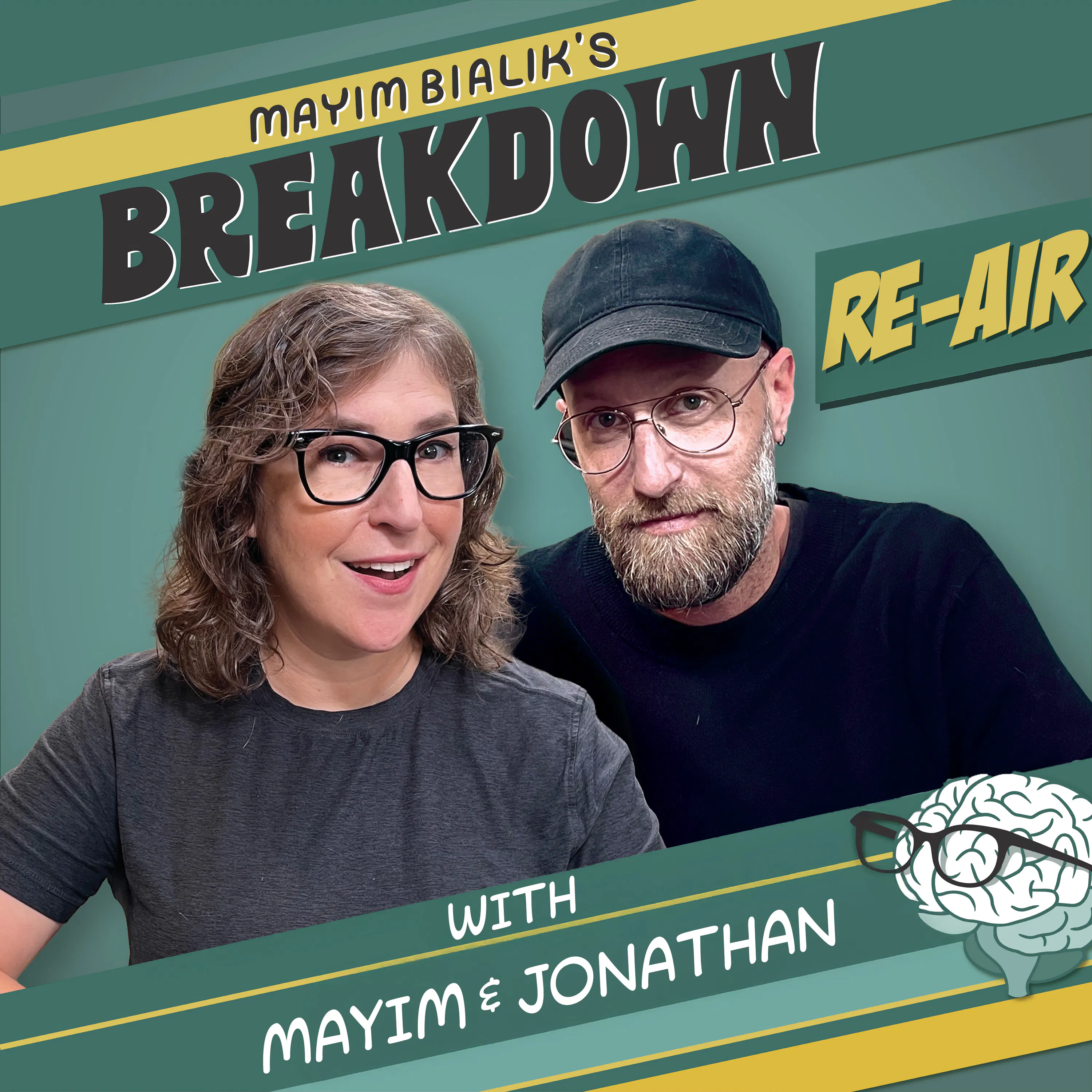
Mayim Bialik's Breakdown
Substack Live Re-Air: Every Thought Carries a Story. Childhood Programming, Core Fears, Subconscious Narratives, and How to Rewrite the Hidden Beliefs Running Your Life
00:38:22
Loading summary
Transcript96 lines
- [00:05]
Jonathan Cohen
Protein is now at Starbucks and it's never tasted so good. You can add protein cold foam to your favorite drink or try one of our new protein lattes or matcha. Try it today at Starbucks.
- [00:21]
Subaru Sponsor
This episode is brought to you by Subaru. Go further in a long range Subaru Hybrid with up to 597 miles per tank in the Crosstrek Hybrid and and up to 581 miles per tank in the Forester Hybrid. Subaru Love goes the extra mile. Visit subaru.com hybrid to learn more. Range based on EPA estimated combined fuel economy in a full tank of fuel. Actual mileage and range may vary.
- [00:45]
Mayim Bialik
Hi, I'm Mayim Bialik. I'm Jonathan Cohen and welcome to our breakdown. This is something really fun that's about to happen. We are sharing something today that was previously only available on Jonathan's substack page. Jonathan, what's your substack page called?
- [01:01]
Jonathan Cohen
It's called Practical Spirituality.
- [01:02]
Mayim Bialik
This conversation that Jonathan and I had is about, one could say, the invisible architecture that is shaping your reality. What does that mean?
- [01:12]
Jonathan Cohen
A question I ask all the time is, am I seeing the world as it actually is, or am I just seeing the narratives that I have built in order to survive? Do I need to update my perspective in order to have more connection, have more opportunity, have more peace of mind?
- [01:30]
Mayim Bialik
So many of the fights that we have with each other, not you and me, but all of us in general, are misunderstandings. But in many cases it's a misunderstanding between what you think the story is based on your own personal trajectory as opposed to what's the dynamic that's happening. And the more we can understand the sort of unconscious stories that we tell, the better we can go into the present without being burdened by the past.
- [01:58]
Jonathan Cohen
Sometimes we also talk about timelines. What timeline are we living in? As we've grown up, we have built narratives based on ourselves at a certain age. What is true in the present moment, how do we integrate that? How do we update how we view the world now and how we see ourselves in order to live more freely?
- [02:20]
Mayim Bialik
One of the reasons we wanted to share this conversation with you is because Jonathan invited me to his substack page to kind of have me explain anything that we could get to that would be neurobiological or neurophysiological. And what we do talk about, and we're so excited to share share with you, is how the grooves in our brain get laid down by the stories we tell and how easy it is for new experiences to be categorized along the deepest grooves, which in many cases may not even be accurate. How is that going to determine how you interact with your family, with loved ones, with potential dates, with friends, at your job? That's what we're going to talk about today.
- [02:59]
Jonathan Cohen
And Mayim does an amazing job explaining the neurophysiology. The other thing that we talk about is that each one of us have a handful, maybe even just a few core narratives that are actually shaping most of how we see the world. And if we can start to understand those, we can begin to shift them.
- [03:17]
Mayim Bialik
We really hope you enjoyed this episode. And please join us over on Substack on Mayimbialik's breakdown on my page and also Jonathan's page, Practical Spirituality, where, as you can tell, sometimes I will appear. But we're so excited to share this episode with you today. And we do lives every week, so make sure to join us over on Substack so that you can be the first to to hear this kind of content. But we are so glad to share it with you. Now, break it down.
- [03:40]
Jonathan Cohen
You don't even know what we're going to talk about yet, but I'm going to give you the pitch. Ready?
- [03:44]
Co-host/Guest (Possibly a therapist or expert)
Okay.
- [03:45]
Jonathan Cohen
Imagine if I were to tell you that each one of us, every moment of every day, is often caught in a distorted version of reality that we are making up.
- [04:01]
Co-host/Guest (Possibly a therapist or expert)
I would believe that.
- [04:03]
Jonathan Cohen
Imagine that every single one of our thoughts is actually just a tiny thread that if you start to pull, you will discover more thoughts and stories and whole narratives connected to just those little thoughts. And we think our thoughts are true. We begin to learn how to disconnect from them, to watch them. But what's actually happening is they're not just thoughts one wave after another. They are this interconnected twirling twine of mess that we have constructed, often in a way to keep ourselves safe from early childhoods, to predict pain and disaster and hardship. And we are trying to protect against that. And we've built these narrative constructions. And so while I believe that meditation is super important to not associate with a thought and follow them, sometimes untangling the thoughts and finding the narratives, the core story in the tangle of thoughts can help us become free to see the world differently and to experience life in a completely different way.
- [05:10]
Co-host/Guest (Possibly a therapist or expert)
I followed that. I like that. I'm into it. There's actually an exercise that I have done where you analyze fears from this perspective. You try and untangle the fear and get to the root fear, Try and get to the root of what's actually going on. The Example I like to give is like, if I were to tell you, you know, I'm afraid of losing my job, you could ask a dozen people. They're going to have as many answers as to why they're afraid of losing their job. Some people might say, I don't want to lose status. Some people might say, I don't want to lose the paycheck. Some people would say, I don't want to lose the ability to socialize with that person I have a crush on. Right. What is your particular fear? Right about Whatever it is. And those are going to be different. But generally what I have found is that they tend to resonate around the few core fears. Usually for each person, I'd be afraid
- [06:02]
Jonathan Cohen
I wouldn't be able to socialize with you anymore if I lost my job.
- [06:05]
Co-host/Guest (Possibly a therapist or expert)
That's an accurate fear.
- [06:06]
Jonathan Cohen
So, okay, I'm going to walk you through a few things that take what you just said and drill it down even further to show that interactions we're having are actually potentially real. Because it's easy to do with a fear. Right? You're like, okay, maybe I have a fear. I'm actually afraid of something else.
- [06:30]
Co-host/Guest (Possibly a therapist or expert)
Sure.
- [06:31]
Jonathan Cohen
What if you don't even truly see the nature of an interaction you have with someone, you say, oh, they don't like me.
- [06:38]
Co-host/Guest (Possibly a therapist or expert)
Oh, yeah, Or I'm not likable.
- [06:41]
Jonathan Cohen
Correct. Let's dive in to the filters that we are using every single day that are constructing our reality. So, okay, every thought starts with a story. That's just an idea to plant in the minds of our listeners as we continue.
- [06:59]
Co-host/Guest (Possibly a therapist or expert)
So everything you think has some story behind it.
- [07:03]
Jonathan Cohen
Every thought is the beginning of the story. And most of us don't realize we are living inside ones we don't even consciously construct. The challenge and the outcome of today's exercise is to start to be aware of how a single thought is actually backed up and supported by an enormous number of stories that you may not be actively writing. You may be playing these out.
- [07:29]
Co-host/Guest (Possibly a therapist or expert)
I was just given an exercise on this from a book that I'm reading. You didn't know that, and so I'm curious what you said.
- [07:34]
Jonathan Cohen
I didn't. We're going to connect this to the work of Bruce Lipton, the notion that these stories are actually our early reprogramming and we're going to explore them. So, quick, quick example, they didn't text me back. I must have done something wrong.
- [07:51]
Co-host/Guest (Possibly a therapist or expert)
Oh, totally. It's my favorite thing to assume.
- [07:55]
Jonathan Cohen
This shouldn't be so hard. Maybe I'm not good at this.
- [08:00]
Co-host/Guest (Possibly a therapist or expert)
Maybe I'm not good.
- [08:02]
Jonathan Cohen
I texted someone that we both know, like, four days ago, and I didn't hear back. And usually this person responds very quickly. And the reason I was texting them was because I felt a disturbance in the field. I felt a sense of things not being right and that this person may have been a little bit annoyed at me. And it happened, like, in October where they asked me something, and I kind of misunderstood what the ask was, and I kind of dismissed it, and I didn't really take it seriously. And like, two months later, it came back to me in this horrible feeling. And I was like, you know what? I really need to make this right. So I wrote to them and I said, I feel really. I wish them Happy New Year. And I felt really badly about it. And I acknowledged that, hey, I misunderstood this, and I'd really like to make it right with you. And then I didn't hear back, and it wore on me. And I. I had all the feelings, I had all the stories, and each time I. One of that. One of those things happened, that one of those stories came up, I would remind myself, wait a second. This is probably not accurate.
- [09:10]
Co-host/Guest (Possibly a therapist or expert)
So, first of all, worrying about anything technically doesn't make it. It doesn't really change the probability. I mean, it doesn't change the probability in the positive, for sure. Second of all, what we fear, it's almost always worse than reality. I'll say that there have been, though, and I'm not. I don't know about this particular interaction, but there have been times in my life where I did mess up. I did miss a text, I missed a call, and the person was upset, Right? And it's not so much like, what did I do wrong? But what's the lesson that I'm being offered here?
- [09:46]
Jonathan Cohen
So you and I have been doing something recently that I think actually we could share here because it's a fun practice related to story. We have been acknowledging the possible reframe of something that may previously have annoyed us. You being silly and playful and putting things on your nose, and people being like, mayim, stop it. You're interrupting this very powerful conversation that's unfolding about the nature of reality. I previously could have been like, she doesn't value my ideas. She doesn't take this seriously. She was recruited as the neuroscientist expert on this, on this.
- [10:26]
Co-host/Guest (Possibly a therapist or expert)
And now she has a crab sticker
- [10:27]
Jonathan Cohen
on her nose for this substack community. And she's making light of this, you know, but instead I said, I Value your playfulness.
- [10:37]
Co-host/Guest (Possibly a therapist or expert)
That's really nice. This actually happened. You sent me an email of something that you had sent to someone else.
- [10:44]
Jonathan Cohen
Normally you would, you would have said, who is this person? Why did you send them? I don't need them in our business. Blah, blah, blah, blah, blah. And instead. And I could hear all of those thoughts happening from two hours away. But instead, instead you wrote back.
- [11:01]
Co-host/Guest (Possibly a therapist or expert)
So, yeah, Jonathan had emailed something. And my first thought indeed was, why did he email this and what is this? And I did. And I, like, I got my defenses up and I got my back against.
- [11:11]
Jonathan Cohen
And you have a lot of story, right? You got a lot of story in that.
- [11:14]
Co-host/Guest (Possibly a therapist or expert)
Punch someone in the face about it. And then I, I realized I have to take a pause. That's not a serene reaction. So I thought about it, and even if I want to bring up to Jonathan at some other time, why did this person get emailed? I wanted to acknowledge that he took initiative in something and that he pursued an avenue. And that was very ambitious of him. And that was sincere. That's the thing too, right? That's sincere. Even if I have other thoughts, that's sincere.
- [11:46]
Jonathan Cohen
Let's now connect story and all the stories that happened. Let's really slow it down. Because when we try to identify the stories that are driving our lives, it's a very slow and meditative act to deconstruct them, to find the core root of it. What often happens is we have this reaction. We feel an intense emotional rush. We have logical, rational thoughts to justify that emotional rush, and then we take action. That's how most people live most of their lives. But instead, what we're suggesting and trying to encourage is the deconstruction of that drive, that reaction. So in that moment, you had a thought or you had an emotional rush, and then you had a thought, or that one feeds the other. So let's unpack the somatic experience and then identify the ideas that were running through your head that you thought were real. Like, this person shouldn't have been emailed. Why did they email her versus him? Talk about the somatic experience and then the rational experience.
- [12:50]
Co-host/Guest (Possibly a therapist or expert)
Well, a lot of people are not even aware of being aware, right? That like, we are actually are constantly experiencing things in our bodies that can indicate an emotion or a story. You know, someone said emotion is different than thought. We are not stoned. We're a lot more fun if we're stoned. When something troubles you, there is almost always a somatic correlate to that. And a lot of people would Say like, I don't need to think about that. I don't want to think about that. You don't have to, but. And there's information in that. So what's a very classic, you know, classic somatic response? Tightening in the chest. Right, Tightening in the chest. Another one. A clenching in the gut, a constriction in your throat. You know that feeling when you're trying not to cry, but you want to cry, and it kind of feels like a. Like a pain, you know, kind of like an ache in your. Well, maybe it's just me. It feels like an ache in your throat and behind your head. Like those are somatic indications that something feels constricted, caught, you know, something is stuck emotionally, as it were. So I think this notion that there is a somatic correlate, Many of us shoot right past that and we go to what we think is a legitimate feeling. A lot of people don't know this. I did not know this. And I studied the brain and nervous system, the course of emotions is that something will happen and you will have a spike in intensity. And you know, happy to talk about, like the neural correlates of that and all the things. You will have a spike in intensity and it causes a rush of sensation and neurochemical things. It's fascinating. It causes blood to flow different places. If we're talking fight or flight, you literally will have a difference in blood distribution. If anyone's ever had brain fog from something intense happening, it's literally because all systems are not thinking, what's the rational response to this? The systems are thinking, do I need to run or do I need to punch someone in the face? Right. So that will peak. And most of us react from that peak. Most of us think that we're responding, we're actually reacting. And the key is, is to respond and not react when that peaks. And it even can happen with a positive emotion if you tell someone you love them. Right as you're having an orgasm. I don't know if you're gonna feel that when you're not having an orgasm. The notion is the place when we're at the peak of emotional intensity is typically a lower brain reaction and not a response. A response. Looks like I'm gonna let that peak settle, I'm gonna let it stabilize. It doesn't mean that if we're upset that we're no longer upset. It means that the rush that our primitive body. We are just animals. The rush that we get, especially if you're a person who has a startle reflex if you have any trauma, if you get startled, right. The response you could choose is either to fight, to flee, to freeze, or to fawn. Once that calms down, we actually get to see where things lie. That's when you let the physiology quiet down and see what does the cognitive part of me say? What does the somatic part of me say? What's the story behind it so that I can respond. I purchased some used furniture from a friend of mine and I completely rushed the timeframe of being given the price and saying yes and doing a thing. And that's all I needed was to pause. Because pausing takes away the, the urgency, it takes away the like excitement, it takes away the intensity. And that is like one of the greatest gifts I think that we can give. You know, our nervous system is that gift of pause. Like nothing is life or death unless it's life or death.
- [16:38]
Jonathan Cohen
Beautifully said. So much wisdom in what you just communicated and I love your examples.
- [16:44]
My Ambialix Breakdown is supported by Shopify.
- [16:47]
Mayim Bialik
Starting something new isn't just hard, it can be downright terrifying. So much time and effort goes into this thing in the pre planning phase, you're not even sure if it's going to work out. It can be hard, you know, to make that leap of faith. Trust us, we know. I mean when we started this podcast, we really didn't know what we were doing. What if no one wants to come on?
- [17:04]
Co-host/Guest (Possibly a therapist or expert)
What if nobody listens?
- [17:05]
Mayim Bialik
What if I make a fool of myself? Now we know we were right to believe in ourselves despite all our fears, hesitations. And that also it helps when you have a partner like Shopify on your side to help like we do. Shopify is the commerce platform behind millions of businesses, businesses around the world and 10% of all e commerce in the US from household names to first time business owners just getting started to a little podcast like maybe Alex Breakdown. Shopify has been our one stop shop
- [17:31]
Co-host/Guest (Possibly a therapist or expert)
for all of our merch store needs
- [17:32]
Mayim Bialik
for the past many years. Now get started with your own design studio. With hundreds of ready to use templates, Shopify helps you build a beautiful online store that matches your brand style. Accelerate your efficiency whether you're uploading new products or trying to improve existing ones. Shopify's package with helpful AI tools that write product descriptions, page headlines and even enhance your product photography. It's time to turn those wh ifs into with Shopify today. Sign up for your $1 per month trial today at shopify.comdowndown go to shopify.comdown that's shopify.comdown
- [18:08]
Jonathan Cohen
maybe Alex Breakdown is supported
- [18:09]
by no CD have you found yourself
- [18:11]
Mayim Bialik
stuck replaying conversations over and over, trying to feel comfortable, completely sure that your friend doesn't secretly hate you? Or have you spent hours researching a minor ache or pain, even after a doctor said you're fine because your doubts and fears just wouldn't go away? You might be surprised to learn that experiences like that, where a distressing, unwanted thought gets stuck in your mind and
- [18:33]
Co-host/Guest (Possibly a therapist or expert)
you feel like you have to do
- [18:35]
Mayim Bialik
something to try and solve it, stop it, or feel 100% sure about it, can be a sign of Obsessive Compulsive Disorder or ocd. OCD is nothing like the stereotypes that you like getting things organized. Real OCD is a serious condition that can focus on anything. Your identity, your morals, your relationships, your sense of reality. But what makes it so debilitating is that it often fixates on exactly the things you care about the most. I've struggled with OCD myself, so I know how misunderstood it is and how hard it can be to even figure out what's going on on, let alone get the right kind of help. That's why I'm telling you about nocd, the world's leading provider of specialty training to identify and effectively treat ocd to help you manage it so that you can get your life back in live, face to face virtual sessions. They help you reclaim your time, confidence and freedom. NOCD is covered by insurance for over 138 million Americans and includes support between sessions so you never have to face OCD alone. If any of this sounds like you or someone you love, NOCD can help. Book a free 15 minute call to get started at learn.nocd.com break that's learn.nocd.com Break.
- [19:49]
Jonathan Cohen
Mind Bialix Breakdown is supported by Cozy Earth.
- [19:52]
Mayim Bialik
What does comfort that actually carries you from morning to night feel like? For me, it starts with a pair of Cozy Earth socks. I am not even kidding. Sometimes everyday comfort begins from the ground up. I love these socks so much. They are soft, they are supportive. And you know what? They make every step feel intentional. And that same attention to detail is in everything they make, from elevated loungewear to breathable comforters that genuinely help you rest deeper at night. Kind of makes you think, what if the everyday things you rely on were built with intention? Because how does what you use every every single day shape how you feel? Cozy Earth focuses on comfort in the details. The fabric, the fit, the way it drapes, the way it breathes. Small choices made well that add up to a big difference. Whether we're on the go or winding down at home. It feels like a quiet little piece of luxury woven into our routine. And here's the best part. It's completely risk free. You get a 100 night sleep trial to try it for yourself. Seriously, sleep in it, live in it, wash it. Repeat returns are easy. But after you finish, feel this level of comfort. We have a feeling you won't want to let it go. Plus it comes with a 10 year warranty because real comfort should last. So this March, upgrade your everyday with Cozy Earth comfort crafted with intention. Discover how care in every detail transforms simple routines into moments of true comfort and ease. Head to cozyearth.com and use our code BREAK for up to 20% off. And if you get a post purchase survey, be sure to mention you heard about Cozy Earth right here.
- [21:18]
Jonathan Cohen
Experience the craft behind the comfort and
- [21:20]
make every day feel intentional. With Cozy Earth
- [21:25]
circling back to the moment where you got the email, you had an emotional reaction. Talk about the. The narratives that went along with the emotional reaction because what you ended up doing was reframing them. Which is what I want to talk about next. Identifying the narrative and then reframing it.
- [21:43]
Co-host/Guest (Possibly a therapist or expert)
I would point people to the book Difficult Conversations, which talks about the three levels of a conversation. There's what happened, there's kind of what we think happened, and then there's what we think about what it says about us that is reflected in what happened. It's a fantastic book, very, very easy to digest and really changed the way I think of all conversations. So in that moment when I felt that frustration, what I thought was, I'm not in charge. I don't have authority to be in charge. He's running roughshod over life and business. And also, I don't have agency. I don't have agency to say I'd prefer we not speak to that person. I don't have any agency because I don't have. I mean, let's just like go there. I don't have the intelligence or the smarts or the, you know, skills to be able to discern. Right. What we should or shouldn't do about this particular email. And this is what I'm talking about. What's the core belief? You know, usually like useless, hopeless. I'm not just saying for me, although it could apply to me, but those are some of those core things, like I don't belong. I'm not lovable. I'm unwanted alone. I'm gonna die alone. Right? That's where. And you're not consciously thinking that, but those are all the stories, as Jonathan just indicated. That's what's stacked up behind it. And it becomes, why'd you send that email? You shouldn't send that email when what it really is, is. I don't know how I feel about this person being involved in this conversation. I need a minute.
- [23:19]
Jonathan Cohen
All of that, all of those stories operating in milliseconds, fractions of milliseconds, that's actually what is guiding our perception of reality.
- [23:32]
Co-host/Guest (Possibly a therapist or expert)
Fear.
- [23:33]
Jonathan Cohen
All the time. All the time fear.
- [23:36]
Co-host/Guest (Possibly a therapist or expert)
Someone just wrote fear. Fear and resentment. Fear and resentment are going to keep coming up. And someone wrote very early in this live, all of these things are what separates you from God, from your source, however you want to call it. All of these things. That's the. That's what's standing in the way of you being a person who says, I'm close to God, I'm close to something bigger than me. I'm not in charge and I don't have to figure it out. That's source, whatever you want to call it.
- [24:01]
Jonathan Cohen
50 million bits of data per second, we are aware of 40.
- [24:06]
Co-host/Guest (Possibly a therapist or expert)
Says you. I'm aware of 400.
- [24:08]
Jonathan Cohen
I can't really over emphasize the profoundness of what was just shared. And you shared it so beautifully. An email to an emotional response to the meta awareness, which is really what separates us from what we believe is almost all other creatures to have a realization that our minds are constructing this very complex web of narratives, most of which are somehow making us feel weak, less than in danger of some kind, stupid. And that sparks our belief that the other person has done something wrong in the mind, being so clever, doubles down and says, why did that person do that? They are wrong in some way and pits us against each other. And the act and the exercise that you went through of not buying into those stories, you didn't even have to unpack all those stories in that moment. What you had to do is separate them and choose something differently, which was. I'm going to focus on a positive attribute that may explain why he did what he did.
- [25:16]
Co-host/Guest (Possibly a therapist or expert)
Really great comments. I really like this community you have. I also feel very excited to be here. Thank you, Jonathan. I was also going to say one of the most prominent and potentially damaging places where this can change a life is if you are a parent or a teacher or anyone who's ever been in charge of supervising, taking care of, or managing small people. John Mulaney has a bit about how children will criticize you in a way that finds Your deepest fear, like insecurity, your voice is too high and there's a darkness in your soul. And like, only a child will look at an adult and be like, there's something deeply wrong with your, the essence of who you are. But anytime you parent and, you know, I say this as someone who, you know, has an anger problem in the past, definitely had an anger problem that my children are happy to talk to me about. As a person who does believe in what is known as gentle discipline, which is a lot more talking than talking to, I will say that a child can get under your skin and push buttons you didn't even know you had, because simply a child saying no can create a feeling in you as a human that you're not respected and they need to respect you and I need to restore order. And who are they to think. And all of a sudden you sound like, you know, the grandparent that you heard, you know, horror stories about their discipline. Right. A child will bring this out. And this is why children are a mirror, you know, they're a total mirror of all of those parts of you. And for them, even a toddler pushing a boundary is a healthy and, you know, developmentally appropriate stage. For me, like there were certain things. If you do not eat when I tell you it's time to eat, it made me lose my mind. If you don't sleep when my clock tells it's your nap time, what is happening and what it is, is it's bringing up all these things of, you know, I don't have authority, I'm, I'm useless. Right? It always gets back to that. Always gets back to those, those core fears.
- [27:42]
Jonathan Cohen
I used to say that monks can achieve enlightenment sitting in their monasteries, but put them with a two and a three year old for three weeks and see how they do. Children, show us also what we did not get growing up. Those stories about not being in control, not having authority, not being respected, they didn't start in your adult years. They were layered in.
- [28:07]
Co-host/Guest (Possibly a therapist or expert)
Nothing started in your adult years.
- [28:09]
Jonathan Cohen
Okay, so we don't choose most of our early programming, but we do get to choose what we keep. That is the work. The work is moving away from a reactivity, assuming that everything we think, everything we feel is legitimate is defensible. Our mind is going to go through a circus of tricks to help us defend and prove that our emotions are real and valid and that person is in the wrong. But what happens when we start to deconstruct it? That is the work that we've been Talking about for 2026 on this page and in this community, trying to shift our states and have more perspective so that we can have more peace, more calm, more intuition. Dr. Tara Swart recently published a piece saying that intuition starts with regulation. When a lot of this community talks about wanting, extra sensory perception, wanting to feel energy, wanting to think about remote interactions, whether it's connecting to someone else, whether it's feeling something else, intuiting, connecting to a larger consciousness system, it starts with a sense of regulation so that we're not in that reactive state. Psychotherapist and former podcast guest Lori Gottlieb, author of maybe youe Should Talk To Someone, explains. People come into therapy thinking they need insight, but often what they need to do is rewrite the narrative. I'm not lovable, I'm not good enough. What if those are not it? And I'm gonna give you a couple of poor narratives that act as protection because everyone has a couple, one, maybe three of these core narratives or beliefs that are actually under every single fear, every single narrative that they have that I'm not lovable, I won't be safe, I don't matter. And some of the ways that they show up is if I'm not agreeable, I won't be loved. If I don't keep the peace, I won't be safe. If I don't achieve enough, I won't matter. If I don't speak up, I won't get hurt.
- [30:21]
Co-host/Guest (Possibly a therapist or expert)
Think of the mean voice in your head. Those are the. Those are stories that you didn't put there. The I'm stupid, I'm fat, I'm ugly, like those voices. That's not you. That's something that you may not have a memory of someone telling you you're stupid, you're ugly, you're fat, or whatever it is. But the notion that that voice has taken over a part of that level of criticism, judgment, control, that's what we're talking about. There's a story behind that voice. That's what's running the show.
- [30:53]
Jonathan Cohen
These internalized stories often belong to someone else. A parent, a teacher, a system or a survival response. They become the emotional operating systems shaping how we interpret feedback, measure success. And here's the most important one for me, define what's possible.
- [31:12]
Co-host/Guest (Possibly a therapist or expert)
Oh, woo. I don't like when you talk about this. For many of us, those stories in, you know, like psychoanalysis, those are called limiting beliefs. You know, those organizing principles are limiting beliefs because they're literally the point at which we stop. I'm unlovable, so I'll just have lots of insignificant relationships with people who don't love me. And I never have to know if someone can love me, right? Meaning, like, those are the things that. That lead to those things. I know a lot of us, or at least me, you know, we tend to be like, o, that's where I'm anxious. That's where I'm depressed. Guess what? People who are narcissistic, people who are grandiose, people who are like, I'm untouchable, I'm perfect. Those people have the same fears as those of us who are, like, cowering and sad, right? It's. It's two sides of the same coin, right? Will you hurt me if I get too close? Here are the skills that I have to never find out, right? That's where a lot of. That's the story a lot of us are operating from. And the notion of what's possible then becomes, what if you did not have limiting beliefs? What if there was no limit to your beliefs? Anything could be possible. You could be more lovable than you thought you were. You would not pursue a relationship where ultimately you thought you couldn't do better. You know? And a lot of times, if we're in an unhealthy relationship, we, oh, but I love him, or, oh, but I love her. She's gonna get better. A lot of times that may be true. It's not for me to say. Many times it's because we don't think we've got what it takes to do better, Right? So in terms of what's possible, and Jonathan always talks about this, and I know this is why a lot of you are here, and I won't invade every live, but I'm enjoying being here. Jonathan talks a lot, you know, in my life, personally, also, what is creativity? Creativity is this notion of what if I imagine things that aren't possible? So when you're doing improv, which I dislike greatly, the answer is never no, because it's always yes, yes, yes, yes, yes, yes, yes, yes, yes. And if you have a closed or a limited belief system kind of operating, separating, that's going to shut off creativity. If there's anyone that you know, whoever is like, I'm not good at art. I can't do a vision board. Those people have an inner critic that is running the entire show of their creativity, right? That fear that I'm not good enough, that it has to be pretty, like, that's a different story. Those are the stories that make you not able to then be open to what's possible. It's not about what the vision board looks like. It's about what it creates for you in possibility, in potentiality, and in the neurophysiology. Right. Of manifesting.
- [33:45]
Jonathan Cohen
Yes.
- [33:46]
Co-host/Guest (Possibly a therapist or expert)
I now run practical spirituality with you.
- [33:49]
Jonathan Cohen
You're going to be invited back at this rate. You don't just think your stories, you live them. Dr. Lisa Feldman Barrett. How Emotions Are Made shows that the brain constructs emotions by interpreting body signals through narrative. If the story is I am not safe, then even a neutral sensation becomes anxiety.
- [34:12]
Co-host/Guest (Possibly a therapist or expert)
That's called dysautonomia. And many, many women are diagnosed with it, in particular in a certain stage of life. Yeah, that's that also inability to be able to distinguish. Right? It's the inability to distinguish, like truth from fiction.
- [34:30]
Jonathan Cohen
These imprints become biochemical records in the body.
- [34:34]
Co-host/Guest (Possibly a therapist or expert)
That's the grooves in your brain that we talk about. It's like a record, you know, when you get to the start, for those of you who remember LPs, when you get to the start of a song and it's that deep groove, right? We slip right back into that.
- [34:46]
Jonathan Cohen
So these affect perception, what we filter in or out, regulation, how safe or reactive we feel, relationships, how we interpret tone, silence and body language, or even,
- [35:00]
Co-host/Guest (Possibly a therapist or expert)
I mean, also how we interact with others. You know, I'm keenly aware of micro movements in other people's face. Some people would say, like, oh, you understand their energy. I just think, like, my eyes are laser focused. I was being interviewed by Kai Dickens for the Telepathy tapes. I was talking and I saw it in her face that she read, and it was so tiny and it, it, you know, threw me off for a second and my brain was like. And I, I, you know, I backpedaled. And then I found it and we were back on track. But I thought, you know, how many people, especially, you know, all the special people that are in our lives or people on the spectrum who maybe are not tuning into those things. Right. And will continue talking past when someone is listening because they're not picking up right. On those signals. So I was actually thinking about that in terms of I can construct an entire story. And depending on how your brain is wired and mine is wired to operate extremely quickly, Right. At least at this age, it's still trying. It sometimes takes a beat to say, you know what? I lost my train of thought. I'm gonna need a minute. Right? And I was thinking, that's why some people are better BSers than others. Cause you can just constantly, right, get feedback in that moment to reorient disruption,
- [36:17]
Jonathan Cohen
recognizing the story that you're in. So first is to identify and understand the concept that we are all in stories almost all the time. How to identify the emotion and somatic experience of the narrative that you are telling. And if that narrative is causing you anxiousness, if it's causing a perpetual flywheel of negative effects, limiting yourself, identifying that and trying to rewrite it. If I can speak to one thing, it's the. It's the notion of what is possible. We constantly build small little worlds for us to live in and then wonder why we're cramped. First thing to ask yourself, what story am I telling right now? What story? Start to pick that one thought and pull the thread to find all the other thoughts and keep going, keep pushing yourself. Ask, what is the story? What is the core belief at the center of these thoughts? Whose voice is this?
- [37:18]
Co-host/Guest (Possibly a therapist or expert)
That's one of my favorites.
- [37:20]
Jonathan Cohen
Where did this come from? Is it yours? It may feel so much like you that you don't even recognize where it came from, but the likelihood is you will find the source if you keep tracing it. Last one. What else might be true? Can I reinforce an alternative version of this reality? Because there are so many different facets that make up what could be possible.
- [37:43]
Co-host/Guest (Possibly a therapist or expert)
I always think in terms of, you know, books and kind of therapy. One of the greatest places to do this is. And this is if you have those resources and if it's available. So somatic therapy is actually not therapy where someone is necessarily touching you. It's a kind of therapy that teaches you to track the sensations in your body as they relate to thoughts, feelings, and stories. The work of Alan Gordon, which is kind of similar to the Dr. Sarno way of thinking the way out is something I would absolutely recommend as well. I also wanted to give a shout out, you know, Jonathan, to David, David Rico, how to be an Adult in Relationships. He talks about a lot of those stories and the patterns and specifically how they play out on relationships. Also, Michael Singer, Untethered Soul helps you understand sort of thoughts and where they live. And I also wanted to give a shout out to Pete Walker, who wrote Complex ptsd. For those of you who do have a PTSD diagnosis and are curious about the stories and where they live. It's a fantastic book.
- [38:42]
Jonathan Cohen
Look, when something feels off, things to look for is emotional charge that doesn't match the moment.
- [38:48]
Co-host/Guest (Possibly a therapist or expert)
Have you ever been accused of being dramatic, which sometimes is not an appropriate diagnosis, but if you've ever been accused of, like, you're so sensitive, right? In some cases it could be just that you're so sensitive. But for me, I often have reactions that, as I describe, are from another timeline.
- [39:07]
Jonathan Cohen
I'm going to get to timelines in a minute because we actually had an experience of a friend who thought that they weren't invited to something and wanted to blow up our friendship because there was a miscommunication thinking that the invite wasn't sent. And what was really underneath that was a very deep story of they're not valued, they're not important, they can be dismissed, and ultimately they're not lovable. Repeated dynamics in a relationship, if you constantly find yourself being like everyone's always excluding me, it may be that you're interpreting natural disorder of social dynamics as very personal. Other things to look out for, thoughts that feel rehearsed, rigid or absolute. The absolute one where there's no other way. That to me is the same small cage that we build for ourselves and catastrophic thinking or binary conclusions. So looking to shift from reaction to observation, asking ourselves what if this isn't the truth? Just one version of it. There are so many stories since I
- [40:11]
Co-host/Guest (Possibly a therapist or expert)
mentioned somatic therapy, internal family systems therapy or ifs is a style of talk therapy. I think dialectical may also get into this a little bit, but I could be wrong. The notion of literally finding out where did this story come from? That's not you, it's a part of you. All that stuff. Very, very helpful method of therapy if you're interested in that, that path.
- [40:34]
Jonathan Cohen
This has been fantastic and very aligned to our 2026 mission. The idea of more Imagine those little boxes built for ourselves if we can expand out from them to look outside of those boxes, to break them down even. The closing sentiment I will leave us all with is you are not the story, you are the one choosing which stories carry forward. It's my be all express breakdown. She's gonna break it down for you. She's got a neuroscience PhD or two and now she's gonna break down so break down she's gonna break it down.
- [41:15]
Athletic Brewing Co. Sponsor
This episode is brought to you by Athletic Brewing Co. No matter how you do game day, on the couch, in the crowd or manning the snack table, Athletic Brewing fits right in with a full lineup of non alcoholic beer style. You can enjoy bold flavors all game long. No hangovers, no buzz, no subbing out for water in the second half. Stock the fridge for tip off with a variety of non alcoholic craft styles. Available at your local grocery store or online at athleticbrewing.com near Beer Fit for
- [41:44]
Co-host/Guest (Possibly a therapist or expert)
all times Spring just slid into your DMs. Grab that boho. Look for that rooftop dinner, those sandals that can keep up with you. And hang some string lights to give your patio a.
- [41:54]
Mayim Bialik
A glow up.
- [41:55]
Co-host/Guest (Possibly a therapist or expert)
Spring's calling, Ross. Work your magic.