← AI to ROI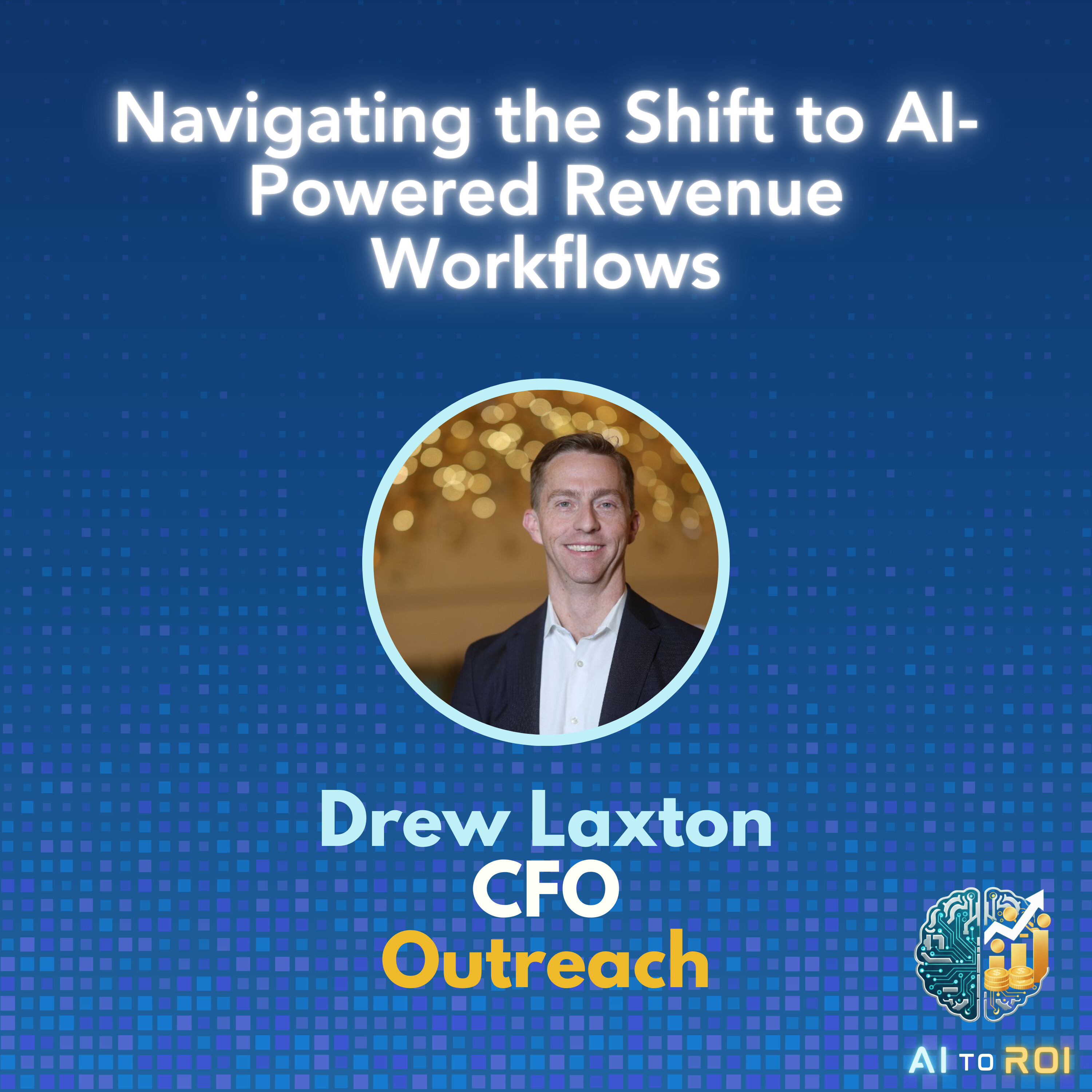
AI to ROI
Navigating the Shift to AI-Powered Revenue Workflows - A CFOs Perspective with Drew Laxton, CFO Outreach
00:31:10
Loading summary
Transcript42 lines
- [00:00]
A
Foreign. Welcome to today's episode of the AI to ROI podcast, formerly known as Metrics Measure Up. Today I am joined by Drew Laxton, the CFO at Outreach. I'll be covering four topics with Drew today. First, the evolution of outreach in 2025 and what to expect heading into 2026. Second, how outreach is using AI to drive financial performance. Third, the role of the CFO in determining the ROI for software investments, specifically AI software investments. And then a little bit of our passion here, the evolution of SaaS performance metrics in a variable pricing world. So with that, Drew, would you mind taking a moment to give a brief overview of your journey to becoming a guest here on the AI to ROI podcast?
- [01:01]
B
Thanks Ray. I appreciate you having me on. So, like I said, Drew Laxton, I'm the CFO at Outreach. I have a pretty traditional finance background. I started my career in banking. I came up through Wall street kind of non traditionally for a SaaS CFO or software CFO. I started my career in oil and gas. I moved out to Seattle probably about 15 years ago now and I transitioned into software finance from there at a company called Aptio. Took the company public and then back private and joined Outreach soon thereafter. I have an interesting Outreach story because I came in to run the FP&A and the analytics teams here. In 2023 I left the company to go be CFO of a different company. Just natural career trajectory. About a year ago the team reached back out to see if I wanted to come back to be the cfo. And initially I thought to myself I was in a good position and I wasn't sure if I wanted to. But when I met the CEO and I didn't overlap initially, he explained where the company was going with the AI products and it just couldn't have aligned more with my vision of where the company in this space needs to go in general. And I know we're going to drill down more on that, but I've been back for about a year now running the finance organization of the whole company.
- [02:10]
A
Okay, well the timing of your departure and return is very interesting because most people heard about Outreach when you were the leading sales engagement platform. But over the past couple years a lot has changed in a category. So can you provide a high level summary of who outreach is in 2025 and probably most importantly, where are you headed in 2026 and beyond with your AI powered revenue workflow?
- [02:36]
B
For sure, and I love the term AI revenue powered workflow because that's really where we are. Yes, to your point, you Know you ask around about outreach. We have a lot of brand equity, but it's generally thought of as a SDR tool. How do we go build more pipeline? But we've always had the workflows, we've always had the understanding of cycle, of the sales, of the entire sales cycle. And in 21, in 2021 we built out our opportunity management conversational intelligence tool. We did a small acquisition as well to build out a forecasting tool. And AI has run through the product for quite a long time. There's been a lot of understanding of how opportunities are moving. But what you're talking about and the reason that I came back is what we've done now. We have added agentic AI into the platform to go help those workflows where there's manual processes and automate them for sales reps. And what we do at its core is we make your AES more efficient. And if you think about all of that history of the company, we understand all the little movements that have an opportunity move through the sales funnel, we're able to take that and automate where we can. So you think about something as simple as our first one that we released as our revenue agent and that allows companies with just a natural language query to go and prospect within their core market, their icp, the way that they design it. And it's automatic, it happens in the background and it's not form letters. These are emails that are tuned to the data that you have, the interactions that you've had previously. And it works automatically so the sales rep doesn't have to be in there writing email after email. And we're just going through. And to your point, as we think about 25 and really 2026 is finding these places within a sales cycle that are just slow moving processes and we automate them and we can do that within the platform. So these are all out of the box. There's very little configuration that happens on the other side of it. So we're able to just go to our customers and stamp these out. To your point, again, we're going to talk about this a little bit more. It's also priced differently. We're going with a consumption based pricing model on that. So you have an underlying SaaS platform that's existed for a long period of time and then all this AI that sits on top of it, that continues to grow, which makes it a really fun place to come to.
- [05:04]
A
I wanted to go back because you mentioned it and you almost mentioned it in passing. I think you said in 2021 22. You did introduce a forecasting product or module. And when I think about AI and all the talk about how do you really measure the return on investment for these AI software investments? Now you've got forecasting as part of your product. Has this evolution for outreach changed who the economic buyers are of your product?
- [05:33]
B
It has through the years. I mean, we really, like I said, we started out with teams, more like marketing SDRs. Our economic buyer now is generally either the chief revenue officer of a company or the head of revenue operations for the company. And you think about those buyers, their. Their needs are different. They think about the company more holistically, not just how an individual is working, but how the whole company is working. And frankly, these are the tools I use, which I love Outreach. For that reason, I'm in there all the time, because we do have a bit more of a manager's view of the world sitting within the product. And so, yeah, I think that's going to continue to be the case as we evolve the product. You're going to need a more centralized team thinking about tools like outreaches. So how you're going to implement AI, how you're going to implement forecasting, really does sit at that leadership level.
- [06:28]
A
Okay, Drew, I'm going to double click here to see if the dogs are eating their own dog food. Do you guys use Outreach at Outreach?
- [06:37]
B
Of course we do. I think we're a good user of outreach. That's actually one of the fun things about working at Outreach. As a cfo, you think about a lot of other companies. You can't use your own tools if you sell security software unless you're on the security team, which is a relatively small team in the grand scheme of a larger company, you're not using the tools. Well, our entire sales team uses outreach every single day. We use our conversational intelligence tool. We use our workflows, we use our AI, we measure it, we talk about it, we talk about what's going on there. The other fun thing is I get to get in the tool a lot. I use our forecasting tool, we call it Commit, almost every single day. And it's great because it puts me and the sales team in the same tool with the same forecast. And you think about how everything worked. Before there were good forecasting tools. It was the mix of spreadsheets and everybody's favorite Salesforce report that they clicked on. And you had different leaders using different reports, and you kind of had to figure out your way through it. Now we're all in the same tool. We use the same forecast, we talk about the same deals in the same way. It just puts everybody on the same page and it makes it much easier for my team to go through and think about what the current quarter is going to look like.
- [07:49]
A
Okay, so Drew, I can see as a CFO while you're, while you're in there, because the forecast, at the end of the day, you're probably communicating that with your CO to your board. But let's talk about that team underneath you, your FP and a or your finance analytics team. Because one of the big values I see beyond having real time signals coming in. So to validate the forecast, it's going to also help even with your annual planning or your quarterly review on the plan to see if you need to change that going forward. Is that accurate?
- [08:20]
B
It's absolutely accurate. So the go to market finance team, so the FP and a team that sits within my organization is in there all the time and use the tool and understand the forecast. It's funny, it actually goes beyond that. Think about the legal team that's thinking about contracts. They can be looking at deals that are coming and anticipate things that might move for them. Think about the order management team that can look at things that might be complicated, deals that are coming through and they're all in one place and you're getting the signals of where that may come from. And again, it's because we're all working off of one playbook there. So it makes such a big difference across the company. It makes it way easier for us to flag when things might get complex.
- [09:00]
A
Yeah, I'm going to pivot just a little bit here because one of the biggest issues and the reason that we have evolved our podcast to the AI to ROI podcasts is there's so much, I'll say, noise around this AI tool or that AI tool, AI native applications or SaaS, tools that now have AI enabled. What do you see as the CFO's role in evaluating, approving, and then basically analyzing the ROI you're getting from AI tools? So I'll just ask, how do you do it in your own company?
- [09:39]
B
Yeah, you know, it's not dissimilar from how we thought about software or, as you know, we've taken on SAS software as tool proliferation has happened. I want to see something either impact our top line or our bottom line. Otherwise it probably isn't worth doing. But a lot of the AI tools that I've seen so far and the ones we've implemented and had success with, there's kind of boring. Outcomes that are very impactful. I think about things like our QA process within the coding side has very much streamlined and these tools that can move through your code so much faster than an individual can. And it's use cases like that. We use our own tools on the sales and go to market side. So that makes a big difference. But I'm seeing things pitched to us that are really interesting on the sales coaching side and I do view me having role in that. If this can impact each one of our sellers or each one of our engineers or product managers or support team to be able to move faster and have just a better overall quality of life, then that's a victory because that's going to be a happier workforce that's going to work faster for you. And so like I said, it's a little hard to measure some of these individual pieces. This is what I love about outreach. It's very measurable. Right. We know the baseline before we turned on our AI and then we know the return after we have turned on our AI on pipeline and time to close and your deal quality. But I still think these softer ones are very valuable. The other piece that I'm pushing everybody on is we're a little unique being a software company that focuses on AI. But I want people to be in playing with these tools because it gives people ideas on how to think about our tools. What other use cases could we use? We started using our own tools to go and as we have these new SKUs coming out to check if our AES are pitching the new tools well, we can have an agent that's running across all the calls and all the emails of saying who is and who isn't what teams are being good and bad about that. We frankly got that idea from somebody else pitching that idea. But we realized it was really easy for us to just spin up in the tools that we have. So there's this softer side of trying to get people curious about where AI is going and I want to keep pushing people to do that.
- [11:57]
A
Yeah, it'll be interesting, Drew, because a lot of the benefits today from AI software, I'll call them personal productivity. I can have higher quality messages going out. I can have a higher conversion rate from activity to qualified sales call. I can have better funnel conversion to win. Like you said, win rates higher, maybe cycle time. But at the end of the day, Drew, when you're presenting to the board, they're really interested. Is it driving revenue growth faster? Is my operating profitability or EBITDA Higher my expenses lower? Is my ARR for FTE higher? So my question to you is, is that, right, that over time it's going to have to be a financial roi, not just a predictivity gain roi.
- [12:49]
B
I mean, you're talking to the cfo, so obviously that's the case, right? We either need to be growing faster or more efficiently or gaining efficiencies on the bottom line. And so where that helps us is maybe we can increase quotas a little bit, maybe we can have engineering capacity grow a little bit because we're putting these tools in place and it gives the individual just a little bit more productivity, a little bit more of an edge. And for sure we see that in the numbers ultimately.
- [13:19]
A
So this is something I'm asking every CFO I talk to now who has invested and AI, whether it's in their product, it's built on top of their product, it's native to their product, etc. You know, one of the great things about the SaaS industry, about 80% gross profit, right? Or gross margin, I should say. And when I look at AI native companies, I'm looking at 60, 65%. So my question to you, Drew, is are you concerned and did you evaluate how building AI and LLMs into your product could impact your gross margin?
- [13:58]
B
Oh, of course. I mean, that's something that we talk about fairly often. And for certain, our gross margin is worse on our AI products than it is on a traditional SaaS product. I mean, gosh, we on even like our forecasting tool, the gross margins are massive on that because there's just not a lot of compute, there's not a lot of data storage that's behind that. The compute on a AI product is massive. One thing I will say though, in just the year I've been back, I've seen a step function improvement in the underlying cost of these models. And I think it's happening on two factors. One, you're just going to see a Moore's Law, I'm convinced, in step function change in the compute power and that we're able to pick up on these LLMs. The other piece is I think we're figuring out how to code them better and how to make sure that we don't need to be running the Ferrari when the Ford F150 works and be able to run the right model for the right use case. And that's going to continue to improve as we need to make sure that that is all running correctly. We don't want to give up performance. Performance, I think, is Actually very important in this time frame when everybody is testing and trying to understand what products do what what products do well. But at some point this gross margin piece is going to become important because you know, I think about early in my career in sas, we kind of threw out gross margin and a lot of our calculations we didn't need to think about it because, oh, it's you know, above 80% and improving things like we do need to bring gross margin into our understanding of SaaS tools because it's just not the same and that impact has downstream impacts. You've got to be more efficient on the go to market side to make the economics work. You've got to be efficient in the way you deliver everything else within the company. Otherwise the just traditional metrics don't hold up.
- [15:42]
A
And Drew, we're going to talk about metrics next and I'm excited about that. But who do you have as the executive responsible for those gross margins for your AI products? Is it the head of R and D? Is it finance? Who is it?
- [15:56]
B
Yeah, you know, it is kind of a triumvirate of our head of product or head of engineering and me. And we work together a lot on it and we have people underlying on each one of those teams that's thinking about it. Literally every day that they get up, they're thinking about how we're going to improve this. So as we think about pricing and packaging that generally sits in our product organization, they think about gross margin a lot. The engineering organization thinks a lot about the underlying infrastructure that we're using in places that we can optimize there. And that all comes together within the finance team to make sure that it's just kind of the scorekeeper and it's the way I view the finance organization is that somebody is sitting there kind of checking the people who are checking this to make sure that we all agree that we understand we're working off the same playbook.
- [16:40]
A
And Drew, unlike cloud service providers, hey, I use AWS or I use Azure with these large language models. I heard you say, hey, maybe there's a best model for this use case and maybe it's a small language model for this use case. Is that happening a lot where you're swap out what language model you're using based upon a use case to get both performance and financial benefits for sure.
- [17:03]
B
And swap out is probably a little more aggressive term than I would use. It's not like we can just turn one on and turn one off. But it is thought about as we think think about A use case within the product of what large language model or what underlying structure might make the most sense. And this is what I was saying is I think we're getting smarter and smarter on this as we build more and understand more and we're going to see some, some efficiency gain just by being smart on these things.
- [17:28]
A
Okay, one last question before we go to metrics. So if you have an executive, let's say it's your head of marketing and they come to you and say, hey, I want to invest $80,000 a year in this AI tool for marketing, right? And here's the projected benefits. My question is, number one, do you have a structured, okay, I need an ROI model to approve this. And then do you in 612 months later say, okay, let's go see if we're really getting that value. Are we at that point of granularity to measure ROI yet?
- [18:03]
B
So not quite to that point. I wish I could say we were so structured as, you know, an $80,000 tool, we've got spec specific metrics behind it. We understand every piece of it. Now I do push on this as we bring in new tools, what are we trying to impact? What are we going to measure as KPIs on the impact of the tool? And, and what are we, when we look back at this for renewal, what are we going to say? Success was like, let's go through those on the front end and then the individual FP and a analyst generally owns making sure that we think about those metrics and we're reporting up on that. We're not 100%. I don't think any company is 100%. If they tell you that they are there, they are either way more tooled than the average company or they're lying to you. But we do try to think and make sure that we're measuring impact of these things as much as we possibly can. Like I said, some of them are soft. These things that are email writers or content makers, like that is okay. We kind of have the same team and we pushed out the same amount of content. Was it better? Was it, you know, it's like, it's kind of hard to measure something like that.
- [19:04]
A
Yeah, yeah. Another reason, and I can't get off this topic, so. But I'll try to in just a minute. I had this event called SAS Metrics Executive Summit and we were going doing a go to market session and almost 90% of the people in there who were heads of sales, heads of marketing were like, we can't validate our customers roi, their benefits too hard to get to data, et cetera. So my question for you, Drew, is do you try to get your sales organizations to go validate the ROI when they're buying your AI powered revenue workflow products?
- [19:38]
B
Absolutely, we do. And we have a huge benefit of being able to do that because we have test use cases that we're going to go in and help a customer with, whether that's email replies or renewals or anything along those lines that we are going to set up an agent around. It's pretty easy for us to baseline because we're going to grab a lot of that data. If they're a new customer, we're hooking into existing systems, they're an existing customer. It's even easier because it's sitting within the outreach platform and we can just show the before and after where the improvement is. And companies, the nice thing about Go to market is it's so measurable. Companies are very good about grabbing all that data. And there's some core metrics that everybody is looking at hopefully all of the time, which is how is your pipeline being built, what's the conversion rates and cycle times on it, what's your average deal size, how productive is your average ae? People know these metrics and if they can pull in our AI and watch those jump, which we see, it's very easy to get that like light bulb moment of this is working. Okay, let's do more of this, let's find other use cases. And so, and you know this is still relatively new for us. These, our agents came to market in May, so our third quarter, we're January year end that ended up about a month and a half ago was our first full quarter of selling these. So we're seeing all the deployments, we're seeing all the usage has been fun so far.
- [21:02]
A
Okay, so these go to market operational metrics, things like win rate, average, acv, that's great. But now we're going to move to a post I saw you make, I think it's about a month ago and it's about metrics and trust me, I could go down this rabbit hole with you for hours, but we got to do this in about five to seven minutes. So you mentioned earlier in the podcast you're moving to a variable pricing model for some of your new AI powered revenue workflow products. How has that changed how you're having to calculate things such as I'll start with CAC payback or CAC ratio because you're not getting the commitment of the subscription upfront anymore. Drew?
- [21:40]
B
Yeah, yeah. What is your ARR? Has become a lot more challenging question than it used to be. And unfortunately there's a bit of trying to fit a square peg in a round hole and taking some of these more consumption based metrics and fitting them into traditional SaaS metrics. You think about just the classic, we always call it a snowball where you have your ending ARR, then it becomes your starting ARR and you're new and you're turning attraction and it ends with ending ARR. Well, where do you plug the AI booking into that? Like it doesn't fit in anywhere in there. So how we started to think about it and this will really be going forward next year as we evolve. This is. We've got to think about those things more on a trailing 12 months or some sort of annualized metrics of the actual revenue recognized. Because there's a couple of vectors. I'm going to get back to your CAC and payback here in just a second. One is consumption is not linear on these products. It's kind of zero, very little. And then a lot as the customer gets in, we get a use case going, they get deployed and then they go up. That's not in SaaS. It's just from day one it's revenue. And so we see that move. We also don't really have enough data to understand how consumption is really going to drive revenue. Ultimately. I heard a talk by some of the early snowflake guys saying that they have data scientists that come in and calculate their how they're thinking about revenue and they're forecasting revenue that, that it gets so complex because of the consumption side and how those type curves work. But so how we're thinking about it right now is we're separating the concept of the reoccurring piece, that kind of annualized revenue from the booking itself. So there is our customers purchase packages of credits and then burn down those credits. It's not just pay as you go where we just be flying blind. There's an option for that. But we're pushing everybody into packages and there's a financial incentive to do so. So that at least gives us a core anchor to understand how then that package gets burned down over time. So from a CAC payback ratio or trying to understand something like the what the underlying ARR is, we can use that booking to understand because that does equate to a billing and at least gives us cash to cash concept. So I feel like that's really important. But the thing that's harder is some of our old just rule of thumb ratios that we have out there don't hold up because what you commented on, the gross margin is not the same. The consumption's not the same though. There's not linearity to it like we always have assumed in the past. And so we're having to react in real time to make sure we understand how these metrics are, are evolving and how the underlying consumption is impacting that.
- [24:31]
A
Yeah, I do like the concept of spend is truth. But spend is truth also means you're looking backwards historic where ARR used to be a forward looking metric. Right. In fact, here's another great debate. So even though you have I'll call it commitments, right. Based upon number of credits that they burn down over time, that's great, that's easier. But now we have the concept of new logo ARR or billing. But now I've got the variable that goes above and beyond that. Right. And my question is how does that impact net revenue retention? So what I'm really asking Drew is how long do you count it as new revenue and then when does it become expansion?
- [25:18]
B
Yeah, and I, I have conviction on this and I'm willing to change my mind if I can hear something better. But what I with having to look at either an annualized number or looking backwards, as long as you're looking year over year, you've got a pretty good concept of how that net revenue retention is moving. So if so the short answer to your question is one year. Right. But you move through the NRR calculation as you move through periods. So you could end up picking something up more as an expansion because you've annualized the two numbers. So a customer has come into your beginning NRR cohort and they're worth more. They were 12 months ago. Therefore they expanded. Like you just take the beginning and ending of and we, we generally look at the annualized nrr. I just like that better as a metric. I think it's more kind of shows the trajectory of the business in a better way. Because to, to your point, if you're looking at it just strictly on the bookings, it could get wild swings in it where you have a customer that, you know, maybe buys $50,000 of credits within a year, buys 50,000 more and at the beginning of their next contract buys 50,000 a 100% like just perfectly 100% gross retention or did that customer decline? Actually, you know, and so this is where the revenue recognition piece of it really helps you on that.
- [26:39]
A
Yeah. And then if you have variability. Right. Say go one month, they spent 10,000. But last month when I say spent, maybe I should down, yeah, consumed 10,000. Then they consumed 8,000, they consumed 15,000 year. GRR and NRR could go all over the place if you don't have some normalization process like.
- [26:59]
B
Yeah, that's exactly right. And my hope is that as the cohort gets big enough it that some of that normalizes out. But you're exactly right. What we expect to see and what we have is you're going to see a big ramp up and then a normalization. And so that as customers learn to manage their credits and we want that, we want customers to be using credits efficiently, it's good for everybody, it's good for renewals, it's good for just customer health overall. But yes, it will create some variability. My hope is that those curves just kind of normalize as you stack them all on top of each other.
- [27:33]
A
Drew, the other belief I have, and I learned this a little bit from MongoDB and Snowflake is product utilization. And this highly variable consumption world becomes a core signal to retention. It's not just revenue anymore, it's utilization.
- [27:51]
B
Month by month without a doubt. And you know, that's been fun being outreach is constructed pretty modern tech stack. We've been able to use product utilization signals for a long period of time. But the consumption product, without a doubt it's a great signal and you know, a credit is a credit but an agent is not necessarily an agent. So you can go even down to the, the what is the specific use case? How is that going to drive retention? That we are looking at constantly and trying to understand.
- [28:23]
A
Okay, well, it's already. Can you believe it? We're up to 30 minutes, Drew, but I'm going to ask you three quick rapid fire questions just as a way for the listening audience to get to know Drew a little bit better. So the first one is what are the core variables you as a CFO are going to want to use to measure the return on investment for AI products? And you mentioned this earlier, so it's kind of a repeat question.
- [28:49]
B
Yeah, I mean look at the end of the day, I want it to impact top line or bottom line. But honestly I want to see usage. I want to see that people in the company have deployed and used the product. And this is the joy of running it. I can look at that.
- [29:04]
A
Okay, and who owns actually measuring and reporting those benefits of a new AI software investment? Is it the functional department head? Is it it? Who do you want to really present. Here's the benefits we've received.
- [29:20]
B
Yeah, and maybe this comes to my bias of being an old FP and a guy, but I like that coming out of the FP and a team. I like them feeling like they're an extension of the team that they support. We have everybody organized within the product organization or within the various organizations, and I want them to own and understand the underlying tools that are being used and if they're actually providing a benefit.
- [29:43]
A
Okay, and then the last question for that earlier career professional. Maybe they're an FPA professional, maybe they're in accounting, but they want to become a CFO over time, you know, in 2026. What advice do you give them, Drew, to become a cfo?
- [30:00]
B
Yeah. Be curious. Just be curious about everything. Ask questions, get time with with CFO or the leaders of the various organizations. I have found through my career that the support I've gotten from people when I just ask questions and I wanted to understand their business has only benefited me and I can't recommend that enough.
- [30:21]
A
Drew Laxon, CFO at Outreach thank you so much for being one of our first guests here on the AI to ROI podcast.
- [30:28]
B
All right, thanks, Ray.
- [30:30]
A
And to the listening audience, if you're enjoying the conversations we're having with amazing guests like Drew Laxton and discussions about things like measuring ARR in a variable pricing world, or how do you measure the return on investment for your AI project, it would mean the world to us to go ahead and subscribe to the AI podcast. Give us that five star ranking and let us know who you'd like to see on the podcast. Thank you, Drew. And thank you to the listening audience.
- [31:02]
B
Sa.