← AI to ROI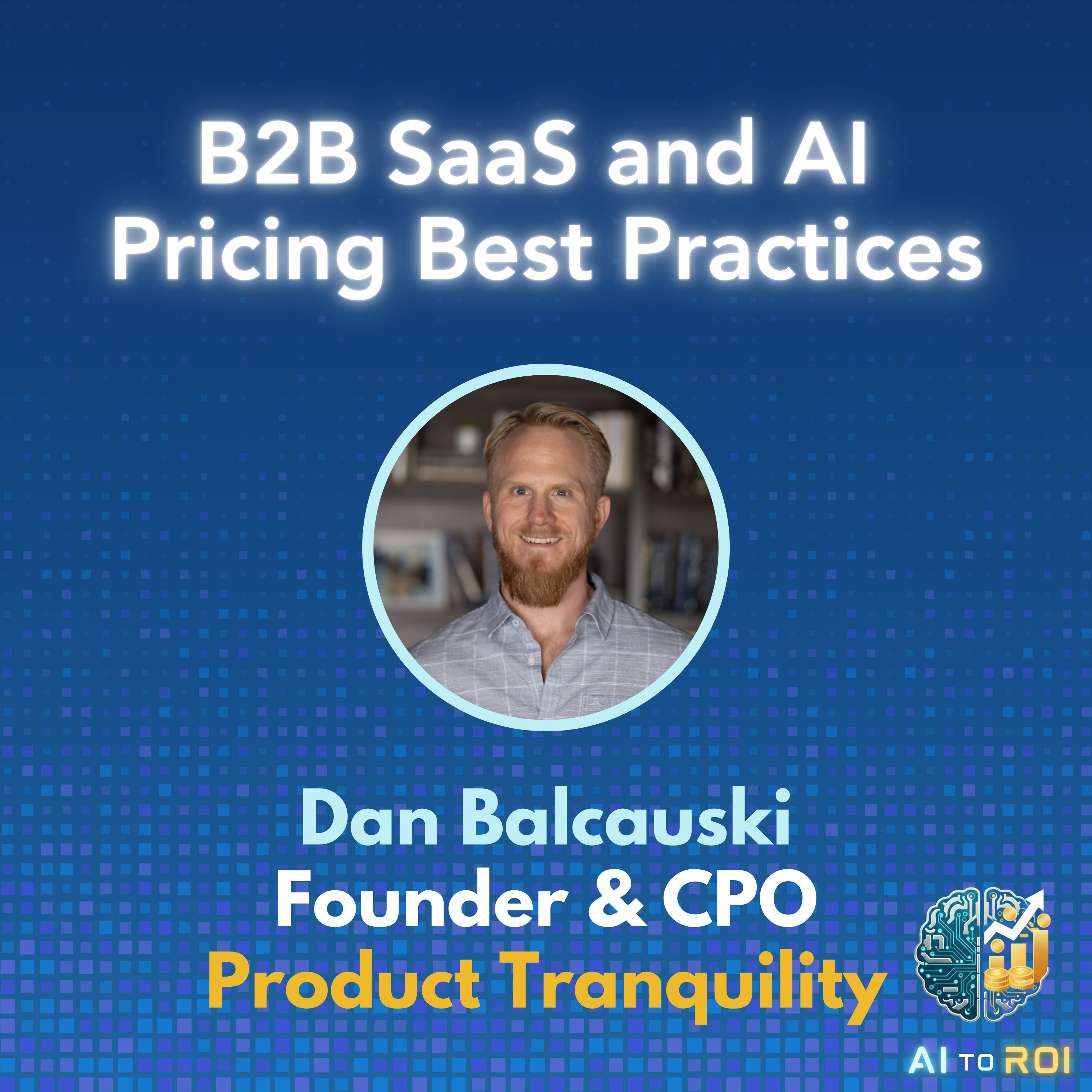
AI to ROI
Pricing Strategy for AI Software and SaaS: When to Change, Who Should Own It, and the CFO's Role with Dan Balcauski
00:33:25
Loading summary
Transcript33 lines
- [00:00]
A
Foreign. Welcome to today's episode of the AI to ROI podcast. Today I am joined by Dan Bukowski, the founder and Chief Pricing Officer at Product Tranquility. I'll be covering four main topics with Dan today. First, signs of needing to review pricing or even transform your pricing. Two, the role of customers in the pricing process. Third, pricing, ownership, and governance. And fourth, the role of the Chief Financial Officer in pricing programs. Dan, please take a moment to give a brief overview of your journey to becoming my guest here on the AI to ROI podcast.
- [00:48]
B
Yeah, well, it's good to be here, Ray. Glad to see you again and thank you for having me on. As you mentioned in your intro, my name is Dan Balkowski. I run a small consulting firm in Austin, Texas called Product Tranquility. We focus explicitly on helping B2B SaaS CEOs define pricing and packaging. And so I spent 20 years plus of my career in software, starting off as an engineer, moving into engineering management, and then product management. And early on noticed most tech companies obsess over acquiring customers but neglect how they capture value. And I saw that a lot as I was building products we were shipping and then kind of looking at it with a question mark of. Of how is that pricing and monetization system designed after the fact? And that insight really crystallized during a my MBA internship. I did an internship with a successful Silicon Valley startup where it happened to be a freemium project that was on the CEO's desk. And so they asked me to take a look at that, among several other things I looked at that summer, and through my research, I uncovered that popular pricing model works only under very specific and surprisingly rare circumstances. And today, you know, focus explicitly on helping CEOs of B2B SaaS companies transform their pricing from a confusing liability into a strategic advantage, whether that's helping them find, you know, millions of dollars of revenue leakage or establishing a pricing process to become their standard approach for future product initiatives going forward.
- [02:17]
A
Okay, Dan, you're the right person to talk to because there sure is a lot of buzz online discussions overall, dare I say, noise around B2B software pricing today. Consumption, pricing, usage, pricing, outcome pricing, value pricing, hybrid pricing, tokens, credits. I mean, I can't even keep up. So, first question I have for you for our CEO and CFO and go to market executive audience, what are some signs that suggest a pricing review is needed?
- [02:51]
B
Well, you know, the thing is, there's not sort of a magic number on how often folks should revisit their pricing, but there are some guardrails. So you know, in general a best practice is to probably review it at least annually. I'd say best in class companies have a review at least quarterly, if not monthly, or you know, when significant product or market changes are occurring. And so that for your particular case, you know, that timing can depend upon things like how fast is the product evolving or the maturity of the product or market competitive dynamics. We're seeing that explicitly right now in the AI space. The hottest AI native companies and even the foundation model providers themselves, it seems like if not weekly, at least monthly, they're iterating and putting out changes because everyone else is iterating and trying to figure out what's working for their customers as well as what, you know, to match their competitive dynamics. So it could really be dependent upon those frames, but also it's going to be dependent upon your sales cycle speed. Right. If we are taking a measured approach, you know, we're going to make a change, we want to then be able to observe the market's reaction for some period of time and that often the limiter on that is going to be, you know, how long your sales cycle takes. So if you have a very enterprise sales cycle of six to 12 months, you probably can't make multiple changes per year because you're not going to be able to tell the impact of those, you know, one after the other within that cycle. But if you have a, a 10 day sales cycle on average. Right. You could potentially get multiple iterations of sales cycles per, per month. Right. In order to get that market feedback. But you know, there's a couple of you maybe telltale signs I would encourage folks to, to look at. Often what I see is impact on net revenue retention. It's not growing as fast as either the, the execs want or the board wants or some combination of both. And that usually points to a problem in the broader pricing and packaging also looking at changes. So you know, often you have some amount of win loss conversion that you expect and all of a sudden that starts trending in a different direction. Right. Which can mean a couple of things. One could be, you know, a competitor entrant or new, new value you're being compared against or your competitors could be, you know, changing pricing or you could have other macro effects. Right. So I'd be looking at a few of those things as well. And yeah, so I'll stop there and see if you want to dig in any further.
- [05:33]
A
Well, yeah, you said something. Hey, you should review it at least once a year. But best in class, maybe you review it Quarterly, even sometimes monthly. Best. But here's my question. Unless you're in a very early stage market or you're in the very early stage of entering a market, you know, doing some experimentation with pricing, I've always been warned that you don't want to change pricing too often because it confuses the customer. Do you have an opinion on how often I can change pricing as an existing vendor?
- [06:10]
B
Yeah, so that's a, that's an excellent question. And it really depends upon what we're talking about changing. And I want to also separate that from, you know, in evaluation.
- [06:24]
A
Right.
- [06:24]
B
Because I think, you know, there's, you know, my previous response. You know, I, I use the term evaluate your pricing, you know, at least annually. Right. That doesn't necessarily mean you change it because I think what I see way too often is, hey, we released this product four years ago. We did pricing and packaging when we launched it, and we haven't looked at it since. Right. When that is, you know, it's like, okay, well you should at least be looking at it or talking about it at least annually or if not quarterly or monthly, reviewing the numbers, bringing in voice of the customer, bringing in feedback from the deal desk team, et cetera. But maybe you're not changing it, but if you're making changes, there's definitely a distinction, I would say, between changing something like your pricing metric. So the pricing metric is the unit of value we charge customer for. So oftentimes that's either seats or, you know, gigabytes of data transferred or stored or number of API calls. Right. Could be any number of things. That is a pretty significant. You might put that in the bucket of pricing transformation. And those can be pretty rocky changes. And you definitely don't want to be changing those probably more than once every two years or so because those can be pretty significant, could cause pretty significant whiplash with your customers and with your internal organization. But things you may change more frequently, things like the price point, things like updates to your pricing page. For example, you may change how the plans, if you have good, better, best, how those plans are laid out in ordering. Or you may change the, the marketing names or labels on those. Or you may be moving features, some features between different tiers or offers. Those are usually a little bit more easy to change and digest than something like maybe a wholesale net new pricing metric that be. There's others in that class as well. But just for simplicity, that one is pretty relatable for folks.
- [08:27]
A
Well, let's talk a little bit about existing customers because a lot of Our listeners, right? Hey, their company's been around for three, five, seven years, they have hundreds of customers and everybody's in the year saying you should consider moving from seat based pricing to some type of usage based pricing or at least seat based pricing plus usage etc. So my question to you is, what role do your existing customers play in helping shape and form your pricing strategy?
- [09:00]
B
That's an excellent question. So I would say they always play some role, but you know, you never want to be anchored to your historical customer base or your historical product because oftentimes when we're anticipating a significant change like a new pricing metric, it's often because we've made some major change as a company.
- [09:26]
A
Right.
- [09:27]
B
We're approaching a new market segment trying to expand our TAM that may include additional tiers of our product or even expanding our product offering into multiple products. So I see that a lot when companies go out and do some M and A and now they are, have, have acquired another business and the pricing and packaging don't meet between those. And so those expected synergies that look really well on a due diligence deck don't, aren't materializing because this, you know, it makes the salesperson's head spin when they have to switch between explaining how one pricing works versus the other. So what I would say is, you know, when we go out to do research on behalf of clients, I would say a general rule of thumb we try to follow is, you know, we always want some existing customers in the mix. So say we're evaluating a new, a switch in a pricing metric. If I'm going to go talk to say 30 customers, I might want 1/3 of those to be existing customers and then 2/3 of those prospects who aren't current customers, you know, because some of those may be folks we haven't targeted with our marketing or value proposition because often those changes are related to a core change in your value proposition. Hey, we have these new set of capabilities and our existing customers never came to us for those. And so they don't really have an opinion on that because it's maybe not in market yet. And so they also may have some anchoring bias. And so we want to be aware of that, but that we want to have both perspectives and then you know, with the re synthesis that we do from that research afterwards, be able to understand, okay, this is where existing customers are anchored versus where these other prospects are. Right? And they both have, it's not anchored in also the, that can be put into a almost entirely negative connotation. I don't mean that because often your existing customers are anchored in the fact that they actually know the real value you're providing versus when you go talk to a prospect, you may have the problem where you show them a couple of slides of a product concept. Hey, this is what that product does, this is what it's about. And that's all they have to go on when they're giving you their feedback. So it could be very valuable to have have your feet in both worlds.
- [11:38]
A
Now one of the pieces of advice I received on pricing was if you have one pricing model for product A and you're then introducing product B and is primarily a cross sell to existing customers, be very thoughtful about changing the pricing model for product B when they're used to pricing model for product A from your company. What's your opinion on that?
- [12:07]
B
So well, it depends what you mean number one by, by pricing model. So like I worked, I used to work for a company called SolarWinds. They're in the IT operations management space. And you know, that company, when I was working for them, we were very acquisitive. So we were acquiring about three to five products a year and just putting them into our go to market model. The company was really, really good at acquiring companies and putting them into their sales machine. And one of the things that they did, it was a practice was to at least make the overall pricing structure similar. So what do I mean by that? So let's say that you have a product that monitors servers and a product that monitors enterprise storage systems. In the enterprise storage system, that product, the price you pay would scale by, you know, gigabytes of data that was under being monitored. The servers would be the number of nodes, endpoints, devices that were being monitored. But when you looked at other tiers had a acute similarity. And so the pricing metrics were different, but at least they followed a similar pattern. And so you know, depending upon, you know, the, this could get quite nuanced depending upon where you're talking about you at least don't you want to at least have some amount of similarity as you start to look across a portfolio? If you're talking about subscription versus more of a consumption like a pay as you go, you know, I think folks, you know, can be very flexible where, where it gets very tricky is depending upon the type of go to market motion that you have. Meaning if you have a very high volume and velocity, go to market motion. I see the problem, you know, hearkening back to a premise you, you put in your original Question around. Hey, we have a seat based model and now we're paying, you know, OpenAI or Anthropic a large amount of money for this, you know, AI component. And so we want to add a floating token usage on top of it. That can get very complex and really gum up the works in a high velocity go to market model. But if maybe you introduce a second product that was pay as you go, that usually is not a consideration that could get explained away pretty quickly.
- [14:26]
A
Okay, I'm gonna, I'm gonna do something here that entrepreneurs are famous for and that's pivoting. So moving beyond, you know, what kind of pricing model, how to introduce it, how to integrate customer feedback. I was recently at a stage two Capital annual summit in New York and Kyle Poyer, who we all know he shared a fight about who owns pricing and dare I say that above $5 million ARR. The answer was it's not clear. And it just depends. Do you have any standard device or best practices on who should own pricing and pricing governance within a company?
- [15:08]
B
Yeah, I saw that, that research from Kyle. I love Kyle, he's great. And so I believe I know the exact report you're referring to and I think the way the question was was framed was who actually owns pricing in your organization? And it's so, so I think it was like this one to five, it was very clearly in the box of the founder, CEO and then kind of north of 20 it was kind of pretty clearly in the box of like product or marketing. But then there was that fuzzy region in between where no one really owned it. And I think this is what he, what he pointed to is, is definitely a reality I see every day which is there's often a lack of an explicit handoff as companies scale of who owns this thing and very naturally, right? So you know, you know, you think about you three founders in a garage writing software, you know, all of a sudden they start getting traction, start getting more sales, they have to hire more salespeople, they start getting more customer support tickets, have to hire more customer support agents, start having to build more product, hire more engineers. But at no point in that process is someone like we need to hire someone for pricing, right? They think about like oh, we need someone to run our demand gen engine, so maybe we need a growth marketer or you know, VP of marketing. But pricing is usually one of these decisions that sort of left vague. And so I think it is very important number one to have an explicit owner of pricing. And so within B2B SaaS, my general point of view is that I think product marketing is best suited to own it because they are at a strategic point of the business where they are supposed to be, you know, the owners of positioning and pricing and packaging I believe is a function of your positioning. They have to keep an eye on the general competitive market. They have to understand which value propositions are resonating with customers in order to, you know, direct the activities of the demand gen organization effectively. And they have a long term view. I generally advise against someone like sales owning it or because it's a little bit lack of or misaligned incentives. It's a little bit like putting Dracula in charge of the blood bank. So they're definitely a stakeholder. And so when it comes to pricing and packaging immediately you say well, well like look, I mean you could point to any member of the executive team and say well they're going to have an opinion on it. They, you know, their bonus or equity or whatever is, is dependent upon it. And so in general I think best practice is to have a pricing council or sometimes also referred to as a pricing committee. That doesn't mean we design by committee. It means you have a regular cadence where that group gets together to discuss all the aspects of how pricing and packaging is affecting different aspects of the business. But it still has an owner and designated decision maker. Because I think the problem becomes when people put together a committee, all of a sudden they think that committee like we' going to put everything to a vote. We don't do that for any other function. I would never recommend you do product management by committee. You know, anybody who's ever been part of an IT steering committee often knows that those are a little bit of a goat rodeo. I still think you need someone to make the final call. But much like product managers are expected to be, you know, the walking, talking voice of the product inside of the business, I think we need the same for pricing. And that person should establish a process where all those stakeholders are brought together to discuss your voice of the customer data. Current pricing initiatives that are away ones that have been launched, what are the results of those and get feedback, you know, from the front lines of the business or the representatives of the front lines of the business. Right. To understand how you know sales is is hearing things in conversation or the deal desk is, is having to navigate considerations within the pricing and packaging, etc. I'll stop there.
- [19:13]
A
You know, one of the things that I have consistently been surprised by and my own companies with the pricing discussions but also with clients is how Seldom deep analysis of discounting of the existing pricing goes on and how it impacts gross margin, win rates, etc. How important do you think is really understanding the current discounting practices and to forming your next pricing or at least understanding pricing?
- [19:45]
B
I would say the easiest wins. And I think this, you know, goes into my point before about always, you know, be evaluating pricing consistently. I think discounting policy should always be a part of that. I mean maybe it's a, a small part over time as you get something that sort of works but you're keeping an eye on it. It's often where the easiest wins are because it's highly tunable and it's relatively easy to change and control within, within the business, doesn't require a bunch of changes to operational systems engineering, doesn't have to get involved in change entitlements, you know, etc. Etc. We will always look at that, the discounting policy and enforcement and those are two separate things because I've seen plenty of companies that have a discounting policy and no enforcement and so that doesn't help but it's always one of the first things that we look at because not because it informs what you should do next with your pricing strategy, but it doesn't make any sense to go spend a bunch of time, money and energy on a net new pricing and packaging approach. If you're discounting policy and enforcement is just the wild west because that effectively is the, you know, the front end interface to the market. And so you know, if you have no enforcement or policy or controls or monitoring, it doesn't matter. We could do, we could build amazing PowerPoints. Right. That will never, the market will never really realize because sales folks could just kind of go do whatever they want. And so we want to always make sure we have a pulse on that. I think there's definitely easy wins. I would. The only point I would quibble with on the premise of your question is I don't necessarily. That tells you directly what you should go do next. I think there's better ways that sort of looking at those past transactions to figure out what the future looks like. It's sort of like driving, looking in the rearview mirror kind of tells you you a little bit about what's working, but it doesn't really tell you what the next step on the road is.
- [21:42]
A
Yeah, I don't know why this popped up, but it did. So I got to ask a question. Outcome based pricing, there's a lot of buzz around especially in the AI native or agentic AI software space. Have you come to any kind of conclusions or perspectives on when outcome based pricing is both appropriate and feasible.
- [22:06]
B
I have many opinions. I think most succinctly summarized in Outcome based pricing is the future and always will be. It's not a new concept in the pricing world. It is getting a lot of airtime in the advent of AI. It is incredibly difficult to pull off except in very rare circumstances. I think also the industry is suffering from a little bit of ambiguity around the word outcome. So when, when we talk about, or when I talk about outcome explicitly, what I mean is, you know, for, especially for most B2B products, they're either going to make you more money or save you money, increase revenue, decrease costs. There's others, but those are the two main. So that is the outcome ultimately that you're trying to sell it is very difficult. So say we're selling you a marketing automation platform. Ostensibly you're, we're going to help you grow revenue. Right. And so it's very difficult though to assign attribution. You know, we give you, I don't know, take any tool of your choice, HubSpot. I'll just use that as an example, put it into your environment. Now your marketers have to use that platform. So how much of the responsibility for the revenue growth was the platform and how much was, you know, the great ideas of the marketing campaign that they launched through that platform? Right. And so attribution is very difficult. I think, you know, it works only in very, very rare cases. The probably best example of this would be something like, you know, Stripe where they're actually in the revenue transaction. And so Stripe says, hey, we're going to take a percentage of, of revenue. As your revenue grows, we both get more successful. And so therefore they're, they're in the transaction. But otherwise you into very contentious relationships with your customer that otherwise backfire. I think there's probably a better way to frame the conversation and I've been hoping to maybe popularize this a little bit more. So I'll take my shot here on the podcast. I think what we want to start talking about instead is output based pricing. So I think an example of this would be Intercom has I think done really well with a lot of their pricing and packaging, especially as they release their FIN AI customer support agent. So Intercom does a lot of things, but one of them is like a customer service desk. So they have a per seat pricing for their customer service platform software their customer service agents use and then they have FIN AI, which is ticket deflection by their AI agent so that your users never touch them and they charge 99 cents per resolved ticket. So some people may say, well that's outcome based pricing. I would say instead, I think a better term there is output. Because ultimately what they're their goal is, is hey, ultimately we're saving you customer support costs, but we're not measuring costs, we're only measuring one or a few steps up the value chain from that which is still the output of a closed customer ticket. And so I think, you know, we be much better suited if we started using that term because I think it gives us a clear delineation between is the customer or the user at the end of your using your platform, clicking buttons and mouse, you know, are they responsible for the value or is it are we working more upstream towards the eventual outcome and then monitoring and monetizing an output in. In between those two extremes of the spectrum?
- [25:39]
A
Got you. I love the clarification of output versus outcome. And that leads me to my final question because we have a lot of CFOs and heads of finance listening to the podcast and they're all about being able to predict, forecast and report financial outcomes. The question is what do you think the role of the CFO should be in pricing and pricing programs?
- [26:02]
B
Yeah, so I think, you know, broadly what I would say is separate. The role of the CFO wears many hats, separate into sort of the strategic role and the operational role. And both are critically important. The operational role usually like heavily, heavily within this CFO finance office, usually in partnership with their sales as well as the operations team. So managing and overseeing the downstream processes of pricing related to legal contracts, billing, quoting payments, collections. They're also really tasked with setting and operationalizing guardrails and rules around discounting. So I think there's often a nice healthy tension. So we, I mentioned it it earlier just in passing. But something like a deal desk I think works best when that's owned by the finance organization. It kind of sits maybe on the floor with the sales team so that you know, they're in the day to day. But there's. It's much like I generally I come from a product world. I don't like when there's just a CTO that owns both product and engineering. I like to have a head of product and head engineering because you want those arguments that are around the same topic to be external. It's very much the same thing where you want that collaborative tension in the organization around operationalizing and enforcing those, those rules around discounting versus you know, just Being up to the, you know, the head of sales to say, oh yeah, anything, anything can fly. Also very important because their cfo, you know, helping to measure, you know, benchmarks performance impact of pricing action. So often a very important operational analytical partner from the strategic side, I think they have a, a very important role, you know, as a stakeholder in a pricing council committee. If companies are shifting revenue or pricing models. So I use pricing models specifically, we're hitting that before. But say you, you know, what everyone went through, say in the 2010s, which was this move in software from perpetual to subscription. The CFO is a critical strategic partner to the CEO in that transition because number one, there's you know, significant change in cash flows as you make that transition from perpetual to subscription. And I'm using perpetual subscription. Same thing applies if you're going subscription to pay as you go. Modeling as well. But there's, there's impacts in cash flow, there's impacts in KPIs, right? We used to not talk. I mean, you know this as well as anybody, Ray. We used to not talk about things like arrows, right? There was bookings and billings, but we didn't have this term of ARR. We didn't have NRR. We had a whole new set of KPIs that came up from a pricing focus. And so the CEO and CFO have to, you know, be hand in hand when you're going through any of these pricing change to be able to explain to the board what those impacts are going to be on here. These are going to be the new metrics we're going to start talking about. This is going to be the impact on cash flow. This is what it's going to mean for us to achieve, you know, run rate revenue and profitability on a given customer. And so I think from a strategic perspective that's very important. I would caution generally going back to like who owns pricing. Finance could often be too focused sometimes on things like margin, especially if you're looking at like a portfolio business. Why is that the case? So let's just say like on average for a software business, they have a 70% gross margin. You may have products that serve very different either customer segments with different competitive dynamics. And so if you try to maintain a consistent margin profile, that may be, you know, may make sense in your spreadsheet, but it doesn't make sense from the competitive or market dynamics explicitly. And so that would just be one caution is why they're, they're definitely a stakeholder in an input, but also you know that's reason talking about otherwise I think like you know, someone like product marketing is more suited to sort of balance, you know, understand that but also then balance those, those trade offs.
- [30:23]
A
Great feedback, Dan. Let's give the listening audience a chance to get to know you a little bit more on a personal basis through three quick questions and answers. First, who's a pricing resource or influencer that you follow besides yourself?
- [30:37]
B
A huge fan of Stephen Forth?
- [30:39]
A
Stephen fourth from abaca.
- [30:42]
B
Yes, I think he says it Ibica, but I never get it right. So apologies Stephen if we've mispronounced it. But yeah, Stephen is an amazing resource. Highly recommend. Everyone read his blog.
- [30:51]
A
Is there do you have a favorite SaaS or AI tool that people should at least evaluate for pricing execution?
- [30:59]
B
For pricing execution? I mean, no, Excel, not specifically for pricing execution. I mean there's, there's, you know what I would say in general is one general trend I've seen these days that has been exciting. You know, you and I were just at out in San Francisco at Logistenses Usage Economy Summit. Uh, the next day I was at uh, CFO Exchange put on by the folks at Zenskar. You know, there's folks at Maxio, etc. I think there's a lot been a lot of really good innovation and development in billing and invoice to cash systems. So I don't have any particular favorite. I'm a bit of, I consider myself Switzerland in that world. But I definitely recommend to anybody who's, you know, even early stage, do not build your own billing system. That may have been a choice that you needed to make in 2012. It is not a choice that you need to make today.
- [31:59]
A
Okay, last question. A lot of early career people who listen to the podcast, what if someone says, man, I really like pricing. I'm really enamored by it. What recommendation or advice do you give them right now? How to become a subject matter expert on all things pricing.
- [32:14]
B
So if they want to go off the deep end, it's a little thick, but it's definitely the bible of pricing is the Strategy and Taxes of Pricing by Tom Nagel. Absolutely required reading for anyone who's really serious about the topic. If you want a little bit lighter of a jump into the maybe the shallower end of the pool. Definitely recommend reading Monetizing Innovation by the folks at Simon Kutcher. Very good resource as well. And there's always, you know, happy to get more readers. My blog is Product Tranquility. I try to demystify this for folks and usually I'm trying to write to also sort out what I think about a topic.
- [32:50]
A
Okay. Dan Bowski, Founder and Chief Pricing Officer at Product Tranquility, thank you so much for being my guest.
- [32:56]
B
Thanks, Ray.
- [32:57]
A
And thank you to all the listeners. And if you like this podcast, along with all the other episodes you've listened to, it'd mean the world to us to go ahead and subscribe to us on your favorite podcast app and go ahead and give us that five star recommendation. Bye everyone. Bye, Dan.