← AI to ROI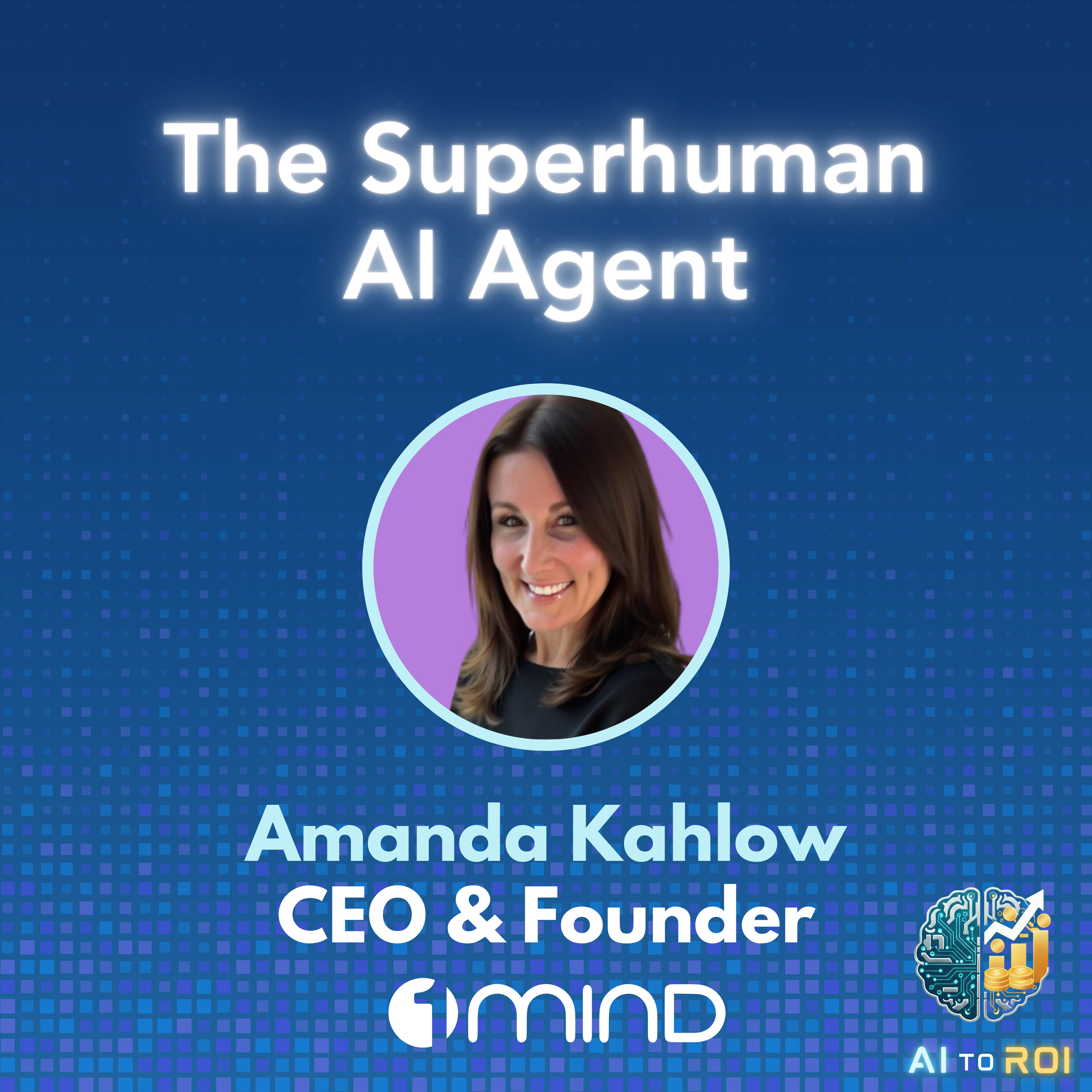
Loading summary
Transcript47 lines
- [00:00]
A
Foreign.
- [00:08]
B
Welcome to today's episode of the AI to ROI podcast. Today I am joined by Amanda Kalo, founder and CEO of One Mind. We'll be covering four main topics with Amanda today. One, the vision behind One Mind. Second, how customers are using AI in the customer acquisition process using the OneMind platform. The benefits that OneMind customers are receiving and then how companies are measuring the return on investment of deploying AI in the customer acquisition process. So with that, Amanda, would you take a moment to give a brief background of your journey to becoming a guest here on the AI to ROI podcast?
- [00:49]
A
Sure thing, Ray. Thank you so much for having me. It is such a pleasure to be here. Yeah. My name is Amanda Kahlo and I am the CEO and founder of One Mind. I was the founder and former CEO of Six Sense. My one line to the market is I started Six Sense to find buyers and One Mind to close them. At OneMind, we are building what we call go to market superhumans and they take on the job across the life cycle of your customer journey. Everything from inbound on the website to qualify, give a live demo pitch and then for your commercial and SMB business, they can go all the way to close. We also have superhumans that join calls and can be a sales engineer, can onboard for your PLG or your customer success, motion across sell upsell, et cetera. So super excited to be here and share how our enterprise customers are deploying and what we see in the market.
- [01:40]
B
Well, I would almost call that a full cycle AI superhuman. You know, you talk about full cycle AES, now you've got a superhuman doing it.
- [01:50]
A
You know, the big lift is in the big difference between humans and superhumans is they have unlimited capacity. Humans can't take on five jobs. Right. They can do one job, one role. They have time, recall, capacity limitations and superhumans don't. So they can keep going.
- [02:05]
B
I'm still looking for that. Seven day a week. 24 by 7 we're going to go beyond 996, but let's start with your background. So you founded and built Six Sense for over 16 years into the category leader in intent data. And now I don't want to put words in your mouth but. But you're essentially saying intent data as we knew it is behind us. How do you reconcile that in your own mind?
- [02:30]
A
Yeah, so just for. Just to clarify, I didn't build it from all 16 years and there was an amazing team that came behind me when I stepped down. But I did play, I believe a large part in the success of six Sense and where it is today. At six Sense we started and we just saw the fundamental problem that big enterprise companies, we started selling to enterprise before we went down market and mid market and they just couldn't find, they didn't know where to focus their resources and couldn't find buyers. And in today's world that seems pretty nascent when you think about all the tools and technologies that are available today. And it was on a mission to help companies prioritize and know who to call and when to call and find the buying committees, et cetera. Today we're moving into a world where at one mind, you know, the idea intent, data as we know it. If you actually break it down and you take it back a step to like the buyer journey back, then we do a Google search, we end up on a website, we're looking across third party research, we're looking at Gartner and other third party tools, we're trying to figure out the best solution and then we call a sales rep and we move forward. Today the world is so fundamentally different. Buyers are no longer going to all these third party publications, they're no longer doing the Google search anymore as we know. And what they expect is not a linear journey. They expect a two way conversation. So you know, if we think about how we are engaging with GPTs today we're at the large language models and the foundational tools. If we're asking a question and then we're getting back rich content and information back and it's on our terms, in our way. And so that's what buyers expect. They no longer want to go to a website and dig around and look through thousands of pages to find the right answer. And it's only one way. Like even think about all of our email campaigns and everything we do in outbound, it's blasting people with a one way form form of communication. So I think that the journey has fundamentally shifted that buyers expect a two way conversation, they expect solution selling, they want their needs to be heard and met with a response. And they also want trust. And so I think, you know, we look at what, where AI is today, we worry that I think the number one thing, I was actually just reading a report yesterday, people talk about the number one like negative detractor from using AI is trust. But when companies and individuals realize that when you put AI on tight guardrails, that trust chasm will shift and they will start to trust AI more than a human. And I love when people ask me if you can trust the superhuman. I'm like and if it's going to hallucinate, I'm like, do your sellers hallucinate and do they do so knowingly, nefariously. So I think that chasm is shifting and they're expecting a two way form of communication. That was a long answer to your question. But it's a completely different world today and we have to move and change and adapt based on it.
- [05:19]
B
Yeah. I don't want to look backwards too much, but I still remember I was involved in marketing automation at the very beginning and our ultimate goal was personalization. One to one communications. But it still was very asynchronously and delayed. Right. Maybe you'd give them a microsite that looked pretty good. But you're talking about real time interactive conversations that, that are personalized and driven through AI, right? Yeah.
- [05:45]
A
It's not. Yeah. And it's so much more than even one to one and personalization because personalization is still a guess at what I think based on what I did that person wants. You are giving the control to the buyer. In today's world the buyer can say this is what I want, this is what I want to learn and how I want to learn it, learn it. And this is the format I want it back. Right. So this is I want back and you know a complete pitch deck that tells me gives me a business case based on all of these requirements and so buyers can ask for exactly what they want and take control and they couldn't before. So I think personalization I think is gone. I think we're moving to a world of every good AI company, especially in go to market. They're all talking about building an account based context graph and that is like personalization times 10. So it's understanding everything that's happening in CRM and your buying committee, everything that's happening across your website. Leveraging the best sales methodologies we are building right now. I haven't announced this or shared this with the market, but happy to share it here. We're building a sales LLM in the sense that we will know what methodologies to use in that right moment for that particular buyer to drive the deal forward and use AI to have like hyper personalization based on all the data signals that we have. What do I need to do to get that outcome? And everything is more outcome driven than conversion driven and goal based.
- [07:07]
B
You know Amanda, I could go down this sales LLM rabbit hole with you, but I'm going to, I'm going to restrain myself and you know we've talked a lot about the theory and the potential of AI and the customer acquisition process. But what I want to do is talk about what are the top, the primary use cases of how companies are using you in the customer acquisition process and maybe where do you often start and then how do they expand it?
- [07:33]
A
Yeah, great. So most companies have a top of funnel pipeline problem, right? So everyone has a growth, I always say a growth opportunity or problem. However you look at the equation, right? So we know growth is shrinking. You know that you measure that all the time, right? Growth is shrinking. The cost to acquire a customer is doubling, tripling in some cases even. I was talking to a public company CEO the other day who told me cost them $5 to acquire $1 of AIR, which is absolutely wide. Now of course I'm not going to out who company is or what, but it's wild to think of where, like where we were back in, you know, 2016, 2017 when I was at 6 cents to where we are now. And like the, or 2020 when the heyday of you know, you can acquire a customer for A$50 which was totally reasonable. So most companies are, they have that pipeline problem. And so the, the challenge is the old way of doing things was bring somebody to your website and you have them go through a deterministic or even an AI driven chatbot, you know, like, like the qualifieds of the world. They're literally. It's an AI chatbot that's booking meetings. Right. So what does that do? It sends you then to SCR who's there just to qualify you. And then you get passed to an AE that can only give you the pitch. You have a technical question and then you get passed to a sales engineer and then God forbid you buy and then you go to an account manager and a csm. I mean it, the, the process is like endless and it just continues to go the handoff from one to another. So when we think of top of funnel, how we can address that problem. What if on your website I could essentially put a salesperson and a salesperson that has the depth and the knowledge of a sales engineer or a solutions engineer. So you're giving control to the buyer. You're saying, hey, I'm going to meet you where you are, I'm going to solution sell with you. I'm going to understand your pain, your needs and then I'm going to qualify you skip the SDR and go to the ae. So and they get all their technical questions answered on first touch. And what does that do? Not only drives pipeline, but more Importantly, it shortens sales deal cycles. So one of the biggest things that we need to do in revenue organizations when we're thinking about our go to market is we need to spend less, shorten deal cycles and increase acv. So I had a very large publicly traded company, I can't say the name but told us that we were able to shorten their sales cycle by 23 days and double the ACV when it went through a superhuman versus going through their traditional call. It qualified to SDR pipeline to an AE.
- [10:00]
B
Amanda, can I ask that 23 day cycle reduction, that's incredible. Do you know what type of cell cycle that was against a 90 day cell cycle? 150 day sales cycle.
- [10:12]
A
It was a 60 some day sales cycle. So it's almost 40% reduction. It was in the 90s and we brought it down to 60 something. So it was almost like an in quarter, a mid market sales cycle but we were able to shrink it. Yeah.
- [10:26]
B
And it started with an inbound lead. Is that that use case where it started?
- [10:30]
A
Correct. So this is the inbound use case. So think of this superhuman living on the website, in some cases taking the real estate of a chatbot, but doesn't have to. It can be an embedded experience, it can be across the site. There's a lot of ways to deploy superhumans, but they engage, they qualify, they give the pitch, they give the interactive demo. Click around and actually give a demo in the moment on first touch. Like imagine that the only other option we give people today is something like a antiquated like the story lanes or the walkmes of the world where nobody likes to Click and go 1, 2, 3. I want like talk to me about my business. I'm a healthcare vertical. I want you to talk to me in my lingo and my language and give that demo that actually relates to the buyer and where they are in their in this most empathetic solution selling type of way. Just like a sales engineer would.
- [11:20]
B
So Amanda, so how does your customer in one mind decide when I do or do not hand off to a human, an account executive, Is it dynamic per engagement or how's that done?
- [11:34]
A
Yeah, they set up rules. So we have, it's a combination of a deterministic engine with the generative. Right. So there are rules that say if this is like for example we want to go all the way to close. Like for somebody like a HubSpot, we help them close for their SMB commercial business. And so if it's a micro SMB or very small business, their superhuman Fiona can Go for the close. If it's enterprise, it books a meeting. So it says, okay, let's pass this off to a salesperson and full transparency. We're not there yet to be closing enterprise deals. We will be soon and that is what we're working towards. So I am super excited about the next like six to nine months. Some of the things that we're going to be building so that she can navigate the org, she can have like the conversations that you would get from an enterprise seller. But yes, as somebody's coming in, the superhuman identifies who they're talking to. Just like any other process, you know, asking what company, what are your role, what's your job function, what are your pain points? And then based on that, oh, I see your SMB. My job is to take you all the way or I see you've already been in the free trial. My job is to get you to move to paid. Right. So her job isn't just to book meetings. Her job is to go and take that next action based on who she's talking to. That will drive revenue for the business. And the way I think about it with our customers of how far they let her go is where is there no business model to support a human interaction today? And in commercial and SMB business or plg, you would never put a human right. So allow the superhuman to do that job today where prior to a superhuman there was no option. The option was content. Give them information, hopefully they get it. Give them the what the demos and hopefully they'll come back on their own, Send them a bunch of spam emails. And now I can actually have a human like conversation in the moment with my buyers.
- [13:23]
B
You know, I mean I can't let go of this one because I love use cases. So that double the acv. Now that really kind of is a former revenue leader. I'm like, wow, that's pretty incredible. Can you tell me, do you know why the ACV is increasing or do you have some hypothesis or do you have data that says this is why?
- [13:42]
A
Yeah, I can only have a hypothesis right now. I don't have concrete data behind it. But we know when you're a vendor of choice sooner, the sooner we get into a deal cycle, earlier in the cycle, the larger the deal is. Right. If I like I just one vendor of choice against one of our competitors, very, very large company, we were in early and that deal is going to be much bigger than if we had come in later and try to get it, get it from them, out from under them. Then we have to cut price and come down, and we don't have the time in the sales cycle. So if you're in early and you're giving your buyers what they need, the information they need to make an informed decision, sooner the prize, the size of the prize goes up.
- [14:25]
B
You know the old benchmark of, hey, if you respond to an inbound lead within five minutes, you double your opportunity to, to win it. You're like putting that on steroids. You respond in real time.
- [14:35]
A
In real time. Right. Why are we making. And then, I mean, it's archaic to think an inbound league comes in and we send them to a junior human.
- [14:43]
B
Yeah, well, you've given me one very common use case, but I'm sure there's a land and expand strategy. So where do you typically expand to with your customers?
- [14:53]
A
Yeah, so the land is on the inbound. The most natural next expansion is one of the products I am most bullish on. And it's our, what we call it, our ride along superhuman. And so it joins a call as a sales engineer on every single call with sellers. So instead. So, for example, we can't put. Let me just talk about the pain here. In an enterprise sales motion, you put your sales engineer or solutions engineer on the third or fourth call. You had to earn the right to ask for that $400,000 resource to join the call. What if you could have that resource on first call? What if, if you do still have SDRs or commercial sellers? What if they get a sales engineer on every single call? Again, this goes back to. There is no business model today to put that resource because it costs too much. On every call we get to, we're there on every single call, the salesperson, the human, still has control. Think of it like a puppet master. You call on it just like you would call on your sales engineer. You know, if the human seller were on the call, they're like, hey, Johnny, will you take that one? When a hard question comes in, you do the same thing with your superhuman. They have back channel controls and voice controls, just like waking up Siri that says, hey Mindy, can you answer that question? Hey Mindy, will you give that demo hey Mindy, will you show that integration? Not only can they do it better than a sales engineer and go deeper and more technical than most sales engineers, but they can bring things up in the moment that a human never can do. So even though I might have the right case study or have the right information, I don't know where the conversation is going to go. So I can't take my 10,000 documents and have it all ready to go to show on the fly because you're bobbing and weaving with the call like you don't know what questions are going to come at you. But the beauty of a superhuman which supersedes capacity limitations of humans is that it can bring the slide in. In any case study and any demo like that, a human can't do it even if they know all the information. So you could even just use the superhuman to bring the com. The information in and then the human can talk about it. And the last piece of that, this, this use case that's super exciting is you use the superhuman to ask the questions that your humans aren't. So you know how to deal. You're like, you're not asking for budget, you're not asking for if you're the champion or you're not asking those hard, you know, questions. You can call on your superhuman to do the hard work. Hey, what did I miss? Hey Mindy, what did I miss here? She jumps in. You know, I didn't hear. Are you the decision maker? Is there anybody else we need in this deal? I didn't hear there was actually a pain point. Can we go a little bit deeper to uncover that pain? So you train her to pull out and tease out the questions that we need. The met the med picked questions or whatever they might be so that you can move the deal forward. It's magical.
- [17:39]
B
Half of the people who listen to the podcast aren't go to market. They're CFOs and CEOs and a lot of enterprise companies. So it's this superhuman, a human looking avatar. Is it voice? Just let them know how it's represented.
- [17:53]
A
Oh, great question. Yes, most of our superhumans do have a face, however, it's face voice and it's sharing slides, giving a demo, basically pulling up a virtual machine and being able to click around like a human seeing the screen, et cetera. So it's doing the thing a human does, but you don't have to have face. I am not just very clear to the market. We're not a face company. We do use faces on top of our technology. We are really about building this context graph, the account based context graph that can do the thing. I'm more about taking the action and having the intelligence. However a face does sometimes, in some cases not every drive more engagement at top of funnel. So it gets people to click on it. So the face is helpful. We have companies that just, you know, use a waveform like new relic they, they don't want to use a face. I have other companies that are, you know, I one of the biggest social networking platforms for businesses and they're all about humans. So they don't want to use a face because they don't want to be perceived and connected to anything that is potentially replacing humans. So they use a waveform. I have others that use their mascot. You know, like we have one company that uses a pink llama as its mascot, you know, to talk people through so you can use anything. And we were dynamic and we're agnostic to that. But it just drives more engagement in some cases, especially for top of funnel to have the face.
- [19:10]
B
Okay, two other questions. God, our time goes so fast. So the first one is, and I even hate to give this report any airtime, but there was a report that came out about three months ago that said 95% of AI proof of concepts and pilots aren't converting and delivering real roi. So my first question to you is, how are your customers, especially those enterprise customers, evaluating the one mind platform to determine do I invest in it? And then the second part of that is, do they start with the proof of concept or do they start with let's go and let's put it in production?
- [19:46]
A
Yeah, we have 65 live superhumans right now. Actually more than 65 customers and probably 70 or 80 live superhumans. So we're not in a pilot mode. We are full enterprise deployments, year year long contracts. We don't do any pilots. And so that's your second part of your question. The first part of the question of how do they measure? So right away, like we are measuring towards revenue. I am not trying to measure to top a funnel pipeline. Some customers do, but I want to measure to the bottom of the funnel because if the superhuman is having a highly engaging conversation, the result should be a shortened deal cycle. Like I said before, the higher ACV and more revenue. As a result, you may not get as many meetings booked, but we can deliver back to the influence of revenue. Now some companies and that there's a maturity curve of where people are and that's scary. Like as a marketer you might be like, whoa, I don't want my pipeline to go down. Great, then we'll just drive to pipeline. If you want us just to drive to top of final book meetings, we can set the superhuman to do that. You can turn the dials to be as aggressive or like as lenient as you want to allow the user to have control. So if you just want to book meetings and you want to go through your traditional flow, we can do that as well. So not to say that that's the goal to not drive top of funnel, but really it's about revenue and that's what CFOs and CEOs care about. I want to cut costs on human, I want to drive revenue, I want to cut deal cycles and increase acv. That's scary for marketers sometimes because the way that we've done it through MQLs is going to have to shift and there's going to have to be a new framework. But I think those that are doing that and that we're seeing across all of our customers and are measuring to the bottom of the funnel are wildly happy because that's the numbers that boards care about. The board doesn't care about your pipeline numbers. The board cares about revenue and the board cares about cross upsell. And how are you affecting existing customers? Imagine a superhuman. We have one customer who's using their superhumans to go in and talk to all existing customers and share the new features and functions and everything that they have available for upsells. Like, let's get like we don't have enough resources. We're moving. So in this world where you can build so freaking fast, one of the biggest challenges, and we even have this challenges inside of our company is telling everyone what we're building. Like the handoff between product and customer success and the life cycle and keeping our customers up to date on, on everything that they have available to them is really tough. So humans can't keep up with the pace of innovation today. So a superhuman can jump in and help share what's new with your product and drive those upsells and cross sells across your business in a very like strategic fashion.
- [22:27]
B
You're right about CEOs and CFOs. They care about what hits the income statement. And that's my revenue growth, my revenue per employee, my new revenue per employee, et cetera. Totally agree. But then, you know, your middle management, maybe your CRO, cmo, some of those leading indicators are just important. Do you know, are you also helping impact that win rate? Because that's one leading indicator almost every head of sales is looking at.
- [22:53]
A
Interesting. Yeah, you know, we haven't been measuring that as closely with our customers. And it's not to say we are or aren't, it's we're looking at the deal cycles and the size of the prize at the end of the day. Um, but that is something. That's a great idea. We should be Looking at win rates as well. If they go through superhumans, you know, just imagine a superhuman is simple. It's an always on sales engineer, sales rep that's available at any time for your customers to ask the one question or go as deep as they want. When we sold to the CRO of Alteryx, Stephen Birdsall, which I don't think would mind, I would share this. When he learned of us, he went and talked to our superhuman Mindy on the weekend for 90 minutes. I got onto my sales call and he sold me. He was like, here are all the ways I want to use this. Because he had spent so much time, our sales cycle, we got to, you know, vendor of choice and a yes, very fast with that company. And it's because he went through and was able to ask all of his questions, deep technical questions, business solutioning questions, et cetera. And then I was just there basically to close the deal.
- [23:52]
B
Wow. Hey, you know, last question, I'm coding to go backwards. We hit the roi. But the last question is, every company has its own sales process, its own voice, the onboarding process for your customers. How much time does it take to get your superhuman kind of trained on not only the actual content, but almost their ethos?
- [24:15]
A
Yeah, I'll be transparent. I'm an open book. It used to take us like four months to get a superhuman live. It was atrocious and it was a lot of, as you would say earlier, forward deployed engineers and resources to do so. We have invested over the last 18 months heavily in what we call our self serve platform to compress that cycle. We had a superhuman that we got live within four days recently for a customer. And on average it's about four weeks now. And so most of that time though is QA and testing. So we can get as soon as we have the content and the flows that you want. And it's a very simple process to do that. Now we have automated that entire pipeline, which I am so wicked proud of our engineering team because it was no simple task. Because what you're doing with a superhuman, if you think about the nuances of a conversation, is quite complex. So we're down to a few weeks and that is just going to be a massive unlock. And also for us to be able to come to market with simpler products, Flywheel products. Like for example, if you just want a chatbot, you can basically have it. You know, if you want just that simple booking, meeting, chatbot, great. Like that is something like eventually very soon we'll be giving away because, you know, if you like, let's start on this maturity curve. Do what all the other vendors are doing today. And then when you want to move to like an actual seller, then we look at like what it looks like, you know, to move into a full onboarding with a One Mind Superhuman.
- [25:41]
B
Yeah. And, you know, context is so important, as you mentioned earlier. And to me, the context isn't just it takes, you know, two to four weeks to get onboarded for the One Mind Superhuman. If you're a company and you have to bring on 12 inbound SDRs every year or five, you're talking about, let's say it's 10. Just make it easier. Ten times the six to eight weeks it takes to get them up to minimum competency. Look at how much time you're saving them.
- [26:08]
A
And then they quit, they get sick, they go to it, and then once they're good, they get either promoted or they're gone. Right. So especially that junior role does not sit in the seat. If they're good, they're good, they're going to get promoted or they're going off to your competitor somewhere else. Once you train a Superhuman, you're done. You did, like, as long as you keep paying license fee. Like, she will stay on and just get better and better and Right. So, and then there's like continual learning that happens where she learns what actually is working. So she just gets smarter and smarter. You add additional goals and say, oh, now I want her to be able to upsell. Now I want her to be able to sell these features. Like, we just signed a really big deal with Sales Loft Clary where we're taking over their Drift book of business. And within a matter of like a week, we spun up a superhuman to talk to every single Sales Loft Clary customer and say, this is what it's going to look like. This is what we're going to do contractually for you. This is what the integration is going to look like. We're going to make it easy for you so anyone can go in and have a conversation with. We call them Dobie is our Superhuman because of the song Dobie Gray, if you know, the song moved away. So I, like, I was driving up to my house in Napa 1, I was like, that song came on and I was like, this is perfect. But anyway, we built a superhuman name, Dobie that can engage and have these conversations. And it was a very specific, nuanced use case for our business that, I mean, I don't think every day I'm going to be, you know, able to take On a sunsetting product of like drift and in a matter of like days, we were able to speak to thousands of customers and give them the messaging we needed to to make them feel comfortable and confident that nothing's going to go away. We're going to take care of them commercially and you know, feature parity across the two companies and how we're going to support the transition.
- [27:50]
B
Very cool. Okay, Amanda, we're at the end. I want to give the audience a chance to get to know you a little bit more on a personal basis with three rapid fire questions.
- [27:58]
A
Sure.
- [27:59]
B
Number one, what do you think the key is when you're talking to a CEO out there or CFO to ensuring you get ROI from AI investments? What does the customer need to be prepared to do?
- [28:11]
A
I think you need to be prepared in this world. It's a top, I believe very much so. It's a top down approach where you have to be ready to tell your team that there has to be new Playbooks. Right. Anybody can use AI to operationalize an efficiency or something. I just built an agent yesterday because I got told from my school that they wanted my child. They didn't want me because they thought I wasn't going to be as participatory as other parents because I was missing emails come in. So I built an agent for myself that comes in and watches my school email so that I make sure I get accepted to the school. Those agents like in daily workflows, anybody can build, but the things that are going to move the big rocks, that are going to move the needle for your company are going to take new Playbooks and this has to be a top down initiative and this has to be, you have to tell like your team this is not about like point solutions making today's world better. This is a new way. And that's going to be difficult.
- [29:06]
B
You know it's interesting, Amanda, we've done three state of AI adoptions in sales and marketing and in finance. And the number one person who drove the AI adoption mandate wasn't the functional executive, it was the CEO. Like 60 to 70% of the time. You're exactly dead on. Okay, second question. Who actually do you think is responsible for measuring and presenting the ROI of their AI investments? Is that the CFO's job or is that functional leaders job?
- [29:35]
A
I think it's a functional leader's job depending on where it's coming in. And I think. But sometimes like what we're saying to our buyers is that it's cross functional. So what Typical. What used to be marketing, sales, customer success. Like, we have a, you know, CRO should be all three of those. In a lot of cases, it's just the sale. They just own sales. But I think we're moving to a world where those three collapse and eventually collapses into product, especially if you have a PLG product. And so it's the person who owns the entire life cycle. And so that's where the buck stops and that's where measurement has to stop.
- [30:09]
B
Okay, and last question, especially being the birther of superhumans, there's a lot of early career people out there wondering, how do they enter corporate America with all these superhumans as my competition, what advice do you give to those early career professionals to really not only survive but thrive in this AI era?
- [30:32]
A
Well, one, just you have to be using it. And like, it's obvious, right? Every day figuring out how you can automate your life and using it in your daily cycles. But I think what's really exciting is, let me say two things. One, I absolutely think jobs will be taken and will be gone in particular categories that we are going through a change. But I in the same breath will say that there are more jobs that are going to be created as a result of AI. And so just being the one who can build these agents and understand the latest models and how to do it, that is where the gold is right now. A hundred percent.
- [31:09]
B
Yeah. I love it. Learn how to build these superhumans and the agents that automate processes. Amanda Kahlo, founder and CEO of One Mind. I cannot thank you enough for being my guest here on the AI @ROI podcast.
- [31:22]
A
Thank you so much for having me. It was such a pleasure. You're so wonderful.
- [31:25]
B
And for people who want to follow you and learn more, how can they do that? Amanda.
- [31:29]
A
Amanda. Amanda kalo. The linked LinkedIn. Amanda Kalo K A H L O W. Okay, perfect.
- [31:35]
B
And to our listening audience, if you're enjoying the insights and quality of the guests we have here on AI to Roi like Amanda, it would mean the world to us to go ahead and subscribe to the AI to Roi podcast and your favorite podcasting app. Go ahead and give us that five star ranking. And hey, reach out to me at Rayreich on LinkedIn and let me know who else you'd like to hear from. Thanks, Amanda.
- [31:53]
A
Thank you, Ray.