
Podcast
Millennial Masters
Hosted by with Daniel Ionescu · EN
Conversations with founders and leaders on business, growth, AI, and how modern companies adapt. Millennial Masters is for people building businesses and leading teams.
millennialmasters.net
millennialmasters.net
25episodes
Episodes
Newest firstAll episodes

AI can build your idea, but it can’t sell it (yet) 🎯 Simon Jenner
Dec 1600:56:56Tap to summarizeSimon Jenner is the co-founder of Million Labs. He has spent the last two decades building, breaking, and rebuilding startups, from selling his first business in his mid-twenties to helping shape the early UK accelerator scene and supporting the launch of more than 1,900 startups.What makes this conversation timely is what he is seeing now. AI has made it far easier to build. People without a technical background can now ship products that once needed a team and serious funding. That has changed who gets to start and how quickly ideas can move. It has not made startups easier.In this episode, we get into where founders still get stuck once building is no longer the hard part, why sales and distribution decide far more than product quality, and what changes when AI lowers the cost of execution but raises the pressure everywhere else.What we cover1️⃣ When building stops being the bottleneckSimon explains how AI and no-code tools have compressed the time and cost of getting something live, and what that changes for founders at the start.2️⃣ The real pressure moves to sales and distributionAs execution gets cheaper, attention gets harder to win. This part gets into why go-to-market is still where so many startups fall apart.3️⃣ Why narrower ideas can work nowServing a focused market is more viable when upfront build costs are lower and founders can move faster without needing a huge team.4️⃣ Side hustles as a better runwayA lot of strong businesses start alongside paid work. That breathing room can extend the learning window and reduce bad decisions made under pressure.5️⃣ Launching before you feel readyFounders lose time waiting for certainty that never comes. Simon talks about what real user feedback reveals that internal polishing never will.Chapters00:00 Introduction to Simon Jenner01:24 Selling a business at 25 and what he got wrong04:26 Building a startup scene before it existed06:36 Why most accelerators do not actually work09:13 What separates builders from wannabe founders10:50 The one-million startup ambition14:47 No-code, vibe coding, and the collapse of build costs23:00 How startups should really go to market28:17 Why marketing costs kill more startups than tech32:37 Founders must sell or stall35:50 How Million Labs uses AI internally38:27 The traits Simon sees in winners42:00 The ideas that still excite him44:40 What off-road driving teaches about startups45:48 Protecting life outside the business49:03 Launch before you feel ready54:13 The myths founders need to let go ofGet more founder interviews and practical business lessons in the Millennial Masters newsletter at MillennialMasters.netShare this with a founder who still thinks the hard part is building 👀 Get full access to Millennial Masters at millennialmasters.net/subscribe
Transcribe →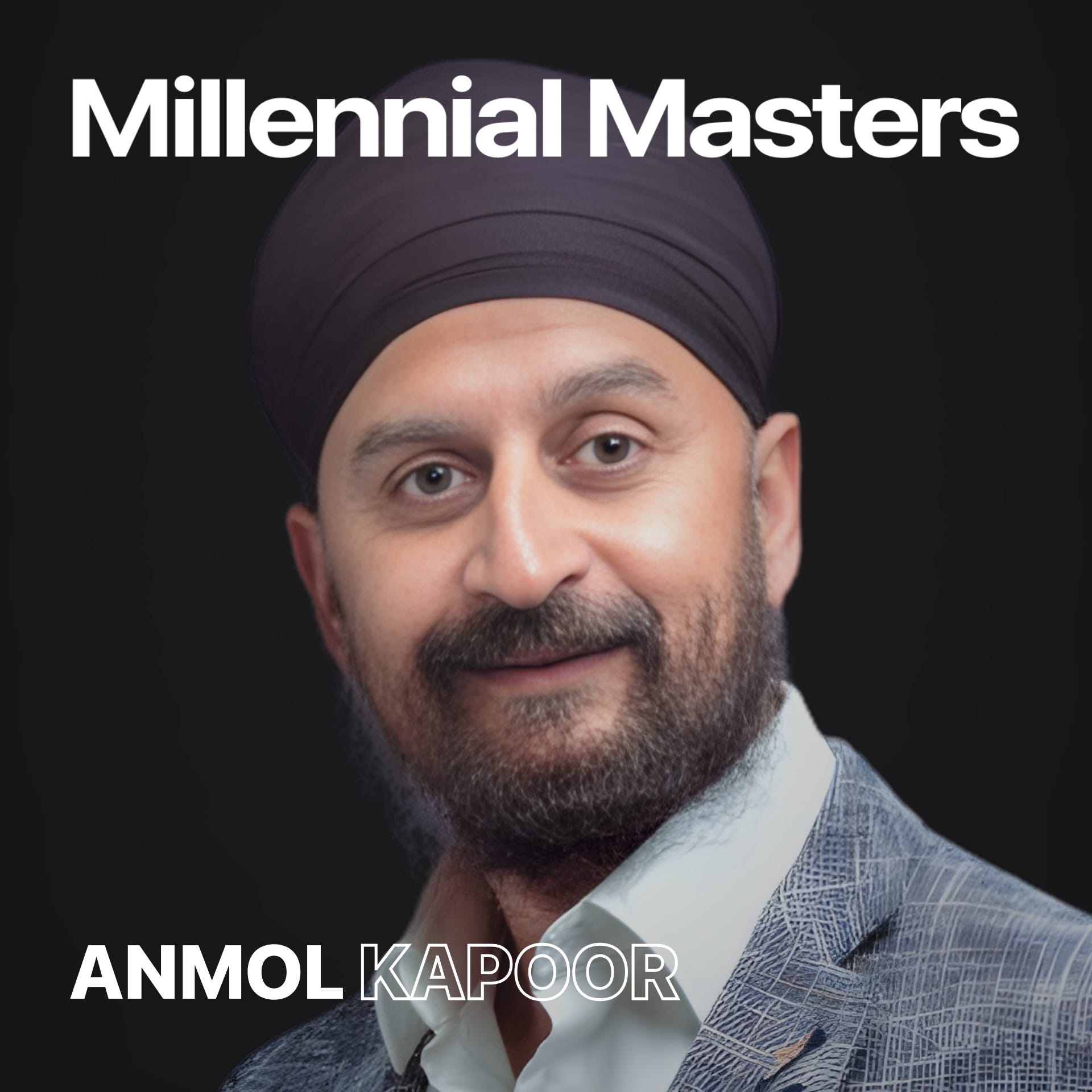
Be the CEO of your own health 🧬 Anmol Kapoor
Dec 801:04:27Tap to summarizeDr Anmol Kapoor is a cardiologist, founder, and investor focused on helping people take control of their health earlier, with better data, clearer signals, and far less guesswork.He started as a heart doctor in Canada and quickly saw the same pattern too often. Patients were doing what they thought was right and still ending up with heart failure, repeat heart attacks, and no real explanation until it was too late. That frustration pushed him out of the clinic and into building genomics companies, AI diagnostics, triage tools, longevity products, and performance testing systems designed to catch problems earlier.In this episode, we get into what prevention really means, where AI is already improving diagnostics behind the scenes, why your genetic data may become more valuable than most people realise, and what founders need to understand if they want to perform well for decades rather than just survive the next busy season.What we cover1️⃣ The control people still have over their healthAnmol explains why prevention starts earlier than most people think and why waiting for symptoms leaves people reacting too late.2️⃣ Genetic data as something you should ownThis part gets into why DNA is not just a medical record, but something with personal, financial, and long-term value.3️⃣ What earlier sequencing changesWhole-genome testing can surface risks sooner, guide treatment better, and reduce years of avoidable trial and error.4️⃣ AI inside modern diagnosticsDoctors already face more data than they can reasonably process. Anmol shares where AI is helping reduce noise and improve decision-making.5️⃣ Health as part of founder performanceSleep, diet, biomarkers, recovery, and circadian rhythm all shape how long you can perform at a high level without breaking yourself in the process.Chapters00:00 Introduction to Anmol Kapoor08:35 Transitioning from doctor to innovator12:33 Owning your genetic data17:53 The process of genetic testing23:13 Building specialised AI models37:33 Responsibility in AI and healthcare44:47 Genetics and performance: understanding our limits52:58 Ethics in genetic selection54:54 Health mistakes people keep making01:01:24 Why you should never give upGet more founder interviews and practical business lessons in the Millennial Masters newsletter at MillennialMasters.netShare this with someone who has been putting their health off for too long ❤️🩹 Get full access to Millennial Masters at millennialmasters.net/subscribe
Transcribe →
Why legal costs are broken for founders ⚖️ | Nick Holzherr
Nov 2301:03:20Tap to summarizeThis week’s Millennial Master is Nick Holzherr, founder and CEO of GitLaw.Nick turned his appearance on The Apprentice in 2012 into a real tech career. He built food AI company Whisk, that Samsung later acquired, spent six intense years running a global product, then walked away from all of it to build again.GitLaw is his latest move: an AI legal platform built for founders, not law firms, backed by a fresh $3 million pre-seed round.Nick is direct about how AI will reshape work and honest about the inefficiencies buried inside traditional legal services. His journey spans TV exposure, scaling teams across continents, navigating corporate buyouts and now building at full speed in one of the most regulated industries.This episode is all about how to build with AI, how to survive high-pressure growth, and how to stay sharp when the rules change overnight.🔗 Find Nick on LinkedInTakeaways from Nick’s episode1️⃣ AI isn’t replacing lawyers, it’s replacing bad habitsFounders already paste legal questions into ChatGPT. Nick’s point is simple: most legal work starts from templates, so the real threat isn’t to lawyers, but to slow, bloated process.2️⃣ Hiring the wrong people is the fastest way to slow a company downNick’s biggest hard-won lesson is that weak hires kill momentum. He shares how structured interviews, case studies and short trials became his safeguard in every company he’s built.3️⃣ Best practice will carry most of your legal needsIf you’re building standard NDAs, employment agreements, or terms, you don’t need custom clauses. You need market norms, properly structured. That’s where tools like GitLaw shine.4️⃣ Raising prices starts with knowing your real valueNick went from £3k contracts to six-figure deals by understanding what enterprise buyers were already paying. Pricing only changes when you see the game from their side.5️⃣ Distributed teams win by documenting everythingAsync habits weren’t a COVID invention for Nick. Writing things down, codifying decisions, and keeping clean specs is what allowed his teams to scale across 16 time zones.In this episode we cover:00:00 Introduction to Nick Holzherr02:08 Turning The Apprentice into startup leverage06:59 Early funding, pivots and finding traction with Whisk10:47 When big tech came calling and choosing Samsung13:52 Hiring 100 people in nine months20:35 How to actually run a remote, async global team24:50 Leaving Samsung and working out what to do next28:24 Spotting the AI moment and the first ideas for GitLaw31:48 AI, job displacement and who gets hit first37:39 Why legal costs are broken for founders and SMEs42:55 Backlash, cease and desist letters and staying resilient48:25 Building GitLaw differently with AI-native workflows51:19 Building from Birmingham and hiring globally55:19 Quickfire: best decision, hiring mistakes, Sam Altman, books and sacrifice Get full access to Millennial Masters at millennialmasters.net/subscribe
Transcribe →
The new rules of building with AI ⚒️ | Josh Payne
Nov 1601:07:37Tap to summarize📺 Watch now on Substack or YouTube | 🎧 Listen on Spotify or Apple Podcasts— Millennial Masters is sponsored by Jolt ⚡️ Reliable hosting for modern buildersThis week’s Millennial Master is Josh Payne, founder and CEO of Coframe.Josh didn’t follow the safe path. He never even took a full-time job. He went straight from Stanford into building things, and somehow turned a pandemic project into a telemedicine company that Tata Group later acquired. Then he co-founded Autograph and helped turn the NFT craze it into a unicorn with some of the biggest investors in the world behind it.But the most interesting thing about Josh isn’t the headlines. It’s the way he works. He builds like someone who can’t look away from the hard problems. He created GPT-Migrate, the first major autonomous AI agent for code transformation, and he’s now running Coframe, one of the strongest AI optimisation engines on the market. Their work has driven millions in extra revenue for brands like OpenAI and The Economist.🔗 Find Josh on LinkedIn, Instagram, and XTakeaways from Josh’s episode1️⃣ AI is moving fast, but not as fast as people thinkJosh expected fully autonomous agents by now. The reality is different. Models still drift, lose context and need guardrails. Progress is wild, but it isn’t magic. Founders who understand the limits build smarter.2️⃣ Human plus AI still winsJosh has tested every LLM model under the sun. The pattern is clear: The strongest results come from pairing humans with AI rather than letting the model run unchecked. If you want reliability and quality, you need a human in the loop.3️⃣ Momentum matters more than model choiceCoFrame didn’t start as a grand thesis. Josh shipped small experiments, watched what users did and let results pull him forward. Everyone obsesses over the perfect model. Josh obsesses over the next 48 hours.4️⃣ Focus is a strategic advantage in the AI eraJosh builds deep instead of wide. No chasing shiny features, no running after the latest hype cycle. The teams that stay locked on a single customer outcome are the ones who survive the next model release.5️⃣ Good AI companies bake improvement into the productCoframe works because the system keeps learning across every interaction. Not in a sci-fi way, but in a measurable, statistical way. The businesses that win with AI won’t bolt it on. They’ll make self-improvement the core engine.Subscribe for more founder stories on mindset, momentum and modern AI ⚙️In this episode we cover:00:00 Introduction to Josh Payne02:35 Skipping the safe 9–5 path04:23 From jazz gigs to building products07:01 AxisBell: launching a COVID telemedicine startup09:45 How one client became a buyer (Tata Group story)12:50 What selling your first startup actually feels like14:48 Autograph, NFTs and the celebrity-backed rocket ship20:06 What LA taught Josh that Silicon Valley couldn’t23:23 NFT hangover: bubbles, greed and timing your exit27:16 GPT-Migrate and the spark that became Coframe31:33 Coframe’s model: real AI value vs AI theatre34:46 Why human + AI beats AI alone (for now)38:31 AI’s limits today and near-term risks42:21 Alignment, jailbreaks and who really controls AGI45:53 Which models Josh trusts and why49:50 The thread connecting healthtech, NFTs and AI52:42 Sleeping in his car, grit and what sacrifice means56:22 Hiring people who run as hard as you58:51 Why Coframe is in-person and how Josh is changing as a CEO1:00:26 What Josh would teach his younger founder self1:01:19 Life, startups and the bicycle race analogy1:02:42 Trade-offs, money and staying aligned with your purpose1:05:46 Cold swims, float tanks, fasting and staying sharpPass this on to the smartest builder you know 🔁Don’t miss these AI insiders episodes: Get full access to Millennial Masters at millennialmasters.net/subscribe
Transcribe →
Build a lean business with AI agents 🤖 | Carly Meyers
Nov 901:12:31Tap to summarize📺 Watch now on Substack or YouTube | 🎧 Listen on Spotify or Apple Podcasts— Millennial Masters is sponsored by Jolt ⚡️ Reliable hosting for modern buildersCarly Meyers has one of those stories that doesn’t sound real on paper.She started out on London’s West End, performing in hit shows like Wicked and even sharing the stage with Monty Python at the O2. Then one bad landing in an audition, and overnight, that life was gone.What followed was a wild reinvention: waitressing, sewing custom clothes, working at the Apple Store, becoming one of the UK’s top network marketing leaders, burning out, rebuilding, and eventually finding her way into tech, automation and AI. Today, Carly runs Made for More, a lean AI-powered business, coaches entrepreneurs, and proudly calls herself a “team of a few humans and a lot of AI agents,” all while being a mum of two and fiercely protective of her time and energy.This episode is all about reinvention, resilience, and the rise of AI-driven entrepreneurship: how to build smarter, stay curious, and protect your time in a world that never stops moving.🔗 Find Carly on LinkedIn, Instagram & YouTubeTakeaways from Carly’s episode1️⃣ Curiosity beats resistanceThe people thriving with AI are explorers. Carly says the most powerful question in this new era is: “I wonder if AI can do this?” That mindset keeps you learning while everyone else hesitates.2️⃣ Build lean, not largeCarly runs a six-figure business with a tiny team and a stack of trained AI agents, from finance and legal to marketing and ops. Her rule: simplify first, automate second, then scale.3️⃣ Automate before you optimiseToo many founders jump straight into AI tools before fixing broken systems. Carly calls it “automation intelligence before artificial intelligence.” Get your foundations right or you’ll just amplify chaos.4️⃣ Fail faster, bounce quickerRejection shaped Carly early as a West End performer. Now, she treats failure as data. Her bounce-back rate went from weeks to minutes, because resilience is a muscle you build through repetition.5️⃣ Protect your time, not just your businessCarly blocks mornings and Fridays for creativity and learning. Hustle isn’t the goal anymore, freedom is. Her rule: design your days, not just your five-year plan.Subscribe for more founder stories on mindset, momentum and modern AI ⚙️In this episode we cover:00:00 Introduction to Carly Meyers02:35 From West End To AI: Reinventing After Injury05:39 Finding Purpose After Losing Identity08:21 Network Marketing Lessons: Building Resilience & Grit13:58 From Burnout To Breakthrough: Fitness, Focus & Mindset16:05 First Steps With AI: Content Creation & Curiosity18:25 How AI Helped Build A Business Without A Big Team21:48 The “I Wonder” Mindset: Curiosity Beats Fear22:45 Building Custom GPTs: Your First Virtual Team28:07 AI Agents Trained On Hormozi & Martel30:52 Claude vs ChatGPT: The Future Of Lean Productivity33:52 Creating AI Financial Advisors & Legal Agents36:33 Virtual Assistants, Automation & N8n45:43 AI Agents vs Employees: What’s The Difference?50:00 Inside Carly’s AI Audit Framework56:01 Why Clean Data Is The Real AI Advantage59:16 How To Fail Fast And Build Resilience01:02:49 Protecting Time And Mental Freedom01:06:39 The Lesson She’d Tell Her Younger Self01:08:00 What Ambition & Kindness Really Mean For Her KidsShare this with a founder who needs their time back ⏳More on AI from Millennial Masters: Get full access to Millennial Masters at millennialmasters.net/subscribe
Transcribe →