Podcast
Millennials Are Killing Capitalism
Hosted by Millennials Are Killing Capitalism · EN
We created this podcast in recognition that there are a number of podcasts for the American "left," but many of them focus heavily on the organizing of social democrats, progressives, and liberal democrats. Aside from that, on the left we are always fighting a war of ideas and if we do not continue to build platforms to share those ideas and the stories of their implementation from a leftist perspective, they will continue to be ignored, misrepresented, and dismissed by the capitalist media and as a result by the general public.
Our goal is to provide a platform for communists, anti-imperialists, Black Liberation movements, ancoms, left libertarians, LBGTQ activists, feminists, immigration activists, and abolitionists to discuss radical politics, radical organizing and share their visions for a better world. Our goal is to center organizers who represent and work with marginalized communities building survival programs, defense programs, political education, and counterpower.
We also plan to bring in perspectives on and from the global south to highlight anti-capitalist struggles outside the imperial core. We view solidarity with decolonization, indigenous, anti-imperialist, environmentalist, socialist, and anarchist movements across the world as necessary steps toward meaningful liberation for all people.
Too often within the imperial core we focus on our own struggles without taking the time to understand those fighting for freedom from beneath the empire's thumb. It is important to highlight these struggles, learn what we can from them, offer solidarity, and support with action when we can. It is not enough to Fight For $15 an hour and Single-Payer within the core, while the US actively fights against the self-determination of the people of the global economically and militarily.
We recognize that except for the extremely wealthy and privileged, our fates and struggles are intrinsically connected. We hope that our podcast becomes a meaningful platform for organizers and activists fighting for social change to connect their local movements to broader movements centered around the fight to end imperialism, capitalism, racism, discrimination based on gender identity or sexuality, sexism, and ableism.
If you like our work please support us at www.patreon.com/millennialsarekillingcapitalism
12episodes
Episodes
Newest firstAll episodes
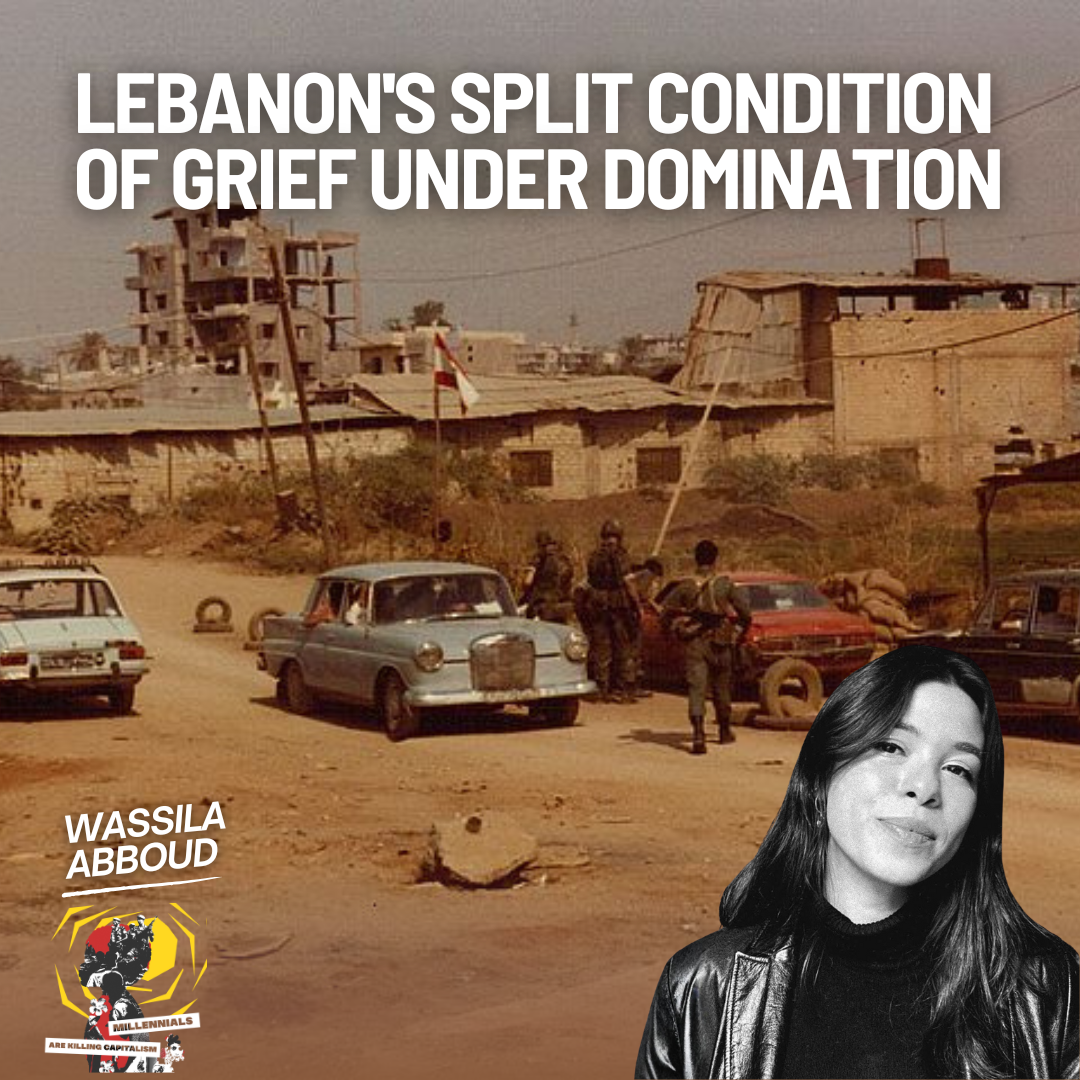
Lebanon's Split Condition of Grief Under Domination with Wassila Abboud
Jan 1100:41:10Tap to summarizeIn this episode we are joined by Wassila Abboud to discuss her essay, "The Dining Table and the Drone." Our conversation begins with her meditations on grief in Lebanon. We explore how people often name today's grief through the language of past griefs — and what this transference between past and present reveals about the psyche under domination. From there, we turn to Walter Benjamin's "angel of history" and why Abboud argues this analogy fails to capture Lebanon's relationship to catastrophe. We discuss why so many returns cluster around 1982, how that year fractured grief itself, reshaping collective memory, political imagination, and the vocabulary of resistance. We examine the paradoxical meaning of ceasefire, the choreography of repeated displacement, and the temporal logic of domination that ensures catastrophe is always waiting just beyond its declaration. Our conversation also situates Lebanon's grief in relation to Gaza's present devastation, asking what it reveals about the impossibility of stability in a regional order sustained by capital accumulation and the extraction of life. We trace the sequence of events between 1978 and 1982 — from Operation Litani to the Camp David Accords and Israel's full-scale invasion of Beirut — not simply as military maneuvers but as the crystallization of a regional order that fractured Lebanon's political landscape and redefined resistance. Wassila Abboud is a cultural worker and writer researching between Beirut and Amsterdam. Her work engages with critical theory, philosophy, and culture and takes on both a speculative and materialist approach, examining the conditions of past and present historical struggles. (Follow her on IG: @wassila_) If you like what we do and want to support our ability to have more conversations like this. Please consider becoming a Patron. You can do so for as little as a 1 Dollar a month at patreon.com/millennialsarekillingcapitalism
Transcribe →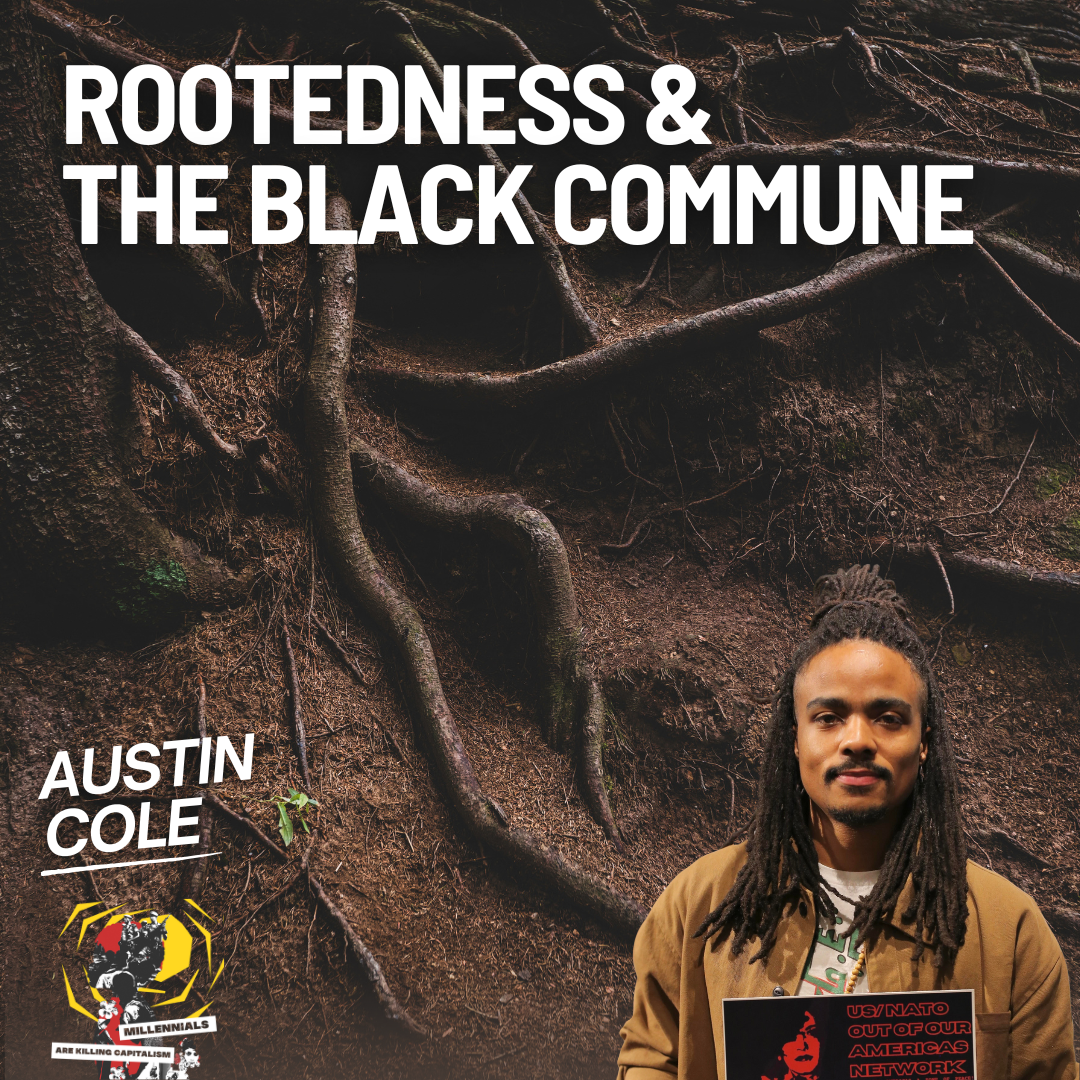
Rootedness and the Black Commune with Austin Cole
Dec 2902:05:47Tap to summarizeIn this episode, we're joined by Austin Cole to discuss the three-part series Black/African Liberation & Grassroots Economies, beginning with part one: "Rootedness for our people, our economies, our liberation." We start with Toni Morrison's concept of rootedness and how it informs urban planning and economic development. From there, we'll dig into Strategies of Counter-war—how fascists are shaping local policy, and how BAP-Baltimore is building alternatives from the ground up. We examine the threat of elite capture and the strategic use of municipal power: how can engagement with the state enable collective self-determination rather than dilute it? Can it do such a thing? We also explore expanded notions of self-defense, the Black commune as theorized by George Jackson and Orisanmi Burton, and the four principles guiding grassroots efforts toward that vision. Finally, we'll sit with the question of mass consciousness—what it demands of us now, and how we might cultivate it together. Austin Cole was raised in Springfield, Ohio, and his people come from the Mississippi Delta and Birmingham, Alabama. He is an organizer, writer, and community development planning practitioner. His professional work focuses on environmental/climate justice, transforming economic systems, and Black/African liberation. He is a member of and currently serves as National Co-Coordinator for the Black Alliance for Peace (BAP) and co-coordinates of BAP's Haiti/Americas Team. Support our work via patreon! Black/African Liberation & Grassroots Economies PT. I: "Rootedness" for Our People, Our Economies, Our Liberation Black/African Liberation & Grassroots Economies PT. II: Situating 'Economy' and Ourselves in the Struggle from the Internal (Neo)Colony Additional writings (not yet released as of the recording of this episode in late 2024) Black/African Liberation & Grassroots Economies PT. III: Constructing the Counter-War That Our Liberation Demands Black/African Liberation & Grassroots Economies PT. IV: Collective Struggle Is Our past and Future
Transcribe →