← Mind Pump: Raw Fitness Truth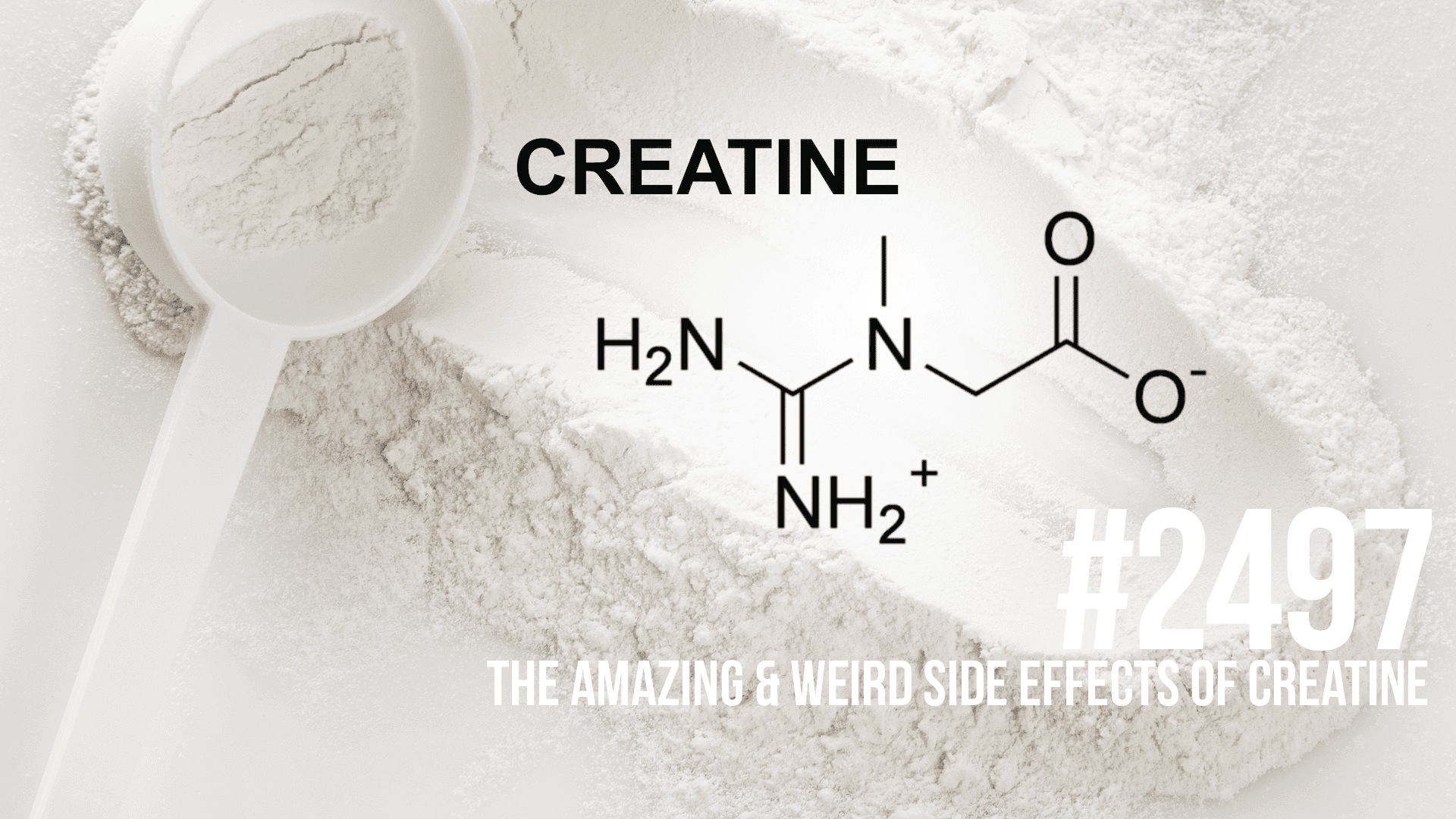
Mind Pump: Raw Fitness Truth
2497: The Amazing & Weird Side Effects of Creatine
00:38:11
The Amazing & Weird Side Effects of Creatine Why MOST people should be taking creatine. (0:58) The Amazing & Weird Side Effects of Creatine #1 - Builds muscle and strength. (8:17) #2 - Prevents injury. (14:40) #3 - Improved...
Loading summary
Transcript134 lines
- [00:00]
Sal DiStefano
If you want to pump your body and expand your mind, there's only one place to go.
- [00:06]
Adam Schaefer
Mind Pump. Mind Pump.
- [00:08]
Sal DiStefano
With your hosts, Sal Destefano, Adam Schaefer.
- [00:12]
Adam Schaefer
And Justin Andrews, you just found the most downloaded fitness, health and entertainment podcast. This is Mind Pump. Today's episode is about the most studied, most effective supplement for muscle building and fat burning and cognitive health and maybe even mental health. We're talking about creatine. By the way, today's episode is brought to you by one of our sponsors, Legion. In fact, they have a great creatine supplement. They have creatine gummies. Go check them out. Go to buylegion.com mindpump Use the code mindpump. Get 20% off. Also, this is the December special for workout program sales. We have two programs on sale for 50% off. Maps Aesthetic and Map Symmetry, both half off. If you're Interested, go to maps fitnessproducts.com and then use the code 1250 for the discount. All right, here comes the show. Creatine. You know what it is? It's amazing. In today's episode, we're going to talk about the amazing and weird side effects of creatine.
- [01:06]
Justin Andrews
The weird side effects? Weird.
- [01:07]
Adam Schaefer
Yeah, yeah, no, that was just the title that they gave us. They said it would do really well.
- [01:11]
Justin Andrews
Thank you, Jeremy.
- [01:12]
Adam Schaefer
Yeah, no, actually, okay, so creatine is now. We've been talking about Creatine for God since day one, forever, for 10 years now on the Pod One supplement, we're.
- [01:21]
Unknown
Like, this one has legitimacy.
- [01:23]
Justin Andrews
Well, yeah, but I. I think it's. I think give you your FL hours. Right. We deserve it. Here is. I mean, plenty of people have been talking about creatine for a very long time. Creatine's the most studied supplement in the market. Like, we've known for a long time. How awesome is what I think you were saying long before everybody else was parroting. It was. It was something that we would recommend eventually to the elderly, to children, to people that aren't necessarily just trying to build muscle, that just for cognitive benefits, for health, for general health, this is going to become accepted by everybody. And I think that's been the most interesting thing that I've seen happen in the last 10 years, is that, yes, we've known for a long time that it's the number one performance supplement. But what is probably new to most people and probably a lot of people that will listen this episode today are all the other benefits and all the other goals. Basically, most everybody, if not everybody, should be taking it.
- [02:21]
Adam Schaefer
Yeah. And we don't say that about any supplement, really. Lots of supplements, their value can come from whether or not you have a deficiency. So, like, you know, if you have a nutrient deficiency, a vitamin that you're lacking is. It's a beneficial supplement. But creatine across the board seems to be beneficial. I don't want to say I say seems. But you said it, Adam. It's the most studied ergogenic supplement in history. There's literally thousands of studies that have been done now on creatine since it's hit the market in the early 90s. So it's, it's extremely well studied. We know very well its safety profile. It's actually exceptionally safe supplement. Not only is it safe, but it's pro health now for people who aren't familiar with what it is or, you know, I remember, by the way, when it first came out in the early 90s, how they talked about it like it was a steroid.
- [03:16]
Unknown
Yes.
- [03:17]
Adam Schaefer
Hormone or something like that.
- [03:18]
Unknown
All these concerns.
- [03:19]
Adam Schaefer
Yeah, all my coaches and at the time I remember, you know, you had like pro athletes would use it, and so it was lumped in with other performance enhancing substances like some of the pro hormones that were out at the time. It's not a hormone, it's not a signal around that way. Creatine is naturally found in animal meat. And your body also synthesizes creatine from the amino acids arginine, glycine and methionine. So it is not an essential nutrient. In other words, you don't have to take creatine because your body will synthesize it, but it is essential for your body. That's why your body makes it. Your body needs creatine because creatine is used in the formation of a very important molecule called ATP. ATP. You know, this is like, you know, biology 101. ATP is a primary source of energy for your cells, all your cells. Any cell that uses energy, which is all of them, has a mitochondria, uses this form of energy known as ATP. ATP is adenosine triphosphate. And your body uses this energy to function. And creatine improves or increases the amount of available ATP. The reason why, 10 years ago I was saying this is a supplement that's good for. Is going to be good for so many things and we're going to see studies start to support this, is because if any cell has more available energy, then it's going to operate better. Right. Regardless of where the cell is.
- [04:57]
Justin Andrews
And if your cells are operating better than pretty much any and every goal related to health and performance is going to improve.
- [05:04]
Adam Schaefer
Now the question is, well, why supplement with creatine? We only get, we don't tap out or top out on the amount of creatine that our body can use from our diets. It's actually quite hard to do. You would have to eat a tremendous amount of animal meat to consume enough creatine to where your body's not going to utilize any more of it. Okay, so the average omnivore is going to get probably half of the creatine that they're going to use from their diet. The body will synthesize the rest. Vegans don't get nearly enough creatine because they don't get any creatine from their diet. They get, they have to synthesize all of it from amino acids. And what the studies have shown with creatine supplementation is you could take additional creatine and derive additional benefits. So although you don't have to take creatine, when you do, you get additional benefits, I think is the point.
- [05:53]
Justin Andrews
What's your, what's your evolutionary theory on why that num. That the upper threshold is higher than what the average one? Do you think that for thousands of years we were intaking much higher levels of creatine and over time that we've introduced other food groups and we can.
- [06:12]
Unknown
Preserve food, woolly mammoth meat.
- [06:14]
Justin Andrews
I mean, we've moved away from actually because like, think about almost everything else. You know, there's a, there's a reason behind or there's an evolutionary theory to why you wanted, we'd want to take a certain amount in the fact that most people, if not everybody, doesn't get the upper limit. Like what?
- [06:31]
Adam Schaefer
That's a good, that's a very good question. I don't know. I mean, I could speculate, I could speculate that, you know, hunter gatherers, a lot of our calories came from animal sources of protein. It wasn't until the agricultural revolution that we moved over to, you know, being able to cultivate crops. And, and so our diets changed radically through that process and a lot of things changed about us because of it. So I'm not quite sure, maybe the body evolved to be able to utilize more creatine during those periods of time when you were successful as a hunter and so you would benefit. I'm not sure. But the, the fact remains that taking the upper limit of creating that your body can synthesize results in benefit. Now the speculation early on with creatine was, well, because it needs to filter through your kidneys. This could be damaging to your kidneys. And now I remember that being the first big counter was, oh, don't take creatine. This is going to stress your kidneys out. And that's, that was the, that was the counter to protein. Even for a long time, eating too much protein isn't good. It needs to be synthesized by the, by the kidneys. We have lots and lots and lots of studies now that have shown conclusively that eating a high protein diet, eating a diet or supplementing with creatine has no negative effects on the kidneys. Probably actually has a beneficial effect, at least in the, in the case of creatine. However, if you have kidney disease, that's when you need to be careful with ingesting both protein and creatine. And you know this, if this is you, you know this, you have a nephrologist that you work with and they'll put you on a modified diet because of your compromised kidney function. But that does not mean that if you have healthy kidneys, you need to be careful at all. Again, there's lots and lots and lots of studies now on this and it does not negatively affect kidney function in any way whatsoever. So let's start with some of the, the benefits and I think we'll start with the, the one that everybody knows, this is the first one that everybody identified, which is that it makes you stronger and you build more muscle on creatine. The strength gains on creatine are predictable by the way. If you, if you don't take creatine and then you supplement with creatine, what you can expect, and I can get, I can, I can get real specific with this. For most people, what you can expect by supplementing with creatine, probably by week two, because it takes time to build up these creatine stores, is about two, two to four reps on every lift or five to ten pounds on every lift. Yeah, it's pretty precise. Most people, you'll notice this, your bench press will go up five to ten pounds or you'll do two to four more reps on your bench press, your deadlift, your squat, your overhead press, whatever.
- [09:10]
Unknown
I remember trying to tease that out because also bumping calories up substantially for me and in a bulk like, I felt a bit of a boost from that performance wise. But then just focusing on supplementing with creatine and, and you know, being really hydrated made a huge difference on its own. And that literally was like a two rep difference that I got out of Squeezed out in terms of like my lifts.
- [09:33]
Adam Schaefer
Yeah.
- [09:33]
Justin Andrews
So I'll, I'm going to tell you how I used to explain it as a 20 year old trainer. And then you can poke holes in my, my science or tell me if you think that it was a good way to explain it. So I tell my clients that I'd say every time you do a set, let's say we'll, we'll say bench press, your body utilizes this ATP and adp, it breaks it down. And let's just say for, for this, you know, explanation, you have a hundred of those molecules and you go do a set of bench press and your body uses 20. And then you sit and you rest. When you sit and you rest, your body replenishes, let's say 15 of those 20 and then you do the next set, which is why you kind of. Oh, throughout the workout you feel like you get a little weaker and tired throughout the workout. And that's just the breaking down of this. And utilizing that when you're on creatine, instead of you replenishing 15 of those molecules on your rest period, you replenish 18 or 19.
- [10:25]
Adam Schaefer
Yeah. And so that's not a bad explanation.
- [10:27]
Justin Andrews
And then that is where the little bit of additional strength comes from. That little bit of additional strength is what allows you to get two more reps or add five more pounds to a set, which that is what in turn builds more muscle.
- [10:37]
Adam Schaefer
Yeah, that's not a bad explanation. It's more like, so when you're strength training or you're doing explosive power movement, you burn through ATP very quickly and then you move to glycogen. Okay. So if you do a sprint or you lift something heavy, the energy that you burn up is ATP. If you, if you, if you do a bunch of sets in a row, no rest. I'm doing circuit training or something like that. I'm, I've burned up my, my ATP. I'm using glycogen. I'm, I'm, I'm building endurance. The ATP burns up quickly. You rest to replenish the ATP. So when I'm doing a set of 10, ATP is gone. I rack the bar.
- [11:13]
Unknown
This is real important.
- [11:14]
Adam Schaefer
ATP rebuilds. What, what's happening, we take creatine is you start out with more ATP right out the gates.
- [11:20]
Unknown
Yeah.
- [11:20]
Adam Schaefer
So I automatically have more of this dynamite, right? More of this quick burning energy that allows my muscles to contract with power and strength for a couple more reps. This process also aids in the muscle building process because then the other criticism was well, you're a little stronger and your lean body mass goes up, but it's not muscle, it's the extra fluid within your.
- [11:45]
Unknown
I was gonna say, isn't that a factor as well, having extra fluid in your muscles just like two. We've noticed a bit of benefit from sodium as well, you know, in terms of like being able to kind of retain fluid if. In terms of performance for strength.
- [12:00]
Adam Schaefer
Yeah, so. So let's actually touch on that. Right. Because that's criticism and that's actually one of the reasons why women have stayed away from creatine. Because when you go on creatine, it's also predictable that you'll gain between 1 to 4 pounds, depending on how much muscle mass you have. Can be as much as five or six pounds on the scale. So if you're a big dude, you'll probably go up five pounds on the scale. If you're a smaller female, one to three pounds on the scale. And so people are like, I'm not taking creatine, I'm not trying to gain any weight. And they say, oh, don't worry, it's not fat, it's water. Well, now you're really freaking someone out, especially a woman. I don't want to be bloated.
- [12:35]
Unknown
Bloated? Yeah.
- [12:36]
Adam Schaefer
I'm not trying to hold water. It's not the same whatsoever. Bloat is water under the skin. It's what makes you look puffy, so it makes your face look puffy. Water that you gain from creatine is the hydrating type of water in your muscle in its intracellular fluid. And water, by the way, your muscles are like 70 plus percent fluid. If you can add more fluid to your muscle, here's what happens to you. Here's what happens to you. When you gain three pounds of water on creatine. Your muscles feel tighter, your muscles look rounder, your glutes look rounder, your shoulders look rounder. It also goes to your skin. Your skin is more hydrated. This is great. And this contributes to a better muscle protein synthesis signal. So the initial gains are definitely this hydrating intracellular fluid, which is not bad. Remember, it makes you look better. You'll actually look better and feel tighter. But now because your muscle cells have more fluid within them, they actually build muscle faster. So the. Because the muscle building process takes longer than a week or two, the initial gain in strength is not because you have more muscles, because you have more ATP. ATP draws water in. So now your muscles are more hydrated, that all that makes them build faster. So you actually see a faster muscle building process when your muscles have more ATP. So it builds strength and builds muscle. But that's the first thing that we identified with the creatine studies and we saw that right out the gates. It's hard to, to, to debate that, like take creatine, you know, right out, right away, oh, I'm stronger. And then you take it for longer and you're like, oh, I'm definitely building more muscle.
- [14:16]
Justin Andrews
Yeah. I think this is the least interesting part of the conversation because I think this is what most people have known, everybody knows that. I think the thing that's most interesting is getting into the other stuff that totally really should appeal to people in advanced age, to women, children, longevity, focus, fat loss, focus. Like those are the areas that I think a lot of people still don't realize and understand the incredible benefits of creatine.
- [14:40]
Adam Schaefer
That's right. So here's the next one, is that studies actually show that creatine probably helps prevent injury. Now early on, another criticism with creatine was muscle cramping, muscle tears, you're going to hurt yourself. That's not true. In fact, the data shows that it.
- [14:54]
Unknown
Helps potentially probably hydration and elasticity of like the ligaments.
- [14:59]
Adam Schaefer
Everything's operating better. Yeah, everything is operating better. And it also helps speed up recovery from injury. It's, it's a great rehab supplement to take. So it's an injury prevention, rehab based molecule or if you will, that you can take that also helps with things like mobility, helps with injury, helps with muscle strain and helps with muscle function.
- [15:25]
Justin Andrews
It reminds me a lot about a similar type of benefits that like red light therapy gives you. Because it improves mitochondria.
- [15:32]
Adam Schaefer
That's right.
- [15:33]
Justin Andrews
It's like anything that improves the cell or it improves mitochondria is going to overall benefit almost anything. I mean if the cells are healthier, more hydrated, they run better then and they're responsible for all those things. It's like it's only going to make all those things better.
- [15:49]
Adam Schaefer
Now my favorite is when we get into the cognitive effects of creatine. It improves iq, memory recall, sharpness and alertness, but it is not a stimulant. This is where it gets really interesting. Things that tend to improve those things like caffeine also tend to be stimulants. Creatine is not a stimulant, although there is anecdotally some people will say they feel more stimulated, maybe from more ATP. They might have been real depleted to begin with, but it's not a traditional Stimulant. You don't get a faster heart rate from it. You don't get anything. Like, by the way, it improves heart health and liver health through the, you know, improved mitochondrial function. But it, it does raise IQ levels, especially in vegans. Yeah, there's actually a measurable IQ rise in vegans who supplement with creatine. And by the way, creatine is vegan. When you buy supplemental creatine, how is that possible? They make it through amino acids fermentation. They do not make it from, they're not taking it from animal sources. So when you buy creatine, you're buying a vegan supplement and you're getting something that could have profound effects on your overall health and function, the cognitive function in particular. And again, the studies on vegans who take creatine is like, they actually will test their.
- [17:08]
Unknown
Take it.
- [17:09]
Adam Schaefer
Oh, yeah, this was a supplement. All my vegan clients was like, we are for sure taking creatine. And every time they did, they were like, oh my God, this is amazing.
- [17:18]
Justin Andrews
I think the biggest takeaway from that is just how common that we are. We're all deficient in that. I think that's what that. I mean, they just highlight. They're. Because they're an extreme version.
- [17:27]
Adam Schaefer
They don't get any creatine from that.
- [17:28]
Justin Andrews
They intentionally avoid meat. But what do we always say that protein is like, is always the thing.
- [17:34]
Unknown
That hits your target?
- [17:35]
Justin Andrews
Yeah. No matter. Even, even when I have an Omnivore client, they still struggle to hit their protein intakes. And so to me, when I, when I hear a study like that that highlights vegans who avoid meat, and I know that all my clients were under eating meat, it just highlights to me how many people are just deficient in that. And if you've ever been told of a deficiency that you have and then you supplement for that deficiency, the, the stuff that you feel positive is crazy. I mean, there's like, that's always the thing. I mean, it's like you've heard me talk about on the show in 10 years, finding out about both my vitamin D, finding out about my magnesium, and just supplementing for those things. How life changes. So if you're deficient in something like creatine, it's like an instant like, oh, feel a difference. Positive benefits, huge.
- [18:22]
Adam Schaefer
Next. And this one's also very exciting. And there's lots of now research around this and data to support this. It has antidepressant effects for many, many people. In other words, taking creatine elevates your mood so this also has been. And I, I predict in the future that creatine will be a supplement that is a first line intervention for somebody suffering from low. Now is this levels of depression related.
- [18:51]
Unknown
From exercising in combination?
- [18:54]
Justin Andrews
It's isolated by itself. So it has taken creatine. Does it have anything to do with like serotonin or dopamine or is it just the overall positiveness of being with more energy? Okay, so it's more that like.
- [19:06]
Adam Schaefer
Yeah, oftentimes depression, I mean, depression is very complex. I want to be clear. It's extremely complex. But sometimes depression is just low energy. It's low energy, low function. Brain function isn't so good. And so you have a physically depressed feeling. This is, that's what that is. Creatine has been shown in studies to have an antidepressant effects in people, especially in women. In women you see a more pronounced effect with creatine supplementation.
- [19:33]
Justin Andrews
So that is, that's probably what goes hand in hand with the anti anxiety stuff too.
- [19:37]
Adam Schaefer
Yes. Also. And it also has anti anxiety effects for many people. And again, this probably has to do with this. I'm not producing enough creatine, I don't have enough ATP, which is going to make you feel uneasy. Not so good. Whereas supplementing with creatine, I feel good, I feel energized. Depression's gone. I feel calmer again. This is, it's not a stimulant. So it's one of those remarkable. I mean it's one of the very few, if only things I can think of that is anti anxiety, antidepressant improves cognition. That's not a stimulant simultaneously. In other words, if you're one of those people, it's like if you have anxiety, you probably don't want to take caffeine, you know, even though it might be an antidepressant, improve cognition. You also have anxiety.
- [20:22]
Unknown
Caffeine might disaster a lot of times.
- [20:24]
Adam Schaefer
That's right. Creatine has enzyolytic effects for many people.
- [20:27]
Justin Andrews
Now as we're going through these sal, do you remember or can you recall like the order in which we, we came to this conclusion? Because some of this stuff is like relatively new research. Right. We've known the muscle building stuff for a very, very long time. Right. That's. It's for a very, very long time. There's tons of studies on that. But in the last decade, some of. Some of this stuff has really been.
- [20:48]
Adam Schaefer
Many in the last 10 years, some of it in less. Five. Okay, yeah.
- [20:51]
Justin Andrews
So what is the most Recent thing.
- [20:52]
Adam Schaefer
That we've learned, probably the depression and anxiety, I would say are some of the more recent ones. When we get to skin health, those are also very recent because as people realize, like, you know, here you have this supplement for athletic performance. And then when people started, you know, marketers and companies started seeing, well, this, this works by improve. By increasing ATP.
- [21:14]
Justin Andrews
Yeah.
- [21:15]
Adam Schaefer
What side effects do people get from not producing enough ATP? Or what happens when we have more mitochondrial energy? So research started going into, well, maybe we know now creatine increases ATP because now it's been around for 20 something years or 30 years. So let's give it to these people with depression. Let's give it to people with anxiety. Let's give it to these people.
- [21:37]
Unknown
General public, it seems that they moved from athletes over to like, kind of see less active people or just like everyday average people.
- [21:45]
Adam Schaefer
Yeah, I mean, it's, you know, by the end of this, you'll realize that it's. This is a, this is probably the best wellness health slash performance supplement you could take. I mean, there's really, I can't think of a more, generally speaking, better supplement to take for all of those things. This is one of the things I tell everybody to take. And very rare cases, very rare cases, do people have, you know, gastrodistress from creatine. So if you're watching this, you've tried creatine, it causes gastro issues, then it's not for you. But that's a very small percentage of people, something like 5% or less. Everybody seems to be pretty well tolerant of supplementing with creatine. One of the more recent studies I've seen shows that it helps with sleep. So now this. These studies were done with postmenopausal women who started supplementing with creatine. And they all had improvements in sleep duration and sleep quality from supplementing with creatine, which was.
- [22:42]
Justin Andrews
What do you think, dude?
- [22:43]
Unknown
What's the mechanism?
- [22:44]
Justin Andrews
Positive energy throughout the day then causes you just to have better rest.
- [22:47]
Adam Schaefer
You think, you know, it all goes back to rhythms, it all goes back to better functioning mitochondria. You, you mentioned something earlier in this episode, Adam, about giving this to the elderly. You hear this in the biohacking world all the time. Mitochondrial health. It's all about mitochondrial health. If you want longevity, you want to stay young, you want to be youthful, you have to focus on improving your mitochondrial health. Right? And they'll talk about supplements like NAD and use this peptide, use that peptide. And here's how you optimize your Sleep and your sunlight and your whatever to improve mitochondrial health. As you age, your mitochondria start to function at lower and lower levels. Anything that improves the function of your mitochondria will help stave off the common effects that come from aging. One of the more common effects as we get older is our sleep quality goes down. Everybody knows this. Like once you hit 40, 50, 60, 70, you talk to anybody in those age groups, sleep quality starts to go down. Postmenopausal women will alsoi mean the majority of them will complain about sleep issues. This study was looking at what does creatine do for them in general and found pronounced effect on improve improvements in sleep. So this is a supplement that can help you get better sleep as well. Bone health will be the next one. So it's, it's probably beneficial for improving bone health. This may have to do with improvements.
- [24:11]
Justin Andrews
In strength for sure, because we already know that. We know that muscles are stronger. Yes. Right. We know that if you're, if you're stronger, you're lifting more weights. The, the same signal that causes muscles to grow and adapt is the same signal that will make bone grow and adapt and get stronger. Right. So it's got to be directly connected.
- [24:28]
Adam Schaefer
It definitely. So it's like a, it's probably going to be one of those things that will start getting recommended regularly to people with osteoporosis and I'm sure it'll be in combination. Because you have osteoporosis, almost every doctor now will tell you to do some kind of weight bearing. They'll say, or strength training exercise. Creatine's probably going to be.
- [24:46]
Justin Andrews
Yeah, I want you to illuminate that too, Sal, as you go through these because. Okay, so some of these, for example, example the cognitive benefits, you don't even necessarily need to be strength training, just you supplementing that should show a difference that. Because you're depleted in that.
- [24:59]
Adam Schaefer
That's right.
- [24:59]
Justin Andrews
So there's an example of something that doesn't even require that. But obviously in order to see the muscle building benefits, you obviously need to be lifting weights too.
- [25:06]
Adam Schaefer
Muscle building, yes. Strength, no. Do no. Strength training. Take creatine, you're stronger.
- [25:10]
Justin Andrews
Oh, wow. So there, so there is studies that show that even or you're stronger, you.
- [25:14]
Adam Schaefer
Just, you're just going to be stronger because you have more ATP. I mean it's not going to be like a, you're going to get an effect and then it's done. So you could do 5 to 10 more pounds than you did before.
- [25:23]
Justin Andrews
So that's interesting.
- [25:23]
Unknown
But then you could recruit at a higher capacity.
- [25:27]
Adam Schaefer
It's like giving your muscles more dynamite. Like you said, more dynamite, more gasoline for the strength. So you don't need to do strength training to get stronger from creatine, but the strength that you gain from it is finite. So you get stronger than you're done. Right. So add the strength training because. Okay, cool. You're five pounds stronger. That's not really that big of a deal.
- [25:45]
Justin Andrews
Because the reason why I wanted to highlight that is because even my. You are a bit of an anomaly. Somebody who's since 17 years old been taking it and you've never stopped and you've been consistent. I, on the other hand, I think I'm probably more like other people that know the benefits of it and go and then are intermittently use it or have runs or, or what I used to do. Like only when I strength trained I took it where it's like this is more likely to be used how you've been using it forever or that's how it should be used. It's just like it doesn't even matter if you're lifting weights or you're falling off the wagon of training. It's like it many other positive benefits that it should just become a regular supplement that you take hold.
- [26:22]
Adam Schaefer
Yeah, probably. And, and there's limited data on this, but it probably improves immune function as well. So you're probably going to have a more, a better functioning immune system. I mean again, anything that makes your.
- [26:35]
Unknown
Cells operate, better function of the cell, if it improves.
- [26:38]
Adam Schaefer
That's right. That's right. Next up, this one's my favorite one is it promotes skin health. So now you're starting to see skin products with creatine in them that really rub into your skin.
- [26:50]
Unknown
I have not seen that like topically.
- [26:52]
Adam Schaefer
Topically.
- [26:53]
Justin Andrews
Really?
- [26:54]
Adam Schaefer
Now taking creatine will also improve your, the health of your skin because that makes sense. The skin cells absorb it, are more hydrated. This and the, the Remember your skin is made up of protein matrices like collagen. Right. So it's like this, your skin is protein. Okay. So if the, if the proteins in your skin are gonna rebuild faster, just like the proteins in your muscle or more hydrated, you're gonna have a more youthful appearance with your skin. So it's a pro.
- [27:23]
Unknown
I didn't know they're using it like that. It is.
- [27:24]
Adam Schaefer
And again, this isit's so crazy to me that women have stayed away from creatine. I can't think of a better supplement for women Than creatine. For anybody. Than creatine. But for women in particular, for the concerns that they have. I want my skin to look better. That tends to be a female thing. I want my muscles to look rounder, more firm. You know, I want to have a faster metabolism like creatine. Across the board is what you need. Which takes us to this next one. Indirectly. I'll say this indirectly. It's probably the best fat burning supplement you'll ever take.
- [27:53]
Justin Andrews
I love that I've heard you make that argument.
- [27:55]
Adam Schaefer
That's right.
- [27:56]
Justin Andrews
In other interviews and stuff that you've done before. And I, and I just think that it the way we've been coaching and training clients for over, well over a decade now, where no matter how much weight you need to lose, the first thing that we all do is reverse diet and focus on building muscle in order to speed their metabolism up. Because that is the fastest way to lose that 100 pounds. It is not to take them where they're at and just start cutting calories and moving more, which is traditionally how we used to do things. The more effective way to do things for that person who needs to lose 100 pounds is actually to reverse diet them, to build their metabolism so that their body then automatically burns more body fat or uses more fuel. That's a far better, not only better, faster strategy, but also a more realistic, sustainable one. So it makes sense that creatine should be one of the best, if not the best, fat burning supplements, even though you don't take creatine and it goes and burns fat. But let's be honest, no supplement does that, not even fat burning supplements do that.
- [28:57]
Adam Schaefer
There is no supplement that burns body fat. That's a total myth. Some make you eat less for a short period of time, others make you more hyper. I guess that makes you move more maybe for a short period of time. But creatine indirectly has this metabolism boosting effect through the muscle building process. Now here's why it's never been sold as a fat burning supplement. Because you gain a few pounds on the scale when you take it, right.
- [29:18]
Justin Andrews
And so people would automatically be like, this is the worst fat burning supplement ever. I took it and I added three pounds on the scale.
- [29:23]
Adam Schaefer
That's right. But remember the three pound. Let me tell you, let me. Okay, here I'm going to more lean muscle. I'm going to blow everybody's mind right now. Okay. If you take creatine today and you take it consistently over the next two weeks and you gain three pounds on the scale, okay? And you lost no body fat. You have a lower body fat percentage. You will have a lower body fat percentage in two weeks on creatine than you did if you didn't take creatine. But you lost no body fat. How is this possible? Because your lean body mass went up. Your body fat stayed the same. Your body fat now is a smaller percentage of your overall body weight. Remember, lean body mass is everything that's not body fat, which includes intracellular fluid. So If I put 3 pounds of intracellular fluid in your muscle muscles feel tighter. They look rounder and firmer. And then you test your body fat. Now it's not a huge effect. It'll be like point, you know, 2% lower. So it's not this big effect. But you're actually leaner. You're actually leaner two weeks later because your lean body mass went up a little bit. Even though your body fat, actual body fat pounds didn't go down or up.
- [30:25]
Justin Andrews
That's right.
- [30:25]
Adam Schaefer
And you look a little bit leaner. Here's what want women to understand. If you took the don't weigh yourself. That messes people up. If you take creatine, you gain three pounds of sculpt and shape and firmness. The way you're going to look is leaner as a result. Now the fat burning effect happens later as you build the muscle and the metabolism starts to speed up. You'll actually improve your body's ability to burn body fat through the muscle building process. Which is something that we sell and talk about every single day. So for those reasons right there, and I can argue this all day long, creatine is the best fat burning supplement you could possibly take.
- [31:02]
Unknown
Okay, we have a couple questions. The first one is how much creatine should I take every day?
- [31:07]
Adam Schaefer
Most people would benefit between 3 to 5 grams a day.
- [31:12]
Justin Andrews
Now haven't some studies showed there's some positive benefits even the upper limits more.
- [31:17]
Adam Schaefer
Muscle mass you have in particular. But, but there's some studies that show that 10 grams a day probably has more of a cognitive boosting effect than just 5 grams a day. Nonetheless, taking upwards of 20 grams has been shown safe for long periods of time. But I always tell people 5, 5 grams, a nice happy medium. Yeah, you're going to do great with that. If you want to play with the 10 grams to see if you notice a difference, go for it.
- [31:39]
Justin Andrews
But that's, that's, I always, I always told my women three to five, my men five plus is what I would say, especially if you're a bigger guy. You're 220 plus pounds because of weight. You could handle five. Five.
- [31:51]
Adam Schaefer
Yeah, more, more, more cells that need more ATP. But I've been taking five grams a day for, like you said, since 16.
- [31:56]
Unknown
So the next question is, does it make a difference when I take the creatine?
- [32:01]
Adam Schaefer
Not really. Although I will say that there have been some studies that showed that years. There's a bit of. Yeah, a bit of improved uptake if you take it right around your workout before or after. That being said, I mean if it increases the uptake by a little bit, like taking an extra half a gram would make up that difference. So it really doesn't make that big of a difference. Anecdotally I will say this though.
- [32:23]
Unknown
You split it.
- [32:24]
Adam Schaefer
I've had in my whole career of training, I did have two clients that if they took it before bed, they got a mild stimulatory effect. They felt kind of like a little more awake. The data doesn't show this. I just had clients tell me, I think in the morning or around your work.
- [32:40]
Justin Andrews
So the way I always answered this was because it's a splitting hair difference on the post workout. So yeah, okay, great. If you can, that's great. But most important is the consistency. So if you do, if you already take your multivitamin or something else at a certain time of the day, take it with, you know, whatever, whatever you, whatever, you'll do it the most consistent. That's the most important part, time of the day. I think that's the best because that, that's far more important than trying to time a anabolic window or something like.
- [33:10]
Unknown
That will be in your system and you could be able to utilize it.
- [33:12]
Justin Andrews
That's right. That's right.
- [33:13]
Unknown
The next question is, should I cycle on and off of creatine?
- [33:16]
Justin Andrews
No.
- [33:17]
Adam Schaefer
That was a myth back in the day. Yeah. So is the whole loading thing. Like you lo creatine and then you go down to a maintenance stove. The loading. I'll touch that, I'll touch on that. The studies showed that when you load creatine taking 20 grams a day for the first seven days that you top out, your creatine stores faster. That's true. By a day or two. It's not worth the money that you're throwing down the tubes by taking you so much and then cycling it.
- [33:40]
Justin Andrews
No.
- [33:40]
Adam Schaefer
Like the benefits are so profound. This is a forever. You just take it all the time. There's no need to cycle it. There's no. Doesn't affect your body's ability to synthesize Creatine, you don't have this negative feedback loop, none of that stuff. You just take it all the time.
- [33:53]
Unknown
The last question is, what is the best form of creatine?
- [33:57]
Adam Schaefer
Okay, so here's what I love about the supplement industry. If a supplement ever comes out that shows any benefit but in creatine is at the top, then what they try to do is come out with ways of selling you more expensive versions or whatever. And this one doesn't cause bloat, which creatine doesn't cause bloat to begin with.
- [34:13]
Unknown
That one's time released or.
- [34:14]
Adam Schaefer
Yeah, like creatine monohydrate is the one that's been studied. With 99% of the studies, there's no problems with it. It's the best form. Every other form of creatine has been shown to be less effective or the same. So it's like, if you're gonna spend more money taking it, like, it makes no sense, go with pure creatine monohydrate.
- [34:33]
Justin Andrews
So you have to tell the audience why that is. And the reason why that is, is because the purest, most basic form of it has become really cheap. Because the market has demanded so much, you can. It's so readily available. Anybody and everybody has access to it. And so what that does is it has driven the price down. And so the margins are tiny on. Most companies that sell creatine make very little profit on it because it's. So many people can get a hold of it. So the way that these companies make up for those margins is by putting other things in it and then marketing and advertising to you that this is better for these reasons because they're trying to make up for the margins that aren't there in creatine monohydrate. But creatine monohydrate is the best.
- [35:14]
Unknown
Gets the job done.
- [35:15]
Adam Schaefer
Dude, I'll tell you, you're so right. In 1994 or five, when I first started taking creatine, 40 servings of creatine. So 40 servings was 50 bucks.
- [35:25]
Justin Andrews
Yeah.
- [35:25]
Adam Schaefer
In 1995, which is like, like $10,000 today. I don't know, inflation, all that, but that's how much it was at least. You could buy so much pure powder creatine now for like 30 bucks. It's ridiculous. So 100. Right. The market got so good with it, so crazy that you could get a lot of it. I would say now, you know, use the form of creatine. That's going to help you use more of it more, more, more consistently.
- [35:49]
Justin Andrews
I'm so glad you said that because that my case I would have made this is why I'm such a fan of the gummies. And I know you tease me all the time about the flavor things and tasting but it's like I am have most of my life been or for most of my lifting career been aware of creatine and I've never been as consistent as I am today. And it's because now companies are making gummy form and I like to eat them and so I know that I need like powder. Yeah. And so.
- [36:16]
Unknown
And my protein again.
- [36:17]
Justin Andrews
If so I guess this is how I would tell the audience if if you want the the best form for the cheapest price, go with one of the reputable companies that we work with. We work with a couple companies that that supply creatine and get their powdered plain form. If you're trying to just save money for the best. If you are concerned about consistency, then I recommend the gummy direction because I think that, I mean it's like four or five gummies.
- [36:39]
Adam Schaefer
You got your five grams of crazy.
- [36:40]
Justin Andrews
Yes. So that's how I. Because it's going to be a little bit more expensive to pay in the gummy form. So if you use it, but you'll use it and if you like it and you don't really care about the couple extra bucks it costs, then go that direction. If you're looking for the best for the cheapest price, then go with one of the reputable companies that does just pure monohydrate, just a pure powder.
- [36:56]
Adam Schaefer
Perfect. All right, look, if you like the show, come find us on Instagram. Justin is at Mind Pump. Justin, I'm at mind pump DiStefano and Adam's mind Pump out.
- [37:03]
Sal DiStefano
Thank you for listening to Mind Pump. If your goal is to build and shape your body, dramatically improve your health and energy and maximize your overall performance, check out our discounted RGB super bundle@mindpumpmedia.com the RGB Super Bundle includes maps, anabolic maps, performance and maps aesthetic nine months of phased expert exercise exercise programming designed by Sal, Adam and Justin to systematically transform the way your body looks, feels and performs with detailed workout blueprints and over 200 videos. The RGB Super Bundle is like having Sal, Adam and Justin as your own personal trainers, but at a fraction of the price. The RGB Super Bundle has a full 30 day money back guarantee and you can get it now. Plus other valuable free resources@mindpumpmedia.com if you enjoy this show, please share the love by leaving us a five star rating and review on itunes and by introducing Mind Pump to your friends and family. We thank you for your support and until next time, this is Mind Pump.
- [38:10]
Unknown
Marketing is hard, but I'll tell you a little secret. It doesn't have to be. Let me point something out. You're listening to a podcast right now and it's great. You love the host. You seek it out and download it. You listen to it while driving, working out, cooking, even going to the bathroom. Podcasts are a pretty close companion. And this is a podcast ad. Did I get your attention? You can reach great listeners like yourself with podcast advertising from Libsyn Ads. Choose from hundreds of top podcasts offering host endorsements or run a pre produced ad like this one across thousands of shows. To reach your target audience in their favorite podcasts with Libsyn ad go to libsynads.com that's L I B S Y N ads.com today.