← Mind Pump: Raw Fitness Truth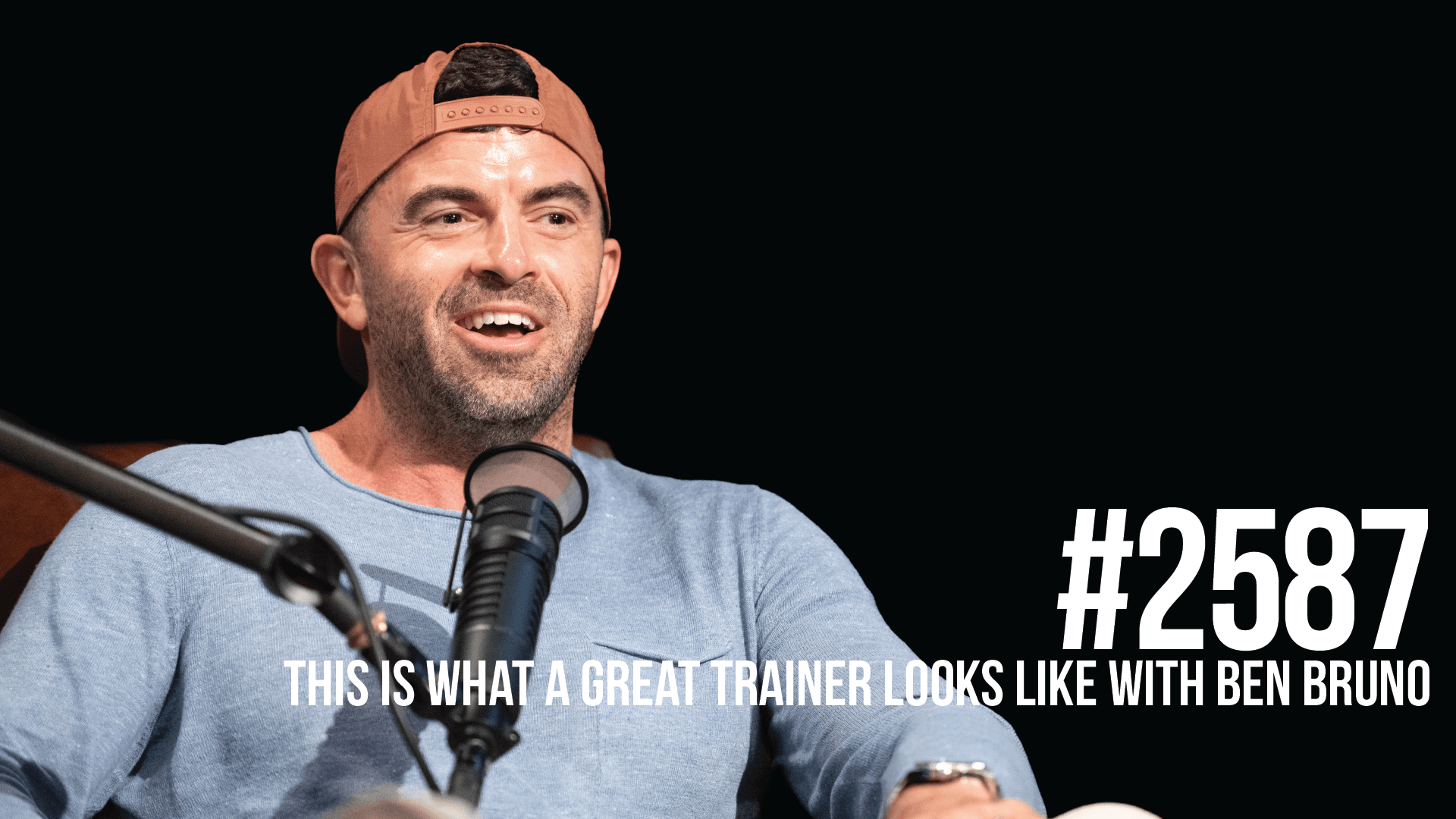
Mind Pump: Raw Fitness Truth
2587: This is What a Great Trainer Looks Like With Ben Bruno
01:51:54
Ben Bruno How long has he been training? (1:11) His love/hate relationship with the social media space with fitness. (2:05) The keys to building life-long clients. (16:25) The art of meeting a client where they are. (27:42) The simple traits...
Loading summary
Transcript297 lines
- [00:00]
Sal Destefano
If you want to pump your body and expand your mind, there's only one place to go. Mind Pump.
- [00:07]
Adam Schaefer
Mind Pump.
- [00:08]
Sal Destefano
With your hosts, Sal Destefano, Adam Schaefer and Justin Andrews, you just found the.
- [00:14]
Adam Schaefer
Most downloaded fitness, health and entertainment podcast. This is Mind Pump. Today's episode we have celebrity trainer Ben Bruno on. He talks about how he became one of the world's most sought after personal trainers. He teaches us techniques. He's hilarious. Great personality, he's got great stories. But honestly, if you want to learn about fitness or you want to learn how to be a successful trainer, don't miss this episode. This episode is brought to you by. Oh, by the way, you could find him at Ben Brunotraining on Instagram. Now, this episode is brought to you by a sponsor, Seed. This is the world's best probiotic, hands down. If you want to try them out and get a discount, go to seed.com mindpump use the code 25 mind pump, get a discount. We also have a sale this month. Maps hit and the Extreme Fitness bundle are 50% off. If you're interested, go to maps fitnessproducts.com and then use the code APR50 for the discount. All right, here comes the show. Ben, welcome to the show.
- [01:12]
Sal Destefano
Thank you.
- [01:13]
Adam Schaefer
Yeah, so we, we, we checking out your Instagram. I love finding. Because you don't see this too often. You don't see too often fitness. I'm going to say something. You don't like influencers. I'm sure a real trainer hates that term. Who communicates like someone who's experienced, who's trained lots of people. Oftentimes you see fitness advice, you're like, oh, that person. I could tell they've never worked with anybody. I could tell they only worked themselves out. But you have a lot of experience and you can tell by the way you communicate your information that you've trained a lot of people. How long have you been training? How long have you been doing this?
- [01:44]
Sal Destefano
19 years.
- [01:45]
Adam Schaefer
Yes, 19.
- [01:47]
Sal Destefano
Honestly, I. Since college, it's all I've done. And for better or worse, I have just about zero life skills outside of taking someone through an hour long working. But I found that. But you're really good at that well enough. You can sort of make the rest of stuff fall into place, at least enough to.
- [02:05]
Adam Schaefer
So what do you think of the social media space with fitness? It's gotta be. I'm sure you got a kind of love hate relationship with it.
- [02:12]
Sal Destefano
Well, first off, dude, when we were going on a walk talking before, I didn't put Two and two together. But I just realized that you are the person that got me putting moisturizer on my face.
- [02:23]
Justin Andrews
No, you do.
- [02:26]
Sal Destefano
Talk like a face caldera. Yeah, dude. I got hit with this ad and timing's everything, but it was. My wife was ripping on me. I'm starting to get wrinkled. I turned 40 this year, and my whole life I've just. You know, I have like a two in one shampoo and conditioner that's actually a four in one. Cause it's a face wash and a body wash. It's all I ever do. Just like the whole deal, it's the whole shebang. And I'm like, I used to kind of think dudes that like, did moisturizer. I'm like, I don't know, like, that's a little less than masculine kind of thing. And then I was seeing the ads and I'm like, I think I gotta fucking put on a moisturizer. I don't have the one you do. But I moisturize this morning. I do it. I do it, like, probably not every day, but most days.
- [03:11]
Justin Andrews
Oh, hey, on your way out, I'll help you up with all kinds of caldera caldera.
- [03:15]
Sal Destefano
I realize that. Yeah. Cause it's starting. I'm like, fuck, this aging thing is not ideal.
- [03:20]
Adam Schaefer
No, I appreciate that. Thank you.
- [03:21]
Justin Andrews
You know what's so funny about you? We started this talking about the Internet and the love hate relationship with social media. It is so wild to us when that happens. Right there now. We've reached a level now where people see ads of our partners that they're running that we're like, Sal will be known as the caldera guy. Yeah. You have vori guys, like, so funny.
- [03:43]
Adam Schaefer
Yeah.
- [03:43]
Justin Andrews
Not that we're trainers or anything that we actually think we're good at. It's like.
- [03:46]
Sal Destefano
Exactly.
- [03:47]
Justin Andrews
You're the caldera guy.
- [03:48]
Sal Destefano
No, I mean, I, I. Thank you, man.
- [03:50]
Adam Schaefer
I was just gonna say your face looks amazing.
- [03:52]
Sal Destefano
Yeah, thank. Thank you.
- [03:54]
Adam Schaefer
This episode's not even sponsored by.
- [03:57]
Sal Destefano
Check. I'm a. I'm a customer.
- [03:59]
Adam Schaefer
Oh, great. So, okay, so what are some of the. What are some of the biggest pet peeves you have with our space on social media? Because, like, we all trained people and worked in gyms before it was even a thing. I mean, this wasn't a thing at all for us until we started this company. And even then, it wasn't until halfway through because we started figuring things out and it's. It's a crazy space to navigate. There's a lot of good and bad Information that's out there.
- [04:24]
Sal Destefano
There is yet. Well, so before I start, you guys, Seinfeld fans, remember Die Hard bro Festivus.
- [04:30]
Adam Schaefer
Yes, of course.
- [04:31]
Sal Destefano
January 3rd, the airing of the Grievances. Yeah, I don't want this to feel like Festivus because I actually do think that the Internet's the single best place to learn information. And then second's not even close. You just got to take the good with the bad. Agreed. But I think the stuff that when Adam and I first connected, it was about a post I did, I think, talking about online training. And really all I was saying was that it's a weird time to be a trainer because the information that's given out about training is from people that don't train. And that's a weird thing. And sometimes I feel old and I think we all have to change with the times. It's a very. You know, when I first started learning about training, it was all through books. And that was a different, totally different thing. And the pros to that were the only people that wrote books were like the actually good trainers. The cons to that was the only information you got was the book. And so now it's a weird time. As somebody who trains, it seems like the way to succeed on the Internet is super different, almost polar opposite to the way to succeed with a client.
- [05:45]
Adam Schaefer
And explain that to succeed with a client versus online. What do you mean by that?
- [05:51]
Sal Destefano
Well, you know, so for example, I've been a trainer in Los Angeles for 12 years. Most of my clients I've had eight years plus. It's a long time. And with that, I would say long term client retention really just boils down to getting people to their goals in a way that doesn't disrupt the rest of their life. Again, you know, getting to their goals safely without excessive soreness, all this stuff. The way to stand out online seems to be to make things hard as fuck and unique as. And things like where I, as a trainer who's trained a lot of people, I. I look at stuff and think like, nobody really does that. Like, let's, you know, it seems there's a. Like I kind of like play out the tape on what I'm seeing and going. They either just start their workout with this weird thing and then go do their normal workout or like, they just throw this in at the end. But I'm like, people don't work out like that in real life, you know, that aren't total gym heads, like, you know. And I think you can really stand out online if you're just really fit yourself, just kind of like flexing what you can do. But that's not really helpful to normal people, that most people can't do that. And so I guess that's what I meant. And then the education thing is weird because, you know, we now have a lot of fitness business coaches that are almost 100% failed trainers. They just, you know, their gym shuts down and then they start doing Facebook ads about how to run a gym. And I'm like, I don't know, like if I want to be listening to that, you know, maybe they have good advice. But it's a. That's just calling it what it is. You know, it's the amount of times that I get hit up by someone that wants to help me grow followers by some shady tactics. And I'm like, you tried to be a trainer and you failed. Like, that's not who I want to be learning from. And at the same time, the Internet shit's fucking confusing. And, you know, I don't know how to do it that well, like most trainers don't. And so I don't begrudge the consumer for listening to these people because it's what's in front of them all the time. You know, I have a lot of trainer friends. I'm actually so that. That post I did, Adam, it got well received by some and like, I'm glad we connected through it. And then it. I feel like a lot of trainers missed my point, if I'm being honest, because, you know, go figure. It's social media. It's crazy. But my point was twofold. One, that I think the consumer needs to kind of be wary of what they see. But two, I actually think that the people training that have good info could probably stand to just take some time to learn how to the ways of the world and get it out there. Because my whole thing is like, until two years ago, I didn't even have an online program, but I would just sit around with my trainer friends talking shit about all the online programs. And I was probably right, but like, you're not making any change at the same time. So I don't know if I know all the answers, but I do think it's a weird thing that in the. With tech, a lot of the trainers that have been doing it a long time, I'm generalizing, but it seems like I don't. I don't have any trainer friends that are great trainers that have been doing it a long time that are very tech savvy. It's just sort of like, you know, we're all like, you know, meatheads that are trying to figure it out. And so that means that these people that become the authorities aren't the ones that have done it or are doing it. And I think a lot of young Internet people are seeing that you can make a lot more quick money going online. And I get that. You know, I also think that trainers have this weird badge of honor about like always struggling financially. So I see like both sides, but it's a little, it's worrisome to me. The information that's taken as gospel isn't very good information a lot of times. And even, you know, even on podcasts, outside of fitness podcasts like this, this podcast is probably the listeners are all probably fitness minded people.
- [10:22]
Justin Andrews
Right?
- [10:22]
Sal Destefano
Like, but then, you know, I'll see clips on the kind of just like self help type podcasts that go to more people like my mom or just regular people. And it's always just the trainers that have a lot of followers. And, and there's some trainers that have a lot of followers that are great trainers and there's a lot that have a lot of followers that don't know their ass from their elbow. And that's what's going out to the, the general, the general podcasts. And so it's, you know, I don't quite know the solve and I definitely don't want to sound like a curmudgeon because I think the Internet's awesome. It's been good for me. It's how we can. And I wouldn't, I wouldn't know you guys without it. But I also think that there's a lot of issues.
- [11:08]
Justin Andrews
Do you think it's just a time thing? Like, I, I feel so much the same way. I also think that this is what gave me hope about what we were doing so 10 years ago. We're already 10 plus years into our training career, so getting to the place where we'd consider ourselves pretty good. Okay. At what we did right. By about year 10. And I saw the exact same thing that you've literally just described as. I looked at the landscape and I went, wow, most of the most popular people right now. This is back when Instagram had just started. YouTube had been going for a little bit. Nobody even knows what a podcast is.
- [11:41]
Sal Destefano
Yeah.
- [11:41]
Justin Andrews
And the authorities, the advice they were giving was stuff that I was probably touting when I was 19, 20, stuff that I thought was probably, oh man, these, these guys and girls just have so much more to learn. They haven't trained enough people, they haven't learned enough, they haven't been around long enough. And so I thought, man, if we could just get out there, I don't know any, I don't know how to turn the camera on, I don't know how to turn the mic on, I don't know how to do any of this. But if we could just get our information out there, I think we can help a lot of people and I think we could figure this out. And that was really what gave me hope for this thing was because we were terrible. I mean, we were really bad from the jump. Just none of us have media experience. Talking to a camera, pretending millions of people are listening is so not my thing. Yeah, I do so much better with a real person. I can like doing the camera thing is so opposite. And you find too, the people that tend to be really good at the camera thing aren't the best socially and in person with real people. And so once we kind of had figured out how to work this and do this, it's just been this slow growth for 10 years because the, the, the good advice, the real advice, the stuff that really changed lives and helps people, it, it's not sexy. It just takes a little longer for people to get it. And then word of mouth, source of travel. So sometimes I wonder if we're just in this weird time that like we were before social media and we're kind of at this early stages still and maybe the cream will rise eventually.
- [13:05]
Sal Destefano
Yeah, I mean, I think it's all evolution. I think most trainers are failed athletes, you know, like me, I can tell you like if I, if I could, like, I'll be the first to say if I could play any sport professionally, I wouldn't be a trainer, you know, but I'm not good enough at them. So then I just started like, you know, kind of like did the next best. I'm kind of like still in the orbit of sports.
- [13:31]
Adam Schaefer
Yeah.
- [13:31]
Sal Destefano
You know, I'm a little bit of an Uncle Rico in that way, that type, you know.
- [13:36]
Adam Schaefer
Did you play in a reunion football game?
- [13:38]
Sal Destefano
Sure, yeah. Like if you guys want to hear how much I bench when I was 21. Yeah. But it's so I, I get, you know, the trainers that are training all day. Yeah. How are you going to also do the online stuff? I, I started like a, an app and I don't even have a subscription app. It's just one off programs two years ago. But it's essentially a full time job in and of itself. It's Like I used to think trainers are always like talking to each other. Like I need to figure out how to make passive income. So forever I'm like, I'm going to do this program, it's going to be passive income. Then you have a hundred customer service emails a day and you're like, fuck, this ain't passive. No, I realize it's not passive at all. It's what you know, So I think it's, I get why people do this as their full time job, the online thing or the. So, you know, like if you ever see me post most days on social media, that means most of my clients are out of town. It's like an inverse how much I do on social media versus how much I'm training. It's just that, that's just how it works. You know, that other stuff takes time too. So I think, and I actually think some people are better suited for online training versus in person training. Just the same as, you know, every time I go to a spin class and I see the instructor, I'm like, better them than me. If I were a spin instructor, I'd be fired in two days. This is as animated as I ever get as a person. So I'm not, you know, I saw you guys have an orange theory across the street. You know, I've managed to do high level personal training, but I would suck at that. You know, I think you have to know your personality, your skill set. I interned to do with a college football team because I thought I might want to be a strength coach. And real quick I was like, I'm not good at this. I'm better at personal training. And so, but some people are great strength coaches and they have that, that energy that kind of commands a group and, and I feel, I felt like an imposter when I was, you know, when I'm yelling at people, I think when you're not yourself, people know. And I'm like, I suck at the group thing. I'm just, I'm better at one on one training. If you saw me with my clients, like, you know, I'm, I'm. This is, this is it. Like I'm kind of like half asleep, but it works for the right type of person. I'm never going to be, you know, like. And again, I think you just have to. One of my best friends is like a rah rah guy. The first time he ever lifted with me, like I was like trying to like push a last rep and he's like, come on. And I racked it and I'm like, dude, I don't do that shit. Like, yell at me, calm the fuck down. You know, Like, I get it, like, but I don't like that. I find that very annoying. Where some people find it motivating, teach their own. It's like, you know, I'm not saying that's better or worse. You just have to know yourself, I think.
- [16:25]
Adam Schaefer
Yeah. You know, you said something that I think is a hallmark of a really good trainer. I think when you. When you. When trainers who start in the industry, one of the big challenges is the client turnover. Big challenge, right? Like, I get new clients, they stay with me for one package, maybe two packages, and then they drop off and I got to get new clients again. So this big conversation. So it was this big conversation about leads and clients and how I build my business. But what I found with really good, experienced trainers like myself, Justin, Adam, other people I've worked with, and you, I heard you say the same thing, was that my clients, when I got good, I should say. Cause it took me a while, they didn't leave. I had clients with me for 10 years. They didn't leave. You know, I had Carol, 9am Monday morning for 10 years. She just didn't leave. What is it? And you, you said a few things. You know, I don't get them too sore. It fits their life. Go into more detail. We have a lot of trainers that listen to the podcast and I think this is important to talk about because if you can do this as a trainer, you have a career. You build a career, build a client base. Over a couple years now you've got your client base and they tend to not go anywhere. You get very few people dropping off. What are the keys to making that happen? To having a client base that just stays with you?
- [17:41]
Sal Destefano
Well, first off, I want to say I love what you said. I think the world judges trainers based on how they look, who they train in, their social media following.
- [17:52]
Adam Schaefer
Yeah.
- [17:53]
Sal Destefano
And I think none of those matter.
- [17:54]
Adam Schaefer
Yeah.
- [17:55]
Sal Destefano
And I say that as someone who, you know, I probably could lean into the who you train thing. I have a great clientele. I don't think my clientele makes me a good trainer. I think the only two things that I judge a trainer by are if you were to walk in the gym and watch me train my clients, do they, do they do it well? And two, client retention. Like, if you keep people a long time, you're doing something right, and that's it. And so I take a lot of pride in. I do take pride in who I train. You know, I think there's an element of, like, if they could pick anyone, I feel good about that, but I take way more pride. Like, I make a thing. I try not to share just, like, random photos of me with some famous client, but I like to celebrate their gym achievements because I think it's really cool to get somebody good in the gym or, you know, whatever. And the client retention thing, I would say training's part art, part science. And depending on who the client is, they'll care more about the art of the science. And I think the key is knowing that. I think some of my clients, I explain the whys behind what I'm doing, I get a little more into the weeds. And then some of them, I just, they, you know, I have clients that have trained me 12 years that don't know what any exercise is called because I just give them a demo and then tell them how many to do, and then we talk about other stuff because I know they only care this much. And I think the key is knowing that. I read. I love. I learn a lot more from non trainers these days than I do from trainers. But I read Nick Saban's book because I think at the end of the day, we're all coaches and he had a part in there because I think it's way harder to be. To me, I love Nick Saban because I think when you're a pro coach, you have way less turnover. But if you're at a top program like in Alabama, and your stars leave every three years, he's had success with a lot of different people, and he was talking about how he has a sense of what dudes to be hard on and what dudes to be nice to. And, you know, if you're hard to a dude, that's. That doesn't respond well to that. You could, you know, make them worse. And if you're. And some people, like, based on their upbringing, based on their personality, you got to be nice to them to bring out the best in them. And some people, you can motherfuck them a little more and that'll make them dig deep. But some people, if you. If you do that to someone that maybe has personal trauma, they just shut down. And I think it's personal training is way less intense than that. But I think that you just sort of sigh, you know, I. I start every. Every new client I ever have. My entire assessment is three questions. It's your goals, your past injury history, and your past training history. And for your goals, it's pretty self Explanatory injury history, self explanatory and past training history. Just gives me an idea of, like, how far down this exercise spectrum you are. And, you know, I think it's important to meet people where they're at and then just like kind of go gradually.
- [21:08]
Adam Schaefer
Totally. There's a misconception too, because this is important, but the longer you train a client, the less important this becomes. Or maybe put differently, it becomes a little more nuanced. A successful trainer helps their clients get to their goals, but when you train someone for 12 years, we're not hitting goal. Yeah, we lost the weight and we're strong. We feel good. Now they're showing up because they feel good. And also, this is a big one. They like to see, like, you. They like me, we're hanging out.
- [21:39]
Sal Destefano
I mean, dude, I'll tell you, you know, because I. I travel with some of my clients, so we're on planes, we're in hotels, and I. And I would bet that when I talk about art, science, I bet the ones that pick me to travel, it's probably just 90% because they like it, you know, it probably. It's very little, you know, because truthfully, when you travel training clients, you're not. You're training in some hotel gym you've never been in. Like, there's nothing to write home about in that workout. It's just to keep a consistent fitness plan. And so I think that's really just a personality thing, you know, But I. I do think that it's just important to meet people where they're at. And the goals thing that you said, I think a lot of trainers go wrong in the beginning. Like, particularly male trainers are almost always dudes that just like to lift. And then they're like, let me try to parlay this into a job. But they're. They're people that like to train way more than the average person that hires a trainer way more. And they just impose their goals on people. But, you know, I always tell trainers, like, the best thing you can learn is like, the personal part of personal training is them, not you. And if you learn that and actually live by that, you'll just have them for life. Just realize, if a dude tells you what his goal physique is, don't judge it, just go with it. Amongst men, amongst women, beauty's in the eye of the beholder. So to some people, a thin build is not ideal. They want to be big. To some people, that's their worst nightmare, being big. And it's not my goal to Judge. It's just to do that. And women's fitness, particularly recently as there's been a rise in women doing strength training, and some women now take it pretty extreme. And I think I, as a dude training women, all I really do is just listen to what they tell me they want to do and then just do that. And there's very. There's a big spectrum on, you know, and. And it's kind of none of my business. It's only my business to. I'm sort of. When I think about my programming style, I just say I'm sort of Captain obvious as far as, like, I listen to what you want to do, and then I just do that and that's it. And like, kind of like really not much else. Keep it safe and nothing else. Like, it's just sort of. Yeah, keep it safe. And. And at the forefront of everything, I believe what the client retention thing. The only thing I'll say is I'm definitely not the hardest trainer. The whole spiel I give everyone in their first session, I say, throughout this whole process, we strive for 7 out of 10 hard. Both in terms of every set should be about 7 out of 10 hard. And you should leave the workout feeling like it was 7 out of 10 hard. You could have done more. But by the way, 7 out of 10 hard is not that easy. Right. You know, like a true 7 out of 10 hard.
- [24:38]
Adam Schaefer
Yeah. But you know what 10 out of 10 hard all the time leads to clients are gone.
- [24:43]
Sal Destefano
Yeah, correct. Well, exactly. And it's burnout injuries. And I'll tell you, you know, I've. I think that ultimately a good example, you know, I've trained Chelsea Handler for 12 years, and I would say at least once a week she tells me to Google new exercises. We're doing the same shit. This wasn't hard enough. You don't know how to do abs. For 12 years, I've been like, the WI fi is down. I don't know how to Google anything. Guess we're going to do the same we've been doing. And she'll kind of laugh about it. And I've had her 12 years because, like, you know, I think people, a lot of people want that soreness that, that, you know, if you train someone 10 out of 10 hard and beat the. Out of them, a lot of people, some people, that's just like a hard pass. But some people love it, but it just doesn't. It doesn't play the tape out on that. There's an end point. And then every single person That I train had a negative experience prior. I'm nobody's first trainer, but I hope to be their last kind of thing in the sense of, I think a lot of insecure trainers beat the shit out of people initially to kind of assert their expertise.
- [25:57]
Adam Schaefer
I know I did early days. That's what I thought you were supposed to do.
- [26:00]
Sal Destefano
And it's, you know, it just, I tell everyone like, you know, trust the process. I'd rather you my whole spiel, 7 out of 10 hard. I'd rather you leave today feeling like I'm too easy than too hard. We can always do more. We can't walk it back if you overdo it.
- [26:13]
Adam Schaefer
Spoken like an experienced trainer.
- [26:14]
Sal Destefano
And that's, you know, now that said, the assessment that I do is goals, injury history, past training history. Based on the past training history, that lets me know how I play the first workout. And if somebody has very, very little experience, our first workout's like almost nothing. Two sets of a couple things call it a day. And that's just like, you know, because I think that with somebody like that, if they're sore, they're gonna say, I don't know that I want to make this a lifestyle.
- [26:45]
Adam Schaefer
Right.
- [26:46]
Sal Destefano
But I think that if somebody's past history is like, I enjoy beating the shit out of myself at Orange Theory, I make it a little bit harder. And they do feel that little bit of soreness of like, okay, cool, we're on the right track type of thing. And so that's, you know, I do think it's important to gauge what people are, where they're at and what they like, because I mean, none of us will. Nobody's going to stick to anything if they just fully hate it, of course. And you know, I think we're all people that like the gym. We do it on our own accord. Most people that hire trainers, I think for a lot of my long term clients, truthfully I'm as much of an accountability partner as a trainer. You know, it's, we've been doing the same shit for a long time and they probably could recite the workout when they walk in, but they still come. And so, you know, there's that there's.
- [27:43]
Justin Andrews
You just, you glossed over something right now that I think is such a, such an art or Sal would say hallmark of a great trainer is this the ability to know your client where they're currently at. And even if like, let's use the Orange theory Cortisol junkie is what we normally call. Yeah, right. That like just needs to get Beat up. And if you are, if you train that person on their first time training them and you give them, you know, four exercises, one set at 6%, like they're never going to come back because they're like, this guy sucks. It's no.
- [28:13]
Adam Schaefer
Even if it's the right, even if.
- [28:14]
Justin Andrews
It'S the right thing for them. So there's a real art to meeting a client where it's at and sometimes meeting them where they're at is way less than you know where you want to take them. And sometimes it's even a little more than you know where you want to take them. And you have to walk them back. Like that cortisol junkie person that I've had trained a lot of, I trained a lot of like high performing executives, CEOs, people like that. Right. Type A's. And that was something I'd always have to do is like, man, I knew like, man, this person is. Their sleep is shit. Cortisol through the roof. Like last thing they need is for me to crush them in a workout. But that's what they want from me. Sort of have to give them a little taste of what they want so they kind of come back and then I slowly drop the science and work them back to get them to where they need to be for, for sure.
- [28:56]
Sal Destefano
I mean sometimes it's as simple as if I have somebody when you've been doing it for a long time. There's a lot of exercises that are soreness producers and some that aren't. And I think if, if I'm, if I have a, a woman that loves to be sore, I could always just throw in two sets of walking lunges and that'll make you sore. If I have an athlete that I definitely don't want to make them sore because they have practice or a game later that day we'll do like a split squat, which they're cousins. It's the same for long term. I don't give a shit if you do a lunge or rear foot elevated split squat or reverse lunge. They're all basically the same to me. But you can kind of say like this one might be better for the person that wants to be a little sore because it makes them feel like coming back. And the person that doesn't want to be sore because they have to run after this, like pick the, pick the stuff that doesn't make them sore.
- [29:53]
Adam Schaefer
How do you feel about this statement that the most? Because there's a lot of things that a good trainer needs to understand and do but the most important thing, especially when you generate, when you're training average person. So most trainers who have careers, who develop, who build or want to build a career in fitness are not going to be training pro athletes. They're not going to be training, you know, they're going to be training the average person. So how do you feel about this statement that the most important thing that a trainer needs to understand is to help this person develop a relationship with exercise where they enjoy it and they want to do it for the rest of their life. That's more important than anything else.
- [30:29]
Sal Destefano
Yeah, yeah, yeah, I would say that. And just teaching good form, it's funny, I actually think training's a very hard job. I don't think anyone that's successful would. There's so many times I think I picked the wrong fucking job to be good at because I train a lot of high performers that make a shitload of money in every other field. And there's no way to make a shitload of money as a in person personal trainer. They're just, you know, you could do well. So you have.
- [31:00]
Adam Schaefer
You're not gonna become a man.
- [31:01]
Sal Destefano
Oh, yeah, yeah. I've, you know, I feel like I've, I'm proud of how I've done. You know, I, you know, bought a house in la. That's hard to do, but it's like the smallest house in la. You know, it's, you know, like that's in a. And that's just the reality of it. Like, you know, I'm never gonna have a huge house doing what I do type of thing. But I think you have to, to love it. But I, I think the one thing I will say is as I've like grown a different. The celebrity pro athlete thing's an interesting thing because I do think that there's a perceived expertise that comes from that. Whether or not there should be. It's, it's definitely helped me. Like, I won't say it had.
- [31:41]
Adam Schaefer
It's like social, it's like it's like authority or social proof.
- [31:44]
Sal Destefano
I mean, I'll, you know, I do the same workouts with everyone but like, if, if the person's famous, like the average person thinks I'm a better trainer. I think that's how it is. But I was training a dude, one of my first, like really big celebrity clients. We went. The first time I went to an event, I was with him and his wife and he was introducing me to someone so I could talk to other people so I didn't have to like Puppy dog around and he was like, dude, Ben is the best trainer. The dude like corrects my form. And it was interesting cause I like to hear why clients like me. Because I think trainers think it's like, cause I prioritize single leg work instead of like bilateral work, but it's not that. And then he was like, he was like, he corrects my form and he's just like so good about like correcting the form. And I just thought like, that's it. This whole time I've been training one of the really, really famous guys. I'm just like, that is such a low bar if that's all you have to do. And so in the workout, I was like, the next workout I was like, like, not for nothing, man, but like that, like, that's it. And he was like, yeah, man. The last guy just like wanted to be my boy. So he asked me what I wanted to do at the start of the workout. And I never knew, like, because you're the trainer and he didn't want to correct. And I just thought like, man, if you just, as a trainer, if you just are ethical, you don't overcharge people, you correct their technique and you're nice, that sets you apart from like 98% of the trainers. And it's really not that high of a bar.
- [33:24]
Justin Andrews
Dude, I have, I have such a funny. You just reminded me such a funny story. One of my longest clients, I had her for nine years at the time and I used to train her. She trained her three days plus a week every week. And inconsistent, never missed. And I remember it was like year eight or nine. I had, remember asking her, like, you know, what is, what is it that keeps you coming back? Like, why? We've done everything we could possibly do in here. You know how to do this. She even had taken her national certification. So yeah, why me? Why, why? She goes, you know, I just like the way you pay attention to my form and the way you count everything. Eight years of everything I've taught, like that's what I got, was the way I paid attention to her form. And the way I counted was like.
- [34:00]
Sal Destefano
Well, I'll tell you this again. When you, I think in the trainer world, when you have high end clients, trainers think like, you've like made it. But we're, we're all service workers. Doesn't matter who your client is, you know, like who you know, I work for them. And to be honest, when you have demanding clients, you're probably more of a certain, you know, I'm, I'M at the beck and call of a lot of people, and I take a lot of pride in my program design and this and that. And one of the women I've trained forever was just telling her friend, like, he's really good. He, like, kind of bends over backwards for my schedule. And I was like, you know, all this other shit goes right out the window if you're not. If you're the type that's, like, too good to work on Sundays, you know, like, you know, I'm still, you know, I don't know if you guys had to deal with the back and forth of me being here, but, like, it's, like, tricky for me to do with this because I'm a lot of people's bitch.
- [34:56]
Justin Andrews
Yeah.
- [34:57]
Sal Destefano
You know, like, it's, you know, like, it's, you know, like, you know, my. My clients don't like. To me, this is really cool. It's an honor that you guys had me here. It's not to them, so it's really just like, I'd pick a day I wasn't working. Yeah. It's funny you say that, just being honest. Yeah, dude.
- [35:14]
Adam Schaefer
Because while I was training, one of.
- [35:16]
Justin Andrews
One of my clients, you know, was one of those high performers executives. And, you know, a lot of times I would sit outside her house waiting.
- [35:24]
Adam Schaefer
To train, and I wouldn't be able.
- [35:26]
Sal Destefano
To train her that day because the.
- [35:28]
Adam Schaefer
The meeting went too long and this. And you just feel like, man, I'm so useless.
- [35:32]
Justin Andrews
Like, what am I doing here?
- [35:33]
Sal Destefano
And I have all this.
- [35:34]
Justin Andrews
But, you know, it's just one of those things. You gotta be flexible, and they know.
- [35:37]
Sal Destefano
That you're there, and this is accountability.
- [35:38]
Justin Andrews
And they value that.
- [35:39]
Adam Schaefer
I think what the. The root underneath what you were saying, you know, he watches my form. He counts well, you know, he's real flexible. Is, I think, the most. I think what they find and value the most. Because what's underneath all of that, beyond the. Okay, we're gonna get to this. Cause, Ben, you're very humble, but, you know, exercise in program design, you know, strength training. You've trained under some of the best strength coaches in the world, and we'll get to that. But I think what these clients are saying is they're present, they pay attention to me, and they make it seem like my time is valuable.
- [36:10]
Sal Destefano
I forget what book it is, but there's that quote about nobody cares how much you know until they know how much you care. That's so true. And I will say, you know, I've been a trainer 19 years. Every single session I've ever done. The next day they get a text, how you feeling? And I, my long term clients, I get ghosted probably 75% of the time. Just say that because they're gonna see. But I always want them to know that you care. I just care about the training. And I really think like the way so many trainers I do Q&As on my Instagram sometimes. And I do that because doing social media as a trainer is sort of tricky. Like when you've been doing it for a long time. Cause I'm like, I don't really know what people want to know, you know, like, I don't, I don't really know. And so I just ask and I'll do these Q and A's. And a lot of times trainers are, it's all about my clientele. How do you kind of tap into that network? And I'm, and I just have no great answer. Except, you know, if you just treat every single client like they're that ideal client, like I think you just work your way towards that. And I think with that comes a follow up text every day, how you feeling? And I just want them to know that I care. I explained to them in the beginning, I'm gonna text you not because I'm like annoying, but if too much time goes by, you'll forget. But I like knowing if you're sore where you're sore, if anything hurts because then I can immediately go back to what we did the day before and maybe tweak it. You know, if you're, if somebody's quads are smoked to oblivion. I like, you know, it's going to be very obvious what we did the day before that caused that. And so I just ask. And at this point I don't even get an answer a lot of times. But I still check because I don't want people to ever take for granted. I'm under no false illusions. Most trainers would give up their whole book of clients to train. Some of my people and I don't take that for granted. So I want them to know that, you know, no longer, no matter how long we've been doing this. I appreciate you.
- [38:21]
Adam Schaefer
I'm so glad.
- [38:22]
Sal Destefano
And I just, you know, none of this. Some of them were friends with, you know, some of my clients were in my wedding party, but I still hit them after every workout to be like, just so, you know, like, I still care as much about this workout as I did on day one. And when I stopped doing that, I'm a bad trainer.
- [38:39]
Adam Schaefer
This is, I'm so, this is so important. I remember a client communicating to their friend one of the things they liked about coming to my, my gym. And what it was, what they said was, so I got, I had this experience as a teenager, I never forget. We had a friend who owned a restaurant, small Italian restaurant, it's over here in Campbell. And when you would walk in, when anybody would walk in, he worked every day, he worked there all the time. He would yell across the restaurant and greet whoever's coming in. Eventually he learned people's names. He'd say their name, he'd come sit down with them for a little bit. Sometimes he'd have a drink with them. But it made the environment so, so when I had my studio, that's what I did. Anybody who walked in, whether they're with me, with another client, I'd yell their name across the gym as they walked in. And that's what she said to her friend. Oh, everybody that walks in, he knows their name. And we're a small studio, of course I know everybody. It was like 15 people coming in here, but, but it made them feel so welcome and important. And then what that did, and I didn't realize this is part of what it did, is it created for them or helped them develop this relationship with fitness that, because that's the hardest thing people don't, they never develop a good relationship with fitness where they want to do it for the rest of their life. Unless you're a fitness fanatic, the average person struggles with being consistent because they never developed that relationship and that's part of what it did. So what you're talking about is so important that making people feel always like their time is so important and that you really care. And part of that is just watching their form and correcting their technique.
- [40:07]
Sal Destefano
Well, it's funny because now when my famous clients, if they have a movie premiere, I always go. And I think, I bet there's a lot of people that just think I'm like a star fucker, that I'm here to go. But I can tell you that before I moved to la, I used to train a high school school hockey team. And I have spent more nights in a cold ass, you know, hockey arena, watching these kids high school hockey games in more random towns. It's just what I do. It's like, you know, I used to go to the cookouts, I used to do everything. And to me I just like people knowing I'm in this. Like I care about what you're doing. I like seeing when we're training in the gym, I like going to your game. And I don't care if that game is the NBA finals or like a high school hockey game. Like, we train for that. I'm showing up. And that's just what in. You know, it might. As my clientele changes, it might seem like I'm just like this star fucker dude. But, like, that's just how I've always trained. It's like, I've. I. I've been to more high school games for, you know, someone without kids and probably anyone, you know, I don't.
- [41:14]
Justin Andrews
Think that at all.
- [41:14]
Sal Destefano
That's just what I've done forever. And so it's like, if we're training for a movie, I'm sure, shit, watching that movie. And I'm gonna send you a text about that and, you know, ever tell.
- [41:23]
Adam Schaefer
Them the movie sucked?
- [41:27]
Sal Destefano
Actually, I do have a funny story when I first moved here, because I don't. My TV stays on espn, to be honest. I'm like a sports guy. And so the celebrity world is like, you know, I know the people I train. And, you know, I've been in that world a little bit now, but when I first started, I was training this woman who was either a producer or director. I still get them confused. But she talked about. I was talking about a hypothetical situation. She talked about how she worked with Liam Neeson on a movie. And I was saying how le. I was saying how Liam Neeson from Taken is one of the most badass movie characters of all time. And I posed a hypothetical in the gym. It was a gym with, like, three or four trainers. So we would all talk and all the clients and stuff. And I was like, Jack Bauer from 24, Liam Neeson from Taken and Jason Bourne from Bourne are in a room. Who's coming out of the room, like, who's the last man standing? And I said, like, Liam Neeson, but he fucking sucked in that movie the Gray. But other than that, he was a badass. And she was like, I produced the Gray. And I was just like, go. All right. I learned do not, like, speak, you know, like, it just kind of like. Anyway, like, you still got four lunges. Whoops.
- [42:52]
Justin Andrews
Next exercise.
- [42:54]
Sal Destefano
Yeah. Oh, my God, dude.
- [42:57]
Justin Andrews
I think everybody has, like, an embarrassing moment done something like that. You know, you have something in common with another one of our friends I think is really cool. So got. I have a ton. Obviously, we all have a ton of trainer friends and know a lot of people. And I know. I actually know a lot of people, too. Who have trained pro athletes and celebrities. But there's two people in particular, you being one of them, Don Saladino being the other, that have trained more a list actors and actresses than.
- [43:23]
Sal Destefano
He's a good friend of mine. Yeah.
- [43:24]
Justin Andrews
Anybody else?
- [43:25]
Sal Destefano
Don and I have, you have very similar.
- [43:26]
Justin Andrews
You both have very. And, and you're actually the way you are around too. Like so the people I, I've known other trainers and they've got the opportunity to train like maybe one celebrity. That celebrity is all over their Instagram. Every opportunity they can. They're dick riding that person and, and touting. They train that person. The two of you people listening right now have no idea how many celebrities and people you guys have actually trained. And it's because you guys aren't like that. You're not a star. You're not like that.
- [43:52]
Sal Destefano
Well, I usually let clients lead with social media. Some, some people, people like it and some don't. And you know, I'm cool either way.
- [44:01]
Justin Andrews
That's how Don communicated. He's like, man, a lot of these people, they get all the limelight attention and photos and also he's like, so the last thing I want to do is make them feel like that when they come to my facility where I'm like, hey, let's get a picture together. Like, oh great. This is like work for me.
- [44:15]
Sal Destefano
Yeah, for me it's just, I don't know if I have like a hard, fast rule in my head, but I basically let them lead. Some people like to share what they're doing, they're proud of it, they worked hard for it. And, and I always like sharing because you know, a lot of those type of people you wouldn't expect to be as strong as they are. And I train, you know, I train in a one car garage. It's like, it sucks. It's like a small gym. So like the kind of people that are going to train with me are fitness minded people. I'm really lucky I don't have to do a lot of motivating my people work out consistently. I told you, I have a lot of long term clients now. So I text them workouts when they're on the road and truthfully, you know, I do. You guys know Eric Cressy? Yeah, I love Eric. He's like one of my friends. But I had, I've trained Kate Upton forever and she lives in the town where his gym is in Florida. And I was, for a while she was just going into his gym and I was texting her workouts and the trainers were like, dude, she like, acts like a trainer. She goes in, she does her stuff, does good tech technique and gets out. And I was like, I felt good about that, you know, Like, I think, you know, I, I think that's cool. Like when they can just do things on their own and do it well. And long term clients, it's an interesting thing with those type because I travel with clients and I always feel I do it less now, but I used to do a lot of traveling and when I'm in like a hotel gym or a private gym, it's an interesting thing when I'm in there with my clients because I don't really talk that much about the workout when I'm with people, you know, when it's in the confines of our garage or at their house, it's fine. But when I'm with, like, you know, I've done a lot of traveling with Justin Timberlake and he is, you know, he lifts with NBA guys and is, and holds his own. He's very athletic. And there's been a lot of times I actually used to take him at Don's gym. And this is before I knew Don well. And I would feel pressure training people like that in a public gym because people watch you and mostly for him. But then the trainers know me and I feel like they expect me to be coaching. So there's times that I would feel the need, if somebody's just doing a really good squat, that I feel the need to like, put my hands on my knees and bend down like I'm watching and say chest up. Even though their chest is up, they're doing it right. And truthfully, like, if you've done a good job on the back end, there's really nothing to say at a certain, you know, like, if you have to, if you have to continually coach it, you're probably not coaching it that well. So there's a lot of. There's probably. I bet there's 50 trainers around the world that are like, man, I watch Ben train like an A list person in some gym. And that motherfucker didn't say a word. And I'd be like, yeah, but did they do it well? Like, they did it well. Like, there's nothing to say. And I think that, you know, like, if you're truly secure, like, they're doing it well, there's nothing to say. The only time there's, you know, we'll talk about sports, we'll do different things. And there's actually a lot of trainers that I would, you know, online People are like, you can't be on your phone during the workout. And I'm like, I don't know. I am all the time. My own workouts as a trainer, I'm texting other clients between my sets. I'm doing all kind of scheduling between my sets. I'm replying to your girl about coming here between my sets. When else am I going to do it? And like, you know, I believe, you know, if you're training hard, you rest like two, three minutes between a set. You don't have to just sit there like, so you could go on your, you go on your phone for those two to three minutes. So I say that to say with my clients, I've probably, you know, had a lot of people watching, going like, this guy's a fraud because they were watching a fucking YouTube video between the sets. And I'd be like, yeah, man. Because we're, we've been training for 10 years. Like, there's only so much to talk about.
- [48:24]
Justin Andrews
Yeah.
- [48:24]
Sal Destefano
You know, like the people that I train consistently, it's like you talk about, you know, if I, if we become friends and I haven't seen you for five years, it's like, hey, what have you been up to? You're like, ah, same shit. Just work. If I see you daily, it's like, okay, so yesterday I had this for breakfast, this for lunch. This is what I watched on tv, this is what I had for dinner. You're just killing the hour.
- [48:47]
Justin Andrews
Yeah.
- [48:48]
Sal Destefano
So I think that as a trainer it's important to like, you don't have to overcoach. They already know what they're doing, you know, So a big part of what I do now, if you want, with my long term clients, is like, you know, I give them like one shitty demo just to remind them which one we're doing. And then I say like six reps. And then we just talk about life.
- [49:08]
Justin Andrews
Yeah.
- [49:08]
Sal Destefano
You know, because like, how much is there really? Like, you know, if I realized, like with Chelsea Handler, she just had her, her 50th birthday and I did this birthday post and I went back and checked our invoices. We've done over 2,000 sessions.
- [49:21]
Justin Andrews
Wow.
- [49:22]
Sal Destefano
It's a lot of personal training sessions.
- [49:23]
Justin Andrews
Wow. 2000 for one person.
- [49:25]
Sal Destefano
2000 over 2000.
- [49:26]
Justin Andrews
I definitely have not done that.
- [49:28]
Sal Destefano
2000 for one person. She, you know, she's somebody that trains like four to six, seven days a week, come hell or high water. She just, you know, and it's not like everyone's not like anything. It's not like you know, it. We're not going to hell and back every day. Right. Like, you. You know how to modulate, but she likes to train. And so, you know, how much can I really say this about? The ex does everything well. Like, what do you, you know, like, just kind of shut up and just like give a program and talk about life.
- [49:58]
Adam Schaefer
Yeah, yeah.
- [49:59]
Justin Andrews
You've earned that right too. You've earned the right, if with that relationship, to be able to do that. I think that that's something that, you know, I remember that with my clients that were with me 5, 6, 7 years versus my relationship with the client who I'm.
- [50:12]
Sal Destefano
We just have to have some fitness in the beginning. If they're doing it wrong and you're not saying anything, they're gonna think you suck. But like, imagine like, if we go lift after this and you know, you were doing the exercise, right. How annoyed would you be if I'm like, make sure to like, keep your chest up. Meanwhile, you're like, chest up. You're like, shut up, dude. Like, I'm doing it right. Like, just fall back. It's not that lifting weights is like, besides, like, there's some athletic based moves, but most, most strength training exercises require very little athleticism. So it's like a little bit of coaching, tweak a couple things, then you're good.
- [50:50]
Justin Andrews
How did you. Okay. So one of the things that was so interesting to me when we met dawn and I asked him about, because another misconception with celebrities, people think like, oh, you train celebrity, you must get paid hell of money for these. Like, you really don't make much more money than you train average people. And more often than not, you're probably working, working harder because you're at their beck and call.
- [51:09]
Sal Destefano
Yeah.
- [51:09]
Justin Andrews
So he had a thing that he did that I had never heard of this that I thought was fascinating. I don't know if you even know this about the way he's done. He'd tell me that some of his celebrity clients, he would even tell him like, oh, don't worry about give me next time or give me later. And he'd almost put it on them to like, decide what to pay them. Do you do, like, and how do you decide when you're traveling with someone, do you charge additional. Do they cover your. Your traveling fees? Like, how do you figure all that out as a business?
- [51:38]
Sal Destefano
You know, I think if I were like, I'm the bad guy to ask about business because I'm probably. I'm an idiot with. I don't, you know, I said, I only have one skill, it's the training. But I feel like if you just do right by people, I. In almost everything I've done with my career and with each client relationship, I just think I play the long game, if that makes sense. I'm not going to nickel and dime somebody over, you know, but if, you know. But I also have a business and want to have a good life, so I think you just kind of balance it out. And I think I. Everybody's things a little different, you know. Like, Don used to have trainers at his gym, so that's a totally different thing. I don't. So when I first started, people pay one of two ways. They either just pay by the session, and I bill them like every 10 or 20 sessions. Like, not like formal or I used to, not anymore. But I think a lot of trainers actually would really benefit from this. But I used to do a retainer thing.
- [52:41]
Adam Schaefer
Yeah.
- [52:42]
Sal Destefano
Where. And that really changed my life because for a while I had a very singular focus to save for a house. So I. And then it's an interesting thing as a trainer when you're trading time for money. Now I do a little bit of online stuff, but to this day, it's 2025. The most money I ever made as a trainer is 2018. And then it was downhill since then. 2016, then 17, then 18. But it was because I was a period in my life that I worked seven days a week for the whole year. I never took vacations and I traveled a lot. And I make a little bit more when I travel versus when I'm here with clients. And so that was cool. But then you're like, oh, now I'm like, married. If I go somewhere on a Saturday, like, I just can't replicate what I did in 2018 because I. When I say I. I lived in. Rent in LA is expensive, but I lived in this really nice older couple's back house forever. Just a studio back house. It was the cheapest rent I could find. And I just basically worked all day every day, just stacking my money and trying to save and that. And then, you know, you can only do that so long before you're like, oh, I went on. On a vacation this year. Like, I can't make as much as last year because I never did that, you know, so that's why I did the online thing, because I was like, that's. I'm actually moving in a bad direction the last, you know, like, money wise. I. I'm not that I should always try and Be doing better.
- [54:19]
Adam Schaefer
Yeah.
- [54:20]
Sal Destefano
Yeah. But in terms of the client thing, when I travel with clients. Yeah. You get a day rate, which is like, you're not trying to gouge anyone over the head, but not trying to lose money. Yeah.
- [54:33]
Justin Andrews
Because you have to factor in if you take off with Justin Timberlake for three days on a trip, you could have been training a full book of clients for two days.
- [54:41]
Sal Destefano
But I also, it's like, you know, every client would. I, I give a little away. A lot of free training, to be honest, either because, you know, I still do my own invoicing and I'm an idiot. So, like, if I get too far behind, I'll eat it. Sometimes if I did something stupid, I always feel like the benefit of the doubt goes to the client. But that probably pays me way more in the long run, you know?
- [55:06]
Adam Schaefer
Yeah.
- [55:06]
Sal Destefano
You know, like, I've, like, agree. There's times like I, I, you know, got a client, a skier that they wanted, and I just put it on my card and then enough time went by that I'm like, do I really? They paid me a lot of money over the last 10 years. Like, I think I'm just gonna eat the thousand bucks on the skier. You know, that's a gift that they never even knew I got them type of thing. Like, they probably assume they bought it. But I think it's a better thing to, you know, I. I've had great mentors and I've had some people that I've, you know, learned what not to do. But I think that the business thing is, like, if you just do right by people and play the long game, it's like, way better than trying to, like, squeeze out a thousand bucks here and then burning a bridge.
- [55:56]
Adam Schaefer
You said it. It's a service mentality. Service mentality. Who are, who are some of the mentors that have given. Have impacted you positively the most?
- [56:06]
Sal Destefano
Mike Boyle and a guy that works with Mike Boyle named Steve Bunker.
- [56:10]
Adam Schaefer
And you actually, like, how did he mentor you?
- [56:12]
Sal Destefano
Work for him? Yeah. So. Well, do we have a time limit on this? I can talk forever.
- [56:18]
Adam Schaefer
No, we're good.
- [56:19]
Sal Destefano
We'll tell you. When I was in college, I didn't know what I wanted to do in college, but so I just started interning in finance. And I also had a back surgery. I was telling you guys off here, but I had a back surgery my sophomore year of college that did nerve damage in my right leg. And so I took a two year medical leave. When I got back into it, I started training and I was actually telling Your guys out, your interns out there. I'm 39. When I was in high school, no sports other than football, lifted weights. Like, I, I never lifted, like. And so it's a pretty new field. Like, you know, people act like it's one thing that's funny about the Internet to me is like the science based crowd that acts like exercise science is the same kind of science as like biology or chemistry. And I'm like, it's definitely not. Like, it's. It's pretty new. And yeah, it changes like every month. You know, the re. And so I never lifted weights in high school, but when I was rehabbing my back, I started and I learned that from my finance internship, that I hated finance and kind of took a bit of a circuitous path to being a trainer because the dude that I was interning for had a. Had two sons that played football and he connected me to their trainer who hired me as a trainer just because I knew this guy. So I parlayed a finance internship into a job as a trainer. And that was like 2000. Remember the 2008 housing crisis?
- [58:01]
Adam Schaefer
Oh, yeah.
- [58:02]
Sal Destefano
And so what happened was right before I started that job, the dude told me that his cousin had got laid off so he couldn't work with me anymore. And, you know, life works in mysterious ways. But his gym, the logo was the skull and crossbones. And it was like one of those crossfittish gyms that just, you know, you beat the fuck out of a tire with a sledgehammer. And I was at that stage in life where I just wanted to beat the fuck out of a tire with a sledgehammer. So I was pumped. And then I kind of got fired before I ever got hired. And I was super bummed and went back to my mom's house because I'd spent the last six months of college thinking I had a job. So I did no networking, so. And also I still don't think people do, but people then definitely didn't think of training as a real job. So when I told people my last couple months of college that I was going to be a trainer, it was like, what went wrong with you? Like, we thought you were going to be something with your life and you're going to be a trainer. And so when I lost that job, I was thinking, like, I guess I might have to get a real job now. So I went back to my mom's house and I was just like, applying to like, dumb jobs. And then I read a teenation article written by Mike Bole. Clicked through to his bio and was like, oh, this Dude's gym is 40 minutes from my mom's house. So I just printed off a resume and went to the gym wearing, like, a golf shirt and golf shorts. I'm like, I don't know what you do to a apply for a trainer job, but I just went in golf clothes and gave this resume and was like, look like, I'm a sociology major. Like, I don't really have any ostensible qualifications, but I love training. It's all I've, like, thought about for the last two years. And I'll mop the floors if you let me, like, hang, basically. And he was like, you want to start tomorrow? And so that's just what I did. I did, like, I did an internship for, like, four or five months and then worked there for, like, four years. And working there, I mean, so what.
- [60:09]
Adam Schaefer
A gift at that point.
- [60:11]
Justin Andrews
You have no idea really how like, well, so.
- [60:13]
Sal Destefano
So the gym is called Mike Boyle Strength and Conditioning. Mike. Mike. You know, it's not hyperbole to say he's changed my life. He was. He officiated my wedding. That's how highly I think of Mike. But there's two gyms at Mike Boyle Strength and Conditioning. And I worked at the one that Mike was at less. And the guy that ran that gym was a guy named Steve Bunker, who's. My dad. Died when I was 9. If I told you who's the person in life that's closest to a dad, it would be Steve Bunker. And he's an amazing trainer that just doesn't use the Internet, so people don't know who he is. But he's a better trainer than 99.9% of the trainers on the Internet. He just doesn't do it. And so I learned a lot from Mike and Steve. And I liken that experience to learning a language by just going abroad and, like, immersion in the sense of that's.
- [61:10]
Adam Schaefer
The best way to learn as a child.
- [61:11]
Sal Destefano
That's the thing. It's like, I took. So when I was in school, I took Spanish for six years, but I took Spanish, but it was like, you know, you cheat on your homework. You, like, memorize for the. You, like, just cheat to get by. And I didn't know much Spanish. And then the summer between high school and college, I went to Spain for six weeks by myself and was fluent by the end because you had no other choice. And I think learning at a place like NBSC, Mike Boyle Strength and Conditioning, they see 400 people a day. In the summer. And so by my first year of training, I trained groups of nine year old kids, which is basically babysitting. I trained a blind guy, I trained pro athletes, I trained men and women of every single age. I trained a dude that was £600. This is all within one year of training. I just trained a lot of people and I think that those sort of time, that's like the stage I think a lot of the Internet people miss because.
- [62:13]
Adam Schaefer
Agreed.
- [62:14]
Sal Destefano
You know, but there's really, that's the best way to get good, just train everyone. And I think that with my kind of clients now, I think what separates really good trainers is just people can tell you an injury or something that happened or they went for a hike that you didn't know they were going to do and you just adjust on the fly. I think being able to adjust on the fly and exude confidence while you do it, you can train anyone. And that I got that just from training so many different kind of people. Because in the beginning it's like pretty stressful when you, when somebody tells you that they have Ms. Or something and you're like in your head you're like, I don't fucking know what to do, I gotta go Google this. But for the next hour I gotta pretend like I know what to do. And so you're just kind of like playing it safe but like thinking like, I hope I don't do something with different. I've had so many times as a trainer where for that first hour that like an issue got downloaded to me. I have no clue what to do for that issue. I didn't even know that issue was an issue. And then you just kind of give them safe stuff and then just go learn as much as you can, call some people, read about it and just get better and that. And you know, when you do that long enough then you know, I would tell you because I, I've never had a, a niche or a niche or whatever it is. Like most, most trainers that I know have like kind of their thing. But I've been a, I've been a generalist since I started. You know, I, I, My youngest client's 13, my oldest is 75. I have men, women athletes, like non athletes. And you know, I like that. I like, I like, I understand the niche thing. Some people say it's good for business, which I actually don't understand because I think as a generalist, like just about anyone is a potential client in the sense of, I think fitness is one of those things that almost anyone either does or intuitively thinks they need to do. You know, it's kind of for everyone in different doses.
- [64:20]
Adam Schaefer
But fitness is valuable for anybody.
- [64:23]
Sal Destefano
Yeah, I just think getting in front of as many people as. And in the beginning, just train everyone. I train my mom's friends for free. I train everyone for free. Because the only way to get clients is from your clients. It's like, you know, there's all these, you know, I've. You guys pro. I'm preaching to the choir with you guys. So I don't want it to, I don't want you to think I'm preaching. But like every single successful trainer that I know with a period at the end, they don't do these funnels or anything to get clients. They don't do these, anything. It's just word of mouth from your other clients. Yeah, it's it.
- [64:58]
Adam Schaefer
And we just did a course, Ben, we just finished filming a course for trainers because we just moved into the train to educate coaches and trainers and we took us a long time to get here because we respect trainers so much. Like we want to do a good job. We literally just did a course on how to build your business without social media. It's because everybody forgot that that's how you build your business.
- [65:19]
Sal Destefano
I would say the, the three trainers over the years that have helped me the most are Mike Boyle, Steve Bunker, who works with Mike Boyle, and a friend of mine named Peter park who runs a gym in Santa Barbara and he used to come to la. But Peter, Peter has the craziest clientele you've ever seen and you know, he doesn't do social media. So nobody, you know, like you guys wouldn't even know about him. But we've shared some of the biggest. And he trains like literally some of the biggest clients in the world and he just doesn't do social media. So I would, I. And the busiest in person trainer I know. So that's why I laugh a lot at like the tactics that I see about how to get clients because I'm like any, truly any. You know, I bet if you ask Don, your clients just send you people here and there. And I think it's mainly client retention. So if you don't lose clients, you don't really have to ever get too many. You just keep your current clients and every once in a while they tell a friend and then you get a new one and then you don't lose them and you just kind of just build like that. And it's one of those things that.
- [66:29]
Adam Schaefer
It doesn't Sound like a secret hack, you know?
- [66:31]
Sal Destefano
It's not a secret hack. Well, you know, the, the downside to that though is it's, it is, it's, it's one of those, you know, simple but not easy. It's like, it's hard to, you know, I, I there, you know that saying, if you love what you do, you'll never work a day in your life. I think about that a lot the longer I train because I, I deal with burnout all the time and I think any trainer that's honest probably does too. Shitty hours. It's like, it's a thing that I can read all the self help books in the world about not taking things personal, but when clients cancel, I take it personal.
- [67:06]
Adam Schaefer
Yeah.
- [67:07]
Sal Destefano
Even though I know it's not, you know, that type of thing. And it's hard to just show up day in and day out. It's a hard job. I think being a trainer is a tough job when you're going through personal stuff because you can't give it to them. You can't give it to them. It's like, you know, I learned early, early on, I don't know who said it, but it's like as a trainer you can only have good days and great days. And that's really hard when you're not having a good day. And so there's been a lot of times that I've felt like I'm acting for pretty prolonged period because it's hard to, you know, I'm somebody, I think we all are. But I'm prone to feeling depressed at times and this and that. And I think it's hard to keep showing up in a job like training when there's not like an immediate payoff. Just like, I hope this pays off.
- [67:53]
Adam Schaefer
You have to love fitness, but you have to really love people.
- [67:57]
Sal Destefano
Totally.
- [67:58]
Adam Schaefer
If you don't really love people, it's the worst job in the world.
- [68:01]
Sal Destefano
Well, I own, I would tell you, actually. I think most dudes get into training because they like to train and they think it's a way to be in the gym.
- [68:09]
Adam Schaefer
Yeah, but then you deal with people.
- [68:10]
Justin Andrews
That's why those trainers suck, dude. I think they don't make it very hard.
- [68:13]
Sal Destefano
I actually think being a trainer is one of the, the worst jobs for your workouts in the sense of, you know, I train at all the times nobody wants to train because at those times I'm training people and I'm on my feet all day, it's really hard to muster up, you know, doing a really hard leg workout when you've been on your feet for 10 hours, you know that it's, you know, it's also.
- [68:36]
Adam Schaefer
You'Re in the gym all day long. If I would work out at different gyms because I don't want to be here. It's my work.
- [68:41]
Sal Destefano
Dude. If I wanted to get jacked, I'd just get a desk job and just like a set schedule and just lift before or after work and that would be best. That's just rest the rest of the day, just get off your feet. You know, it's like that's what I would do. But I think you, that's why I say you have to like the actual being a coach and, and I say coach because I think there's, it's not too dissimilar being a fitness coach or a football coach or a basketball coach. I think you have to figure out what makes people tick and how to help them.
- [69:14]
Justin Andrews
You know the one, A couple of things to comment on that you said that I think is, is an interesting conversation. The, the niche conf. Conversation. I, I really think that's come from the Internet. It is, it is from it that that only benefits you when you're trying to create a sales funnel and you're trying to go out into the entire world and it's like, you know, you need to be, you need to go really deep on this, this topic. You don't want to go really broad and wide because it doesn't serve you for Internet marketing. So I really think that's where that's come from.
- [69:43]
Sal Destefano
I mean I never, I actually never thought of that. But that makes sense.
- [69:45]
Justin Andrews
Yeah. Because the real world, because in the real world and if you train in gyms and people, you need to have the skills to train a 7 year old and a 90 year old and everything in between because that's what walks in the gym. That's the people. That's. So it wouldn't serve you in the real world. And so I think that that's the other thing to your point about the, you know, you really don't have to market and stuff like that. What, what's hard about what you said is it, it takes time to get good. That's what. And everybody today wants it now. Everybody wants to be a trainer tomorrow. And tomorrow I want to train famous people and I want to make lots of money. And it's just like, well, you didn't mop floors for four months for somebody, mentor underneath them for two years and then go to like, that's the part that Everybody wants to skip and just get right to where you're at and they're not willing to put the time into.
- [70:33]
Sal Destefano
Well, I also don't think people realize what be. What training a high level clientele is. It's one of the. It probably sounds cooler than it is, but like, you know, like when I text with dawn or a Mike Boyle or a Gunner Peterson, they've been doing it longer than I have and we still only, we only text before 5:30am like we're all just playing. You know what I mean? It's the same thing. It's like not, it's not this like crazy luxurious life. You're just, you're still a service, you know, Like, I think everyone knows at like that does it for long enough. Like we're. It's a service job and it's, it's not. There's really no Kush training thing. It's like, you know, and I, and I also think, you know, like, I remember when I met my wife basically explaining, like, yeah, like those holidays, like Columbus Day, like, I'm busy. Like, those don't exist for me. Like those, you know, like Sundays, like, I'm busy. Like, I work in people's free time. Just like, so that's just so, you know, like a lot of those, like 4th of July doesn't really apply to me because, Pete, when people are off work, it's when they want to train time. And so, you know, my schedule kind of blows. But, you know, you know, I think the, everything's pros and cons. I like the fact, you know, like, this is like his dress. Like, I wore my dressy sweatpants to come to you guys because I wanted, I wanted to be, you know, like, this is like, I mean, this is like, this is the fancy as it gets right here. Tux, what is your.
- [72:07]
Justin Andrews
Okay, so because you've done such a cool broad, I mean everything from high school athletes to famous actors and actresses and at pro athletes, like, do you have a favorite? Like, I mean, what gets you more excited, like doing. Watching, you know, Klay Thompson hit a PR Iggy hit a PR with you, or watching them play a game after you train them, Is that more exciting for you or is it cooler? Training an actor, an actress, getting ready to do a big movie premiere. Like, what's, what's, what's your most favorite?
- [72:33]
Sal Destefano
I really think anyone with a good attitude about training is fun to train, but it's, it's an interesting thing. Training actors and professional athletes is very cool in the sense of Let me think of how to say this. Sometimes people tell me that I don't seem phased by celebrity or talent and it's actually not true. I have the utmost respect for anyone that's really talented at what they do. Doesn't matter. Like, I love the Olympics, the summer and Winter Olympics and I watch the random sports because I just think like, if you're the best at what you do, that's really cool. It doesn't matter what it is. You know, I have, I don't like, you know, I'm, I'll listen to someone in a hotel play the piano really well and be like, whoa. Because I'm, I, I've tried it and it's hard.
- [73:21]
Justin Andrews
Yeah.
- [73:21]
Sal Destefano
You know, so I respect talent, but so, and it's very motivating to be around talent like that. And I think that it's changed me as a person because my second year in la, my mom sent me a card for some event, but it said the one thing that all high level musicians, athletes, actors had in common is they didn't start out that way. And I thought that was a really cool thing.
- [73:54]
Justin Andrews
Yeah.
- [73:55]
Sal Destefano
Because I think that when you're, you know, I'm from a town of 800 people in New Hampshire and sometimes I look at my network in my life and I'm like, man, that's crazy. You know, I don't, I've had some crazy life experiences through training. You know, Chelsea Handler got me as a guest on the Ellen Show. I was literally on like a guest. Like that shouldn't happen to me, you know, And I'm under. No, false. That wasn't up my own merit. It was just because I've trained Chelsea for a long time and she threw me a lob. You know, that's cool. But the one, but, and so training's taken me to really cool life places. But then the converse to that is all those, pretty much all the people I've ever trained in la, if I'm honest, were, were who they were before they met me. And I don't, I, I actually, so I have, I have a pet peeve. Having trained a lot of pro athletes now I have a real pet peeve when private trainers will try and take credit, try to take credit for good athletes being good. Because I'm like, dude, they were really good, you know, before, you know.
- [75:02]
Justin Andrews
Well, before you.
- [75:03]
Sal Destefano
Yeah. And I do think training helps people. I think if you do it well, it makes you more resilient and stuff like that. But I'm never gonna say that, you know, and, and with that, you know, a lot of, you know, I used to train a lot of the Victoria's Secret girls before the show. They all look the exact same before they came to me, if I'm just being dead honest. But they're, but they're good for business. Yeah. So, you know, and you can get them in shape, you know, like, you know, I gave them a facility to keep working out, you know, but, and I, and I think I know what I'm doing, but I'm under no false illusions that I'm, you know.
- [75:41]
Justin Andrews
You created it.
- [75:42]
Sal Destefano
Yeah. The great athletes that you see on my social media were great before I met him. And so there's something, you know, I used to train high school kids. You know, one of the, one of the high school kids I trained, his name is Jack Eichel. He's now one of the best players in the NF, in the NHL. But I met him when he was 13, and again, if he had gone to a different gym, he'd still be where he is. But, like, I was, it was cool to train him when he was a kid. And then now see him when I go to the game, half the place is wearing his jersey. And I'm like, man, like, I remember loaning that kid money for Chipotle. That's so cool now, you know, and so there's a rewarding element to that with people when you help them get to where they were. Whereas, like most of the people I train now, I, I, I'm very clear not to try to take credit for their success because they were already successful.
- [76:37]
Justin Andrews
Any of them, or do you have one, or maybe a couple that has made the biggest impact on you personally, man?
- [76:45]
Sal Destefano
A lot, I, well, yeah, a lot, a lot. And some, some that they know, some that they don't. Because I would say I started this, this app two years ago and it's just like workouts, gen pop workouts. And I thought about that for, like 10 years, but it took me a long time because I was training, you know, and then. But I think being surrounded by success and the, that card I told you about, like, how all these successful people started, the commonalities that they weren't always like that. There's kind of this thing of, why not me? When you're around people, like, in the sense of everyone's got a story like that. Because for a while I always told myself I had like a tough childhood. I think everyone's got a story. But for a lot of time I thought, like, I definitely don't deserve to be doing this. And then when you really dig behind the hood on a lot of people, they all have their story too, and they're doing great things. And I think that most people hold themselves back from achieving their full potential. So I think that just being surrounded, there's that thing of you're the sum of the five people you spend the most time with. And I've been very fortunate that, you know, my five is really doing big things. Doing big things. And I think that that makes you think bigger. And, you know, that idea, like, you know, when I said that I put clients on a. On a monthly retainer, that idea came from one of my really, really wealthy business clients. And that. And he. And when I talk about, like, fortunate for me, he suggested a retainer. Even though it didn't work out to his benefit. He was. He was wealthy enough that he. And he saw me busting my ass and wanted to help me. He was like, dude, people like the clients that want to set time, you just got to get them on a retainer. So that, like, when, you know, and he was talking about him, he's like, you know, like, every November and December when I go to London to do the movie, like, that way you still get your money.
- [78:54]
Justin Andrews
Yeah.
- [78:55]
Sal Destefano
And like, all these people, like, if you want to lock them into a time. And I thought, like, what a guy to, like, suggest something that, like, sucks for him to help me. I would have never thought of that. I'm not a business guy. Yeah. But I learned that from him, you know, and he's not in training and so that, like, that's awesome. Yeah.
- [79:12]
Justin Andrews
Clients, when. Especially when you have clients like you have that you've had for a really long time also tend to be almost like family gift you with really cool things. Anyone who gifted you with something like that was so cool that caught you off guard or did something for you.
- [79:28]
Sal Destefano
I mean, I'm very lucky. I will say a lot. You know, there's a lot of stuff. But I will tell you again, life is not all you see on social media. I've had some struggles, but I. My house got hit with a mudslide four days after I bought it. I spent forever trying to save for my down payment and was told, you know, and how. I don't know about buying a house, but I was told, you know, that you'll need to build a retaining wall in the back or whatever, you know, four days after I bought it, we had the biggest rainstorm in 50 years. Mudslide fucks up my house and I had to cancel a workout with JT to attend to the mudslide. I sent him a picture. Next thing I know, like, 40 dudes are over there cleaning it up. And I was like, hey, man, like, I don't know how to pay you. Like, I don't know, we can do this in training. And he was just like, dude, it's your house, right? I've still never seen the bill.
- [80:28]
Justin Andrews
Well, that's sick.
- [80:30]
Sal Destefano
You know, that's a cool story. So that. Where you're like, you know, I. That. That to me is stuff like, he probably actually wouldn't even want me to. You know, those. That's just.
- [80:39]
Justin Andrews
Yeah. That's what makes it so special, too, though. That's what's even more special.
- [80:42]
Sal Destefano
The people that do. Cool. Like, he's probably never even told anyone that he did that. He just does, you know, it wasn't even, like, a thing. Just did it.
- [80:51]
Justin Andrews
That's one of my favorite. I mean, I'm a big sports nut. Like, you are, like, one of my favorite athletes, Shaquille O'Neal. And one of the reasons why he's one of my favorite athletes is because I'm aware of a lot of the things he does that nobody else knows that he does. Like, that. Like, when they do things for people and they don't ex. They don't want anything in return. They don't want the credit for it.
- [81:07]
Sal Destefano
Yeah. He was just like, dude, it's your house. And, like, because I. I mean, when I got. When that happened, I was crying and I got the. I was like, I just bought this. What did I do?
- [81:16]
Justin Andrews
Devastating.
- [81:17]
Sal Destefano
You know, all my money went into this down payment, and then I was like, so it was. That was super cool.
- [81:24]
Adam Schaefer
That's great. One thing that can be frustrating sometimes, you see this rise. We've seen this rise of fitness. People in social media who don't have experience training people, but they're good science people, so they'll quote studies and give advice based off of studies. Like, a good example is, like, lengthened partials are great for.
- [81:49]
Sal Destefano
That one's not going to age well.
- [81:51]
Adam Schaefer
Yeah.
- [81:51]
Sal Destefano
It's so funny when you're like, things like lengthened partials, they just don't even pass, like, the eye test. If you showed up, I'm sure there's. I'm not going to say it's. It's like, doesn't work. But, like, if you showed that to, like, a gen pop client, they would look at you, like, your forms wrong. It just doesn't look.
- [82:14]
Adam Schaefer
Yeah.
- [82:15]
Sal Destefano
You know like, and I'm sure it's, like, equal in hyper and things, but I. It's weird. It's like. It's just a weird. That's the stuff I feel. That's where I feel like a curmudgeon kind of, where I think I'm like, you're trying to change something that doesn't really need to be changed. Like, and it's worse. You know, it's like, I. Yeah, it's just. It's no better.
- [82:37]
Adam Schaefer
Yeah. Or, you know, it is frustrating because you'll see. For example. I'll give you another example. I don't remember how long the study was, but there was a study that showed it was like a legs press versus a barbell hack squat. It was a short study. It was like, six weeks, and untrained individuals and a leg press built more muscle, therefore, it's superior back squat. Now, I'm an experienced trainer. I'm like, it takes you at least three months to learn how to back squat properly. Leg press is a piece of cake for most people, but people just don't understand that. And so that can be very frustrating for me is when I see the science. You know, Adam calls them science dorks, presenting fitness advice. Having never trained anybody, they're just. Maybe they're scientists, so they understand research, but they've never trained anybody, so they don't understand how this applies in the real world. It's really frustrating.
- [83:25]
Sal Destefano
Well, when I was in college, I. I can't tell you. They used to have all these flyers where you just rip off a thing and can join a study. I. Man, I was part of so many, like, psychology, this, that, because it's like, 25 bucks cash. I'm like, I'm just gonna single A on everything, and now it just buys me lunch. So I up so many studies, just hung over, being like, a. A where's my money? That's a study like, that got published somewhere. Like, I was part of that. Like, so. But there's stuff where I.
- [84:02]
Justin Andrews
So much truth to that.
- [84:03]
Sal Destefano
Yeah. Oh, that's who does the studies. And so I actually like science. I'm kind of nerdy with this stuff. I don't think exercise science is a science in the same way that biology, physics, chemistry, anatomy. Physiology is a science. There's a human element to it, and it's not pour this and pour this, and you get that reaction, because I can tell you that, you know, if you ask 10 dudes about a walking lunge, five might say it hurts their knee, and five are fine. And you know, I don't know the science, you know, and then the other shortcomings of science with exercise science, like there's never going to be a study on high level athletes. You'll never get a control group to just do something that might not work right at a high level. Or you'll never get. If you were going to test protein intake amongst like bodybuilders, what bodybuilder is going to agree to just like not eat protein for a while?
- [85:05]
Adam Schaefer
Right?
- [85:05]
Sal Destefano
You just won't. So there's, it's very limited in who these studies are, are being performed on. And you know, they'll never be a control group. There's no I can tell you. I used to train mainly hockey and football players and then I started in la. I got into basketball. It's a whole new world when you're that tall. The gym's not built for you. Like when you go to do a dumbbell bench press, your head goes off the bench, you know, Like I, I used to love and I still do I for me, but I'm 5 9. I love like a landmine press as like kind of an intermediate intermediary between a bench press and an overhead press. To me it's great if you have shoulder problems, you can press in the landmine. I'll never forget I was training Roy Hibbert. He's. He was like 7:3 and I had, I asked him to do the landmine press. And it wasn't, it was like pressing this way, like there's no gravity. And I'm like, I could have put £400 on the bar and it would have been the same. He's literally. There's no gravity. And I thought, oh, that's a shitty exercise when you're 7 3. But I would have never known that, right, right. If I didn't try it on a guy that was 7:3. You don't know. You don't know. And there's stuff, you know, really tall guys can almost never lat pull down at a normal gym because their gym, their arms are like this when they set up. Okay, that's a shitty exercise. Like there's no study for that. You just like, no, like that. It doesn't work. They're too tall. You know, if you've ever. The funniest thing you could ever see is trying to watch a guy that's seven feet do the concept two rower. Because at the end their legs are still bent. Like where most people start, it ain't for them, you know, you can't learn that. Except I can only tell you that because I've tried it. And then I was like, yep, we're gonna do something different. You know, I don't know. Like, I see the gym like a five, nine person, you know, so. But I do think the science is good in the sense of, you know, I think we can learn things. And I think it's, it's funny because science dorks or whatever you call it. Talk about confirmation bias.
- [87:14]
Adam Schaefer
Yeah.
- [87:14]
Sal Destefano
And I'm like, that's all I want. Like, I've been doing this. There's a lot of stuff that I know works.
- [87:20]
Adam Schaefer
You just don't have studies.
- [87:21]
Sal Destefano
Or like, for example, like we do, I'm a very, very, I love. We do leg curls on the slide board. You know what I'm talking about?
- [87:28]
Adam Schaefer
Oh yeah, yeah.
- [87:29]
Sal Destefano
So you, you know, you're on your back, you curl your legs in. Right, right, right. And, and I love it. I've done it for a long time. I'm somebody that has lower back and knee problems. So it's a very lower back and knee friendly way to smoke your hamstrings. And we do it every which way. We load it with bands and stuff. I've lifted for a really long time. But it's a knee flexion based hamstring exercise. But the glutes have to be engaged. So it's in the same category.
- [87:55]
Adam Schaefer
I like them on a physio ball. I used to do them on a physio ball, but I don't know.
- [87:57]
Sal Destefano
Yeah, the only difference, so the physio ball. And even when you go one leg, it's not that hard. And so the slide board, you can make it very hard. There's more friction. We load a bar at the hips, we put a band at the heels. So you can make it, you progress it, you can make it very hard. We've done that forever. I remember somebody saying to me, do you have any studies on that? And I'm like, to my knowledge, nobody else is doing this. So no, there's not a study, but do it. And it's in the same category, for example, as a Nordic leg curl where you drop. I don't love Nordics for most people because they're, you know, I don't care.
- [88:35]
Justin Andrews
If you smash their face.
- [88:37]
Sal Destefano
But they're really, they're really hard.
- [88:38]
Adam Schaefer
Really hard.
- [88:39]
Sal Destefano
Most people free fall, you know, so it's hard to like quantify progress when you free fall. And they also create an extreme amount of soreness. So I think if you're, if you're planning to do anything athletic in the two or three days after a Nordic, you're probably more prone to, like, an injury. Even though there's a lot of studies saying that they're good for injury prevention, it's a lot of soreness. So all these people were saying, and I've been saying for a long time, I think that these slide board leg curls, when you progress them, are similar but better because they don't create this. And I can say that because I've done them for a long time with a lot of people, and I'm one of the few people, I can do, like, five or six Nordic leg curls with my hands behind my back, you know? Like, I think I deserve an opinion on this at least. Like, and I don't care, like, if there's no studies on this, you know, Like, I've done both. And I can tell you that you can make the slide board leg curl every bit as hard, because I've done both, like, very hard, you know, And I'm like, I'm not some dude that, like, shits on an exercise just because I suck at it. There's some. There's a lot of moves that I, you know, I'm. I'm a smaller guy, so I think a lot of the shit in the gym is easier for me than some people. So there's, you know, I will tell you that I don't love Nordic leg curls, even as somebody who can do them really well. Like, I don't, you know, but I don't. But I've trained a lot of people and almost nobody else can. Like, I'm kind of, like, short, stocky. I'm not that heavy. So a lot of that stuff is, like, it's, you know, it's.
- [90:17]
Adam Schaefer
It's, you know, we.
- [90:18]
Justin Andrews
We.
- [90:18]
Adam Schaefer
You. We. During the time that you've been training people, and even for us, there's been the rise of an exercise that went from total obscurity to everyone does it, especially women. The hip thrust barbell. Yeah. Do you think that's an overrated exercise? Do you like it? Who's it good for? And I'm purely saying this to get views right now because I know they're going to clip this, but I'd love to hear your opinion on the hip thrust.
- [90:41]
Sal Destefano
Well, I. So I will say I've been friends with Brett Contreras since before anyone knew either of us. He's great.
- [90:48]
Adam Schaefer
We love him.
- [90:49]
Sal Destefano
Yeah, I knew. Yeah, I knew Brett when he was, like, still a high school math teacher. So.
- [90:55]
Adam Schaefer
Did you really before he got into fitness.
- [90:56]
Sal Destefano
Yeah, we. Well, we connected. Right, when. Because he did both for a while.
- [91:00]
Adam Schaefer
Yeah, that's right.
- [91:01]
Sal Destefano
Yeah. But I've known Brett for a long time. We've talked about this a lot. I. I like hip thrusts a lot, but we don't do them in the same way he does. Like, and because I think every trainer has their biases, everything that I come at, for better or worse, my mom is saying, we're all products of our experiences. I started training after a very serious lower back surgery. So I have found with myself that I don't like going super heavy on them. It's just a thing, like, it hurts my hips. I. I look at people and I just think maybe I'm a. Because if I do 315 with, like, an AirX pad, it feels like it's, like, breaking, like, this whole situation. I'm like. And I'm like, I don't understand. When I see people go heavier, I'm like, maybe I'm just soft, but I don't like it. But we do. Everyone does some sort of bridging. I feel like there's a continuum. I also, I train in my garage, so I don't have, like, a hip thrust machine. I think that would make it a lot easier. But we do it.
- [92:12]
Adam Schaefer
Yeah. Setup's a bit of pain in the ass.
- [92:14]
Sal Destefano
So I. We do tons of single leg hip thrusts. That's kind of like what I usually do is progress people. To start, we start on a bilateral hip thrust until it gets either cumbersome or uncomfortable. And then we go to a single leg hip thrust. And one thing Brett actually posted me, I like, I do the single leg with, like, 275, like, real, like, a lot of weight. Like, I don't think most people do the single leg that hard, that heavy. Most people do, like, lightweights, But I do. I can do the single leg pretty heavy, but I just like it because I don't have to load as heavy and it's a quicker setup and stuff. But we do. We do hip thrusts, like, in all forms. Like, actually, Brett had me on his blog. A lot of the variations he has, like, we've, like, I. I actually thought of after, you know, talking to Brett, the true, just, like, heavy bilateral one we only really do in the beginning, and then once it gets to a point of like, yeah, cumbersome or uncomfortable, we switch and. But we do them every which way. So we do single leg hip thrust. We do staggered stance, which is like kind of an intermediate, like the Internet calls it. B stance. I don't know why. B stance makes no sense, really.
- [93:38]
Adam Schaefer
Stagger stance makes sense.
- [93:39]
Sal Destefano
Yeah. Staggered stance makes sense. But people. You see every. There's a lot of B stance stuff, and I don't even know. Okay, yeah, I call it staggered stance, but we do that. We do stuff like where we'll come up on two legs, go down on one.
- [93:56]
Adam Schaefer
Yeah.
- [93:58]
Sal Destefano
I put the slide board leg curls that we do in the bridging category because you're performing a knee flexion hamstring exercise, but the glutes are engaged the whole time. So I coach it the way I coach slide board leg curls is straight line from your shoulder to your knee the whole set. So that's a bridge. So, yeah, we kind of do them every which way. But this actually brings up a good point, because I think within the fitness world, there's just so many factions, and I think a lot of the Internet arguments come from people having a different context. So, for example, like, I don't have a single female client that would, like, hang in Brett's gym. They're way stronger. But it's a different type of physique goals, too. Right. You know, he gets all the girls.
- [94:50]
Justin Andrews
That want giant Instagram booty.
- [94:52]
Sal Destefano
And so, like, you know, so, for example. And I say that, like, I go back to beauties in the eye of the beholder. So, you know, I'm five nine, 170 pounds. My goal physique, to be honest, like, I feel my. I feel like I look my best when I'm like, 163 pounds, but I just don't have, like, the dietary discipline to stay there. I like, you know, I like sweets too much. So I'm like, 170 and then. But I got, like, at 170. I have, like, lower ab fat and some love handles. But, like, my ideal is, like, 163. I like being thin. That's just, you know, if I told you, like, I look at a RIP surfer, and I'd rather have that than be a bodybuilder. It's just my thing. So when I look at some of the stuff that bodybuilders do, I'm like, good on you, but I don't want to do that. And there's nothing either in. I think the same thing goes for girls that do the, like, physique stuff. It's very different than, like, the girls that just want to be, like, thin and toned. And so we're all drawing, like. Like, a lot of the criticism that I get online comes from, like, bodybuilders power lifters. And I'm like, I'm not talking about you.
- [96:04]
Adam Schaefer
What are they saying? What are they saying to you? Like, this is not gonna pack on mass.
- [96:07]
Sal Destefano
Yeah, that type of thing. Like that. Or that. Yeah, like that. Basically. Like, I don't, I don't like to like stir it up, but like, you guys know Mike Israel tell or something? Yeah, Yeah. I can't stand him, to be honest. Really? I don't actually know him, but I literally, I found out this guy existed two or three years ago. Cause he blasted me on YouTube.
- [96:30]
Adam Schaefer
Did he really?
- [96:31]
Sal Destefano
He has this series about he just shits on all these celebrity workouts. And so he shit on one of my clients and intern me. But it's like, to me, it was kind of everything that's wrong about fitness because dude's a bodybuilder that has in my mind my true worst nightmare physique. Like, I'd rather have a dad bod than look like this guy. But he's talking about how he's judging of a comedian's workout, female comedian, that she was doing a single leg rdl. And that's not ideal for hypertrophy. And I'm like, you can miss me with that shit, dude. She doesn't care. You know? And like, that's just a dumb criticism.
- [97:09]
Justin Andrews
Yeah.
- [97:09]
Sal Destefano
And what you wouldn't know is that this woman at the time, her goal was knee stability for skiing, in which.
- [97:16]
Adam Schaefer
Case that's a great exercise.
- [97:17]
Sal Destefano
You can see that from a clip. So single leg RDL is a great exercise. Yeah. So I just got blasted by a bunch of wannabe bodybuilders. And I'm like, I don't know how else to tell you. Like, I'm not for you. Like, go somewhere else. But if you get, if you know the way the Internet is, you get a bunch of bodybuilders that are like, yeah, that's, that's soft, like blow, you know, like, we're not. I'm not talking about you. It's. It's the same, you know, I think with like bodybuilding, powerlifting, strongman. I hate the word functional fitness, but that probably explains my training better than anything. Sports training, whatever. They're all similar. We're all drawn from the same pool of moves, but it's different goals and it dictates to me. It's like how we have tennis, pickleball, paddle, ping pong, volleyball. All like, all, you know, sports that are sort of similar, but they're all different. And so like, if, you know, imagine if a Tennis player went to a ping pong guy and was like, you're. That racket's wrong. They'd be like, not for ping pong. It's not like I don't use a tennis racket for ping pong, but I feel like that's a lot of the Internet arguments is like people that are doing a different activity will just be like, that doesn't work for my activity.
- [98:39]
Adam Schaefer
Yeah.
- [98:40]
Sal Destefano
And, you know, if you, if I did. But if my, if I got my clients to look like bodybuilders, I'd be broke. You know, like, nobody wants to do that. It's a different type of thing. So. And that's not to say it. It's a funny thing because I always think, like, I'm social media friends with Phil Heath, one of the, probably the most.
- [99:03]
Adam Schaefer
We just had him on the show.
- [99:05]
Sal Destefano
Oh, love him. Probably one of the most successful bodybuilders of all time, if not the most. And that dude always cheers on. When I post my clients doing different stuff. He always cheers him on. You know, he used to play basketball. Like, when I post a basketball guy, he'll be like, man, that's badass. Those guys know enough to know, like, they're doing a different activity. You know, not only that they're all lifting weights, but it's different.
- [99:30]
Justin Andrews
Not only that, he's also more aware about his own insecurities that drove him to even want to look the way he looks. He's aware of that. And a lot of these big meathead science door guys are still stuck in that part of their life where the, even the look that they're trying to get everybody else to be attracted to is drawn from an insecurity of, I was too small as a kid and now look at me now, you know?
- [99:53]
Sal Destefano
Yeah. And that's the thing, like, I would never say my style of training is, is ideal for bodybuilding, you know, Like, I just wouldn't. I, I've never, you know, I've, I've done a lot of articles, for example, about why I do single leg training instead of bilateral training in a lot of cases, because I have, I've had a serious back surgery. It's kind of Captain Obvious rationale, but that's, that's controversy on the Internet, even though it shouldn't be. But I wouldn't tell you, I've never seen a bodybuilder get massive legs doing the stuff I do, you know, Like, I think you can get pretty developed legs, but I don't know. I don't actually. Don't know if you did all the other stuff they do and ate like they do. Maybe you could. I'm not sure. I'm not saying you can, but I'm saying I don't want that. And to me, this is like a good way to do it around your injuries. Right. You know, that's all.
- [100:40]
Adam Schaefer
And there's value to all of it, I think. And I think with gen Pop, there's good value in learning, hypertrophy, stability, endurance, you know, some strength, some power. There's. It's good to know all of that stuff. And as a good trainer, you got to know it. Right. Because you're training a lot of people.
- [100:56]
Sal Destefano
Yeah.
- [100:56]
Adam Schaefer
Otherwise you're terrible.
- [100:57]
Sal Destefano
Well, and you know, but again, I don't attract. I mean, look at me. I barely look like. I lift with clothes on, so it's like I don't attract the dudes that are trying to look right around.
- [101:06]
Adam Schaefer
You're not. Yeah, you're not.
- [101:07]
Sal Destefano
You know, like, and, and I don't, you know, and I attract all the better clients, but I think it's.
- [101:13]
Justin Andrews
Well, so the ones that can afford training, you trust.
- [101:16]
Sal Destefano
One thing you were saying, though, it's interesting because I think that social media fitness warps reality in the sense of, again, I'm 5 9, 170 pounds, my clients think I'm big. And so it's all on a continuum. And that's a thing of. I'll never Forget this. In 2005, 13 so 12 years ago, I tore the labrum in my right shoulder and I was basically told, you can either do surgery or rehab this. And I was just starting my business. I kind of didn't have the time or money to get surgery, so I'm like just rehab it. And it took like seven or eight months of doing rehab and stuff before it started feeling better. But I did like no upper body for like eight months. And at the time when I moved to la, I was a little thicker than I am now. I was like the biggest I've ever been is like 185 pounds. But 15 pounds of muscle is pretty significant. On my height I was still pretty lean, so I was a little bit thicker. And at that time I was just training hard as all the time. You know, slow eccentrics, drop sets, just beat the out of myself every workout and consciously trying to, you know, double protein on everything and stuff like that. And I was just fully in the lifestyle. And then I hurt my shoulder and for eight months I did no upper body, just all leg stuff and rehab and so Much. It started with me because all these girls are training were like, man, you look great. Like, you look. You're really losing weight. And I was like, am I beating the. Out of myself for just to get compliments when I lost the weight? And it was like. And I realized, like, that look is a very niche look. It just is, you know, like. Like, if you, you know, that's not to say anything's better than the other, but I sort of, like, that was a pivotal thing for me where I was like, I should change my training because I feel like every day and I don't even look how I want. Like, you know, it's.
- [103:27]
Justin Andrews
Let's be honest, that look is driven by an insecure person who's driven to look that way, who attracts other insecure boys that think they want to look that way too. Because when you really unpack what you just said at one point, and I guarantee everybody in this room has had that same exact situation where when. When I'm the. Was the most jacked. It was not when any of my girlfriends or women in my life were coming over to tell me how great I looked. It was other young dudes who wanted to look like that. And when I thought I looked my way worst with some of the best compliments.
- [103:56]
Sal Destefano
Well, it's a niche. Like, there. There's this, you know, like, yeah, I don't want to on people, but I think you just have to do what makes you happy at the end of the day. But I. I wish that there was more in the online world, less criticism of people that just. You're shooting at different baskets. So, like, for, you know, for you to criticize a single leg RDL when the goal is knee stability, because it's not ideal for hypertrophy. Like, what are we. What are you even talking about?
- [104:26]
Justin Andrews
Yeah, what's your point?
- [104:27]
Sal Destefano
You know, so. And then I also, I. I felt insecurity as a trainer, for sure, because I want to be successful and stuff, but I'm. I'm not a big guy, and I don't want to be. And I feel like that's actually. In my opinion, it's probably better when you're. When you're training gen pop people. I actually think if you got. If I got, like, it's intimidating, I think my clients would be less apt because that's not what they're going for.
- [104:56]
Adam Schaefer
No, you're right.
- [104:56]
Sal Destefano
So I actually think it's made me better. But I do feel sometimes insecure in the Internet rat race because that's not my goal. And, and particularly as I start to, you know, I turn 40 this year, I can't lift the same weight I lifted when I was 30. I actually can, but I just pay for it, you know, And I'm like, I don't really want to keep doing this. I don't want to keep, like, why would I go to hell and back for just like some video to show I can. I, I, it's hard. But I, but I think that the Internet, with everyone's head, myself included, I've done so much stupid where I'm like, social media didn't exist, I wouldn't have done that. You know, the amount of times that I, I pride myself on my relative body strength. And so I like to, Sometimes I do the, I think at the, at the crux of it, I have videos that I do to help people and then videos where you try to just like flex that you can do it.
- [105:47]
Justin Andrews
Yeah.
- [105:47]
Sal Destefano
You know, like, and there's been so many times that I myself up being like, why did you feel the need to do that?
- [105:54]
Justin Andrews
Yeah.
- [105:54]
Sal Destefano
You know, and I, and I, you know, I don't know. I don't know if I'll ever stop being an idiot. Like, I've gotten a little better, but I'm still stupid.
- [106:02]
Justin Andrews
I try and remind myself that the Internet is predominantly teenage boys. That's what Most of the YouTube and Instagram is, is dominated by teenage boys that don't have much going on in their life that are on it all day long to talk to. That's really what you have to remind yourself of.
- [106:18]
Sal Destefano
That.
- [106:18]
Justin Andrews
That's who I'm trying to impress right now when I do this shit.
- [106:20]
Sal Destefano
I have to tell two years ago when I, right before I started my app, somebody was like, you gotta, you gotta try TikTok. So it's another way to sell your app. So I, a friend of mine that helps me with the videos for the app, he basically started putting my stuff from Instagram onto TikTok. And it's so funny because every on, on Instagram I get, I definitely get trolled, but it's nowhere near, like, well, it's, you know, it's, I don't get trolled that, you know, one thing I learned about celebrities is like, if you get trolled in the fitness world is nothing like real famous people, they get trolled like crazy. You know, like, if you're a pro athlete and you have a bad game, like, it's not going to be a good day for you the next day on the Internet. So I've learned they all have way thicker skin than like fit. When I used to write Teenation articles and somebody would be like, you're small. I'm like Googling their dress. I'm like, I'm pulling up. Like, I'm pulling up. Like, I'm.
- [107:16]
Adam Schaefer
I don't.
- [107:17]
Sal Destefano
This person doesn't agree with me. Like, we need to settle this. Like, I'm coming to your house. And then I've learned to grow thick skin. But Instagram, I definitely get trolls and I get way more trolls because it's like we were talking about off air. But I get a lot more troll trainer. They're probably not even trolls. But I do my social media for the clients I'm trying to attract. I don't like, not for other trainers. And I say that to say you have to know your audience and how to speak. So in trainer world, everything is an it depends type answer. But to people that don't care, I kind of say things in black and whites even though they're not. Just because I talk how people talk. And so that gets like, gets me into some Internet trouble with people. Like, well, what about this situation? And I'm like, I wasn't talking about that. Yeah, you know, I kind of feel like on my social media page, you know what you're getting. So I don't have to, I don't want to say every single post. Like, I'm a dude that comes at things from like a performance based standpoint with like lower back. And I don't have to say that every time. Like, it is what it is. Like if you want to do back squats or Jefferson curls, I couldn't possibly care less. But like, that's not here. Yeah. Type of thing. You know, it'd be like if you go to like a Mexican restaurant, you wouldn't be like, why the fuck don't you have pasta? Like it was on the sign, dude. Like it was on the side. I don't know what to tell you. Came to the wrong place. You know, that's, that's how I feel.
- [108:51]
Justin Andrews
What happened on TikTok?
- [108:53]
Sal Destefano
Well, so I basically, I just, I started tick tock because I was like, maybe this is another place to hawk my app. And it's like a hundred percent of the comments were bad. That's what happened to us pro athlete training. And I'm like, and I know good training. You guys know good training. Every, all this, anything I post is good form. Like it like if you train people, like, you know, real form. Like, I never post anything if it's bad form. So if I like, I'm like, I'm co signing this. Like, this is good form on Tick Tock. This. This dude's doing it wrong. Like snap City. He's gonna be hurt. And I'm all these kids and I'm like, how. You guys are like, I. So I just stopped after like six months. I was like, bro, stop putting up the videos. I guess this place just isn't for me.
- [109:41]
Justin Andrews
Like TikTok is.
- [109:43]
Sal Destefano
I just, you know, like, it's not that, like, I'm like, I'm probably not selling video. Very many apps here. I'll see myself out.
- [109:48]
Justin Andrews
We. We hired. We hired a company about four or five years ago, same thing. We hadn't even been on Tick Tock. Everyone's like, man, you got. You got to be on Tick Tock. You're missing out on all this, whatever. And all we did was literally pay the companies. They take our stuff from Instagram and from the other stuff and put it right over onto Tick Tock and these and these kids, man. The first like five posts, we would get hundreds and hundreds of nothing but negative. I had to stay off of it. Completely. Completely stay off of. It was so bad.
- [110:15]
Sal Destefano
Oh, dude, it's cr. And it's all people that have like, they'd kill to be where you're at and like, you know, whatever. It's, it's. It's weird.
- [110:23]
Adam Schaefer
Good time, Ben. This has been great, man. We had you on for almost two hours. Be good. Great conversation.
- [110:29]
Sal Destefano
I talk too much.
- [110:30]
Adam Schaefer
No, no, it's a good, it's a good sign. It's a good sign.
- [110:32]
Justin Andrews
I don't know. Good time, dude.
- [110:33]
Adam Schaefer
Yeah, no, very good, bro. Yeah, I appreciate you. Yeah, you're funny too. So I think.
- [110:37]
Sal Destefano
Hashtag Caldera Labs. Shout out. Shout out. Tie that back. Shout out.
- [110:43]
Justin Andrews
Appreciate you, dude. Appreciate you coming.
- [110:45]
Sal Destefano
Likewise. Yeah.
- [110:46]
Adam Schaefer
Thank you for listening to Mind Pomp.
- [110:48]
Sal Destefano
If your goal is to build and shape your body, dramatically improve your health.
- [110:51]
Adam Schaefer
And energy and maximize your overall performance, check out our discounted RGB super bundle@mindpumpmedia.com.
- [111:00]
Sal Destefano
The RGB Super Bundle includes maps, anabolic.
- [111:03]
Adam Schaefer
Maps, performance and maps aesthetic. Nine months of phased expert experiments.
- [111:08]
Sal Destefano
Exercise programming designed by Sal, Adam and Justin to systematically transform the way your body looks, feels and performs with detailed workout blueprints and over 200 videos.
- [111:19]
Adam Schaefer
The RGB Super Bundle is like having.
- [111:21]
Sal Destefano
Sal, Adam and Justin as your own personal trainers, but at a fraction of the price. The RGB Super Bundle has a full 30 day money back guarantee and you can get it now.
- [111:33]
Adam Schaefer
Plus other valuable free resources at mindpumpmedia. Com.
- [111:38]
Sal Destefano
If you enjoy this show, please share.
- [111:39]
Adam Schaefer
The love by leaving us a five.
- [111:41]
Sal Destefano
Star rating and review on itunes and.
- [111:44]
Adam Schaefer
By introducing Mind Pump to your friends and family.
- [111:47]
Sal Destefano
We thank you for your support and until next time, this is Mind Pump.