← Mind Pump: Raw Fitness Truth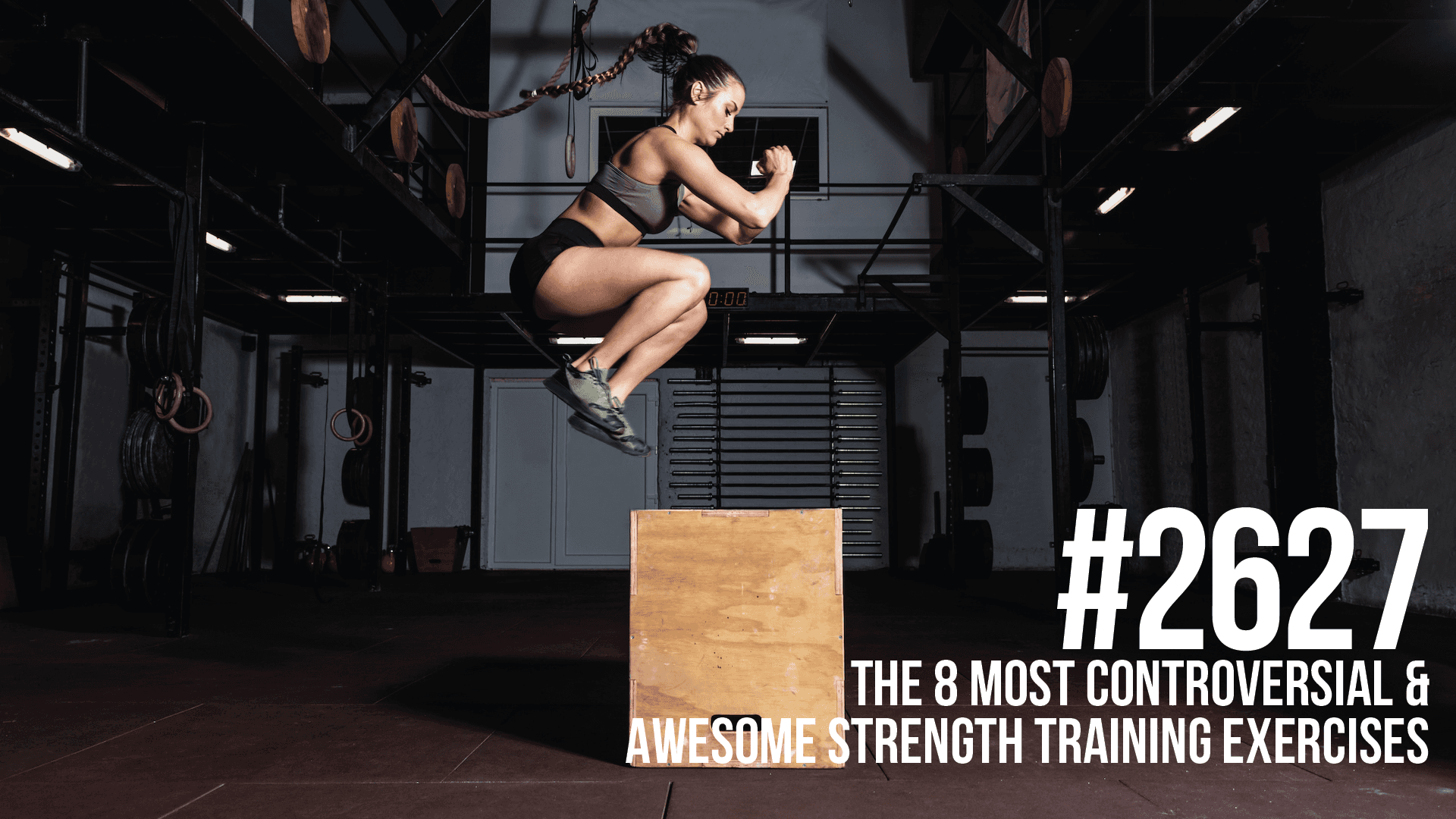
Mind Pump: Raw Fitness Truth
2627: The 8 Most Controversial and Awesome Strength Training Exercises
00:35:38
The 8 Most Controversial and Awesome Strength Training Exercises Every exercise is good if applied properly, with good mobility and stability. (0:49) The 8 Most Controversial and Awesome Strength Training Exercises, Who They’re For, Who Should...
Loading summary
Transcript290 lines
- [00:00]
Zoe Saldana
Hi, Zoe Saldana.
- [00:01]
Sal Destefano
Welcome to T Mobile.
- [00:02]
Adam Schaefer
Here's your new iPhone 16 Pro on us. Thanks. And here's my old phone to trade in. You don't need to trade in. When you switch to T mobile, we'll give you a new iPhone 16 Pro.
- [00:11]
Sal Destefano
Plus we'll help you pay off your old phone.
- [00:13]
Adam Schaefer
Up to 800 bucks and you still.
- [00:15]
Sal Destefano
Get to keep it.
- [00:15]
Adam Schaefer
There's always a trade in. Not right now. At T Mobile.
- [00:18]
Zoe Saldana
I feel like I have to give.
- [00:19]
Adam Schaefer
You something in return for karma. That's okay. I don't really have much in my purse. Oh, let's see. Hand sanitizer. It's lavender.
- [00:26]
Sal Destefano
I'm good. Seriously.
- [00:28]
Adam Schaefer
Let me check this pocket. Oh, mints. Really, I'm fine. Oh, I have raisins. I'm a mom. Wait, wait one sec. I've got cupcakes in the car. It's our best iPhone offer ever.
- [00:37]
Sal Destefano
Switch to T Mobile. Get a new iPhone 16 Pro with Apple intelligence on us. No trade in needed. We'll even pay off your Phone up.
- [00:44]
Adam Schaefer
To 800 bucks with 24 monthly bill credits. New line $100 plus a month on.
- [00:49]
Sal Destefano
Experience beyond finance agreement.
- [00:51]
Adam Schaefer
$999.99 and qualifying ported for well qualified.
- [00:53]
Sal Destefano
Plus tax and $10 connection charge. Pay off via virtual prepaid card.
- [00:56]
Adam Schaefer
Allow 15 days credits end in balance.
- [00:58]
Sal Destefano
Due if you pay off early or cancel mobile.com.
- [01:00]
Adam Schaefer
If you want to pump your body and expand your mind, there's only one place to go. Mind pump. Mind pump with your hosts, Sal Destefano, Adam Schaefer and Justin Andrews. In this episode, we're going to introduce you to eight of the most controversial strength training exercises and how you might apply them. By the way, this episode is brought to you by a sponsor, Seed. This is the world's best probiotic, hands down. If you want the benefits of a probiotic, go to seed. Go to seed.com mindpump use the code 25. Mindpump get 25% off. We also have a sale on some programs this month. The shredded summer bundle of programs and the bikini bundle of programs are both 50% off. If you're interested, go to maps fitnessproducts.com and then use the code JUNE50 for that discount. All right, here comes the show. Strength training. It's one of the most effective ways to exercise, but not all exercises are created equal. Today, we're going to talk about the eight most controversial strength training exercises, and we're going to determine who they're for, who should do them, and who should not do them 8.
- [02:06]
Zoe Saldana
I like this because there's value in these if done correctly.
- [02:10]
Adam Schaefer
That's right.
- [02:10]
Zoe Saldana
Applied correctly.
- [02:11]
Adam Schaefer
I'm so glad you said that. Strength training is a unique form of exercise in its complexity. There is no other form of exercise that is quite as complex. In other words, there's so many different exercises that could be done for strength training and there's applications for each of them and then there are applications that would not be suitable for each of them. So it's a good topic. It's a very good topic. And some of them are just controversial where a lot of people say avoid them. And oftentimes when I hear that, what's really being said is I just don't know how to use these properly or who they're for.
- [02:48]
Zoe Saldana
These are all your common knee jerk reaction exercises that people will hammer. If they see a video or see somebody performing these in the gym, they'll come up and be like, you're gonna hurt yourself.
- [02:59]
Adam Schaefer
Yes.
- [02:59]
Sal Destefano
Yeah, I think I, I learned that the hard way as a young arrogant trainer who thought he knew better. Trying to tell people what was right or wrong or that's not a safe or a good exercise and then finding out that this person had a very specific goal that, that made a lot of sense to be doing that movement. And so I always taught my trainers, like, don't assume that that person doesn't have a very specific goal that that movement applies to. And you may think it's dangerous or silly or dumb or worthless, but that's the cool thing about, you know, strength training is there, there's basically a application from damn near every movement you've ever seen in the gym.
- [03:35]
Adam Schaefer
That's right.
- [03:35]
Sal Destefano
And the question now, the question becomes, are they using it correctly for that?
- [03:40]
Adam Schaefer
Right.
- [03:40]
Sal Destefano
And is that the best approach for what they're trying to design? And so many times people are doing these movements that I'm sure you're going to list, haven't seen them, but then their desired outcome doesn't align with that. I think that's where this conversation is probably.
- [03:55]
Zoe Saldana
Yeah. And the wrist reward is like not worth it in certain instances when it's not applied correctly.
- [04:01]
Adam Schaefer
That's right. All right, we'll start with the first one, the behind the neck press. This one is interesting because this one went from being like a bodybuilding staple in the 80s, in the 70s, 80s and 90s, to suddenly becoming like leprosy. Like, everybody runs away from this exercise. But I mean, back in the 90s, like this was how bodybuilders they did. They almost all did behind the neck presses until people said, oh, that's dangerous. Don't do that. So they stopped doing them. Now, the critique is that it places the shoulder joint in this really extreme, externally rotated position, and it's abducted. That's true. It is true. It does require far more shoulder mobility and stability.
- [04:46]
Zoe Saldana
It already has to be there.
- [04:47]
Adam Schaefer
Yes. It requires more of your shoulder and all the muscles that support because the shoulder joint is pretty complex. Right. You got your. The humerus, and then you got the scapula, and they all have to kind of move together in the right way. It requires far more mobility and stability than a standard overhead press, which also requires a decent amount of mobility. So I get the critique, but that's also one of the pluses, I think, of it. It's like, if you don't exercise this motion, you tend to lose it. And I know this because I was this. Like, I did over. I did behind the neck presses as a kid. Then I became a personal trainer. My certification said don't do it, so I stopped doing it. Then in my 20s, I saw Mario Pucianowski. He was a strongman competitor, and he used to be an Olympic lifter. And he literally had the bar sitting on his traps and would press it up.
- [05:39]
Zoe Saldana
Do, like a push press from behind the head.
- [05:41]
Adam Schaefer
Yeah. And I thought, this is weird. Like, Olympic lifters do this all the time. And I went back to trying to do them, and it took me a long time to get back to being able to do it because I had lost the mobility. But once I did, it was like just a great exercise for shoulder development. Yeah.
- [05:55]
Zoe Saldana
And that external rotation, it's even more challenging these days because of all the forces against us with daily habits and what we do all day long. And so I understand. Understand the caution and concern because already our. Our shoulders just aren't in a good anatomical position to start. And so getting, you know, good posture first is obviously, that's the main thing we need to focus on in. In stabilizing the joint. But once you have stabilization, we can express, you know, that external rotation have, like, solid stability. With that getting strong in that position, it. It just. It's bulletproof. Yes. Like, you don't have that, you know, the. The. The opportunity for. All of a sudden now where I'm getting impingements of my shoulders, like, you know, in that less optimal position where I'm going to get more shearing stress.
- [06:50]
Sal Destefano
The truth is, every exercise that you don't have mobility and stability in is dangerous.
- [06:55]
Adam Schaefer
That's right. Curl.
- [06:57]
Sal Destefano
Yes.
- [06:57]
Adam Schaefer
Can be that way.
- [06:58]
Sal Destefano
If you lack the mobility and stability in a joint that. That you're using to perform a movement, it's now dangerous.
- [07:05]
Adam Schaefer
That's right.
- [07:06]
Sal Destefano
So this idea that we eliminate exercises for that versus going, hey, this exercise can be dangerous if we don't. Therefore, we should train mobility and stability in this joint so that you can do these movements. Now, the thing that I love about this and any movement that falls in this category is that once you put the work in to have the mobility and stability, continuing, just to perform that exercise keeps it, Keeps it. And so that was a. That was like a big aha moment for me as a trainer because I fell into this category. In fact, my national cert, my first national certification, said, do not teach behind the neck presses. Like that was a no, no. That you don't tell clients that or you tell clients not to do that. And then when I realized that, like, that any exercise without mobility and stability could be dangerous and that we should. We should train our body in a way that we have mobility and stability in all joints, in all ranges that we can. That's reasonable. Especially movements that you could potentially do inside the G or anywhere else. I went, oh, my God. And then when I did the work and to get there and realized, oh, wow, these great movements that we tend to tell people not to do, if you can get to a place where you can do them safely, and then you just make sure you incorporate them periodically in your training routine, you keep great stability and mobility in that joint. Like, that's crazy.
- [08:26]
Adam Schaefer
Now, I'll tell you this. Here's why bodybuilders used to love them. If you want a shoulder pump, the shoulder pump you get from behind the neck presses is insane precisely because of the criticisms. The external rotated and abducted position, like you are activating your lateral delts, even your rear delts, holding yourself into position. Again, this is with someone who can do this safely because they have the mobility, the pump that this produces in the shoulders. Why bodybuilders used to love this exercise. Now Olympic lifters love it. Because when you're pressing a weight overhead, like they do, you want the most vertical position possible.
- [09:03]
Zoe Saldana
Any forward, no momentum, or you're done. Yeah, it's all vertical.
- [09:07]
Adam Schaefer
And they do this a lot. In fact, the way they do it back, they do an extreme version of it where it's like.
- [09:11]
Zoe Saldana
Like, it's like they're doing a pushing it backwards almost.
- [09:14]
Adam Schaefer
Yes, 100%. Next up is the upright row. The criticism, of course, is pulling a barbell or dumbbells close to the body. It's like lots of internal rotation of the shoulders. You risk impingement. There was a study in 2003 that linked it to certain issues in the shoulder joint itself. Again, these studies are based on everyday people who you're going to have people doing it wrong, people having poor stability, mobility. This is another exercise that bodybuilders have loved for decades and decades and decades. I love this. This is a staple in my workouts and with my clients.
- [09:51]
Sal Destefano
I.
- [09:52]
Adam Schaefer
My goal, one of my goals. There's lots of goals I have with my clients with exercises, but one of them was to be able to do these and not have pain and feel good. And when I could do that, I knew their shoulders were healthy. But again, bodybuilder favorite. I think this exercise was more one of the exercises that was responsible for my shoulders getting really round. I just noticed that when I did these really well, I got these really, really round looking shoulders.
- [10:15]
Sal Destefano
Well, I mean it's, it's a great way to heavy load the, the lateral head too because you, if you do traditional lateral raises, it's a long lever and so you can only load that so much before it turns into like.
- [10:31]
Adam Schaefer
A, like a swing or something.
- [10:33]
Sal Destefano
Yeah, before it turns into like another muscle completely overtaking the movement. And so, you know, this is a exercise that you can target that part of the shoulder and actually load it. And so long as you have the mobility and stability, it's very safe to load and get after it. So it was a staple movement for me.
- [10:51]
Adam Schaefer
It's so crazy too because this is again, this was another bodybuilding favorite for decades. And if you look at old bodybuilding videos from like the 70s and even the 80s, these giants had amazing shoulder mobility. You don't see this as often today, but back then like you watch Arnold do behind the neck presses and upright rows and he had incredible shoulder mobility and he was really well developed, obviously was a bodybuilder. But it's because they practice these exercises. Like you take these exercises out and you build these big shoulders without practicing these kind of movements, then they become dangerous because you don't have the ability to do them.
- [11:31]
Sal Destefano
And maybe one of the dangers or fears on this too is the mistake of. To the point I was making that you can load them is that you don't have the proper mobility and stability and you go right to loading it really heavy first time. Because the other way to also.
- [11:46]
Adam Schaefer
Yeah. Treat them with respect.
- [11:47]
Sal Destefano
Yeah. Is exactly. It's just like you should almost any first mood movement for the first time is, you know, start light and controlled and make sure you do own the range of motion and the ability and the stability in that. And then, and then eventually load it. But maybe that's why it gets. Maybe a bad rap is because you can. First time. If you've never done it, you'll grab a decent amount of weight, you know, and then go do it.
- [12:09]
Adam Schaefer
Start swinging the hell out of it.
- [12:10]
Sal Destefano
Yeah.
- [12:11]
Adam Schaefer
Next up. This one's very controversial because. Because people do them wrong or for the wrong reasons. Keeping pull up. Now, I've definitely criticized these, yes, because people have replaced pull ups with keeping pull ups, but they were never meant. The real history of a kipping pull.
- [12:30]
Zoe Saldana
Up gymnastics is, yes, it's a transitional move.
- [12:33]
Adam Schaefer
It was never meant to replace a pull up. Like, if you want pull ups to develop your lats and your biceps, there's a way you do them. If you're doing a kipping pull up. This is a skill. It's what it is essentially a skill. It's a transitional exercise, getting yourself up and over a bar. I think that they should be performed not to fatigue. Like any explosive movement, like, that's a mistake. You start doing them till you fatigue. That's when you get issues. You train them explosively and it is a skill. And if you get good at these, I'll tell you, I don't practice these, but I could probably benefit from practicing, practicing something like this because I could see that there's, there's definitely some holes with my upper body explosiveness and coordination because I don't do stuff like this. So I could see that value.
- [13:19]
Zoe Saldana
Yeah, yeah. Again, it's. Yeah. It was never meant to be multiple repetitions back to back to back. It was to get you into a position where now we could perform a dip. Now we could perform a lot of these other like, you know, grueling type move. And again too, these are people that have, you know, spent years and years developing the kind of strength to isometrically hold and support and, and build that kind of stability around the, the shoulder joint. So then the general public, you know, kind of going in a CrossFit gym where, where we're promoting this. So that way too, this is like another way that we can increase the number of reps from a competition perspective. So for me, that was, that was sort of the disconnect was like the, the value of it really is to be able to get you into a position where now we're working on, you know, from a top position down, not, not necessarily to, to Put all that velocity and ballistic stress like all around the shoulder joint. It's actually ridiculous.
- [14:25]
Sal Destefano
So, okay, yeah, I, I don't know what the full list is looking like. And so I'm not sure if the desired outcome is for us to agree on these movements or not because this is not a movement I'm a fan of at all. Like, so, yes, I can make the case of having the mobility and stability and strength to be able to do it is, that's a good thing if you can and do it in a healthy way. But unless you're a gymnast, I would never train this with one of my clients. There's no, I would never take on a client and be like potential for terrorists and think of all the array of potential goals that you've trained. I would, between the three of us, pretty sure we've trained them all. There's not a client who fits in that category is like, oh, you know, what we're going to make sure we include is giving pull ups. That just unless they were a gymnast, which I have trained gymnasts and absolutely that's something that they would do. But everybody else, I don't see the application.
- [15:19]
Adam Schaefer
Most of the, no, I, I, that's because most of our clients were everyday people. But let's say you had a client.
- [15:25]
Sal Destefano
Who was a gymnast. Yes.
- [15:26]
Adam Schaefer
No, not just a gymnast, but let's say they're really fit and they want to like explore different movements and they're like, you know, like a muscle up.
- [15:32]
Sal Destefano
Yeah, but when you, how do you practice them? Some sort of an Olympic movement, strict muscle up.
- [15:36]
Zoe Saldana
That's the thing.
- [15:37]
Adam Schaefer
Right. But I could see this technique being taught as a way to coordinate your body. I could see the value, I'm not saying I would use it necessarily, but I could see the value. Because there is a value. But it's kind of narrow. Right, Is what you're saying. It's a narrow value. You're limiting it to gymnasts.
- [15:52]
Sal Destefano
Yeah, because the other ones that we've talked about so far, there's a much broader appeal to them.
- [15:57]
Adam Schaefer
Sure.
- [15:57]
Sal Destefano
Like going back to the upright roads, for example. Example. Like great shoulder development for that. You know what I'm saying? And if you were to compare the two of them, relatively safe compared to.
- [16:06]
Adam Schaefer
That, I could see this as a stepping stone first off, not to fatigue, but as a way to get someone to be able to do the first muscle up to learn how to get this body to swing up. It's kind of that first step.
- [16:17]
Zoe Saldana
It's almost like what do you call that? One squat where you pick the barbell up from the side.
- [16:22]
Adam Schaefer
Oh, yeah.
- [16:22]
Zoe Saldana
You bring it up here.
- [16:23]
Adam Schaefer
Yeah.
- [16:24]
Zoe Saldana
You'd be just doing that a bunch of times.
- [16:26]
Adam Schaefer
Yeah.
- [16:27]
Zoe Saldana
You know, like that's a transitionary move.
- [16:29]
Adam Schaefer
That's right.
- [16:29]
Zoe Saldana
That's really high risk.
- [16:31]
Adam Schaefer
Yeah.
- [16:32]
Zoe Saldana
So why would I repeat that a bunch of times? It makes no sense.
- [16:34]
Sal Destefano
Well, the problem to mention, even your argument to get it to do a muscle up, like muscle ups got. Got popular because of the stupid Instagram.
- [16:43]
Adam Schaefer
Yeah.
- [16:44]
Sal Destefano
Before that, like, I. That was never a thing. It's like again, another gymnast type of like, cool move. But it's like, like what Your client doing a muscle up. What?
- [16:54]
Adam Schaefer
It's so advanced that I probably wouldn't have had a client doing it, but.
- [16:57]
Zoe Saldana
I could climb up over a fence.
- [16:59]
Sal Destefano
Yes, but look, you run from the cops.
- [17:02]
Adam Schaefer
Well, I could see the value. I could see. Hey, John, let me teach. I could see the value.
- [17:08]
Sal Destefano
I'm going to rub a bank next week.
- [17:10]
Adam Schaefer
I could see the value in a muscle up because it's coordinating, pulling and pushing all in one movement. And there's not very many exercises that do it.
- [17:17]
Zoe Saldana
Muscle ups. Yeah, it's really hard.
- [17:19]
Adam Schaefer
They are really hard. And it's a. It's a upper body coordinated strength skill that I think is really awesome. I think it's hard. And yes, it's a very narrow scope of. I can't think of a single client. Maybe Doug would have been someone that we trained to try to get here because he was so consistent.
- [17:34]
Zoe Saldana
Yeah.
- [17:35]
Adam Schaefer
But. But my point with this is, you know, the thing is CrossFit really bastardized this because they turned it into its own exercise and they did it to like, well, the.
- [17:44]
Sal Destefano
And I guess the reason why I'm pushing back so much right now, I can only. I can see the next two that are coming up and I already see.
- [17:49]
Zoe Saldana
This is the only one I have contention.
- [17:50]
Sal Destefano
Yeah, I was gonn this. I. I can see application because I'm like there a lot of these other ones. Like I can make a case for a. A lot of different clients that I trained that like either we did do these movements or I would want them to work towards that. I just didn't have that. And I mean, I don't even see anybody that would want to do that until the movement of CrossFit came out. Then of course, it becomes like a thing that people want to learn how to do. And even like the muscle up. The muscle up was not a thing that people wanted to do before until he got popular on. On Instagram.
- [18:22]
Adam Schaefer
Well, the Original muscle ups with rings. That's what they were. Pull yourself up to the rings to press yourself up. Yeah, yeah, yeah, yeah. All right, next up, barbell. Good mornings. This one's gained a little bit of popularity, but for a while there, this was like, nobody touched these.
- [18:35]
Zoe Saldana
I know, Great exercise.
- [18:36]
Adam Schaefer
It requires really good technique of form. You got to really maintain your spine in this nice, strong, stable position. But man, it is a great hamstring and butt exercise. Who's popularized this? Female fitness influencers. They've made this popular because they're so interested in developing their backside.
- [18:55]
Sal Destefano
They have, they have made this more popular yet. This is, this is a, this has been a long time bodybuilding movement.
- [19:01]
Adam Schaefer
Oh, it's, this was a, this was.
- [19:03]
Sal Destefano
I mean, this is in Arnold's book. Oh, yeah, yeah. So this is not, this is not new. We know this is great for this movement. Yes. You can like a super brand new person, dangerous exercise, but a great exercise to get people.
- [19:20]
Adam Schaefer
I mean, it teaches that thoracic, like, you know, scapular retracted, thoracic stability, lumbar.
- [19:25]
Zoe Saldana
Stability.
- [19:28]
Sal Destefano
Your core strength to do that, your posture to do that. And then the posterior chain. I mean it's just.
- [19:32]
Adam Schaefer
Yeah.
- [19:33]
Sal Destefano
And then it takes also the like. Have you ever had somebody who wants to develop hamstrings but then have issues with hands or wrist or something like that?
- [19:41]
Zoe Saldana
So.
- [19:41]
Sal Destefano
Because it can't hold on to like a normal stiff legged deadlift, like you can load it on the back like that. So yeah, no, I, I find this to be.
- [19:48]
Adam Schaefer
Power lifters love this for a long time.
- [19:50]
Sal Destefano
Great movement.
- [19:51]
Adam Schaefer
And you know, bodybuilders in the 40s would actually, this was actually one of the exercises. They would, they would show off their strength. So you'd see these guys lift tremendous weight way back in the 1940s. One of my favorite exercises for the posterior chain. And it didn't until recently you didn't see these in gyms at all. In fact, if you tried doing this in a gym. I was a trainer.
- [20:09]
Zoe Saldana
Stop. You right?
- [20:10]
Adam Schaefer
Oh, God, yeah. People come up to you.
- [20:11]
Sal Destefano
I think you're doing a bad squat.
- [20:13]
Zoe Saldana
Hey, you gotta snap your back in half.
- [20:15]
Adam Schaefer
That's right. Yeah. All right, next up, box jumps. Box jumps are controversial because.
- [20:21]
Sal Destefano
Bastardized. They're awesome.
- [20:22]
Adam Schaefer
They're great for what they're for.
- [20:24]
Sal Destefano
When you're, when used correctly, they are awesome. Problem is nobody, nobody does. You go in the gym. If you go in the gym right now, if you're listening right now, you can look, there's probably somebody doing boxers right now. Wrong. There's a good. There's a 50, 50 shot. If you're in the gym right now listening to this podcast, look around. There's somebody doing box jumps and 90%.
- [20:41]
Adam Schaefer
Of them are doing.
- [20:42]
Sal Destefano
Yeah, yeah. They're doing high rep reps. Sloppy and, you know, for time or for repetition, Fatigue. Yeah.
- [20:48]
Adam Schaefer
Box jumps became a filler exercise. So there's a lot of exercises that, that bad trainers use as fillers when they're creating a circuit. When they're creating a circuit, they like to think of hard stuff to do. So you go do this over here for a minute.
- [21:02]
Zoe Saldana
These box jumps.
- [21:03]
Adam Schaefer
Yes. Like, they just throw in these filler extra. Like another one is where you hold onto the bench and jump back and forth over it, you know?
- [21:08]
Sal Destefano
Oh, God, I haven't seen that.
- [21:09]
Adam Schaefer
They're just coming up with like, like stuff to do just to get people sweaty. And for some reason, someone thought a box jump, which is like you just took an explosive power movement, which that's what, that's what it's good for.
- [21:21]
Sal Destefano
High skill.
- [21:21]
Adam Schaefer
Like if in the way you practice them is you jump as hard as you can, explode, come down, wait, soft landing, soft landing. Wait, wait until you're ready to explode again. Fatigue makes this exercise not effective and also makes it now something stupid. You might as well do jumping jacks if you're just going to do this to fatigue. And that's what trainers did. So you go into gyms and it was just a hard exercise for people to do.
- [21:46]
Zoe Saldana
People are just eating shins and flying across the gym.
- [21:49]
Adam Schaefer
But box jumps, plyos have been around for a long time. The Soviets really pioneered this kind of training for their sprinters and athletes. And this is a great way to teach the body to express strength and torenoviches.
- [22:04]
Zoe Saldana
Yeah. You ever check out their training? Oh, yeah. Tom Marinovich had crazy amounts of, like, playing football tomorrow.
- [22:11]
Sal Destefano
Oh, wow.
- [22:11]
Zoe Saldana
You should check in, check out his training sometimes.
- [22:14]
Sal Destefano
Related to me, you know that, huh? They're related to me. Yeah. So his brother Paul is married to my stepbrother's mom.
- [22:22]
Zoe Saldana
No way.
- [22:22]
Adam Schaefer
Oh, wow. Yeah.
- [22:24]
Zoe Saldana
He's a local guy.
- [22:25]
Sal Destefano
Yeah, he's a local from over Riverbank. That direction. Teacher over there. Yeah, yeah.
- [22:30]
Adam Schaefer
Wow. Now, now I will say this. I think box jumps regressed way down, have some value for everyday people. Because here's, this is a fact, and I know this personally, you don't practice jumping, you lose a skill.
- [22:44]
Sal Destefano
Yeah.
- [22:44]
Adam Schaefer
You suddenly lose a skill. Like you'll jump off a curb or something and you're like, ouch. What happened? I can't. I can't do this well anymore. Now, what this looks like for, you know, beginner clients is you, like, you'll jump in place and you'll practice something like that, and then the box is super, super low. You're not trying to see how high that you can jump, but rather practice.
- [23:03]
Sal Destefano
The skill and not trying to do 50 reps.
- [23:05]
Adam Schaefer
Yes. So. But. But it's valuable for everyday people because if you stop jumping, you'll forget your body.
- [23:10]
Sal Destefano
I mean, I guess you would, because this is probably almost a category by itself of, like, all plyometrics.
- [23:15]
Adam Schaefer
All of them.
- [23:16]
Sal Destefano
Like, all. All plyometrics can be amazing, but most often done incorrectly.
- [23:20]
Adam Schaefer
Totally.
- [23:21]
Sal Destefano
So, I mean, you throw ice skaters, you throw all these tuck jumps. You throw all kinds of, like, cool plyo moves.
- [23:26]
Adam Schaefer
Those are all filler exercises and trainer circuits.
- [23:28]
Sal Destefano
Yeah, that's the problem. They could have been really good movement or can be really good movements, but they've been bastardized by the industry to just get people tired between other exercises.
- [23:39]
Adam Schaefer
So, I mean, just to put it differently, when you see trainers do this, where they have, like, 10 exercises put together with all these plyo exercises, you could replace the way that they're doing it. You could replace every exercise with jumping jacks. You could have 10 jumping jack stations, and they get the same effort, get the same result. How funny is that?
- [23:55]
Sal Destefano
Yeah. No, if I'm doing box jumps with an athlete, because that's typically who I'd be doing that with. That is the only thing we're doing.
- [24:02]
Adam Schaefer
Yeah.
- [24:03]
Sal Destefano
And. And we are. We are taking. And if anything, we are taking ext. Like, powerlifting. Extended periods of time in breaks. And. And I'm, like, breaking down What I saw. Like, okay, look at. Your hips were too low here. You need to pull your arms back, explode with your. Like, I'm. Like, I'm. I'm watching every time they do one, then they. While they're resting. I'm talking about what I saw. Like, you. You rocked forward too much on your. On the balls of your feet.
- [24:28]
Adam Schaefer
You're.
- [24:28]
Sal Destefano
You're on your heels too much or, you know, your arms didn't come back. You know, like, I'm taking the entire movement and getting them to try. And each time they go back to.
- [24:37]
Adam Schaefer
That job, just create that power.
- [24:38]
Sal Destefano
Yeah, they got. It got higher and more explosive each time because I made minor adjustments to how they loaded the body before they exploded. Like, that's how a box jump is taught. It's not taught in repetitions and definitely not Taught in repetitions with something else that's just right.
- [24:54]
Adam Schaefer
Next up is the behind the neck pull down. This is another one of those bodybuilding exercises that was a favorite. You could not find a bodybuilding article in the 90s or 80s that did not include, like, a bodybuilding back workout that did not include behind the neck pull downs. This is what they did. And then suddenly it became like the most unpopular back exercise ever, because why. It strains the shoulders, wrist, rotator cuff damage, impingement, blah, blah, blah. I love behind the neck pull downs because it really helps maintain shoulder mobility.
- [25:26]
Zoe Saldana
Strengthens, reinforces position of being, like, externally rotated.
- [25:30]
Adam Schaefer
That's right. External rot. Pulling down. Getting my scapula to rotate down and in while retracted. Like, you stop training that, it goes away.
- [25:37]
Zoe Saldana
It will.
- [25:37]
Adam Schaefer
It goes away. That's right.
- [25:39]
Sal Destefano
Well, the good part. This goes hand in hand with the behind the head presses. If you can do that, you'll do this.
- [25:43]
Adam Schaefer
That's right.
- [25:43]
Sal Destefano
So, you know, again, if you get. If you gain the stability and mobility in order to do that in your shoulders, then both these movements, just keep them in your routine and you'll forever keep that ability. Like, you don't have to, like, actively work on mobility and stability all this time. You just do those two movements periodically in your routine and you'll keep. Incredible.
- [26:06]
Adam Schaefer
I still do these probably, you know, if I. If I work out my back twice in a week. Once for sure. So at least three days, three times out of a month do I train behind the neck pull down.
- [26:17]
Sal Destefano
I mean, I like to. I like to warm up the lap pull down like that.
- [26:20]
Adam Schaefer
Oh.
- [26:20]
Sal Destefano
Just light. And do this to keep that ability.
- [26:23]
Zoe Saldana
The problem is, I think when people, like, force the position.
- [26:27]
Adam Schaefer
Oh, yeah.
- [26:27]
Zoe Saldana
They don't go forward. Yeah, yeah. Their head's protruding too far. And they haven't done a lot of the work to be able to get those shoulders fully externally rotated. And so it's like.
- [26:37]
Adam Schaefer
It looks like a curl. Yeah.
- [26:39]
Zoe Saldana
They're looking for. They're kind of shrimping their posture to make it work. It's not for you. You don't own it yet.
- [26:47]
Sal Destefano
Great priming movement for both of those prone cobras.
- [26:50]
Adam Schaefer
Oh, yeah.
- [26:50]
Sal Destefano
A great way to prime press. Yeah. Or wall press. Are great movements to pr. Get you in the position to both.
- [26:56]
Adam Schaefer
That reminds me, there was, I remember now, one of the. One of the contributing factors to why this fell out of popularity in the. I want to say, the late 90s. There was a story of a man who was doing just obviously terrible form. Too much weight. The cable Snapped. He. He slammed the bar down on his neck and got paralyzed.
- [27:13]
Sal Destefano
Oh.
- [27:14]
Adam Schaefer
And. And so everybody was like don't ever do this.
- [27:17]
Zoe Saldana
Literally the worst case scenario, slammed the.
- [27:19]
Sal Destefano
Bar on his neck.
- [27:19]
Zoe Saldana
Yeah.
- [27:20]
Adam Schaefer
Cuz he was yanking it and you know, going forward. And then the bar came down and he hit himself horrible in the neck. Now nobody wants to do them if that happens. That's super. Yeah. Super rare. Next up, Roman chair sit ups. So Roman chair sit ups. This is where you have your hips are essentially supported.
- [27:37]
Sal Destefano
Now most people use do hyperextensions on these.
- [27:39]
Adam Schaefer
Yes, yes, yes. This was an. Oh, this was a favorite bodybuilders in the 70s. Arnold loved doing these. Wrestlers love doing these.
- [27:47]
Sal Destefano
So are you, are you sitting reversed in on.
- [27:49]
Adam Schaefer
You are.
- [27:50]
Sal Destefano
Okay. So the, so the average. Because I, Justin and I were talking about that when you mentioned this. It was like, like I always thought the Roman chair was a different machine.
- [27:57]
Zoe Saldana
A chair you hold and then you.
- [27:59]
Adam Schaefer
Bring your knees up.
- [28:00]
Sal Destefano
But it's not that. But we're wrong. It's the one you're talking about. And then what most people use the Roman chair for are for hyperextension.
- [28:07]
Adam Schaefer
That's right. So you go backwards on it. You know, you anchor your feet.
- [28:11]
Sal Destefano
Yeah.
- [28:12]
Adam Schaefer
Now here's why they're controversial because you could turn these into hip flexor blasters. Like if you're not focused on the abs, you're not extending and then flexing at the spine, you're just doing, you know, so as raises essentially. And yeah, that'll hurt your back. That'll definitely hurt your back. And a good amount of strength is required to do these. If you don't have really strong core muscles, then this is not a go to starter exercise. But if they are strong and you can do these right, man, these develop the abs like, like almost nothing else. It's a great exercise.
- [28:45]
Sal Destefano
Obviously the theory of that is just because the range of motion, gnarly range.
- [28:49]
Adam Schaefer
Of motion with no support. Like you're leaning back there, there's air behind you.
- [28:52]
Sal Destefano
Yeah.
- [28:52]
Adam Schaefer
You know, so you can't see how somebody will hurt themselves if they don't have.
- [28:55]
Sal Destefano
Yeah. So far the exercise that like this would be the second least I would use. So if you were to go.
- [29:01]
Adam Schaefer
You would go decline bench.
- [29:02]
Sal Destefano
Yeah. There's like a lot of things I would do first and, and although I could see somebody who has great control stability there and they really want to develop abs and like I could see, I could see maybe working this way where I see nothing where I would ever do a kipping unless it was very sports specific person. So. But I would, I would. If I had to order these, this would be the second least.
- [29:23]
Zoe Saldana
Typically you'd have something supporting, you know, your lower back on.
- [29:27]
Sal Destefano
Yeah.
- [29:27]
Zoe Saldana
Just as a precursor.
- [29:29]
Sal Destefano
Well, because what I'm also the, the game I'm playing as you're going through these is like go through all the people you ever train and all the goals. And I'm trying to think of a person that would. That has ever told me a goal where I'm like, oh, I have a movement.
- [29:41]
Adam Schaefer
We're.
- [29:41]
Sal Destefano
We got to do where that would. That would surface to the top. Some of these other ones, they absolutely would, you know, would. Would go there. This one's.
- [29:50]
Adam Schaefer
You know what's funny about the Roman chair setups in the 70s, like Arnold was famous for this. They would do this for time, not for reps. So they do Roman chair sit ups for five minutes and they just go, yeah, I know. Isn't that funny?
- [30:03]
Sal Destefano
I mean, this is. That's an example too. Isn't this wouldn't. Well, I guess.
- [30:06]
Adam Schaefer
Yeah.
- [30:06]
Sal Destefano
Yeah, you would. Still. Isn't that what you would call what Rocky is doing off the. Off the. Hey, hey.
- [30:12]
Adam Schaefer
Always hanging upside down? I mean, no, but I mean, that's also great. I don't know where you'd be able to do that.
- [30:18]
Sal Destefano
It's kind of like that boots where.
- [30:20]
Zoe Saldana
You hang upside down. Like on the.
- [30:22]
Sal Destefano
Yeah, the gravity boost.
- [30:23]
Zoe Saldana
Yeah, gravity boots.
- [30:24]
Adam Schaefer
I've never done those. All right. The last one is by far the most controversial. In fact, if you do this in a gym, I would love reaction videos. I would love seeing people who can do these properly to do them and then film the reactions. So it's called a Jefferson curl. And what a Jefferson curl looks like, for sure.
- [30:43]
Sal Destefano
Most controversy.
- [30:44]
Adam Schaefer
It looks like a terrible deadlift.
- [30:45]
Sal Destefano
Yeah.
- [30:46]
Adam Schaefer
It looks like you're trying to hurt your back.
- [30:47]
Zoe Saldana
Looks like. Yeah.
- [30:48]
Adam Schaefer
And essentially what you're doing is you're holding a barbell and you're on my spine and you are. You are literally deliberately flexing the spine. Literally deliberately rounding your back on the way down and coming all the way up. Now this was a. This was a wrestler staple for Greco Roman wrestlers, especially Soviet wrestlers. And they did this Zercher style. They would stand on a block and they would. Yes, they would zercher it and they'd go all the way down, all the way up. Now why. I mean, in Greco Roman you're picking.
- [31:21]
Zoe Saldana
Up dead weight, dudes off the floor, moving weight.
- [31:25]
Adam Schaefer
And that's what you look like when you're picking them up off the floor. Now the risk here is if you let your spine support you, if you allow the. Your end range of motion of your. Of your discs support you. Yeah. You're hurt yourself. So there's a, there's a def. A high level of, of stability and control that's required to be able to load this. But this is an exercise that like.
- [31:47]
Zoe Saldana
You know you have high body iq.
- [31:48]
Adam Schaefer
Yes.
- [31:49]
Zoe Saldana
To pull this off.
- [31:50]
Sal Destefano
Yes.
- [31:50]
Zoe Saldana
For sure.
- [31:50]
Adam Schaefer
Yeah.
- [31:51]
Sal Destefano
Most controversial for sure on the list. Maybe at least up there for sure with kipping. Although what I know now and under. Because this is not something I trained. I did not train clients on this. But what I understand now, I could actually see myself doing this with more and more and not who you would think. Like I would take advanced age people that are. But with no weight. No weight.
- [32:13]
Adam Schaefer
That's right.
- [32:14]
Sal Destefano
And just little bit teaching them how.
- [32:16]
Adam Schaefer
To articulate each vertebrae.
- [32:18]
Sal Destefano
Because the benefits of you being able to articulate every vertebrae slowly and controlled like that.
- [32:24]
Adam Schaefer
Totally.
- [32:24]
Sal Destefano
And I would just regress it to like nothing. Right. Like. And then eventually holding like 10 pounds and then, and then if I got that client to be able to do that with a decent amount of weight, boy, are you really protecting them.
- [32:37]
Adam Schaefer
I was not familiar with the Jefferson curl until later in my career, but I did exactly what you said with clients. When I had people who were at advanced age and they had back pain and we get them to a point where we could do certain things, I would have them reach down with their hands and I'd have them articulate their spine all the way down until we reached a point where they're like, oh, that's a little iffy. And then I'd have them roll back up. And here's what happened. Over time they got lower. They were able over months. Right. They were able to go lower and lower and lower. And no back paper.
- [33:03]
Sal Destefano
Yeah.
- [33:04]
Zoe Saldana
Bulletproofs it. Yeah. And then you do the opposite of the perfect push up where you articulated up each. Yeah. Perfect sit up is what I mean.
- [33:11]
Sal Destefano
Yes, that's what I mean. Like perfect setup and Jefferson curl to me are movements that I didn't use a lot in my career early on purely out of fear and what I thought was so dangerous. But looking back now, I go like, oh, I would just regress the. Out of that and actually could see a. Actually a wide application for a lot of people for just overall safety and protecting them. You just have. It is. It is highly dangerous. But when we look at the list of things that you listed off today, Like I said, regress this. Yes. I see more application for this than some of the other ones.
- [33:44]
Zoe Saldana
So protective. Once you get strong.
- [33:45]
Adam Schaefer
Well, you know what?
- [33:46]
Sal Destefano
Even though it's the most controversial and.
- [33:47]
Adam Schaefer
What they teach people, which is terrible, is, oh, you have back pain, don't move that way anymore.
- [33:53]
Sal Destefano
So gradually, over time, just completely prune it, Right?
- [33:56]
Adam Schaefer
Yeah.
- [33:57]
Zoe Saldana
That much more susceptible.
- [33:58]
Adam Schaefer
It's like, oh, you got knee pain. Stop squatting. Oh, you got this. Stop pressing. It's like, oh, my God, you're gonna lose that mobility.
- [34:03]
Zoe Saldana
I have to.
- [34:04]
Adam Schaefer
That's right. And then you're totally screwed. No. 100. That's so. It's funny because I did this movement with people, but we didn't load it just to be able to articulate.
- [34:10]
Zoe Saldana
Yeah.
- [34:10]
Adam Schaefer
But then later, like I said, I found it. I found it by watching videos of these wrestlers. And they would. They would hold them in, like I said, in. In these Zurcher positions, and they would load them. But that's what you do in those. In those wrestling matches. You're picking people off the ground. Oh, yeah.
- [34:23]
Zoe Saldana
You're scooping them off the ground.
- [34:24]
Adam Schaefer
That's right.
- [34:25]
Zoe Saldana
It's a really low position. Yeah. I actually thought you were going to add squat.
- [34:32]
Sal Destefano
People.
- [34:32]
Zoe Saldana
People's looking, you know, from outside perspective, like in. In the stress. I gotta say, we'd say.
- [34:38]
Adam Schaefer
I gotta say, I think we're. I think we're responsible for bringing that exercise back. For sure. When we started the podcast, nobody knew what it was.
- [34:45]
Sal Destefano
I didn't know what it was until you introduced it to me.
- [34:46]
Zoe Saldana
Yeah.
- [34:47]
Sal Destefano
And now I was already over 10 years of my career, didn't know what the hell that was. And then you showed it to me and. And then I remember attempting it, and then the learning curve and then getting good at it. Then I went, oh, wow, I fell in love with them.
- [34:58]
Adam Schaefer
Yeah.
- [34:59]
Zoe Saldana
Yeah. So I prefer them especially.
- [35:02]
Sal Destefano
Oh, yeah.
- [35:02]
Adam Schaefer
And I see them now. I see people doing it.
- [35:04]
Sal Destefano
You know, I used to. This is so funny, because I remember we were. I was heated bodybuilding when you guys, we all got together. I would hold the leg extension machine to balance. So I'm sure people are like, what the.
- [35:17]
Adam Schaefer
You're using them.
- [35:18]
Sal Destefano
Yeah, yeah, yeah, I totally used to do that. So, so funny. I love those.
- [35:22]
Adam Schaefer
That's a good honorable.
- [35:23]
Sal Destefano
That is a great honorable mention for sure right there.
- [35:25]
Adam Schaefer
Look, if you like us, come find us on Instagram. Justin is @mindpumpjustin. I'm @mindpump. Distefano Adams @mindpump. Thank you for listening to Mind. Pump. If your goal is to build and.
- [35:33]
Zoe Saldana
Shape your body dramatically, improve your health.
- [35:36]
Adam Schaefer
And energy, and maximize your overall performance, check out our discounted RGB super bundle@mindpumpmedia.com the RGB Super Bundle includes Maps, Anabolic Maps, Performance and Maps Aesthetic nine months of phased expert exercise programming designed by Sal, Adam and Justin to systematically transform the way your body looks, feels and performs with detailed workout blueprints and over 200 videos. The RGB Super Bundle is like having Sal, Adam and Justin as your own personal trainers, but at a fraction of the price. The RGB Super Bundle has a full 30 day money back guarantee and you can get it now. Plus other valuable free resources@mindpumpmedia.com if you enjoy this show, please share the love by leaving us a five star rating and review on itunes and by introducing.
- [36:29]
Zoe Saldana
Mind Pump to your friends and family.
- [36:31]
Adam Schaefer
We thank you for your support and until next time, this is Mind Pump.
- [36:38]
Sal Destefano
This episode is brought to you by Progressive Insurance. Do you ever think about switching insurance.
- [36:43]
Adam Schaefer
Companies to see if you could save some cash? Progressive makes it easy to see if.
- [36:47]
Sal Destefano
You could save when you bundle your home in auto policy policies. Try it at progressive. Com, Progressive Casualty Insurance Company and affiliates.
- [36:55]
Adam Schaefer
Potential savings will vary. Not available in all states.