← Mind Pump: Raw Fitness Truth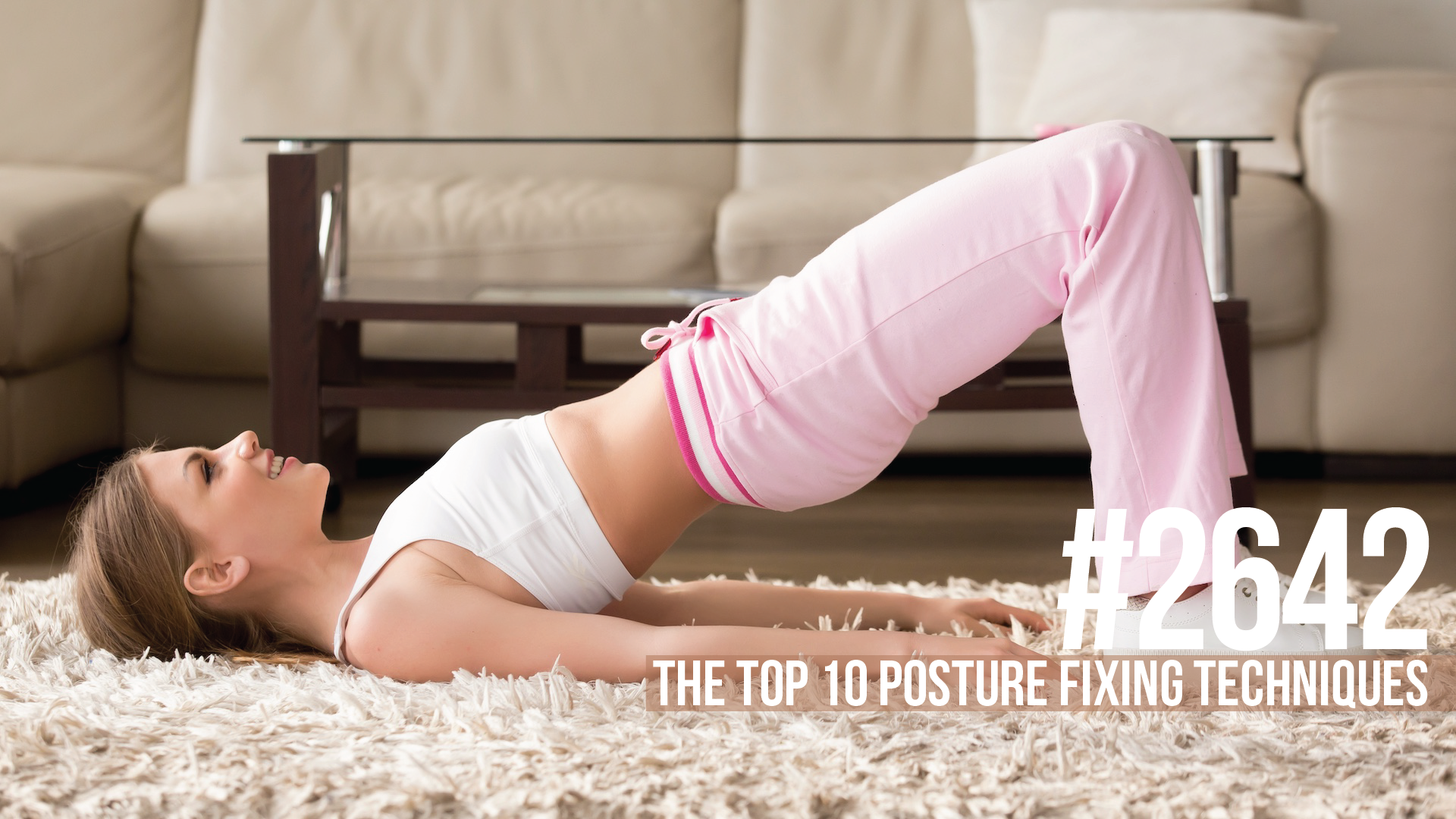
Mind Pump: Raw Fitness Truth
2642: The Top 10 Posture Fixing Techniques
00:30:35
The Top 10 Posture Fixing Techniques Why it’s NECESSARY to strengthen good posture. (0:57) The Top 10 Posture Fixing Techniques #1 - Seated rows. (8:30) #2 - Prone cobra. (11:01) #3 - Static stretching of the pecs/delts. (12:17) #4 -...
Loading summary
Transcript109 lines
- [00:00]
Sal Destefano
If you want to pump your body and expand your mind, there's only one place to go.
- [00:06]
Adam Schafer
Mind Pump. Mind Pump. With your hosts Sal Destefano, Adam Schafer and Justin Andrews, you just found the most downloaded fitness, health and entertainment podcast in podcast history. This is Mind Pump. Today we talk about fixing your posture. You won't want to miss this. By the way, this episode is brought to you by vuoriclothing. This is the best athleisure wear you'll find anywhere. By the way, we have the biggest discount you'll find anywhere online. They gave it to us years ago. They haven't changed it. You want 20% off, that's what you do. Go to vuoriclothing.com mindpump that's V U O R I clothing.com mindpump we also have some workout program sales maps split in the anabolic metabolism bundle. It's all 50% off. Head over to maps fitnessproducts.com and then use the code july50 for that discount. Here comes the show. Do you slouch at your desk? Do you have tightness in your neck? Do you feel dragged down by bad posture? We're going to talk about the best techniques that can fix that. You're not going to want to miss this look. You're going to feel taller, you're going to stand taller, you're going to look more confident, and you're going to be stronger. Stay tuned. Here we go.
- [01:17]
Justin Andrews
So awkward you saying that while I'm slouching.
- [01:19]
Unknown
I feel it.
- [01:20]
Justin Andrews
I feel attacked. I'm over here like this.
- [01:23]
Unknown
Let's start this podcast that are sitting way too much these days.
- [01:26]
Adam Schafer
Well, I'm glad you said that, Adam, because it's not just that you could sit in a way where your posture isn't great, it's that your bad posture starts to hurt. That's really what it is, right? If you have good strength in posture, then you can sit those ways, stand up and not feel the neck tightness and the thoracic area tightness at mid back or stand in line and not get low back pain or tightness and that kind of stuff. That's what happens when your posture is off. I mean, when your head moves forward just a little bit, it becomes exponentially more challenging for the muscles of your that surround the neck or support the skull to support it. When your posture is not ideal or your muscle recruitment patterns aren't ideal for your posture, lifting a weight off the floor, playing with your kids, it becomes exponentially more difficult. And we are in Environments that do not encourage good, strong posture. So it is necessary for most people to strengthen good posture, because your everyday life isn't going to do that. In fact, it's going to do the opposite.
- [02:30]
Unknown
Well, it's funny because even you just mentioning it makes you conscious of it almost immediately. And I think that's important to be constantly reminded of, you know, just how you're holding the position of your body and, and just that the accumulation of volume of how you end up holding these positions really does matter and it affects you long term.
- [02:49]
Justin Andrews
I love this conversation. I 100% agree, Justin. I think step one is becoming aware of it. Step two, once you become aware of what good posture and bad posture looks like, the inevitable is going to happen. You're going to slouch in a chair, you're going to be in a plane. You're going to be in these positions where, oh, you're like, oh my God, I'm totally slouching or doing the thing. What's cool is that what I'm excited about. As we go over these, these movements and exercises to correct bad posture, once you understand how to correctly do them, you can actually cue yourself when you catch those moments. So, like, I don't know if you guys do this or not, but it's like I'll find myself sometimes in on the plane and I'm like slouching. And then because it's a long flight, all a sudden I do feel like the tightening up the low back and I'm like, oh, God. And then you'll. And then I'll literally, like, I'll, I'll rotate my pelvis, I'll activate my core, I'll pull my shoulder blades and depress and like, which is all what you're doing in these corrective exercise movements you're going to talk about. And so once you become aware, obviously step one and then two, you know, the things to do to help correct that posture, then it's not just, oh, you do these, these exercises, you know, every time you warm up at the gym or every once in a while or just when things get bad, but you, you become more aware of the, how you're holding yourself throughout the day. And then when you become aware of it, you take a moment to kind of engage the antagonist muscles and, and boy, does that go a long way just by becoming aware and doing those little things.
- [04:15]
Adam Schafer
Yeah. Without getting too deep into the weeds. So your body holds itself in the way that it deems to be the safest. Okay. And it's using lots of information to decide this. And part of this information is do we have the strength and stability to hold ourselves in an ideal position? No, we don't. So we're going to take the second best or third best or 10th best position. And so what this feels like is tightness or instability. It feels like tension, it feels like pain, it feels like immobility. And so what you're doing with quote unquote, posture correcting exercise, and this is a bit controversial, by the way, in the trainer space because they'll argue there is no ideal posture. Okay, Yes. I can't take a picture and say this is perfect posture for everybody. But there's more ideal posture for you and there's less ideal posture for you. And the more ideal posture simply means that your central nervous system is holding you in a position that is more advantageous. It's better, it's going to improve mobility and reduce the strain on muscles trying to do more work than they're supposed to because other muscles aren't doing their job.
- [05:23]
Unknown
The practice of trying to achieve better posture and more optimal positions does nothing but benefit you.
- [05:29]
Adam Schafer
That's right.
- [05:29]
Unknown
So why would we discard that and, and just, you know, work in a direction where we're just, okay, well this is what your posture is now. We're just going to keep it as is and you know, let's improve that.
- [05:41]
Adam Schafer
Right. So what we're going to be doing is we're going to be going through 10 movements and it's movements because it includes strength training exercises, correctional exercises and stretches. And all of them play a role here. Right? Stretches, they weaken. I shouldn't say weaken. They reduce the central nervous system signal, allowing those tight muscles to relax a little bit. This is important for some people. And then in combination with that, you strengthen muscles that need to be strengthened so that other muscles aren't doing more of the job than they're supposed to do. By the way, this is oftentimes why people feel like neck tension. Like, why is my neck always tight? Like, I don't understand why my neck's always tight. It probably is. Tight is because there's muscles there that are doing more work than they should to stabilize you, to stabilize either your neck or your shoulders, because there's muscles that are not doing their job. So it's like if, you know, we're all rowing in the same direction, but you're not doing any of the work and we need to go a certain speed, that means I gotta do more work to get us to keep moving. This is what Your body does, your body doesn't care. It's just like, I gotta hold you up and we gotta figure out how to do this.
- [06:42]
Unknown
I'm just gonna pick up the slack.
- [06:43]
Adam Schafer
That's right. So that's what's happening with the combination of movements that we're gonna talk about. And some of these are traditional strength training exercises and others not so much. So some of them you can do in your workouts, others you could do outside of your workouts to help. But I'll look to speaking to trainers watching this right now, like this is key. Like you figure this out, you can do this on most clients and they're going to feel a profound difference that session. That session. They'll feel a difference in how they're standing. And yes, it does exude confidence to stand with better posture, not just because the posture looks different, but because you feel different. So a lot of this has to do with how you feel as well.
- [07:20]
Justin Andrews
And these are so common that when I look at the list of 10 that you've created and I, and I connect them to like my programming to my clients, especially the back half of my career, maybe not so much the front half, but all of these are. We're integrated.
- [07:34]
Adam Schafer
Yep.
- [07:35]
Justin Andrews
Because everybody is, everybody has got some sort of upper cross syndrome, lower cross syndrome. To what. Yeah. To what extent? There's a wide range, but we're all doing all these things in front of us and we're closing in and rounding.
- [07:49]
Adam Schafer
All day long we're sitting down at a desk.
- [07:51]
Justin Andrews
So these movements become paramount to all clients. And so a good trend, this is also, this, this episode could also be titled Good sign or signs you have a good trainer is if your trainer is incorporating a lot of these movements within your training program. Because these are they, I thought in my early years, tedious, silly movements for the most part. Oh, these are dumb. Why am I doing these?
- [08:14]
Unknown
Get through them as much fast as possible.
- [08:15]
Justin Andrews
Yeah. Back in the, when it was all about getting you sore, burning calories, teaching, wowing you with difficult movements. But some of these, these fundamental stretches and mobility drills and movements are, are paramount to keeping somebody with good strong posture.
- [08:30]
Adam Schafer
Absolutely. So we'll start with number one, which is a great general posture improving exercise, especially for the mid upper back. And that's a seated row. So now, now, by the way, you have to do these things right for them to work, because you could do a seated row in a way that makes your posture worse. Right. So the way you do a seated row, especially to improve posture, is you got to Sit real tall. When you row the weight, the shoulder blades need to come back and down. Okay. So you're looking for retraction and depression of the scapula. What you don't want to do is keep the shoulders rolled forward as you row the weight. And you also don't want to shrug your shoulders as you roll the weight. That's actually going to make things much worse. So think about taking your shoulder blades and putting them in your back pockets. That's what I used to tell my clients. Now this is more difficult than it sounds for a lot of people. In fact, for a lot of clients, they couldn't do this without me holding their shoulders and placing them in position.
- [09:27]
Unknown
This is a go to assessment for trainers, really. I mean, this is like one of the first exercises to really kind of assess where you know what we're working with right now in terms of how severe. Because there's various degrees of what you'll see in terms of compensations. But for your average person, you're going to find a lot of compensation, especially in this type of an exercise.
- [09:49]
Justin Andrews
Well, yeah, we do everything in front of us. And so if we are driving, riding on whiteboards, I mean, you name computer, cutting hair, computer. I mean, we do it all, we do it all in front of our body, which puts us in this kind of forward shoulder, forward rounded shoulder, forward head position. Yeah. And yeah, especially now with phones, we're like this, this. And so that becomes your default position. So if that becomes your default position and then you put somebody in a seated row, they go right to their default position. And then you ask that person, pull that in. The default movement to that is for the biceps to activate and pull in while they stay in that rounded position. You actually have to cue and do what you said, Sal, which is be able to get them to retract and depress those shoulders, which is unnatural for the average person doesn't know yet. So, so beneficial to counter what they're doing all day long on their job or driving or phone or all those things. And so learning this movement properly and then integrate. This is a staple. I don't think I trained a client that seated row was not in every single.
- [10:53]
Adam Schafer
That's right.
- [10:53]
Justin Andrews
I don't. I can't think of a client I trained that we didn't do seated.
- [10:56]
Adam Schafer
That's right. Same. Same here. So use lighter weight because technique is everything when you're trying to correct posture. Next is the prone cobra. So you could do this lying on the floor or you could do this supported on A physio ball. And with this, what you're doing is you're rounding and then coming up. So you're getting some back extension. You're rotating or supinating the hands with the arms at your sides and you're pulling the shoulder blades back. You're squeezing everything back and down again, bring the shoulder blades back and down. This is not a muscle builder. This is. The seated rows are a muscle builder as well. Prone cobra is pure correctional exercise. Like this is not for bodybuilders who are just trying to. This is like I do this to get better posture. In fact, prone cobras are a great way to set up the seated row because it gets you in that position. Then you can go to the seated row.
- [11:39]
Justin Andrews
And now you are literally unwinding what, you know, forward, rounded shoulder, forward, head is right. So as you round forward, you.
- [11:49]
Unknown
It's the antidote to that.
- [11:50]
Justin Andrews
Yeah, exactly. So you, you're, you're, you're internally rotating, you're coming forward like this. And so prone cobra is the opposite. So you're literally unwinding that and all the muscles that are weakened. Because what happens when you get so dominant this way? These muscles become dominant, overactive. The ones in the back that are responsible for pulling you back into posture become weak. And what you're doing in that prone cobra is unwinding and waking up all those muscles that oppose that poor posture.
- [12:17]
Adam Schafer
That's right. Next are static stretches of the pecs and delts. Now why would I want to do that? Well, sometimes, oftentimes what gets in the way of strengthening the mid back is tight pecs and delts. They're so tight, in fact, that trying to get in better position, it's like, it's like holding me back. Oftentimes with clients, we would start a posture correcting workout with static stretches of the pecs and the delts, which by the way, feels amazing to these people. Now the stretch itself doesn't feel so good. It can be a little bit painful, but afterwards, like, oh my God, I can breathe. Everything feels so much better. And static stretching, all that does, by the way, when you hold a stretch for a long period of time, the CNS eventually weakens its signal to that muscle. So what you're doing is you're allowing those muscles to relax. Essentially.
- [13:02]
Unknown
That's it.
- [13:02]
Adam Schafer
Yep, 100%.
- [13:03]
Justin Andrews
There's actually a time for that. It's approximately 30 seconds, right? 30 seconds and it relaxes and it allows you to do that.
- [13:10]
Adam Schafer
I like to go to a minute.
- [13:11]
Justin Andrews
Response, Yes, I think that's one of the. Yeah. At least 30 seconds to a minute you want to hold that. So that's one of the most important things that differentiates something from a, you know, active type of stretch to a corrective type of stretch is if you don't hold it for longer than that, you don't allow the CNS to relax. So it's important that when you are describing a static stretch that we also communicate that you get into that position and you hold it, intensify it for a good solid 30 seconds to a minute to allow it to.
- [13:40]
Adam Schafer
By the way.
- [13:41]
Unknown
Yeah. I love static stretches from a correctional kind of perspective as well, especially when you see how limited they are range of motion wise. Like I can't even get them into a position now where I can stress that position and add load. I have to really open up first and spend that time to incrementally achieve those new ranges.
- [13:59]
Justin Andrews
This is also a good moment to discuss where there is some contention in the fitness space around this conversation because it's pretty well known most trainers that have been doing this for a long time know that static stretching before you go activate and work muscles typically is not a good idea.
- [14:15]
Adam Schafer
No.
- [14:16]
Justin Andrews
But in the context of you trying to get somebody into correct posture to go do a movement, it makes sense.
- [14:22]
Unknown
Yeah.
- [14:22]
Justin Andrews
So for example, if I, your, your point earlier, if someone is so tight and so rounded, I can't even get them to retract and depress their shoulders. And the major big muscle that's tight is that, that pec. And so static stretching relaxes it. So then I could then pull them back in that posture so then we can go and work out. And so they're. This is also why I don't like when trainers criticize other trainers because they may not know that that client that they're dealing with may need that static stretch in order to get them in optimum position. Now, it's not ideal to stretch a muscle that you're going to go active explosively. Yeah.
- [14:58]
Adam Schafer
You don't do the static stretch and then do jumping push ups like you're going to reduce your performance.
- [15:01]
Justin Andrews
Right, right. So, yeah, so that, that's not a good idea. So there, there is a place, and there is an exception to every rule that we tend to hear. And you do see a little bit of contention and debate online about this, you know, and you've probably heard, oh, static stretching is good. Then you hear, oh, no, but this trainer says it's bad. You don't.
- [15:18]
Adam Schafer
It's a tool that needs to Be used properly.
- [15:20]
Justin Andrews
That's right.
- [15:21]
Adam Schafer
Tool.
- [15:21]
Justin Andrews
And there is a place for it. And it does make sense sometimes before you work out. And this is the case.
- [15:25]
Adam Schafer
Yeah. Like a screwdriver is a terrible way to hammer a nail, but it's a great way to screw in a screw. Right?
- [15:30]
Unknown
Yeah.
- [15:30]
Adam Schafer
So. And by the way, when you're doing a static stretch, a mistake a lot of people make is they hold their breath. That will. That will tell your central nervous systems to stay tight, to stay activated. So breathe deep and relax your body as you hold the static stretch. It's far more effective. Next up is a straight arm pull down. Okay, so what is a straight arm pull down? Well, when we're trying to build muscle, it's a lat exercise. Is that what we're doing this for? No, I'm not trying to build the lats. Here's what I'm trying to do. I'm trying to do a straight arm pull down, let my lats activate and also simultaneously be able to pull my shoulder blades back and down. Why? Because I need to learn the muscle recruitment pattern that says it's okay to activate my lats while also retracting and depressing my scapula. Oftentimes when people have poor posture, whenever they activate their lats, their scapula rolls forward. Okay, so a pull down looks like this. A row looks like this. So really, this is just teaching things to work in the right way. So a standing straight arm pull down in the context of correctional exercise is lighter. And the idea isn't to work my lats, but rather, can I work my lats while pulling my shoulder blades? Anchoring shoulder blades at the same.
- [16:33]
Justin Andrews
Super light movement. Super light movement. I always encourage trainers to teach clients this with little to no way.
- [16:39]
Adam Schafer
A band.
- [16:40]
Justin Andrews
Yes. This is one of those things where it. It's very difficult to articulate your scapula if you've never trained yourself to do it. This is a great exercise in movement. Of the ones we've talked about so far, I would say the more complex one to get someone to do correctly.
- [16:56]
Adam Schafer
Yes.
- [16:56]
Justin Andrews
So, like, the cedar row is fairly easy. These other movements. Pro cobra, fairly easy to look at it. Watch. Okay, I get it. This one's a little bit difficult and you do see a lot more. There's a lot more room for error. And so really pay attention to form and technique. Really go light. But what a great movement to teach you how to articulate that scapula.
- [17:15]
Adam Schafer
That's right. Next up, farmer walks. Okay. Farmer walks. Well, normally. Farmer walk is great. For your grip strengthens the body. You go really heavy. That's not how we're going to do farmer walks in this context. The farmer walks here, you're holding resistance, and what you're consciously doing while you're walking is maintaining good posture. Okay, so here's what you're going to do from the bottom up. First off, with your feet, your whole foot needs to make contact with the floor. So you roll from the heel to the toe. You want to stand nice and tall, but you don't want to overarch your back. You want to tuck your pelvis a little bit, tighten your core, maintain your chest high, keep your shoulder blades back and down. And again, what you're trying to do with this is you're trying to teach your body to do things with good posture, because that's a skill as well. Can I get good posture while doing a seated row? Yes. But now can you do it while you're walking, or can you do it when you're pushing, or can you do it when you're doing an overhead press? Completely different skill. Farmer walks focusing on good posture help teach the skill of having good posture while also doing something functional.
- [18:14]
Unknown
Yeah.
- [18:14]
Adam Schafer
Next, planks with a posterior pelvic tilt. I love this one. This was so controversial.
- [18:18]
Justin Andrews
One of our first viral videos when.
- [18:20]
Adam Schafer
We first showed this. Right. So you. Everybody knows what a plank is, Right. But what we're going to teach here is how to do a plank with a posterior pelvic tilt. So a common posture issue with a lot of people is called an anterior pelvic tilt. What does that look like? Looks like I'm sticking my butt up. I have a little bit of an excessive curve to my low back.
- [18:37]
Justin Andrews
We call it Instagram model, Instagram model butt.
- [18:39]
Adam Schafer
Right. That pose or whatever. Well, when you're doing a plank, when you're in that position. Well, first off, this is going to crush your abs. Okay. Because this really makes a plank an ab exercise. But you get in that position, hold that position, take your butt, which is sticking up, and tuck your tailbone. Now hold that position. Now, what we're doing is we're offsetting that anterior pelvic tilt. And, yes, it's an ab exercise, intensifying that contraction. This is my. This was my favorite movement for people with really bad anterior pelvic tilt. What would people with anterior pelvic tilt complain of? Low back pain and tightness when they did squats, overhead presses, even seated rows. I'd have some clients do seated rows, and they'd be like, oh, it's my low back. And I would go to do these. This planks with posterior pelvic tilt go back to the. The rows and would fix the problem. Yeah.
- [19:22]
Unknown
And what helps, too, is you can start really priming and teaching these people these default positions when normally, if they're in a relaxed, while they're going through this stress, it's going to all direct it towards their lower back. But now if they have this, where they've been continuously practicing, drawing and directing it more for the core supporting it, then now they're going to have that at their benefit.
- [19:45]
Justin Andrews
This, to me, is the seated row of the lower body, meaning that it is that impactful for, like 99% of the people out there. And the reason for that is that when we sit down, which all of us do when we're driving, when we're sitting at desk, when we're sitting on our podcast chairs, whatever, your hip flexors are in a shortened position, and you're in that shortened position so much of the day that that becomes its default. So then when you try to stand up, they stay tight. They stay tight. And then that knot that. That tilts the hips in that position. In the Instagram Instagram butt position, we're talking about where you're excessively arching the.
- [20:20]
Unknown
Low back weak point for force.
- [20:22]
Justin Andrews
Right. And so this. And why I love the this tip, because it is controversial, because somebody would debate that, oh, plank is supposed to be neutral spine. You shouldn't be tucking the tailbone. But what you're doing is you're not only incorporating the core, which is so important in the plank, but then you're also countering a. One of the most common postural deviations, which is an anterior pelvic tilt. And so what a great way to add that into your plank movement. And so beneficial and difficult for a lot of people to do. And. And so many looks. And a lot of people, a lot of planks you see out there are done wrong. A lot of people, they're all anterior pelvic tilt.
- [20:59]
Adam Schafer
Yeah.
- [21:00]
Justin Andrews
They're resting on their low back, and they don't even realize it because that's their default position. And so you are, again, going the opposite, completely working the opposing muscles by doing that, by tilting all the way in. And I think one in maybe 10,000 clients you'll ever have will have the posterior pelvic chest. I mean, I think I can only recall one client.
- [21:21]
Unknown
Yeah, I've had maybe.
- [21:22]
Justin Andrews
I think I have one client.
- [21:23]
Adam Schafer
And, you know, it.
- [21:24]
Justin Andrews
Oh, yeah. It looks weird. It looks. Yeah.
- [21:26]
Adam Schafer
It looks like a shrimp.
- [21:26]
Justin Andrews
Yeah, it looks really, really weird.
- [21:28]
Adam Schafer
Yeah. Which brings us to the next one, which is physioball crunches. Now, now, yes, it works your abs, but here's how you do physio ball crunches in the context of correctional exercise. So when you're on the physio ball, put your low back on the physio ball, push your hips up and activate your glutes. What that's going to do, it's going to help deactivate the hip flexors. Tight hip flexors. Weak tight hip flexors contribute to poor lower body posture, especially in the low back. So what we're trying to do is, we're trying to deactivate them. You activate the glutes, then do your crunches. This is teaching your body to stop relying so much on your hip flexors and rely a little bit more on your abs. So it is a great ab exercise. But more importantly, it's separating the hip flexors from the abs, which people have a lot of trouble with. Anytime they. They have to stabilize their core, it's hip flexor dominant. Hip flexor dominant. This teaches them to separate. Let's get those relaxed, let's get the core to work. And without the hip flexors, my favorite exercise to do.
- [22:22]
Justin Andrews
You know, speaking specifically to our trainers that are potentially listening to this episode, a common client that you will get, you will get a advanced age client who suffers from chronic pain, has horrible posture, and they give two shits about how much muscle is on their body or how much body fat to lose. And they are purely there for longevity, feeling better. You can literally build almost an entire routine around what we're talking about. Oh, yeah, like this. And then because there is a progression to everything we're talking about, right? You can eventually add load and add things to challenge all it. But this is like a great foundational program for a client, right? Taking from these movements and building an entire program that is around that. Like, and let me tell you, this is a. It's very hard to take somebody who's 75 years old and show them 5 pounds of muscle or lose 15 pounds of body fat. But you can immediately start to impact the way they sleep, they sit, they walk, the way they feel. And so what a great program is to do, like take from all these movements, build a program from. And then as they get better and stronger, you can progress that. I. And I think as we're talking about this right now, I had a lot of clients that this was our workout right here. Like, this is like this.
- [23:32]
Adam Schafer
Oh, I'd start with the stretches, I'd go to the mobility stuff, and we'd end with the strengthening. Yeah, 100%.
- [23:37]
Justin Andrews
This is. This was an incredible workout and program right here that we're building for.
- [23:42]
Adam Schafer
People loved it, too. A lot of people feel so good.
- [23:44]
Justin Andrews
Yes, a lot. There's a lot. Like, as a trainer, you know, I think we all.
- [23:47]
Adam Schafer
How many bodybuilding clients you guys?
- [23:49]
Justin Andrews
Never. I was just, I was just going there. I'm like, when you get into personal training, you think you're going to train someone like you. You're probably going to train one other person like you. You think maybe you're gonna get all these athletes and then maybe bodybuild. It's like, those aren't your clients. You get everyday normal people. And the number one thing they want to get rid of is pain, chronic pain. And most chronic pain is from these poor. These poor habits, these poor posture and learning to correct that boy. Is that this makes you incredibly valuable as a trainer to be able to teach this stuff.
- [24:23]
Adam Schafer
Totally. Next up is thread the needle. Now, this is a movement that helps with thoracic mobility. So this is kind of your upper back mobility. Now when this is tight, here's what ends up happening. When your thoracic area is tight, your rib cage can't expand very well. You tend to not breathe deeply. It's kind of shallow. And you don't even realize it. You don't even realize it until you fix it. And then all of a sudden you feel relaxed. You feel a sense of peace. Like, wow, this makes a big difference. Thoracic tightness also contributes to shoulder pain. It also contributes to neck pain. Thread the needle is a great easy movement. And this is not a. This is more of a correctional mobility movement. Great way to start your workout. It's a very valuable. Again, and we talked. You said this earlier. Oftentimes I would start a workout with my clients. We would start with stuff like this.
- [25:08]
Justin Andrews
Yeah. I don't know what the research says or what the statistics are on injuries. I know that low back is one of the most common. I know shoulders up there. But I definitely recall a lot of clients that got hurt doing some sort of like rotational movement. Right. Like something so basic. It was like reaching back to the back car seat or pulling a weed.
- [25:31]
Adam Schafer
To the left, getting a shampoo bottle off the floor.
- [25:34]
Justin Andrews
Like this really basic light. But they just moved out of a rotational because we stopped rotating like that. I'm. I noticed this already in my own body. Like, of all the Things that we're listing right now, this is one of the ones that I have to make sure I always do because I just don't do a lot of things where I have to rotate that, my teeth that much. I just don't do that. I don't move like that that often anymore. I don't do a lot of physical sport, like activities that require that. And so this becomes one that even myself, I have to do on a regular basis.
- [26:03]
Unknown
Speaking to your point earlier about the shortness or short breaths and like having low level anxiety too, like a lot of clients would come in with like, you know, some of these issues. And it's like, you know, to get more expansive in your breathing and really open that up and work on that thoracic mobility. It was transformative.
- [26:21]
Adam Schafer
Yeah. So next up. This looks like a gluten hip thrust, but it's on the floor and it's a hip bridge. And this helps strengthen the glutes and also helps get the hip flexors out of the way. And you're not just pushing your hips up. You're doing that posterior pelvic tilt and then you're doing a hip squash the bug. You're flattening your back into the floor. So that's going to involve a crunch of the abs and then maintain that position while doing the hip bridge. This is really great for people with an anterior pelvic tilt. It helps activate the glutes, helps deactivate, for lack of a better term, the hip flexors. It's easy to do. Don't add weight to this great way to start a workout.
- [26:59]
Justin Andrews
It's first step to addressing sleepy butt. Right. Which is very, very common in people. And it's common because of all the things that we're talking about. So many people have an anterior pelvic tilt. So many people are hip flexor tight, quad dominant, which whenever you do any lower body movements, tends to shift all the focus on the anterior, on the front, front of the body. And they just can't seem to engage the butt and glutes. This movement and done properly, because you could do a hip bridge and still.
- [27:25]
Adam Schafer
Not really lift your hips.
- [27:26]
Justin Andrews
Yeah, you just hip. Your hip flexors still engaged because that's going to be the default. The default is going to be hip flexors lift you up, not the glutes, lift you up. And the way you eliminate that is the flatten the backers. What we say squash the bug. Inactivate that core, then keep the core tight as you lift up.
- [27:40]
Unknown
Always have them hold for an excessive amount.
- [27:42]
Adam Schafer
Yes.
- [27:43]
Justin Andrews
Three to five seconds.
- [27:43]
Adam Schafer
Yes.
- [27:44]
Unknown
Because we do not do enough extension throughout the day. It's just not part of our routine. I don't know anybody does. Or there's always just a little bit of that flex. And you know, to really, like, emphasize extension and get that opportunity for your body to react to that is.
- [28:00]
Justin Andrews
So I'm. I'm with you. It's a three to five second, not only hold, but intensify. Yeah, right. Because we know the benefits of isometrics.
- [28:07]
Adam Schafer
Like flatten your back and then come.
- [28:08]
Justin Andrews
Up, hold, squeeze, intensify at the top, three to five seconds, come back down. Just a great movement for damn near everybody to prime before they do their workouts. Especially if you have a client who is complaining of sleepy butt syndrome.
- [28:23]
Adam Schafer
Yeah. Lastly, child's pose with reach. Okay, so in child's pose with reach, you're looking for thoracic extension. So this helps with thoracic. And simultaneously, you're stretching the lats out. And the lats tend to be tight in people with forward shoulder because they do everything with their lats. They do nothing with their upper back. But you also need that thoracic extension. Thoracic extension helps fight that upper back rounding. Actually, you see this a lot with people who use their phones a lot where they start to get that. It's almost like a humpback. Sometimes you can even see it nodule.
- [28:58]
Unknown
Like behind their neck.
- [28:59]
Adam Schafer
And so this offsets it's opposite of that posture, and it helps loosen things up. This is more of a stretch than it is anything else. By the way, when you do this, if this is good for you, here's what you're gonna feel like when you stand up. I could take a deep breath again. Oh, my God. I feel so, so much better. Do something like this and hold it for about 30 seconds. Repeat it about two or three times.
- [29:19]
Justin Andrews
One of my favorite poses.
- [29:20]
Adam Schafer
Look, if you like the show, come find us on Instagram. Justin is mindpumpjustin. I'm @mindpump distefano. And Adam is @mindpump.
- [29:27]
Sal Destefano
Thank you for listening to Mind Pump. If your goal is to build and shape your body, dramatically improve your health and energy, and maximize your overall performance, check out our discounted RGB Super Bundle@mindpumpmedia.com the RGB Super Bundle includes Maps, Anabolic Maps, Performance and Maps aesthetic. Nine months of phased expert exercise programming designed by Sal, Adam and Justin to systematically transform the way your body looks, feels, and performs with detailed workout blueprints and over 200 videos. The RGB Super Bundle is like having Sal, Adam and Justin as your own personal trainers, but at a fraction of the price. The RGB Super Bundle has a full 30 day money back guarantee and you can get it now. Plus other valuable free resources@mindpumpmedia.com if you enjoy this show, please share the love by leaving us a five star rating and review on itunes and by introducing Mind Pump to your friends and family. We thank you for your support and until next time, this is Mind Pump.