← Mind Pump: Raw Fitness Truth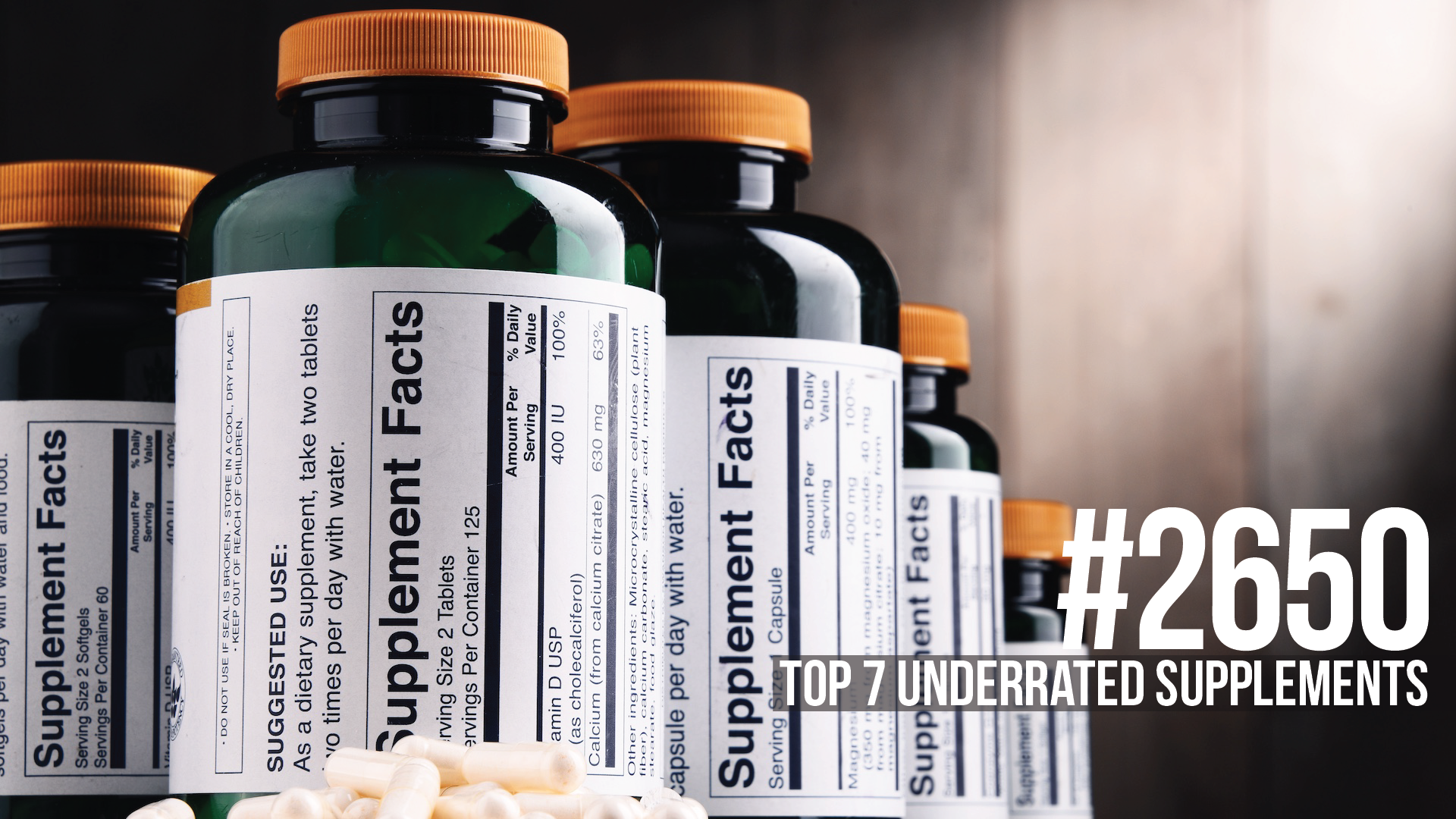
Mind Pump: Raw Fitness Truth
2650: Top 7 Underrated Supplements
00:25:02
Top 7 Underrated Supplements Top 7 Underrated Supplements. (1:11) #1 - Vitamin D. (50%) take 2000-4000iu. (2:01) #2 - Vitamin k2. (97%) 100micrograms a day. (8:48) #3 - NAC. 600-1800mgs a day. (11:52) #4 - Berberine. 500mgs 3x day w/food....
Loading summary
Transcript183 lines
- [00:00]
T-Mobile Representative
Everyone's loving family Freedom from T Mobile. We'll pay off four phones up to $3200 and give you four free phones, all on America's largest 5G network. Visit your local T Mobile location or learn more@t mobile.com FamilyFreedom up to $800 per line via virtual prepaid card typically takes 15 days. Free phones via 24 monthly bill credits with finance agreement eg Apple iPhone16128GB8999 Eligible trade in eg iPhone11 Pro for well qualified credits End and balance due if you pay off early or cancel contact T Mobile.
- [00:29]
Sal DeStefano
If you want to pump your body and expand, there's only one place to go. Mind Pump Mind Pump with your hosts Sal DeStefano, Adam Schaeffer and Justin Andrews.
- [00:42]
Adam Schaeffer
You just found the most downloaded fitness, health and entertainment podcast in the history of podcast. You guessed it, this is Mind Pump. Today's episode we talk about the most underrated supplements you probably should be taking. This episode is brought to you by Mass Zymes. Mass Zymes by bioptimizers. These are digestive enzymes that break down your foods into proteins, carbohydrates and fats. In other words, you take these digestive enzymes, eat your food and the food gets broken down easier. Better digestion, better health, better performance. Go try them out. By the way, these are the best digestive enzymes. For those of you who eat a high protein diet, go to masszymes.com that's M A S S Z Y-M-E-S.com mindpump Use the code mindpump10. Get 10% off your order. We also have a sale this month on some programs, maps split in the anabolic metabolism bundle. It's all 50% off. Just head over to mapsfitnessproducts.com and then use the code 7uly50 for that discount. Back to the show. Supplements. Oftentimes people place way too much value on them. But sometimes, other times, they can actually be game changers. Now, in today's episode, we're not going to talk about the supplements you probably already heard about, like creatine, for example. It's a real popular one. We're going to talk about the most underrated supplements, ones that people just don't consider but should probably take. And this is based on data and it shows. The data shows many people benefit. Let's get it.
- [02:09]
Justin Andrews
The overlooked class.
- [02:11]
Guest Speaker
I bet most people couldn't or wouldn't guess even two of these on the list.
- [02:16]
Adam Schaeffer
Yeah, one of them maybe One of them, yeah.
- [02:21]
Guest Speaker
But the rest of them I wouldn't have even seen you putting on this list. So this will be interesting to watch you explain each of these because. And are you gonna go in order? Because the very first one to me is, is the, is the one.
- [02:32]
Justin Andrews
It's the only one.
- [02:32]
Adam Schaeffer
Yeah, this is the, this is the vitamin. Vitamin is the first one. And I. Is it underrated? Maybe still, but it's moving close to like people understand its value, but we should talk about it still. It's a, it's an inexpensive supplement.
- [02:48]
Justin Andrews
A lot of people are deficient in it too, so.
- [02:50]
Adam Schaeffer
Oh, you know, probably 50%. Some studies will show 50% of people are deficient. But if we include people that don't have what is now showing to be optimal vitamin D levels, when you get your blood test done, vitamin D, I think the cutoff is like 30 nanograms per deciliter, I believe is the number. Right. So under that is deficient. And if you're deficient in vitamin D, that's not good. This is like warning zone, like much higher risk of disease, depression, pain, low energy hormone production. By the way, vitamin D is actually some people classified as a hormone because of the way it acts in the body. So that's like warning. Okay, if you're below that, you're going to get prescription vitamin D or your doctor's going to say you have to take it. But most people are not what would be considered optimal. And the studies on vitamin D and bringing them to optimal levels are now compiling to the point where you should probably supplement with it.
- [03:48]
Guest Speaker
Probably take vitamin D. My favorite news about vitamin D that I did not know until just recently was the fact that I could stack it or I could load it.
- [03:59]
Adam Schaeffer
I don't carry you.
- [04:01]
Guest Speaker
Yeah, I was under the impression that you, yeah, you take five, maybe 10,000 IUs a day and that's the most you would want to take or could take. But I didn't know that I could load up on it and say take 50,000 and then not take it for two or three days versus or 10 days.
- [04:18]
Adam Schaeffer
Right. Because that would be 5,000 a day.
- [04:20]
Guest Speaker
And so this, for someone like me who has a hard time with being consistent with taking any supplements and taking this little tiny vitamin D pill all the time is just one of those things that I'm inconsistent with where now I just, I have, I have it in my bathroom and, you know, I do. I forget a few days and then, oh, I remember. And so I'll take, you know, three days worth and Then I'll forget and then I'll take three or four days worth again. And so I become way more consistent with taking my vitamin D because of that.
- [04:48]
Adam Schaeffer
Yeah, if you, in fact, if you get prescription vitamin D, because they have prescription of vitamin D for people who are deficient, they'll typically do that. They'll give you one, one pill once a week or something like that to get your D levels up quickly. It's fat soluble. That's why it's stored in the body. I'll read to you guys a recent study, and they just keep compiling. This was a study on postmenopausal women with breast cancer. Okay, here's what they found. 2,000 IUs a day. Which, by the way, most people, 2,000 4,000 IUs will probably be adequate, although getting a blood test would be best so you can know how much you need to take. But these women took 2000ius of vitamin D a day during chemo. This raised complete tumor clearance from the body. Okay, so you take. You're on chemo. The idea with chemo is get the cancer out. It increased the rate of clearance or complete clearance of the body from between 24 to 43%.
- [05:45]
Justin Andrews
Wow.
- [05:45]
Adam Schaeffer
Just by taking 2000ius of vitamin D a day. And the reason why I love vitamin D, besides its benefits, which I'll go through some of these, some other studies, is that it's cheap. Vitamin D3 is dirt cheap. It is one of the least expensive supplements that you'll find, and it probably belongs, most likely belongs in your supplement regiment. And here's the interesting thing about vitamin D. You could get a lot of sunlight, but if you have like me, I'm a little darker complected, it might still not be enough. I always use a story of my father because this one really shocked me. I mean, obviously I'm same complexion as my father, so we're, you know, Sicilian, so darker skin. And my dad was never. Would I put my dad in the category of someone who's inside too much. Okay, he's always outside. He's outside in his backyard. He's always doing work. He's out in the sun all day long. I mean, my dad's old world, like, getting him to do nothing is so difficult. He's always outside and he had all these strange symptoms of. Most of them were pain and low energy, but a lot of pain. He thought it was due to the hard labor that he's done most of his life. And it's like, my back's hurting, my knees are hurting. My hips are hurting. I don't know what's going on. Taking pain medications, getting CT scans and all kinds of stuff. Finally did a blood test. Oh, your vitamin D is painfully low, which I wouldn't have guessed, as someone who works.
- [07:10]
Justin Andrews
I would have thought the opposite.
- [07:11]
Adam Schaeffer
I totally would have never guessed it. He took, I think it was 50,000 IUs, you know, right out the gates, and then started taking that, I think once a week or something like that. And his pain dropped significantly, which is crazy. Here's some of the studies that we find that we see with vitamin D. 2019 meta analysis found that vitamin D supplementation with calcium reduced fracture risk by 15 to 20% in older adults. 15 to 20% just taking a cheap supplement. They didn't do anything else? No strength training? No, none of that stuff. Just that another study showed. Another meta analysis showed vitamin D supplementation reduced acute respiratory infections by 10 to 25%. Another study, this is another meta analysis, found that 800 to 1,000 IUs a day improved muscle strength and balance in older adults, reducing falls by 19%. So just took vitamin D again, cheap, easy. You're not even exercising and you reduce your risk of falling by 19%.
- [08:10]
Justin Andrews
I feel like respiratory issues are very much on the rise.
- [08:14]
Adam Schaeffer
Yes.
- [08:14]
Justin Andrews
After Covid everything else, but like, I just hear so many cases of pneumonia and lots of respiratory issues people are dealing with.
- [08:21]
Adam Schaeffer
Yes. Here's another one. 2018 meta analysis found 1,000 to 3,000 IUs a day improved depressive symptoms in deficient adults, which is, again, 50% of you probably are. Another one showed that 4,000 IUs a day reduced C reactive protein by 20% in obese individuals. Easy supplement to take. Underrated. I think it's underrated still, because I think it is. I think I know a lot of health, like fitness fanatics.
- [08:49]
Justin Andrews
It's very protective.
- [08:50]
Adam Schaeffer
They don't consider it, especially if they go outside all the time. They're like, I'm okay. But again, the data seems to show now about 50 nanograms per deciliter in your blood is ideal. And most people fall below that, even if they're not deficient.
- [09:05]
Guest Speaker
Now, can you flip your second one and your third one? Because the third one kind of pairs with this one. And that's something that I think that not a lot of people talk about is taking these together and the benefits of that. Correct.
- [09:17]
Adam Schaeffer
Yes. Vitamin K2, which is interesting. So this is. It directs calcium to bones, reduces arterial calcification. Okay. So that means less risk of heart disease and heart attack. In fact, back in the. Do you guys remember the push in the 80s and 90s for women to take calcium?
- [09:35]
Justin Andrews
Oh, yeah.
- [09:36]
Adam Schaeffer
And what they ended up finding was calcium deposits in the arteries.
- [09:39]
Guest Speaker
Yeah. Too much, right?
- [09:40]
Adam Schaeffer
Yeah. And what it was was they. They weren't taking. They didn't have enough vitamin.
- [09:45]
Justin Andrews
They were so worried about osteoporosis back in the day.
- [09:47]
Guest Speaker
So how does it work again with. Like everyone says, if you take that with vitamin D, you should also. Is it because the uptake is that they're synergistic? Okay.
- [09:55]
Adam Schaeffer
Yes. They work together in. And K2. Again, it's one of those, you know, it's one of those underrated. I don't. Do you know anybody who takes vitamin K2?
- [10:03]
Justin Andrews
I don't.
- [10:04]
Adam Schaeffer
Yeah, I take it with my Vitamin D. Actually comes together.
- [10:07]
Guest Speaker
That's Mike's legion. Legion does. So his vitamin D pill actually comes with, you know, I think the ideal ratio of vitamin D to K ratio.
- [10:18]
Adam Schaeffer
Now, here's. Here's the. Here's the number of people that are probably. Recent study in 2017 found older adults. The percentage of older adults that were deficient in vitamin K. Yeah. 97%.
- [10:30]
Guest Speaker
97.
- [10:31]
Adam Schaeffer
97%. You know where you find vitamin K, the kind that you absorb, by the way, because they'll say, oh, you get vitamin K and leafy greens. You don't absorb it very well. You normally will get vitamin K from organ meats and fermented foods. Your gut will produce it with the microbiome, will produce vitamin K. Organ meats is another one. Nobody eats organ meats. So this is. And it's. It's another super.
- [10:54]
Guest Speaker
So vitamin K helps direct the calcium directly to the bones and teeth.
- [10:58]
Adam Schaeffer
That's right.
- [10:58]
Guest Speaker
Okay.
- [10:59]
Adam Schaeffer
That's right.
- [10:59]
Justin Andrews
This is the one good advice Liver King had.
- [11:01]
Adam Schaeffer
Yeah. So.
- [11:04]
Guest Speaker
Hey, you know he's in prison right now, right?
- [11:06]
Adam Schaeffer
Yeah, he is.
- [11:07]
Guest Speaker
Yeah.
- [11:07]
Adam Schaeffer
Yeah.
- [11:07]
Guest Speaker
He looks bad right now.
- [11:09]
Adam Schaeffer
This is crazy.
- [11:09]
Guest Speaker
Another topic.
- [11:10]
Adam Schaeffer
So. So again, save that one. Fermented dairy organ meats. Now, K1 is abundant in leafy greens, but you just don't absorb nearly enough typically from.
- [11:22]
Guest Speaker
I didn't realize that that 97.
- [11:24]
Adam Schaeffer
Deficient of an old. Of older adults.
- [11:26]
Justin Andrews
Wow.
- [11:26]
Adam Schaeffer
Was deficient in K. Yeah. And it's. Again, these are like. When you talk about vitamins and minerals, these are essential for the body. So if you're deficient, your body is dysfunctional. So it's not like other supplements, you know, that can give you some benefits, some health benefits, an herb or something like that. Like, there's no. Now there's no Ginseng deficiency.
- [11:48]
Justin Andrews
Now, typically find this in a multi.
- [11:50]
Guest Speaker
I'm just gonna say typically in a good multivitamin, you have this. You have both of these.
- [11:54]
Justin Andrews
Yes, but you have to look for that, I'm sure.
- [11:56]
Adam Schaeffer
And it's got to be a good 100 micrograms a day is what you typically want. Sometimes what multivitamins do is a little.
- [12:02]
Guest Speaker
Bit of everything, not very much.
- [12:03]
Adam Schaeffer
They'll have a lot of, like, B, a lot of C, a lot of. And then you'll look at K2 and it's like.
- [12:07]
Guest Speaker
Or they'll do like, the 20 micro. They'll do, like, the minimum RDA versus the optimal dose. And there are certain things, like vitamin D, for example, there's an optimal dose and then there's, like, the baseline. So knowing the difference is probably important.
- [12:21]
Adam Schaeffer
Yes. Another one that a lot of people don't take is nac. N acetyl cysteine. This is a precursor to glutathione. It supports detoxification, lung health, and mood regulation. There was a 2015 meta analysis that showed 600 to 1200 milligrams a day reduced depressive symptoms and aided in thinning the mucus. For respiratory health?
- [12:42]
Guest Speaker
No. Now, because it's a precursor to glutathione, do you get the same benefits if I just take glutathione?
- [12:47]
Adam Schaeffer
Yes. The problem with glutathione is not typically well absorbed. So people inject glutathione.
- [12:52]
Guest Speaker
Well, if we have the liposome, that helps.
- [12:54]
Adam Schaeffer
That definitely helps. NHC's cheap. Yeah. Say what it says.
- [12:58]
Justin Andrews
Gross, but worth it.
- [12:59]
Adam Schaeffer
Yeah, yeah. It's. It's. It's got great liver support and mental health benefits with, uh, you know, by taking nac, and I believe was nac, what was the supplement they tried to ban? Doug. When? During COVID Yeah, it was nac. Yeah. So. So here's the deal. So we talked about respiratory illness. Okay. During COVID Nac, because it raised glutathione and helped with lung health. There were some studies showing that it really improved outcomes.
- [13:28]
Justin Andrews
Yeah.
- [13:28]
Adam Schaeffer
Suddenly, regulatory agencies came up, came on nac, made Amazon stop selling it.
- [13:34]
Justin Andrews
NAC and glutathione. Well, I guess glutathione wasn't shut out, but that was what they found later. Oh, my God. Yeah.
- [13:40]
Adam Schaeffer
If we.
- [13:40]
Justin Andrews
If we raise our glutathione.
- [13:41]
Adam Schaeffer
Yes. And NAC was a supplement for, like, 20 or 30 years. So it's funny, they tried to shut it down, which is, you know, a little conspiracy theory for you. But for health, riddled with it. But for health, it's a good thing.
- [13:52]
Guest Speaker
I don't even know what this next one is.
- [13:54]
Adam Schaeffer
Berberine. Yeah, yeah. Berberine is interesting. Of all the supplements that can improve or that are touted to improve, like.
- [14:01]
Justin Andrews
Some kind of plaid blood sugar.
- [14:03]
Guest Speaker
Yes. Like the brand.
- [14:06]
Adam Schaeffer
Say what?
- [14:06]
Guest Speaker
The brand.
- [14:07]
Adam Schaeffer
Yeah. No, not. Not Burberry. Burberry. No, you're not talking about that. Sorry. So of all the supplements that tout the ability to improve insulin sensitivity or lower your fasting glucose, berberine is the only one in the data to show.
- [14:23]
Guest Speaker
So I'm assuming that's in all those.
- [14:26]
Adam Schaeffer
Well, they better have it.
- [14:27]
Guest Speaker
So, like, the. What's the popular, like, carb. There's like a carb supplement. I forget what it's called.
- [14:32]
Adam Schaeffer
Oh, God. I think you're talking about ones that try to block. They try.
- [14:35]
Guest Speaker
Yes. Yes. Would it most have this?
- [14:38]
Adam Schaeffer
It should, if you're looking at. Because. Okay, so we've had. So continual glucose monitors have now been available to the average person for a little while. And I remember when we had. We had. I forgot who it was that was on our show that was an expert. There were a dietitian that used these with their patients.
- [14:54]
Guest Speaker
Oh, the. The girl from. From the Gl. The glucose monitor.
- [14:59]
Adam Schaeffer
Yeah, yeah. I can't remember the name.
- [15:00]
Guest Speaker
I know it's slipping me right now.
- [15:01]
Adam Schaeffer
Nutrient Nutrisense. Yeah.
- [15:02]
Guest Speaker
What was her name, though? Heather.
- [15:04]
Adam Schaeffer
Or maybe Doug will. Yeah, let's get that, Doug. So. So what they found when I asked her, is there any supplements that you notice that'll change somebody's fasting glucose? She's like, not really. Berberine is the only one. So here's what studies will show. 500 milligrams, three times a day with food will reduce fasting glucose. This is in studies by 7% in type 2 diabetes. That's very. You don't find many natural compounds that'll do that.
- [15:31]
Guest Speaker
So explain who this is most beneficial to then and in what cases. Because, like, you or I, if it.
- [15:37]
Adam Schaeffer
Improves your insulin sensitivity, everybody benefits from it. Everybody's gonna benefit from. If you're somebody with fasting glucose that is starting to get in that pre diabetes, you know, stage, and you're like, then. Then use it. Then you should use it on a regular basis. So, Doug, you brought up cinnamon. Yeah. It's shown to help reduce fasting glucose, but berberine is. Is like. Seems to be the gold standard when it comes to that. So next we have glycine. This is an amino acid that is high. I know in, like, certain proteins I think collagen protein, if I'm not mistaken, glycine on an empty stomach before bed. The data is showing has really, really beneficial effects for sleep. Which is. Yeah. Which is really, really cool. There was a 2017 study that found that glycine improves sleep latency and reduced daytime fatigue. And again, there's very few supplements you can take that help with sleep that don't also simultaneously maybe either make you groggy or you wake up. You know, not so interesting.
- [16:39]
Guest Speaker
I. I actually did find it interesting that you didn't put this under underrated. And maybe that's because it is. Talked a little bit more about it. I thought magnesium would have made it to this list.
- [16:46]
Adam Schaeffer
Yeah, it could. I don't know if it's still considered underrated, although I think. I think it's kind of popular now. Yeah.
- [16:51]
Guest Speaker
And interesting that. So mellow doesn't have glycine, does it? Because I think that would be a great pair with the. With the magnesium.
- [16:56]
Adam Schaeffer
I know they have GABA and they have magnesium. Not sure if they have. I take glycine. Oh, you do whatever I take before I go to bed.
- [17:03]
Guest Speaker
Oh, okay. That's something I would love to try.
- [17:05]
Adam Schaeffer
Yeah, it's super cheap. Yeah.
- [17:07]
Sal DeStefano
Actually bio optimizers has it in their sleep formula. They have glycine and theanine as well as some other things, and it works great.
- [17:14]
Guest Speaker
I wonder if I combine that with my taking my mellow. I would get like a.
- [17:18]
Adam Schaeffer
That's what I do. Really? Yeah. I take three grams. I'm gonna try super inexpensive supplement on an empty stomach. You want to take it?
- [17:25]
Guest Speaker
Okay.
- [17:25]
Adam Schaeffer
If you take it with food, then the other amino acids change. It doesn't have.
- [17:29]
Guest Speaker
It would be most likely two hours at your dinner.
- [17:31]
Adam Schaeffer
That's empty stomach. Okay. Yeah, that'll totally work. Next up we have choline. Choline is. You know, I've heard experts say that choline should be reclassified as an essential nutrient because of its effects on cognition and brain health. So when you look at studies with.
- [17:51]
Justin Andrews
Like, improves your iq, right? In kids.
- [17:54]
Adam Schaeffer
Yes. When you look at studies with children and they. They show them eating eggs, whole eggs, and there's an improvement in their cognitive function.
- [18:02]
Guest Speaker
That's what. That's what they're measuring. I remember that study. There's a study they did that.
- [18:06]
Adam Schaeffer
Right. With.
- [18:06]
Guest Speaker
And they showed a huge improvement with one egg a day or something in or. So was it something like that study?
- [18:11]
Adam Schaeffer
Yes. And. And Choline, 500 to 2,000mg a day is what you want to take, by the way, the studies show that about 90% of people don't get enough choline. So. So a vast majority of people won't get enough choline.
- [18:24]
Guest Speaker
Now, is that okay? What if you were somebody that eats quite a bit of eggs or eggs every day?
- [18:28]
Adam Schaeffer
You probably get enough. Doug, how much choline is in one egg? Let's. Let's. Let's look at that.
- [18:33]
Justin Andrews
It's only really, like, promoted with pregnancy. Right. Like, they're trying to.
- [18:37]
Guest Speaker
Oh, yeah, that's in the prenatal.
- [18:41]
Adam Schaeffer
Not choline.
- [18:42]
Guest Speaker
It's not choline.
- [18:43]
Adam Schaeffer
Usually not, no.
- [18:44]
Sal DeStefano
They'll have other 147 milligrams.
- [18:47]
Adam Schaeffer
How much?
- [18:47]
Sal DeStefano
147.
- [18:48]
Adam Schaeffer
Yeah. So if you wait quite a bit. If you ate, like, four eggs a day, you're minimum. You're great.
- [18:52]
Guest Speaker
Of four eggs a day. Yeah, yeah. You want to be eating at least four eggs a day.
- [18:56]
Adam Schaeffer
Not egg whites. Right.
- [18:57]
Guest Speaker
Four whole eggs a day in order to get the kind of bear. Because you're saying 500 to 2,000 milligrams.
- [19:03]
Adam Schaeffer
That's right.
- [19:04]
Guest Speaker
So you would need at least four. And you could do. Do with more even.
- [19:07]
Adam Schaeffer
Yes. Okay. Doug, Find other sources of choline. If I'm not mistaken, organ meats, I believe, are high in choline. Choline's interesting, too, because it's. It can be considered a. A cognitive boosting supplement. Like, if you combine choline with. A lot of people take it with caffeine, Creatine, maybe. No, they'll take it with caffeine and like, you know, caffeine, theanine and choline is like a great stack for something like that. What does it say for food, Doug?
- [19:32]
Sal DeStefano
Yeah, eggs, obviously. The first one. Legumes such as beans and peas. Vegetables. Cruciferous ones like Brussels sprouts, broccoli, et cetera.
- [19:41]
Adam Schaeffer
Okay.
- [19:42]
Sal DeStefano
Canned tuna and salmon.
- [19:44]
Adam Schaeffer
Yeah. Okay. But here's the deal. How many legumes would you need to eat to get. Whenever they. By the way, whenever they mention a plant source of a nutrient. Yeah. It's high. In the context of other plants, you.
- [19:55]
Justin Andrews
Need to eat, like, this whole room amount.
- [19:57]
Adam Schaeffer
Yeah. Like, I'd like to see, like, how much. Doug, look up how much choline is in whatever bean they name. Yeah.
- [20:02]
Guest Speaker
I bet four eggs is double or triple what, you know.
- [20:06]
Adam Schaeffer
Well, let's see.
- [20:07]
Guest Speaker
Pound of beans are.
- [20:08]
Adam Schaeffer
Let's see. Because I know there's certain vegetables. Like, this is a high protein vegetable. It's like. Well, you have to eat 3,000 calories.
- [20:13]
Justin Andrews
All the gastral distress.
- [20:14]
Guest Speaker
Yeah.
- [20:15]
Adam Schaeffer
To get so I'd like to see what that, what that says with choline, but I do know that the data on cognitive function and brain health and choline is pretty well.
- [20:23]
Sal DeStefano
Okay, so a cup of cooked kidney beans contains 54.
- [20:28]
Adam Schaeffer
54, yeah, that's it. Yeah.
- [20:30]
Guest Speaker
So you have to eat 10 cups. You have to have 10 cups to, to, to. Four to do what four eggs would do.
- [20:36]
Adam Schaeffer
Yeah, right, yeah. Okay.
- [20:37]
Guest Speaker
You're not eating 10 cups of kidneys.
- [20:40]
Adam Schaeffer
So this is just across the board, by the way.
- [20:42]
Justin Andrews
Nice turbo boost.
- [20:43]
Adam Schaeffer
Plants have phytonutrients and antioxidants, which are amazing in certain cases. But when you're talking about nutrients like vitamins and minerals in particular plants, either a, you get a version of it that is not as absorbable or bioavailable. For example, vitamin D. You can get a form of vitamin D in mushrooms, but it's not nearly as bioavailable as vitamin D. Like you would get in like, let's say like cod liver, for example. And this is true for a lot of different types of nutrients. So when they say here's some sources of choline and you see plants, keep in mind that those are typically in the context of other plants, not in the context of where you would actually get a decent dose of that particular nutrient. Same thing with like omega 3 fatty acids. Flaxseed oil. Oh, yeah, yeah, it's great. But your body has to convert that to the usable form, which means a big chunk of it isn't being used versus like fish oil, which gives it to you. And then we have grape seed extract. This actually improves blood pressure and blood flow. There's a, there's a 2016 meta analysis found that grapeseed extract alone lowered systolic blood pressure by 6. So.
- [22:03]
Guest Speaker
And I'm assuming that's the only place you get it is where from grape seeds?
- [22:07]
Adam Schaeffer
Yes.
- [22:07]
Guest Speaker
Okay, that's interesting because when you think about a lot of the other nutrients that we talk about, there sin there tends to be multiple sources that you can get this specific nutrient. This happens to be something just grapeseed. You have to take that extract and there's nothing else that replaces that.
- [22:23]
Adam Schaeffer
Yeah. And I know there's other uses for grapeseed extract. I know it's blood pressure anti inflammatory effects. I know it has, but again, it's.
- [22:30]
Guest Speaker
Like they tend to put steroids with it.
- [22:33]
Adam Schaeffer
No, that's not grapeseed. Yes, grapeseed oil.
- [22:36]
Guest Speaker
Oh, it's not the same thing.
- [22:38]
Adam Schaeffer
No, I do, you know, and again I, I pick these supplements because I bet you most listeners of ours Take supplements. Most of them probably take creatine. And if you don't, I don't know what's wrong with you. Yeah, probably take protein powder, fish oil. They might take vitamin D. I don't think they take any of these other supplements.
- [23:00]
Guest Speaker
I don't think so.
- [23:01]
Adam Schaeffer
They're all backed by.
- [23:03]
Guest Speaker
I'd use legions. Vitamin D. So. Which has the K2. So I do take that one. But all the rest of them, I'm. I'm most interested. I mean, this has been a fun conversation because I do want to play with the glycine. I would love to try that little stack. I'm always looking for cool little bedtime to help me, like, go to sleep or calm down and stuff like that. So that'd be interesting. And do you a certain amount of time before bed you, like, take it? Is it okay, right before bed? Like right before?
- [23:29]
Adam Schaeffer
Yeah, just right before bed. You can wait 30 minutes or whatever, but just right before.
- [23:31]
Guest Speaker
Is there any. Is. Is it bad if I do it? Like, because sometimes I'll take mellow kind of early, like, meaning like 7 o' clock or like that to just like mellow me out to head into the night. You need any drawbacks? I mean, I don't know.
- [23:43]
Adam Schaeffer
Good question. I know in the studies, you know.
- [23:44]
Guest Speaker
Sometimes things like, if you take like that, like melatonin. Yeah. And then it passes, and then it's almost like it's worse because you miss that one. I don't know.
- [23:51]
Adam Schaeffer
I don't know. That's a good question. I know in the studies they'll give glycine to people about 30 minutes before bed, typically. Okay. I just keep it next to my bed, on my bed. Bedstand or nightstand, I should say.
- [24:01]
Guest Speaker
Is it powder or pill form you're taking?
- [24:03]
Adam Schaeffer
Capsule.
- [24:03]
Guest Speaker
Capsule, yeah.
- [24:04]
Adam Schaeffer
3,000 milligrams, I think. I think I take like.
- [24:06]
Guest Speaker
See, this is three or four I could take. I could like. You take it out. I make like. Now I make like a little shot of the mellow.
- [24:11]
Adam Schaeffer
Yeah. And then take a few capsules with it. Okay. And I'll report back and you're totally done. Yeah. Look, if you like the show, come find us on Instagram. Come check us out. It's at mindpump Media. We'll see you there.
- [24:22]
Sal DeStefano
Thank you for listening to Mind Pump. If your goal is to build and shape your body dramatically improve your health and energy, and maximize your overall performance, check out our discounted RGB Super Bundle@mindpumpmedia.com. the RGB Super Bundle includes maps, anabolic Maps Performance and Maps aesthetic. Nine months of phased expert exercise programming designed by Sal, Adam and Justin to systematically transform the way your body looks, feels and performs with detailed workout blueprints and over 200 videos. The RGB Super Bundle is like having Sal, Adam and Justin as your own personal trainers, but at a fraction of the price. The RGB Super Bundle has a full 30 day money back guarantee and you can get it now. Plus other valuable free resources@mindpumpmedia.com if you enjoy this show, please share the love by leaving us a five star rating and review on itunes and by introducing Mind Pump to your friends and family. We thank you for your support and until next time, this is Mind Pump.
- [25:30]
Ryan Reynolds
Hey, it's Ryan Reynolds here from Mint Mobile. Now I was looking for fun ways to tell you that Mint's offer of unlimited Premium Wireless for $15 a month is back. So I thought it would be fun if we made $15 bills, but it turns out that's very illegal. So there goes my big idea for the commercial. Give it a try@mintmobile.com Save upfront payment.
- [25:51]
T-Mobile Representative
Of $45 for 3 month plan equivalent to $15 per month Required new customer offer for first 3 months only. Speed slow after 35 gigabytes of networks Busy taxes and fees extra see Mintmo.