← Mind Pump: Raw Fitness Truth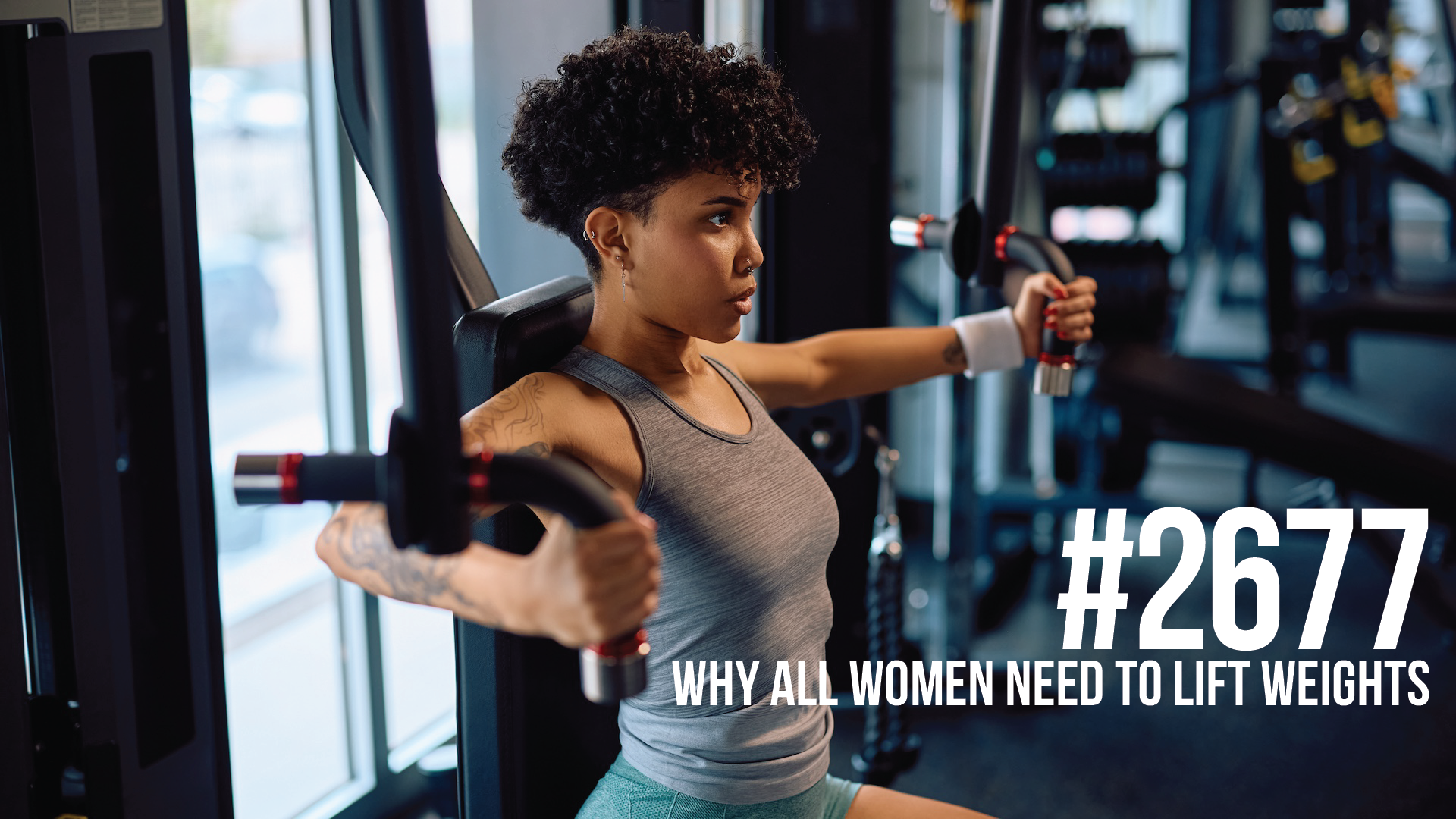
Mind Pump: Raw Fitness Truth
2677: Why All Women Need to Lift Weights
00:28:42
Why All Women Need to Lift Weights The MASSIVE growth of the Muscle Mommy avatar. (1:06) 8 Reasons Why All Women Need to Lift Weights #1 - Its empowering. (4:51) #2 - It strengthens bones. (8:25) #3 - It helps regulate hormones. (11:35) #4 - It’s...
Loading summary
Transcript77 lines
- [00:00]
T-Mobile Advertiser
Back to school is better with family freedom From T Mobile, we'll pay off four phones up to $3200 and give you four free phones, all on America's largest 5G network. Visit your local T Mobile location or learn more@t mobile.com familyfreedom. Up to $800 per line via virtual prepaid card typically takes 15 days. Free phones via 24 monthly bill credits with finance agreement eg Apple iPhone 16128 gigabyte 8 $2009.99 eligible trade in eg iPhone 11 Pro for well qualified credits end and balance due if you pay off earlier, cancel contact T Mobile.
- [00:29]
Justin Andrews
If you want to pump your body, your mind, there's only one place to go.
- [00:35]
Sal DeStefano
Mind Pump.
- [00:36]
Justin Andrews
Mind Pump. With your hosts Sal Destefano, Adam Schaefer and Justin Andrews, you just found the.
- [00:43]
Sal DeStefano
Most downloaded fitness, health and entertainment podcast. This is Mind Pump. Today's episode is for women. You all need to lift weights and we explain why and the benefits specifically for women that you can get only from strength trainers. This episode is brought to you by a sponsor, Manu Kora. That's M a n u K O R a. You got to check this honey out. So it's honey, but it's the highest in mgo you'll find anywhere. Four times higher than other competitors. What's mgo? This is the incredible compound in this special type of honey that's antimicrobial, good for gut health, good for inflammation. You'll. It's the best. Try it out. I like it before my workouts. Go to manukora.com. that's M A N U-K-O-R-A.com forward/mindpump. Use the code mind pumpkin. Get yourself a big discount plus some free gifts with their starter kit. Here comes the show. Women are lifting weights more than ever these days. But not enough. Look, if you're listening to this, you're a woman. You're not lifting weights. You need to. It's one of the best things you can do for yourself and we're going to break it down as to why.
- [01:48]
Adam Schafer
Can't wait for you to man explain this right now. Mansplain.
- [01:52]
Sal DeStefano
Mansplain. Messed it up, dude. Oh, man. The. The. The numbers on this is pretty remarkable. Huge growth in the percentage of women that now do strength training as a and we're here for it as their primary form of exercise. But it's still a minority. It's still.
- [02:09]
Adam Schafer
I thought we're close to 50. 50 now.
- [02:11]
Sal DeStefano
No, no, no, no. I mean, as a percentage, it's still not the price, it's not the, the largest draw, but it's the, one of the fastest growing. It's way more than when we started training people back in the late 90s, early 2000s, way more. And it's because, well, part of the reason is there, you know, social media, you're seeing women now talk about it more and then women are experiencing the benefit of it. And look, as personal trainers, this is just a fact in the field, a majority of the people that hire trainers are women. So a good majority is good. 60% plus of the typical client is a woman. And that was my clients. Most of my clients, I would say, were women. And, and many of them, especially in the early days, were apprehensive to strength training. None of them were apprehensive after 30 or 60 days. They were all bought in once they experienced just the benefit of it.
- [03:03]
Adam Schafer
Do you think that this has anything to do with the kind of shift in marketing and the, I mean even like the women on magazines that we celebrated, say in the 80s versus today, like how much that has changed? Do you think this changed first and then that followed, or did we start marketing and advertising like these fuller bodies, thicker looks like more muscularly built women? We were celebrating that and putting them on covers first and then the, then people followed or was. Do you think it was the reverse?
- [03:36]
Sal DeStefano
No, I think it was reverse. And some of it was driven by the fitness, the personal trainer industry, because the number one tool of a personal trainer in helping someone's shape, sculpt their body, get fit, is strength training. So most trainers will tell you this is like the number one exercise tool because it's so effective. So you have that, you have decades of, you know, communication. Then you had CrossFit. I think CrossFit. In fact, when I looked this up, CrossFit had a huge influence because you had these female athletes. Now CrossFit, top female athletes are very muscular, but some women saw that and said, whoa, that's really interesting.
- [04:10]
Adam Schafer
I, I would attribute a lot of this to CrossFit because I think it actually normalized that that body type and celebrated. These girls were winning, they were badass. They, and they definitely had very muscular physiques. And before that, I don't feel like that body to women was marketed or celebrated like it was in CrossFit.
- [04:31]
Guest or Additional Host
I think too, a big point with that is it was co ed. So like your normal commercial gym, it's like, it's almost like you siphon off like there's A lot of cardio machines. There's machines that were, even back in the day, were like, just tailored just for women. And so it was like, very, like, segmented. Whereas, like, CrossFit was really just this class. And like, everybody was after, you know, just getting strong and going through these, like, core lifts.
- [04:56]
Sal DeStefano
Yeah. And it's, it's interesting. So the, the, the main, the first reason why this is such a valuable form of exercise is because it's incredibly empowering. You mentioned strong, Justin. In the 90s, when I started training, if I told a woman I was going to make her strong, you could almost see her face change. Like, yeah, like, I don't want to. Yeah, I don't want to do that because they, they thought that that looked like broad shoulders or, you know, like, like a guy. And the truth is, strength is empowering. I. I remember years ago, years ago, one of the. I heard women say this to me all the time. My clients where they would. They would train with me, and after about 60 days, they'd say, oh, God, I feel so. I feel so empowered in my body. I feel so empowered. I really understand what that meant fully. It's like, okay, well, you're stronger. Like, what does that mean? Until I had a client that explained to me that she used to travel a lot for work, and she came back from one of her workshops. She's a very petite woman. She was like five foot, very small, petite woman. And she came back from a work trip and she was so. I mean, she was so excited. And she told me, she said, sal, I. This is the first time I put my luggage in the overhead compartment by myself. And I'm like, what do you mean? She goes, every time I travel, because I travel alone. She was a CFO of a tech company. I have to ask some guy next to me to do it. And then I realized what these women meant by being empowered. Women naturally have a lot less upper body strength than men. And so when it comes to doing things that require strength, you know, the old, you know, the classic meme of the opening the jar or whatever, having to depend on someone else to do something for you, that can feel a bit disempowering. Suddenly you want to move the couch or the coffee table or lift your luggage again in the overhead compartment. Now you can do it yourself. That's a great feeling. It's a very empowering feeling. And it's very empowering to feel strong in your body. To feel weak in your body is the opposite. Like, you need to depend on other People to do things for you.
- [06:52]
Adam Schafer
Yeah. Another way to say this, I think too, would just say it's a confidence builder.
- [06:56]
Sal DeStefano
Totally.
- [06:57]
Adam Schafer
And I think that this carries across both sexes, that there's nothing like, you know, going to the gym, working towards getting stronger, and then feeling that apply to your real life, like male or female, you feel that attractive. Exactly. And I think the first time you. You notice it in your real life application, like lifting the luggage, you go like, oh, well, that's cool. Yep, that's a. That feels good.
- [07:21]
Sal DeStefano
Yeah. And I've had women explain to me like this as well, where they feel more empowered walking. Because when you strength train, by the way, if you're a beginner and you're watching this right now and you haven't done consistent strength training and you're about to get started, it is totally within the realm of, you know, being reasonable. Like, this is very achievable. You could double your strength within a year. Many times in six months, double your strength. So now imagine what it must feel like to walk around in your body. First off, how's your posture going to change? How is every step going to feel? How does every time you sit down and stand up going to feel when you are twice as strong? And this is, again, this is quite reasonable. You could. You take a woman who's never strength trained, having her squat with, you know, 30 pounds on her back would be pretty difficult. It's totally reasonable to say she'll be able to do £60 by the end of the year. Much more for most women. So imagine being twice as strong and what that's gonna feel like in your body. And that is. It's not just reasonable. It's expected if you do things properly. And that's an amazing kill.
- [08:29]
Adam Schafer
Huge confidence boost.
- [08:30]
Sal DeStefano
Huge. Next up, it strengthens bones. Osteopenia, osteoporosis. This is a real risk for women. It's far less of a risk for men than it is for women, but it's an actual, real risk. The percentages are relatively high, especially if women are petite and, you know, as.
- [08:48]
Adam Schafer
They get older, what is the ratio, as in. In people that as they age, like.
- [08:52]
Sal DeStefano
Women to men, you know, maybe Doug needs to look that up. Like, what's the rate of osteopenia in women as they age?
- [08:58]
Adam Schafer
Is it significantly more? I didn't know.
- [08:59]
Sal DeStefano
I didn't realize. Versus men? Yeah. Oh, yeah.
- [09:01]
Guest or Additional Host
Anticipated.
- [09:02]
Sal DeStefano
It's way more.
- [09:04]
Adam Schafer
I knew it was more. I didn't realize it was way more.
- [09:06]
Sal DeStefano
It's relatively rare to see a man with Osteopenia, unless they're really sick and frail.
- [09:11]
Adam Schafer
Oh, interesting.
- [09:12]
Sal DeStefano
But for women, it's, it's definitely a problem. And you guys know this, like all the bone strengthening supplements and calcium, it's always advertised to women because. And weak bones is scary. You know, you, you break a bone, fall down and break something like, that's, that's a, that's a massive risk. What does that show there? Yes.
- [09:31]
Justin Andrews
So osteopenia is 26.5% in pre menopausal women to over 48.5% in post and.
- [09:39]
Adam Schafer
Up to 54% in comparison to men, though.
- [09:42]
Sal DeStefano
Yeah. Well, look up men.
- [09:43]
Adam Schafer
That's what I'm just curious about.
- [09:44]
Sal DeStefano
But let's just consider this for a second. Perimenopausal women are typically between 35 to 40. One out of four.
- [09:52]
Adam Schafer
Yeah, that's a lot.
- [09:53]
Sal DeStefano
One out of four are going to.
- [09:55]
Adam Schafer
Have some at that young of an age.
- [09:56]
Sal DeStefano
Osteopenia. Yeah.
- [09:57]
Adam Schafer
Wow.
- [09:57]
Sal DeStefano
You in menopause, almost half. Almost half suffer from bone weakness, which is insane.
- [10:03]
Adam Schafer
I mean, that tells the story for sure that it's going to be a huge discrepancy.
- [10:07]
Sal DeStefano
It's four times that of menopause.
- [10:09]
Adam Schafer
Oh, is it four times more? Yeah, because I, you know, I had clients and, you know, stories of the, the, even the male client falling down the stairs and breaking his head and doing things like that. But. And so I guess I just never really realized how much more common it was.
- [10:21]
Sal DeStefano
A lot more part of it is just our bones are bigger and stronger. We have different hormones, but yeah, like more muscle mass. Nothing builds bone like strength training. There is no, there is no form of exercise. In fact, when they do studies on other forms of exercise, you see some bone strengthening, for example, running, you'll see some bone strengthening. The lower extremities. Nothing really in the upper extremities. And it's not a huge percent increase. Strength training. Who. I said you could double your strength with how much you lift. That's what you can do with your bones just through strength training. By the way, the other part of this, I have to say this because women who strength train regularly but also under eat will also fall in that category of osteopenia. So you can get osteopenia even if you strength train, if you under eat. So the other side of this is.
- [11:08]
Guest or Additional Host
If you're looking, you see it a lot under eating and also the running, the cardiovascular preference, super high. And you get the, you know, the repetitive injuries that occur as well from running more so than. Yeah, you're gonna face.
- [11:21]
Sal DeStefano
So if you strength train and feed yourself properly, your rate of osteopenia is almost zero. In fact, if you look. You can look up the data on this, it takes it down from, you know, you know, a fourth in perimenopause to 50 in postmenopause to almost nothing. So you could pretty much eliminate that risk by just lifting some weights. Next up, strength training has this remarkable ability to regulate hormones more so than any other form of exercise. Now, all forms of exercise, if they're applied properly, will improve your health. Improving your health generally improves your hormone profile. So that's a fact. Strength training, however, is unique because of the signal that it sends to the body. What's the main signal of strength training? Get stronger, which leads to more muscle. When your body is trying to build muscle and get stronger and you feed it properly, what it starts to do is it starts to organize its hormones in a way that does this. So it tries to create a more. What's known as anabolic hormone profile. So what does that look like? Testosterone becomes more effective. Yes. This is true for women as well. Women also have testosterone, also important for women. Just as important for women as it is for men. It's just different ratio. You get better balance of estrogen and progesterone, and you become more sensitive to insulin and growth hormone becomes more youthful. So, in essence, you get this youthful hormone profile because your body's like, okay, we want to build some muscle. Let's start to organize our hormones in a way to do this.
- [12:48]
Adam Schafer
This used to be one of my favorite things to point out to my female clients, especially as we first started our journey, because many times we would start to see this and notice this. Before we saw the weight loss or the physical change that much in the mirror, it was like. But right away, if we had done our blood work before and saw where we're at, one of the things I could lean on was like, hey, let's go get that checked again. And how often they would see positive impact from that, which I think can be really encouraging when you have a big journey ahead of you or you're just getting started into weight training. And it's like, it takes a long time to build a lot of muscle. It takes a long time to burn a lot of body fat. But right away, when you start eating better and strength training, you start to see these hormones get optimized relatively quick. And it's a very. And tends to also impact their life. Like, they notice energy going up. They notice sleep is better. Is Better libido is better, which is such a cool thing. And for all the coaches and trainers that follow and listen to us, like, this is like a really important thing to pay attention to with your clients when they first start out. Because I, I do think it's so important that when people are first starting off that you, they have encouraging reasons to keep going. And sometimes people can be so drawn to the scale in the mirror and when that's not moving fast enough, they get discouraged. But that's already showing positive benefit.
- [14:01]
Sal DeStefano
That's right. Yeah.
- [14:02]
Guest or Additional Host
You think of perimenopause, you think of like having a child, and you think about these major shifts in hormone swings, like, you know, how, how necessary it is to, to weight train, to be able to kind of counter and balance that back out.
- [14:16]
Sal DeStefano
It is, yeah. And a lot of hormone imbalances of women are, are closely connected to insulin insensitivity or resistance. Right. Like pcos, for example, as an example of this strength training. As muscles get stronger, they become far more insulin sensitive. I mean, your muscles are a storage vessel for glycogen. This is what your body turns sugar and carbohydrates into. So now you have a bigger, you know, essentially gas tank to store it so it has somewhere to go. And muscle, I mean, building muscle is one of the fastest way to improve blood sugar or insulin sensitivity. This is well established. So you get that, you get. Thyroid becomes more effective. So your thyroid hormones, a lot of far more women than men suffer from thyroid issues. Well, your thyroid becomes more effective because muscle plays a role in that. And then you have increase in what are known as androgen receptors. These are the receptors that your testosterone attaches to. So even if your testosterone stays the same, it becomes more effective because there's more places for the testosterone to dock on. So it's really this unique form of exercise when it comes to hormone regulation. No other form of exercise does it as directly as strength training. Next up, it's anti anxiety and antidepressant. All forms of exercise, by the way, are this way. Strength training seems to edge them out just a bit in some of the data that I've seen. But the most recent data on exercise in general shows that Exercise is about 1 1/2 times, so 1.5 times more effective than medication and talk therapy, which is crazy. For low. The common forms of depression and the common forms of general.
- [15:49]
Adam Schafer
Great.
- [15:49]
Guest or Additional Host
We have that data now because it's something we all suspected.
- [15:52]
Adam Schafer
It's so wild though, because that's, it's not even the first form of defense for us. Yeah, it's like you would think the thing that is not just a little bit better, significantly better is the third option or below for our like for, for people. People suffer from these things and we want to throw medication or talk therapy at them. When strength training actually trumps both of.
- [16:14]
Sal DeStefano
Those, it shapes the brain in a way that looks more like. Because you can actually see chronic depression, you can actually see with MRIs that they have differences in their brain. Strength training exercise, generally, strength training in particular shapes the brain to look more like a brain that's less anxious and less depressed. Muscles also produce feel good chemicals and peptides. So as muscles develop and get stronger, they shoot out these compounds that make you feel good. So it's just this wonderful remedy for these things.
- [16:48]
Adam Schafer
There's also got to be a psychological side to setting, setting a goal to go do something, following through and doing it, then executing that. I mean, you know, one of the cycles you can get in depression is feeling like I can't do anything at all. Like talking, having that self talk that's negative, where you start to go do something like that and you accomplish that and then you see positive change in your life. You can actually see it and feel it. That's got to do play a huge part.
- [17:14]
Sal DeStefano
It also points to the first point, which is that one of the hallmarks of anxiety and depression is feeling like you're disempowered, feeling stronger, lifting more weight. I'm doing twice as much in my deadlift as I did four months ago or six months ago. That plays a huge role.
- [17:30]
Adam Schafer
Yeah.
- [17:30]
Sal DeStefano
In those things. Next up. This is probably one of the reasons why it's getting more popular. Women get hammered far more than men. On trying to look a particular way. Like this is just general for everybody where we're told we need to look a particular way. But women in particular get hammered by media, by marketing. And so what this creates with a lot of women, girls and as they grow up, is that they're afraid to eat. They're afraid to eat. So eating disorders are far higher, much more prevalent in women than in men. They're not non existent in men, but they're definitely less prevalent. And strength training, it boosts your metabolism. Like you can eat more and stay lean. So when you do eat more and enjoy your meal or whatever, you're not suddenly gaining all this body fat. Why? Muscle is metabolically expensive. It burns calories. So you know, you gain a little bit of muscle and you feed yourself appropriately. It's again within the realm of reasonable to be able to boost your metabolic rate by 500 calories. I've done way more than that with female clients. 500 calories. By the way, you know how much cardio you have to do, you know how much running you have to do to burn.
- [18:37]
Adam Schafer
That's like an hour, hour a day, every day.
- [18:39]
Sal DeStefano
Every day it's an hour of running to burn that many calories.
- [18:43]
Adam Schafer
And that is, that's nothing. And anybody who's any woman that's listening, that has experienced this will tell you that this is life changing. I mean I, I remember being with Katrina for the first few years and watching the way she approached exercise with running high intensity, just cutting calories like crazy. And then when she, and she would swing, her weight would go up like 10, 15 pounds. And she'd get to that point, she's like, oh God, I gotta fix this. Cut calories hard, run like crazy. And like I remember just kind of standing back and, and letting her do it until finally she came to me and said like, okay, what would you have me do? And it was like, okay, well we're gonna stop the running, we're going to reverse diet you, we're going to strength train, we're going to get strong, you know, rest periods, all this stuff. And then to watch her go from somebody who probably averaged around 1800-2200 calories and kind of fluctuated in their weight wise, to be eating 28, 2900 calories, no running whatsoever, better physique than she's ever had in her life. Like, I mean, what that, oh what that does confidence wise, the metabolic flexibility that she can enjoy Friday night pizza night or a glass of wine here and there and not feel like it's going to pack all the weight on. Like I, this is one of my favorite things to. And this is again, this is men and women, but women in particular, I think, to your point, have been scared into eating so low a calorie so often that they under eat so much and then they chronically. Yeah, yeah. And then they're, then their metabolism adapts to that low calorie and then they get stuck in this place where either one, they end up putting a ton of weight on or they have to manage themselves so low just to keep their weight down and to boy allow someone to have that flexibility also. Very empowering.
- [20:22]
Sal DeStefano
Right? And you know, you live in a modern society, we're surrounded by food. Having a metabolism that's faster is definitely an asset. You know, maybe not 50,000 years ago when food was scarce but now you got a fast metabolism like this. This actually keeps you healthy and allows you to enjoy life. And other forms of exercise don't do this. They don't speed up your metabolism like we talked about running. Other forms of exercise, like running, actually teaches your body to burn less calories. You actually teach your body to become more efficient with calories. You don't need a lot of muscle. You don't need strength for endurance. And endurance is great. If you're an athlete and you want endurance, there's nothing wrong with that. But if that's what you're doing and that's your goal, your goal is to stay lean, and you do lots of running, your body learns how to burn less calories. Through that process, you actually can slow your metabolism down. Whereas with strength training, the opposite is true. You're actually directly affecting your metabolism in a way to make it faster, which, again, makes things a lot easier for you. Next up. This is one of my favorites is. And you see this with women, it's just so cool, is they learn to trade the scale for weights. What do I mean by that? Look, a woman that is 150 pounds at 17% body fat looks way different. And 17% is lean. Let's even go 20. 20%, which is great. Looks very different than a woman that's 150 pounds and 30% body fat. Same height, huge difference. They look very different. I'll even say this. A woman that's 165 pounds at 20% body fat looks smaller, leaner, more sculpted than a woman that's 15 pounds lighter with higher body fat percentage. Muscle looks different. Muscle def still weighs something. But what ends up happening through this process is you start to see yourself. You start to feel yourself. You're like, man, I look good, I feel good. And I really don't care what the scale says. I'm more interested in how much weight is on the bar. And you get rid of that scale, you break those chains, and now you're lifting weights in the gym, you look great, and the scale doesn't matter anymore.
- [22:11]
Adam Schafer
Also, another thing that I think is so freeing. I can't tell you how many clients, female clients that I've trained that all had this, like, arbitrary number in their head, you know, that either somebody else put in there or they attached to a point in their life. And I always remember, like, getting started with them, going like that number means nothing. Like, I can have you 20 pounds heavier than that and looking better than you've ever looked in your life. You can be Five pounds lighter than that not look so good. You could be like, that number is so irrelevant. You have no idea when it comes to building muscle on your body. So, like, throw that out the window. And that takes a long time sometimes for people to let go of that because they've attached a number to maybe a time in their life or how they felt when they were at that number. And it's like you. When you put on a lot of muscle, muscle weighs a lot, and it. And it looks way different on a body. And then you. When you start to realize, like, oh, my God, the 10 or 15 pounds, north or south, doesn't really matter. It has everything to do with how much muscle.
- [23:07]
Sal DeStefano
Muscle takes up less. First off, it takes up less space than body fat on a pound for bound basis. It takes up something like a fifth less space. So it's just smaller because it's denser. And muscle looks different because it's firm. And you can choose where you can build your muscle. You can't always choose where you gain your body fat, right? You get more body fat. So some people would like to go in their boobs. It tends to go wherever it wants muscle. I can choose to build on my butt, build on my legs, add some shoulders, nice back. And so you gain 10 pounds of muscle, you lose 10 pounds of body fat. The scale says the same. You don't look the same. You look very different, and you feel different. You have a faster metabolism. Next up. It's definitely more fun than the treadmill. You get on the treadmill. There are a lot of different exercises you can do with strength training. There's so many different ways to progress. There's so many different movements you could do. A treadmill is a treadmill. You get on there and you just go, okay, I'm gonna go run for 45 minutes.
- [23:59]
Guest or Additional Host
It's a hamster wheel.
- [24:00]
Sal DeStefano
It's the same thing over and over again. Versus I'm gonna go in the gym, I'm gonna do five different exercises. These are the body parts I'm gonna work on. And next week, I'm gonna try a couple different exercises. And wow, I'm seeing my weight go up. And this is. It's a totally different experience. And when you talk to women that finally embrace strength training and they do it for 60 days and they stick with it, they all say the same thing. This is way more fun than running on the treadmill.
- [24:22]
Adam Schafer
I think part of that, too, is that there's so many different, like, specific attributes or goals that you can have that training different ways can give you, you know what I'm saying? So like if you all sudden want to have agility, you know, or you need to work on stability or you want to be able to jump higher or like there's, there's a lot of things that you can do with the way you, you strength train to get different results. And that in itself is, I mean, it's the only thing that's been able to keep me going for over 20 years is switching up the goals. It becomes, okay, switch up the programming. Like if it was the same five exercises the same way, all which is what a treadmill or any sort of form of cardio is, the same thing the same way all the time. Oh man, that would be tough to keep it going. But the fact that you can be changing goals and going after different after attributes and simply modifying, changing exercises or doing them in a different manner gives you a different outcome. That's a lot more fun.
- [25:19]
Guest or Additional Host
Yeah, I was just talking to one of my friends, she's a runner and had switched over to strength training and just, you know, her overall energy levels, first of all, you know, through the roof and strength really, you know, helping with that. But, but the elimination of pain in this chronic, like low level pain that sometimes is, you know, big loud signal of pain. It's like when you get strong, you don't get that type of a signal anymore.
- [25:44]
Sal DeStefano
No, you go to a physical therapist for pain. They use strength training. It's correctional exercise, but it's strength training. That's the primary form of exercise they use for pain. And then here's this. You can spot, you can't spot, reduce. So I can't just burn body fat from wherever I want, but I can spot, shape and sculpt with strength training. So I can literally like a sculptor, go in the gym and say, I want this to look a particular way and develop that muscle and move towards that.
- [26:09]
Adam Schafer
That is, to me, that's such a cool thing that you can look at your physique and you can actually go and go, hey, you want more of this or less of that? And you can go build that look with weights. You cannot do that any other way.
- [26:23]
Sal DeStefano
No, it's as close as being a sculptor as you can get with exercise. And then finally, this is the best part, this is the best one. You don't need to do a lot of it. Here's what the data shows, everybody. Two days a week, Two days a week of consistent strength training will give you about 80 to 85% of all the results. You get from strength training.
- [26:40]
Guest or Additional Host
Pretty good return there.
- [26:41]
Sal DeStefano
Yeah. Now the majority, the bulk of the results you'll get from strength training happen with about two days a week. There's diminishing returns after that. Yes, you'll get more if you did three days and four days and five days, so long as it's appropriate, because you could also overdo it, but it becomes diminishing. Now you're squeezing out the extra 5, 10%, but 80 to 85% from two days a week. Tell me a form of exercise that will do that. There isn't. Almost every other form of exercise has to be practiced on a very regular, consistent basis. You go to the gym two days a week, 45 minutes to an hour, you do some strength training, you're getting most of the results. You get for all the stuff that we talked about, you'll get most of it, which is two days a week, which makes it this incredible roi.
- [27:19]
Adam Schafer
Well, and even too, like the, the way atrophy sets in. And like, because muscle, you don't get just the benefits from the weightlifting when you do it. You can also get all these added benefits metabolically and it stays on the body for a period of time even if you fell off and didn't train it for a week. So one of the cool benefits around. Yeah, like when we, when we get on a treadmill and we run for an hour, the entire benefits happen in those, those 50 minutes or whatever it is you run the minute you get off of it. Like there's extra benefits. Stop. And so with weight training, you don't only get the benefits of the movements that you're doing out there, but then also the benefits of the muscle. And then it even stays with you even if you don't do it for a week or two. And so that in itself makes it so beneficial.
- [27:59]
Sal DeStefano
Totally. Look, if you like the show, come find us on Instagram. We'll see you at Mind Pump Media.
- [28:03]
Justin Andrews
Thank you for listening to Mind Pump. If your goal is to build and shape your body, dramatically improve your health and energy and maximize your overall performance, check out our discounted RGB super bundle@mindpumpmedia.com the RGB Super Bundle includes Maps, Anabolic Maps, Performance and Maps, Aesthetic nine months of phased expert exercise programming designed by Sal, Adam and Justin to systematically transform the way your body looks, feels and performs with detailed workout blueprints and over 200 videos. The RGB Super Bundle is like having Sal, Adam and Justin as your own personal trainers, but at a fraction of the price. The RGB super bundle has a full 30 day money back guarantee and you can get it now. Plus other valuable free resources@mindpumpmedia.com if you enjoy this show, please share the love by leaving us a five star rating and review on itunes and by introducing Mind Pump to your friends and family. We thank you for your support and until next time, this is Mind Pump.