← Mixed Signals from Semafor Media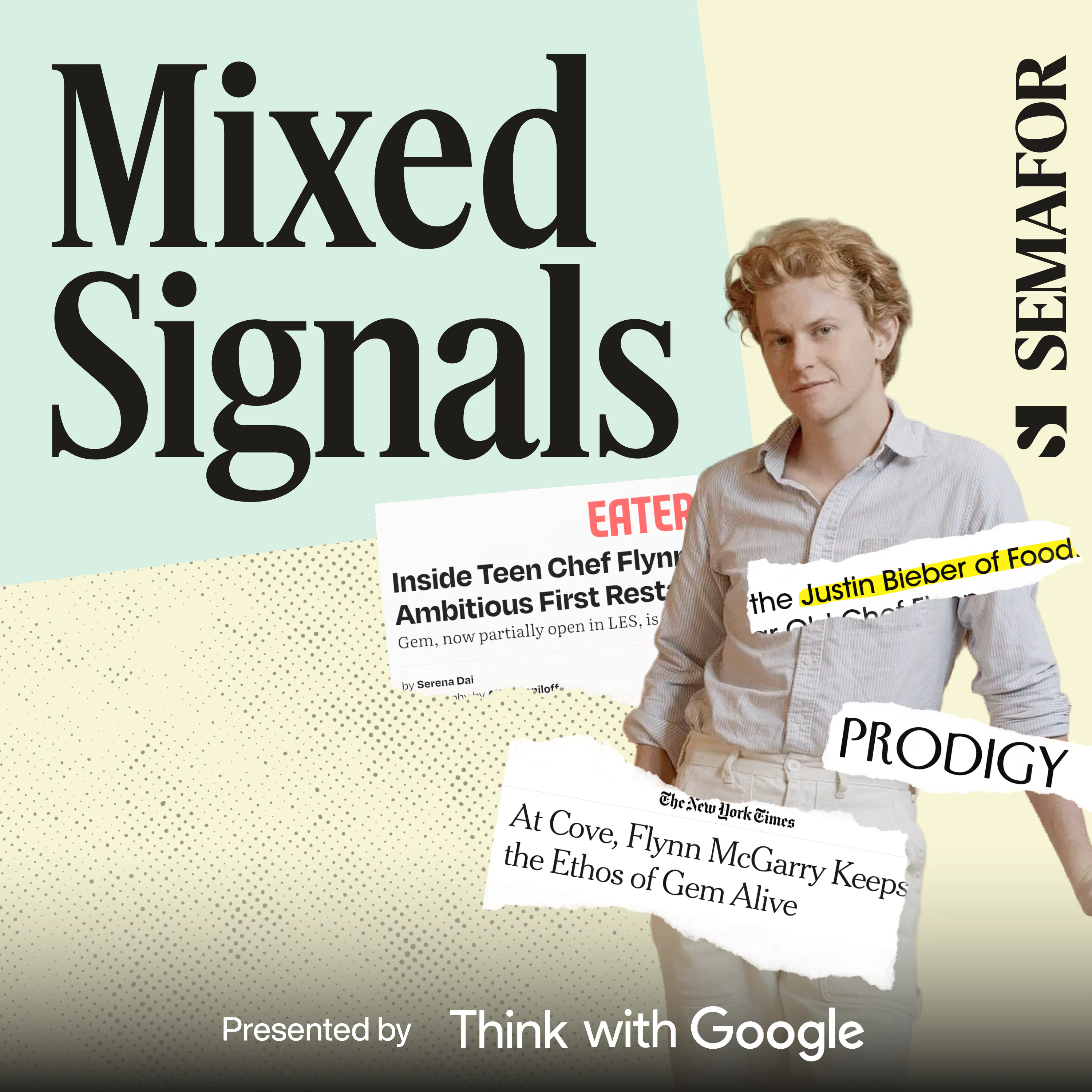
Mixed Signals from Semafor Media
Flynn McGarry on growing up as a food prodigy and the waning power of restaurant reviews
00:42:28
Loading summary
Transcript94 lines
- [00:11]
A
Welcome to another episode of the Mixed Signals podcast from us here at Semaphore Media, where we are talking to all the most interesting and important people shaping our new media age. I'm Max Tawney. I'm the media editor here at Semaphore and with me, as always, is Semaphore's Editor in chief, Ben Smith. Ben, I'm a little sluggish this morning, a little bit more so than normal because last night I had a two and a half hour long dinner at Cove in preparation for our episode. Today I had the hard work of eating at Cove.
- [00:42]
B
Really stretching the definition of a media show here, Max. And the limits of the Semaphore expense account.
- [00:47]
A
Yeah, that is definitely true on one account, which is our financial expenses. Sorry to our cfo Garrett, but this is a really exciting episode for me because every once or twice a year we like to do an episode about food and about food media because it is such a big part of not only the stuff that I'm consuming on a day to day basis, but it really is a major part of the world that we live in. And it's also this space where two worlds are increasingly colliding. The worlds of food and of restaurants and of media, particularly here in New York City. And that's why I was so interested in having on Flynn McGarry. He is chef and owner of COVID which is an excellent new restaurant in the somewhat weird area neighborhood of Hudson Square here in New York. Flynn is a really interesting chef because he is somebody who has experienced food media both as someone who's creating it in promotion and marketing of his restaurants, but also he's been the subject of it. He was a widely profiled, written about, talked about chef from when he was a teenager and when he was hosting food popups at his parents house in Los Angeles. He had a New York Times profile written about him when he was 15. He was described as a prodigy and a wunderkind, you know, by places like the New Yorker and NBC and pretty much every major media outlet that was interested in food was writing about him from a really young age. He's now 27 years old, he's opened multiple restaurants and I think he has a lot of really interesting food thoughts about being the subject of intense national media attention and scrutiny at a young age and also what it's like to be a restaurateur and a chef and a kind of a business owner at a time when food media is something that will make or break your restaurant and is changing dramatically.
- [02:42]
B
Yeah, I think both restaurateurs and chefs are kind of coping with all the same radical changes to the media ecosystem that we who live in media are.
- [02:50]
A
Well, we want to get into that. We want to ask him about this show that he almost did with White Lotus creator Mike White, and we want to ask him about how the national media changed, how he thought about himself and where food media is going from here. Does the New York Times review still make or break your restaurant? We have a lot that we want to get into with Flynn. We have to take a short break, but we'll be right back with more after this.
- [03:20]
B
Our friend Josh Spanier, Google's VP of marketing, has a new podcast out called Frontier cmo. It's from Think with Google. And it gets into all the ways marketing is shifting, especially in the AI era, where the old marketing playbooks have become obsolete and the whole role of the CMO is being redefined in real time. Josh talks to the people who are actually figuring it out, top CMOs, industry leaders and creators, and gets into the real world challenges and specific strategies, but they're using to navigate this new era. These are notes from the marketing Frontier. You can find Frontier CMO on any podcast platform or watch it on YouTube.
- [03:59]
A
Flynn, thank you so much for joining us. We're really excited to have you here on the show. So the first thing I kind of wanted to ask you is for people who may not know who you are, how do you kind of explain your trajectory as a chef and also kind of a family figure in food media more broadly? How do you explain yourself to them?
- [04:20]
C
I started cooking as a very young person and it was very, you know, intended as not really what it kind of came out to be. And even at that time was very aware that, like being 15 years old, that sort of world that I was living in, and even media wise, there was a documentary about my, like, upbringing and kind of how I started cooking. And I was very sort of cognizant of how being a child prodigy, as it has been mentioned, and I'm kind of glad that stops being the number one thing that's been said. But it's funny because being a child that does a lot in food is very different than being a child that does a lot in music or art because there are literal age restrictions on your potential to succeed. So no matter how talented I could have been, I was still 12 years old and I wouldn't be able to run a kitchen or do any of these other things. So I think that always sort of helped me Separate these two things of like, there was a time where me being young and cooking was the interest and the intrigue and there was a lot of obvious coverage around that, especially the documentary. But I even myself at the time knew that I hadn't done anything yet.
- [05:33]
A
The first time you got national media attention was when you were a teenager or maybe even like 12. The New Yorker covered pop up that you had done in your home. Did you invite them there? How did the national media attention happen?
- [05:46]
C
My mom's friend's friend was a freelance writer for the New Yorker. His whole thing that I remember him saying was like, you know, I had this group of friends who were in their, you know, 40s being like, we're going to dinner at this kid's house. And he was sort of like, what? And so, yeah, it did really just come up in the sense of word of mouth, you know, I was, I think in this way lucky to be doing this in Los Angeles where friend to friend can end up being someone that writes the New Yorker. He was like, I'm going to write for it. I don't know if we knew if it was going to get like accepted or anything. And yeah, he came to the dinner, spent a little bit of time in the day writing it, but it was a very small piece in the end, but did sort of spark this kind of larger thing which I don't think would happen today at all.
- [06:33]
A
Hmm, interesting. Why, why not?
- [06:36]
C
No shade on media as, as a whole. But if there wasn't, you can shade
- [06:40]
A
media as a whole. Plenty of our guests do. That's the whole point of the show.
- [06:43]
C
We're in this landscape where just writing about someone doing something specific without a follow up because you can't be like, oh, it's, it's going to pull people here and then it's going to, we can keep doing this thing. It's going to keep going and going and going. These sort of one off stories, I think are so rare now and the one off stories, they do still exist. I'm not saying that that doesn't happen whatsoever, but the traction to them, it allows them. They are just one off stories. This was a one off story that then other writers read and then other people read that and then we were reached out to by other media forms and the media fed the media. Now someone would say, oh, you were in the New Yorker, I'm not going to write about you. You were already in the New Yorker. I'm not going to write about you for the New York Times. Like, we're not going to double cover the same person.
- [07:30]
A
This is something that we're definitely guilty of, right, Ben? I mean, we're a smaller media company. We operate based on those principles, the same principles, which is like we need to be the first people doing something.
- [07:40]
B
Yeah. And I think it is sort of a social media era assumption that everybody's read everything, everything is centralizing into the same funnel. If there was a New York story on food and you care about food, you're going to have read it. Why would the New York Times read it? There's this like, or sort of slurry of media that everything feeds into.
- [07:54]
C
Or that something that I've always believed is that the writer's point of view from one story to another and what you get out of a subject from talking to them would not be completely different. And I think that that's something that I've always found interesting as like a subject. We get an exclusive or whatever. And they're like, you can only work with this one thing. And then I talked to the writer and I'm like, oh, your angle. Because every story always has an angle. Your angle for this is actually not what maybe I wanted to get across or what I find interesting about the story. And now because we're in this very competitive. If someone already wrote about you, huge elements of stories in people's lives just kind of get lost because no one cares to like dig a little deeper.
- [08:33]
B
Yeah, we got. It's time for a. Time for a Flynn McGarry takedown. The media's built him up too much.
- [08:38]
C
Yeah, right, exactly.
- [08:40]
B
This is a media show and a lot of our listeners and viewers are people who sometimes write or make films or make advertising about kids. Is there anything from your experience at that time that you would say to the adults who were doing that? Any advice?
- [08:57]
C
I think it's honestly less about the sort of profile itself. I think I was lucky enough to, you know, pretty much every profile or writer or, you know, filmmaker that I worked with I think was really genuine. And. And you know, I don't think you find yourself interviewing a 15 year old chef unless you actually think they're doing something interesting or you're trying to kind of make fun of them. And I think you're trying to make fun of them. That's pretty mean.
- [09:24]
B
Did that happen to you?
- [09:25]
C
No, I think it was pretty obvious to see if that was going to happen, you know, from the way that someone was approaching it. And obviously when I was being interviewed those years ago and now the media landscape has changed A lot. But I do think interviewing a young person who the entire interview kind of like we spoke about is going to be about dreams, hopes, potential. You know, that's what you're, you're looking at, you're not looking at. I'm going to talk about this person who has all these accolades under their belt. You're look, you're interviewing someone who's very naive and very excited. And that is like what you're trying to get across in this thing that hopefully inspires people to also dream and hope and all these kinds of things. And how important the context of both the platform, the editing, the way that people receive it is in that, you know, I think in a lot of ways a big thing that happened with me in media that got incredibly misconstrued, not even by anyone's fault, is that, you know, we had a lot of these writers kind of talk about this idea that I built a kitchen in my bedroom. And as I would always say to them, it was a few IKEA tables and a hundred dollar induction burner, but it was more of just like I would still have to go to the normal kitchen to wash dishes and whatever. Like, it was more of a space that I could take all my stuff, close the door and be able to kind of create. But in talking about it in this way that was like supposed to be like, look at how passionate this person is. They obviously want to make everything feel the highest version of it. What that led to is all these people being like, this rich kid had his mommy and daddy build him a kitchen in his bedroom, which was very much so not the case. And that's what I mean about like starting to understand not just your own context of what you're trying to get across, but the way that people will receive it, you know, And I think there was maybe one or two pieces that described that. And then once that narrative kind of happened on the Internet and kind of completely outside of these pieces, the rest of every single interview and even today has had to have some sort of like, either the question of do you want to like, comment on how that wasn't the case or, you know, how do you phrase it in that way? And I think that that would be, my advice is, is, you know, trying to think about not just, you know, your own context of trying to make, obviously you want to convince people that this child that you're writing about is worth writing about, but kind of asking the question of the way that people receive young people, because it is always a very polarizing subject. You Know, how can you be a little bit more delicate? Because they're not someone that has accolades or whatever to sort of rest on. This is a very sensitive period in someone's career. Yeah.
- [12:07]
B
Did the media and social media shape how you thought about yourself?
- [12:10]
C
I think it shaped me, you know, in a lot of good ways. I've always been very like, my social media is supposed to be food, and it's focused on the food that I make. And I think that I always had some sort of, like, you know, blockades around it. And so I do actually think in that way that was. That was helpful. Being a teenager and being like, the only things that I'm going to post on social media are food, and I'm going to use it for a specific avenue of my life. And obviously it's blended into other ways as I've gotten older, but I think that I've only allowed it to do so as I've started to sort of not value it less. But it's a thing that I have. But I think very young, you can become incredibly impressionable on it. And being able to say, that wasn't like a parent, that was my own, like, I'm only gonna posts about food on here.
- [13:03]
A
As I was listening to Flynn answer the question, I was kind of curious, like, Ben, you've been written about a lot by various people over the years. In your time running buzzfeed, in your time as a columnist at the New York Times, New York magazine wrote a big profile on you. I'm curious to ask you that question, actually. Do you ever let the media coverage of the stuff that you do impact how you think about yourself? Obviously, this wasn't stuff that was happening to you when you were a kid,
- [13:27]
B
but, yeah, people often refer to me as the Flynn McGarry of blogging. No, I don't know. I don't know. I just. I sort of, I think from the early Internet, mean blog commenters. I also got a very thick skin and also have very careful boundaries around my personal life that I don't post about. When I was 37, the New York Times ran a headline calling me a boy wonder, for which I was, like, widely and deservedly mocked. And I do think there's something nice about the expiry of the, like, wow, you're so young thing. I mean, mostly that's bad, but there is an upside to it. You do kind of miss it, though.
- [14:01]
C
Yeah.
- [14:02]
B
Yeah.
- [14:03]
C
I'm sure one day I will. I will be yearning for it.
- [14:05]
B
Exactly.
- [14:06]
A
Yeah, exactly. People talk about the kind of the dangers and the kind of drawbacks of being a child star in the entertainment business, this is something that's well worn territory. Now that there are more chefs who are younger, do you think that there are risks to young food stardom?
- [14:23]
C
I think it's the same risk that the rest of the entertainment industry hold. Because if you are a young chef, you are in the entertainment industry, you are not in the restaurant industry. You know, I worked in a restaurant incredibly illegally. As you know, there are child labor laws. For these reasons, Hollywood is allowed to skirt all of them. You know, the only legal 8 hour day I was able to work before I was 18 was shooting a Cadillac commercial. So I, I think that, you know, these are these kinds of things that in that in your exact point, if you are a young chef and you're gaining following, you're on a TV show, any of these kinds of things, you face the same exact problems, you could say as the entertainment industry. But if you look at chefs for history, you know, it's like they've never gone to this level of stardom that you see really does affect children, I do think in a lot of ways, obviously you're speeding up your life to a certain extent. That is a danger to kind of anyone. And I do believe still to this day that every decision and thing that I did as a teenager, the awful ideas that I said no to, were on my own accord. And I think that when it starts to not be on your own accord, I think is where you start to see, I mean, that's the classic child star dilemma in a lot of ways is that they're forced into a lot of places in life, a lot of decisions that were not their own decisions. Then when they become an adult, they don't know how to make their own decisions. And I would say, you know, if someone is watching this and has a kid that is, wants to be a chef, I think it's obviously being as supportive as possible, but also making sure that if your child wants to do something out of the ordinary, it has to be their decision. Otherwise they're not going to know how to make decisions one day. Because that's what you learn in high school, in, you know, as you become an adult. And you know, it's, it's funny, like growing up in la, I had a lot of friends that were also in the entertainment industry from a very young age. And I was lucky that the ones that I was friends with then and still are friends with now all have this same sort of upbringing to it that was like, my parent didn't force me to do this. This is something that I wanted to do. So I, I, I think it holds the, the same risk as, as anything, but I think it also holds the same benefits that if your child finds something that they're very passionate about and talented at at a young age, they're probably going to get mocked on the Internet at some point. But the pros outweigh the cons for sure.
- [16:55]
B
Speaking of getting mocked on the Internet, you've said that one of the places you really learned to cook was the Internet. And I wonder if 10 years on the Internet is still as good a place to learn to cook as it was then.
- [17:06]
C
It's definitely a little bit more confusing. There's a lot more out there. But yeah, I mean, I think the same YouTube videos that I learned and what I meant by like learning from the Internet was like, obviously these sort of basic ideas. But what I really also learned on the Internet was I was obsessed with these like early 2000s videos of professional kitchens. I forget the name of this channel, but it was this like German YouTube channel that would just literally film inside of a three mission star kitchen for two hours. And when I was obsessed with the sort of fine dining cooking and didn't have the means to get there, being able to watch countless hours of these videos, I do believe, like, set me up for success. Because when you, you know, oh, I know how they move. I see how they're, they're speaking to each other. So that when I actually got in there, I already had context to it. You know, I think that is what I've always used the Internet for is like, it can give you context, it can give you that first jump. I still use it today. It's like if I'm like, oh, I want to make this recipe or whatever, I might Google something to make sure that someone else has sort of started it. And then I'll use that context to then, as I put something together, find how I would do it. But I still think it's a really good way to find your own individual way that you can learn how to cook. I think that's kind of the best thing about it is that whether it's a YouTube video or an Instagram thing, an article, a weird old cookbook that's available online. Like, I think there's so many avenues to learn how to cook and learn about restaurants. The one thing that I will say has started to become a little bit dangerous that I've been very aware of is obviously the AI in Cooking. And like, honestly, someone just convinced me to do this and it was very helpful, I will say, where you can use it to translate your recipes from grams to like a percentage based thing pretty much instantly. And that is very helpful. But I remember, you know, find we had some young kind of cook come in and ask, chat gbt like how to know why this sauce broke and I think, like, having a dependency on it for how to actually cook. That I think has always been unhealthy, but I think having it give you the first foot in the door and then, you know, once you're in the kitchen, you have to figure it out. Is, is sort of always been my.
- [19:27]
B
Was it, was it right about the sauce?
- [19:29]
C
No, it was absolutely wrong about it. And that's what was frustrating to me, is I was standing right next to them and I was like, I could actually tell you what went wrong here.
- [19:38]
A
Not to totally blow up your spot here, Ben, but we had a lovely conversation last year with Allison Roman in which she was slightly horrified by Ben's use of AI for a morning breakfast recipe. Sorry, Ben.
- [19:50]
B
Limited ingredients, you know.
- [19:51]
A
Yeah, exactly. But I think that's one of the only times we've really offended a guest on our show. Mildly. Of course.
- [19:58]
C
Honestly, that doesn't offend me. If you were trying to be, be a chef, that might be offensive to
- [20:03]
B
me, but definitely be offensive.
- [20:06]
A
Well, I thought this was the most interesting thing that she said when she came on the show. Basically, she had gone to chatgpt and basically said, make me an Allison Roman style recipe for XYZ thing and some of the adjectives that it spit back out. She has taken out of her cookbooks and her kind of repertoire the whole, like, interesting, you know. Yeah, yeah, like beanie, like greeny, like the way that it was described. She was like, I don't want to be boxed in that way and I need to stay ahead of it. Have you ever done that? Have you asked it about yourself?
- [20:39]
C
We've done it at the restaurant as sort of a, as, as a joke. And, and I'm proud to say it does not. It, it cannot compete with me yet it has no idea what I would do. I think, yeah, we asked it what kind of burger I would make because everyone has always, you know, I, I, I'm not putting a burger on the menu anytime soon. But I was, I was curious and it was so far off. It was remarkable.
- [21:03]
B
What did it say and what kind of burger would you make?
- [21:05]
C
It said what a normal person would want to hear, you know, like, that's it said it was like a high quality burger with a nice cheese and, you know, a nice bun. It's like, okay. I think that that's what's unique to us is that if we were to ever do something, it would be about the farm that we're, you know, who raised the cows and you know, where are we sourcing the cheese from? And it sure they're not wrong that it would be a very nice burger with a nice cheese and a good bun, but I don't think it is developed enough to understand, intentioned like the intention behind making, you know, what is a nice burger. And I think that that is where I am very glad to still have a job that it cannot replace.
- [21:53]
B
Yeah, I mean, I think that's, it's funny, that's like when you talk about creative professions, that is like the one thing that AI can't really do. It can't intend.
- [22:00]
C
No, it takes a long time to intend.
- [22:06]
A
Well, we have a lot more that we want to get into with Flynn, but we have to take a short break. So we'll be right back. More after this.
- [22:18]
B
In this week's branded segment from Think with Google, I talked with Google's VP of marketing, Josh Spanier, about what YouTube is doing for advertisers this year. It's upfront season in New York. How's YouTube going to show up for advertisers this year?
- [22:30]
D
YouTube has been on fire. It is the largest video platform in the world. It is the largest CTV platform in your home. It is the largest podcast platform. Last I checked, there were 200 billion daily views of YouTube shorts. It's just a remarkable platform with lots and lots of momentum and energy. One of the things I've been thinking about though is, is YouTube is no longer a tween or a teenager. It's a young adult. It's been around for 20 years. There is a whole cohort and generation who've grown up and only ever known YouTube and loved YouTube. And for us oldies, we've had 20 years of YouTube. I can't really remember a life before YouTube. It's kind of a amazing thought.
- [23:10]
B
And what does that mean for marketers?
- [23:11]
D
I think it means a couple of things. First, the passion, the trust, the sort of the legacy of YouTube translates into positive things for brands. What we see is viewers rank YouTube as the number one place they go to when they're shopping for services, when they're looking for products, when they're just trying to find new items. Be where your customers are. That's Obviously a good thing. But second, that long term legacy, that 20 years of YouTube, the passion and trust that we all have with our creators that we follow actually translates into a positive halo for marketers. We love the creators, we love the brands that advertise around those creators. You can actually take advantage of that as a marketing organization by tapping into the inherent trust that YouTube has built up over 20 years. That's valuable.
- [23:54]
B
And where can people go to find out more other than YouTube?
- [23:57]
D
Head on over to thinkwithgoogle.com where we published a whole load of stuff about the new YouTube era and actually follow up and watch the YouTube broadcast event on YouTube.
- [24:13]
A
We had Tom Colicchio and Gail Simmons from Top Chef on the show last year. Why didn't you go down the route of food television or competition? Why'd you kind of stay away from that lane?
- [24:26]
C
I just never found the right thing. I was never like fully opposed to food tv. I mean, there was many years spent. Years ago we tried to develop a show with Mike White that was like, show that I actually, that actually I think would have been pretty cool years ago. There was many attempts made. You know, I, I did live in Hollywood and I had an agent and there was lots of ideas on the table and conversations and I think I was probably just a little bit too much of a pain in the ass. And I think that the type of food that I've always been really interested in and the type of food show that I've also always been interested in was never really something that was commercially viable, you know, until maybe like a chef's table kind of like focusing on that. But that was one in a million chance that that worked. And so, you know, I was never against it, but I didn't want to make a bad food show. I was very aware that similar to what I said because I had not done anything yet, I didn't want doing a bad food show to be the death of me.
- [25:34]
B
Do you think most food shows are bad?
- [25:36]
C
Yes. I was lucky to honestly just have a lot of people in my life that have also very good taste. You know, growing up, the food shows that I watched were good ones, you know, like old, remember, like growing up watching like two fat ladies. I don't know if you ever saw that. It was like these two English ladies that would just travel or it was just like very cool old styles of, of like food television that was, was honestly what was interesting to me is I, I met with probably literally every single food TV production company. And the answer that I got Pretty much unequivocally was we will have you do this, not, I don't wanna call it bad low brow thing that to me didn't show any whatsoever of like my artistic taste, my, you know, type of food that I was interested in.
- [26:27]
A
Obviously the main way that most people now engage with food media isn't necessarily through television, it's through their phones. And you make plenty of stuff for your own social media. You make stuff for Cove's social media, you made stuff for gem and gem wines. How do you think about the content that you like to put on those channels and how do you think about your own food media content creation?
- [26:51]
C
I think it's all kind of changed in the last year or so, honestly. And like it's something that we talk a lot about in restaurants. There's two directions that you can go now, it seems. There is. You look at your Instagram account as, for lack of a better term, shit posting. And it's just straight to the grid. This is a tomato that came in today. You know, the sort of superiority burger style, like, you know, kind of like guerrilla style documentary filmmaking. And that is one side and then there's the other side that is incredibly polished, full production videos. And those are the only two forms of social media that are working in the food world right now is, you know, this very sort of DIY or very high level production. And the way that I would describe what we're trying, we're doing right now is we're kind of experimenting with what works. You know, I, we used to, and we talk about this a lot. We used to be able to post on Instagram, hey, we have four tables open tomorrow. And those tables would instantly get booked. That doesn't exist anymore. People don't see it quickly enough. It's not talked about the algorithm changing, whatever. And I think what's changing is the way that people are, they're turning restaurants into brands, which I've always thought is going to be a thing. And so what they have to do is create this sort of slow kind of cult like following, you know, to a content base. And we're a couple of weeks late because a bunch of other restaurants just did it. But we're launching a substack actually as an intentional way to bridge the gap between Me, Jem Home and Cove. Because the way that, you know, I look at it as I own both of these restaurants and we have different pools of clientele and I believe anyone that likes one would probably like the other. And how do we blend them together? I Don't believe Instagram is the platform for that right now. It would take too much convincing on Instagram, which is not what Instagram is for. I feel like the second you try to convince someone on there, you've already gone too long. And I think the interesting thing about that, we hired a woman. Her name's Emma McDonald, and she's going to be sort of managing it.
- [29:09]
A
Ben, it sounds to me like Flynn is running a little bit of our strategy here. I mean, he's literally going direct through email. It's amazing.
- [29:17]
B
Yeah, no, I feel like I could just. I'm going to like, take that monologue and send it to everybody at Semaphore.
- [29:21]
A
The interesting thing about this too, is, like, Cove's, an upscale restaurant. It's definitely for, you know, a person who has a higher tolerance for spending money. It's so interesting that you're leaning into substit, because as we have discovered, you know, with Semaphore is not for everybody. You know, we still do a lot of written stuff and it's really aimed at top decision makers, CEOs, executives and whatnot. It's people who still read things and still, you know, when they get an email from somebody who they're interested in, they're like, oh, you know, I want to see that versus, you know, the type of person who is, you know, tends to be on Instagram is somebody who is a little bit more like, you know, casual in some way. No offense to a former Instagram friend of the pod, Adam Mosseri.
- [30:03]
C
Yeah, I mean, honestly, I was gonna say to that too, just to finish the Instagram thought that it has worked a lot better. I do actually still see it for Gem Home specifically, that if we post, like, if we have this pastry, people will show up 30 minutes later for the pastry. And so I do think there still is a small world in which that works. But I think it is either 100% instant or long term, that in between, which is where, like, true restaurants exist, where you have to convince them to book a reservation tomorrow or that weekend or that next week. You know, the way to get people in consistently, I think right now is the great unknown for everyone in New York.
- [30:49]
A
Another thing that we want to get to. And then we'll. We'll let you go here. I'm sure this is something that you thought about, and we asked Tom Colicchio about this when, when he was on the show last year. But how do you think about the social media that's created about you and about COVID by people who are kind of coming in. And do you feel that the. We had. We had Pete Wells on the show, I guess, two. Two or three years ago now, who talked about the changing nature of, you know, food reviews and whatnot. What sorts of media attention effectively drives business to a restaurant in 2026? Is it TikTok? Is it your own social media? Is it a positive review in the Times?
- [31:28]
C
What is it maybe, like, if you got three Michelin stars, you got this, like, incredible, crazy level thing that no one else has? Yes, I do believe something like that. Four stars in your times would drive pretty intense traffic. But I think that everything has sort of been whittled down a bit. That, for example, we got a really good New Yorker review. And I remember everyone that came in for the following months, like, I could. People would be like, I read the New Yorker review. And so you're like, okay, this brought one group of people that read that thing and wanted to go to a restaurant. But that one group of people that came from there is not enough to fill a restaurant every night. So you need it all. And I think that is. You need everything. What is actually very funny is the most noticeable app you could say or whatever that brought people in was. We had this guy actually bring it up to us recently that was coming to the restaurant because all of a sudden we started selling all these squabs we served. It's a bird. And. And we went from selling, you know, 4, 5, 6 a night to selling, like, 20, 30 a night overnight. And we're like, what? Something must have happened. And I. And I literally made a joke where I was like, oh, it must be on some, like, social media thing that, you know, we have. Haven't seen. And these people are coming in. They're like, your squab went viral on Red Note.
- [32:51]
A
Do you know what that is? I don't even know what that is.
- [32:53]
B
The Chinese social network.
- [32:54]
A
Oh, it is.
- [32:56]
C
It's a Chinese social network. Yeah.
- [32:58]
A
Oh, man.
- [32:59]
C
That. I would say, out of any other review piece, Instagram, anything had the largest, like, visible. Like, someone told me that our squabble was viral on RedNote. The next. We're still in it. We're selling eight times as much squab as we've ever sold. And I. I do think that's where it's just, like, you. You don't know what's gonna hit. Let me tell you. I did not think it was gonna be this, but I. Yeah, I think as a restaurant, you have to just be adaptable. I think that's the most important thing that I would say is, like, you can't rely on one source. It's not. We're not in the world even right now. You know, were awaiting our New York Times review and them to come in and everything. But it used to be you do everything to get a good New York Times review, and that's going to set your restaurant up for success. I still don't know if it's. Or close it. I don't think it will do either of those things now. And I think that that is a whole new. It's a little bit freeing in a way. I will say that, like, you have to do something that appeals to critics, but you also have to find a way to have the same people come in and go from just coming with one friend to coming with six friends, and you kind of have to hit it on all sides.
- [34:14]
A
Yeah.
- [34:14]
B
We had Pete Wells on earlier, and I do think there was something about the power of the times critics, particularly for food and theater, that was too much. Put them in a very strange position. These individuals with their individual tastes who really were deciding, particularly if a Broadway show would succeed or fail, particularly as the rest of critical establishment kind of fell away. And it's just the times. So I think it's probably a healthier world where they're one voice among many.
- [34:35]
C
Yeah, I think we. We haven't figured out. I don't think the restaurant industry has really figured out how to do that, because it used to be that that was something that would make or break you if you were not just a neighborhood restaurant.
- [34:49]
B
I mean, do you miss that? Because the flip of that is that there's a kind of critical discernment and a pressure to innovate. That Red Note doesn't care about. They just like your squab.
- [34:57]
C
Yeah, a little bit. Honestly, I think, like, there is something in you as a chef inherently where you want to be challenged by someone whose voice you respect. You know, I remember when Pete Wells came to Jem, he called me to do the fact check and, you know, went over these sorts of things, and, like, I learned a lot from that review and a lot of ways to, like, now if he came back to the restaurant, I could. I think I could impress him specifically because I learned what his taste was. And I think there's something kind of charming about that kind of cat and mouse game of the New York Times critic that now we're playing four, five, six of them. And I do think, to your point, it does become more decentralized, and it's One voice amongst many. But for me, as a restaurant owner, it is really just I'm happy whatever is bringing people in to the restaurant. And I think the last thing I'll say on that is that what is has been working for restaurants in New York. I think we all in the restaurant industry look at it and see how unsustainable it is. What has been working is you're so busy for your first four or five months because there's this incredible push for just like you, you're brand new, you're brand new. And what, you know, I'm very excited about with COVID and hopefully it keeps going, is that we actually were slower when we first opened than we are now. To me, that has been the sign of a restaurant that can last that. Your first year is not supposed to be your busiest year. It's supposed to be as you gain clientele, as you gain regulars, you get busier. That has now become the opposite. And we're in this, you know, these restaurants open to such incredible, like, lines and being booked out for six months straight, but then that group that wants just that goes on to the next one. And by the time that they make it back to that restaurant that they went to the first week that it was open, they might not be around.
- [36:56]
A
That feels like a really good place for us to leave it. But Flynn, thank you so much. This is a really interesting conversation and
- [37:03]
B
yeah, I feel like I learned a lot about media.
- [37:05]
A
Yeah. And also, thanks for dinner. It was pretty great. We're hoping that you see a tremendous boost in bookings from our excellent group of elite discerning McSignals listeners.
- [37:15]
C
I will track it for sure.
- [37:17]
B
Please, please tell your server you heard it first on mixed signals.
- [37:21]
A
Yes, exactly, exactly. But Flynn, thanks so much.
- [37:25]
B
Thank you, Flynn.
- [37:26]
C
Thank you guys.
- [37:41]
B
We talk a lot on this show about reading the mixed signals of the media landscape. But when you need a clear signal for your marketing strategy, where do you go? Think with Google is there to help. While everyone else is guessing how AI changes the game in 2026, think with Google as publishing the actual playbook that includes next level consumer insights, guidance on creating, capturing and converting demand and data backed strategies that move you from experimenting with AI to actually driving profitability with it. You can read all that and more@thinkwithgoogle.com. All right, Max, so we, we obviously learned a lot about food there, but do you think there are lessons that we can take away from what Flynn is doing for media?
- [38:25]
A
It's funny, it seems like Flynn is experiencing a Lot of things as a owner of a high end restaurant that a lot of media companies are experiencing, which is that social media has changed the way that people and the primary way through which people are discovering content is algorithmic feeds. And those feeds prioritize newness from individuals you may not have seen before. And that makes it incredibly challenging for the casual but interested fan of your work to find out about it when it's competing with something that's more viral and that the algorithm has decided is maybe more engaging. And it's so interesting to me that that has changed the way that literal restaurants operate and that it's actually forced some restaurants, particularly in New York, somewhat downstream from these really high concept, ambitious, kind of sometimes difficult, buzzy, but flash in a pan restaurants to something that, that wants to be seen as a neighborhood restaurant that you go to again and again and again. Because food media and food discovery and the way that people engage with restaurants and especially buzzy restaurants has changed. It's harder buzz as a restaurant. And so that's made most of these smart, savvy restaurateurs into people who want to make neighborhood restaurants that automatically people feel like, I can go to this again and again and again. The other thing he's talking about is something that we've encountered in media, which is that people have a shorter memory for content because they're flooded with so much of it all the time, right? And as we've had this discussion about attention and maintaining attention and how hard it is to do that when you're subsumed by content all day long on your phone and on your computer, on whatever screen that you're engaging with, that it's harder for people to remember things. And you know, in some ways that's, that applies to the articles that we write and it applies to a restaurant review that someone may have read. If they're interested in food and food media, they're gonna see the thing that's in their feed. Maybe they'll book a table somewhere that night and then they'll kind of just forget about it. A review in the New York Times can't make or break restaurants as much anymore because people just are encountering more content and not remembering that stuff as much.
- [40:47]
B
The other thing that is just absolutely a parallel to the broader media world is this sense that the elite gatekeepers have lost their power. But I thought what's so interesting, as you say, is the way that then shapes the content, right? Politicians and restaurateurs are no longer thinking, how do I get the new York Times endorsement. They're thinking maybe, how do I go viral on Red Note?
- [41:07]
A
Right?
- [41:08]
B
And that really leads to very, very different. That means you're serving different dishes, you're serving different policies, you're making different kinds of media. I mean, it's a really consequential shift. And you see it so, so concretely with his squabs is the plural of squab. Squab. I feel like. I feel like the plural squab is just squab.
- [41:23]
A
I had it last night. It was squab or squabs. It was. I would have liked to have multiple squabs. It was. It was excellent.
- [41:29]
B
Did you post it to rednet?
- [41:31]
A
I did not post it on Red Note. I'm not really a poster of food. I've kind of believe, like, it's just. It's not that interesting to look at food that other people has eaten. I'd like to eat it myself. And also, I'm just not very good at taking pictures of it. Well, that is it for us this week. Thank you so much for listening to another episode of the Mixed Signals podcast from us here at Semaphore Media. Our show is produced by Manny Fadal, with special thanks to Josh Billenson, Rachel Oppenheim, Anna Pizzino, Daniel Haft, Garrett Wiley, Jules Zern, and Tori Kaur. Our engineer is Rick Kwan, and our theme music is by the excellent Steve Bone. Our public editor is Pete Wells. Pete, what did you have to fact check when you called Flynn McGarry? And do you think that Flynn knows your tastes? Let us know. And if you want more, you can always sign up for Semaphore's media newsletter, which is out every.