← Mixed Signals from Semafor Media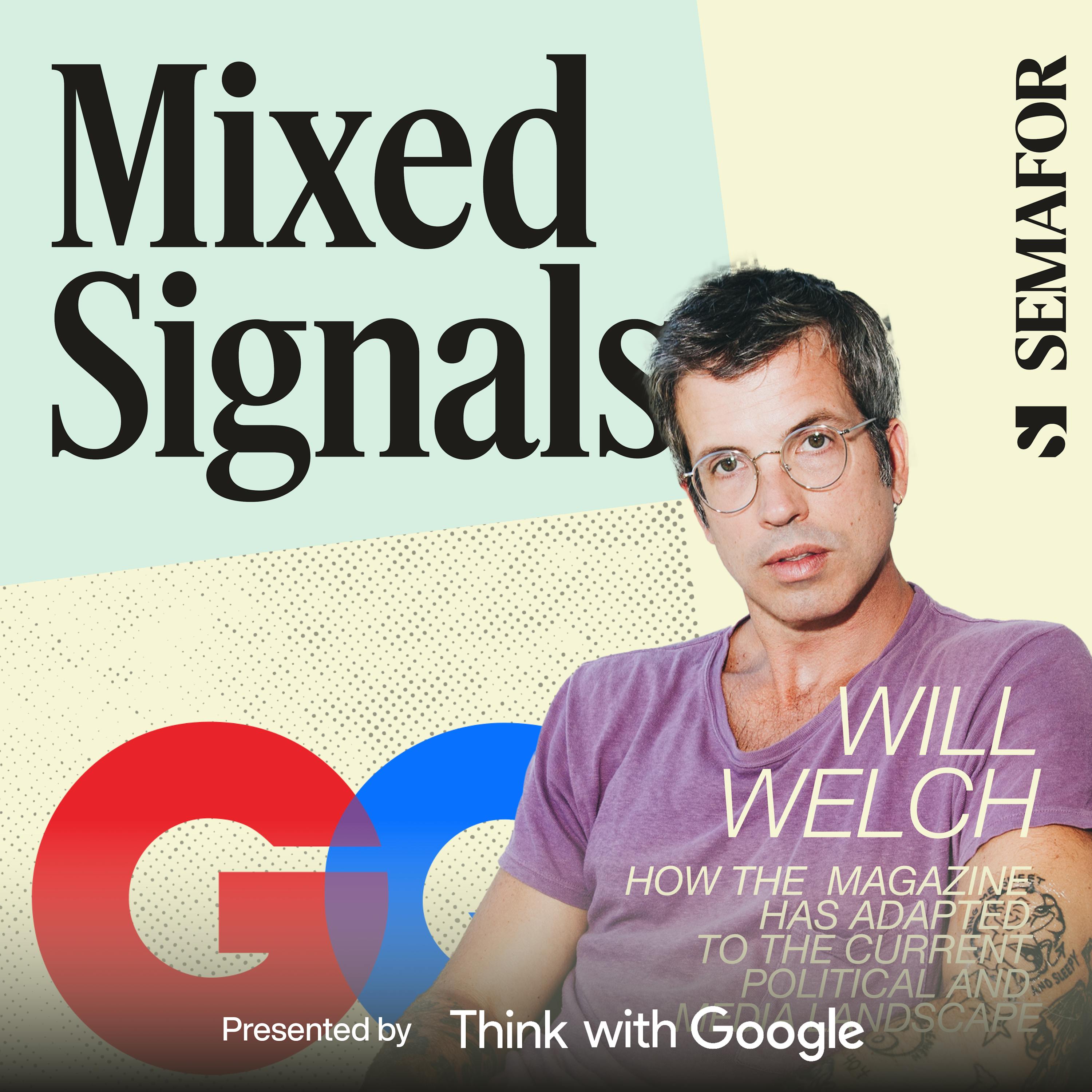
Mixed Signals from Semafor Media
GQ Editor Will Welch on masculinity, celebrities, and staying cool as he ages
00:44:26
Loading summary
Transcript104 lines
- [00:08]
A
Welcome to another episode of the Mixed Signals podcast from us here at Semaphore, where we are talking to all of the most interesting and important people shaping our new media age. I'm Max Taney. I am the media editor here at Semaphore and with me just a few rooms away. Actually that's just a little insider tip or secret for all of our listeners and viewers is our editor in chief, Ben Smith. How's it going Ben?
- [00:32]
B
Good. I'm thrilled to be here this week.
- [00:34]
A
We are excited to be chatting with the editor in chief of gq. That's Will Welch. We'll talk to him about what it means to write about and cover men in the year 2025. A very light topic, how the end of the monoculture has shaped GQ over the 20 years that will has been there, why he loves working with Robert Pattinson, and why the future of GQ may lie with Twitch streamers like Phantom. Ben, do you know who Fanom is? Do you have any idea who Will at this time? Go.
- [01:03]
B
I am struggling to know anything about either Phantom or Men's Fashion, so I'm excited to learn.
- [01:08]
A
Well, neither of us know very much about either, but we do know about media. So we'll ask some of the questions about all of the above to Will right after the break.
- [01:20]
B
In an era where AI is rewriting the rules and consumer behavior is changing by the minute, how do you stay relevant? You turn to the experts. Think with Google, brings you insights from top CMOs, practical guides on emerging tech and strategies that drive real growth. It's like having a marketing guru in your pocket. Visit thinkwithgoogle.com to become a forward thinking marketer. Your next game changing idea is just a click away.
- [01:49]
A
So Ben, you run a publication. I'm curious, what's the percentage of people who read and engage with semafor that are men versus the percentage that are women? Do you know that information offhand?
- [02:04]
B
I do not know that offhand. We slice and dice our audience a lot of ways, but that's not top of the list.
- [02:08]
A
That's interesting because I would imagine that's something that's very close to the top of the list for tech, algorithms or even some people who run media organizations. I feel like I knew that information when I worked at other publications. Why do you think that is? That you don't? That's not something that you really care about?
- [02:25]
B
I mean, I think in a way we're looking at people very much by their professions and addressing them as professionals because in some Sense. A lot of our business is organized around reaching people in their professional lives. The people who most want to know your. Your sex are people trying to reach you as consumers.
- [02:42]
A
So somebody who clearly knows a little bit more about the gender breakdown of their audience is Will Welch, who is our guest today. Ben, do you know Will at all? Have you bumped into him in your professional careers as editors in.
- [02:56]
B
Not really. Only from afar.
- [02:57]
A
You guys aren't going to the secret confab, off the record things where you all complain about your employees, people such as me.
- [03:04]
B
Yeah, I don't know why he's not invited to that one. He must have no problems with his employees.
- [03:08]
A
I think that he also is like hanging out with like celebrities and we're hanging out with other people in kind of media. He's like one of the. He's one of those people who. There are a few people in journalism who are still. Who still manage to become celebrities and more widely known. And I think Will is one of those people. And I think we were both interested in chat with Will because he has this role as head of gq. He's been the editor in chief there for eight years. At a moment when a lot of people are really interested in men. Seemingly again, I don't know, I feel like we kind of were interested in the bad things that men were doing for a while right now in the wake of the 2024 election. I guess it's been a year, but we're still talking about it and its implications as we talk about the male loneliness epidemic, the emergence of the manosphere, these gaps between men in terms of their education and HAPP levels and various things like that. And so I actually think that Will clearly seems to be grappling with this. You can see it in the editorial. And I think it makes it a really interesting moment to have a conversation with him about what's going on with men. What is media for men these days? What's media for men? That's not like the horrible stuff that we read and sometimes write about in the newsletter. I don't know. Ben, what do you think about what I'm getting at here?
- [04:23]
B
Yeah, I think it's an incredibly complicated job. It's always been a complicated job in some sense, like setting and embodying these trends and never more confusing, never more politicized.
- [04:34]
A
I think also the one thing that I will be curious to ask him about is how much of his job is dealing with the kind of fashion stuff to buy element of things, which is what I feel like I grew up knowing GQ for, like, I would go to, literally, Barnes and Noble and pick it up and be like, okay, that's a jacket that rich people wear. And how much of it is, like, this leaned back, heady stuff about the future of men and how much he's really thinking about this and whether or not that ratio has changed over the course of the last few years?
- [05:09]
B
If those aren't exactly the same questions.
- [05:11]
A
Right. Well, I guess we'll ask him. We're a few minutes late. We've gone over on this intro, so Will is waiting for us. Why don't we bring him in right now? Will, thank you so much for joining us. As we were talking about before the show, for people who are watching on YouTube or watching our little clips, your background looks just fantastic. People say that magazines are over. I read that Graydon Carter was saying it's terrible now, but clearly not. We've got a nice view there.
- [05:35]
C
Still got views of the Hudson river, so all's not lost.
- [05:39]
A
Yeah, gq. I feel like I first started reading or interacting with it. I was telling Ben this before we started recording. Whenever, like, my mom would take me to, like, Barnes and Noble in Santa Ana, California, and, you know, ostensibly to buy books to enrich my life in some way as a teenager, but what I would really end up doing was going to the magazine section and just looking at clothes and things that I couldn't necessarily afford. But when I first started to get to know gq, that was my conception of it. Magazine that was telling me as a suburban teenager what to buy, what was cool, what was aspirational. What is GQ in 2025?
- [06:17]
C
The tagline that we put on it when I became editor in chief in the end of 2018 was, we're the global flagship of men's fashion. And the idea was to reseize that position because it had become, I think, something really compelling, but much broader than that. And so in a way, we were. I just believe that in the era of the Internet, this is a very niche, driven culture. And it's very hard to be broad if you want to have a cultural impact, which is my, like, highest focus, and you want to grow. I think you need to find a way to be concise and be declarative and essentially to be niche. And so really recommitting ourselves to that mantle of the global flagship of men's fashion. And then we have another way of thinking about it and talking about it that goes, it's for people who see the world through the lens of taste. And style. And I use the word people intentionally. We have a lot of female readers in addition to male readers. Although we're, like, classically and proudly a men's magazine. I have friends, I have relatives, et cetera, who, like, really see the world through a political lens. That's like how they get up in the morning. Those are, like the lenses in their glasses. And others are interested in style and lifestyle and culture. And of course, that gets you to politics and all these other places as well. But just trying to really be focused. So I think, yeah, I imagine, obviously it's now mostly on YouTube and TikTok and GQ.com et cetera. But I think there are probably still young people who are discovering GQ through all these different portals. And hopefully, as I did, and as it sounds like you did, finding something to latch onto and find something that stimulates them or makes them think differently or gets them excited in some way.
- [08:08]
B
So I am curious so much of the job of an editor. I mean, I feel this is kind of patrolling the boundaries of your brand and understanding. Yeah, that is a story for us. No, that's not a story for us. And I'm curious how you sort of do set those boundaries for what makes it a men's magazine. What's content for a men's magazine? What isn't?
- [08:27]
C
Yeah, I don't think we really, like, sort through the news of the day and in our morning ideas meetings and so on. We're not, like, not really a men's magazine story, but we are like, oh, that feels like us. Or that feels like a GQ story. And I think that is, I don't know, an electricity. Like, for instance, for our long form, we always want them to be, like, filmic. We want it to feel like this could be a movie. And I think you want that same electricity in the, like, you know, the daily Stories on. On GQ.com so it's less about thinking about our positioning as a men's magazine and more just like, is this smart? Is this funny? Is this related to, like, fashion or style or that lens of taste and style that I articulated before? And then we really had fun pushing the boundaries of, like, where that can take you. You know, I also think I have always been interested, and I started out at a music magazine that was basically like itself, a subculture and also covered subcultures. But I think we're really interested in small little subcultures. And so that can take you to all kinds of, like, weird and funky digital places that can take you down really crazy wellness rabbit holes. Like, wellness subculture is like a big, big and wild and woolly one right now that we have been doing a lot of work in and driving a lot of. Just a lot of people reading those stories. Yeah, I think we're just looking for, like, texture, electricity. I always say that if people in the ideas meeting start fighting about whatever somebody has thrown out, then, like, you definitely need to assign that story and get it up.
- [10:01]
A
I know that you came from the Fader, where you covered a lot of stuff that would have been considered niche, but did you feel that broader change within gq and when did that happen?
- [10:10]
C
I guess it really was like, as the Internet swallowed publishing. Like, when I started at GQ 2007, the focus was on these big print issues that dropped on a desk like a phone book. And over time, it just became more and more about our digital publishing. And with that became just like wildly different consumption habits. With that came more always on dialogue with the audience. People used to write Jim Nelson letters from the editor, and by write him a letter, I mean they wrote him a letter and mailed it to the Conde Nast office offices. And now we're obviously in dialogue with our audience all day, every day on all these platforms. You guys are covering this all the time. Like, single content creators can now drive an audience or have an influence that is on par with what was once, like a giant, robust legacy media brand. I mean, that is an incredible shift I was thinking recently about, because d' Angelo passed. I was thinking about Amy Wallace's incredible d' Angelo story, which I was involved in, and booking that story. I think it was 2012, and I was just trying to remember what was the environment that we published that into. How much feedback did we get? Obviously, in 2012, GQ.com was a robust place. Social media was nascent relative to where it is now. And then you go back to stories that we published when I got to GQ, like 2007 to 2010. And you just, like, hoped that page six, like, picked up one of the images and published it, and you hoped that some friends texted you and said, oh, wow, amazing piece. Like, now we live in a world of data. You guys are going to be able to tell me exactly how many people didn't listen to my appearance on your podcast.
- [11:59]
B
Yeah, they're dropping off right here.
- [12:01]
C
You can decide whether to tag me back.
- [12:03]
B
How about when it comes to sort of you personally, like, I mean, Conde Nast editors actually have always been part of the job has been to be a sort of embodiment of the brand. I don't know if you got there too late for, like, the free apartment and the black car, but still there's a real sort of, come over to.
- [12:17]
C
My place sometime, Ben, and you can tell me.
- [12:20]
B
But. But there's a real public role, and I'm curious if you felt that change, like, how much of your, like, of your work is like, I'm representing GQ versus how much is like, I'm a faceless manager moving widgets and people.
- [12:33]
C
I definitely feel like a representative of gq and I encourage the members of the team to think of themselves that way too. And I think they are. They don't really need to be encouraged, but it is something that we, we talk about a little bit. But the other thing, Ben, that I believe is that if the magazine is going to be good, it needs to be deeply connected to the people who are making it happen. And obviously, as the editor, that that starts with me, and I'm totally comfortable with that. But I just also, I wouldn't be interested in, you know, a piece of art or a magazine or anything if you, like, couldn't discern the connection between the person making it and the output. So it's like the more personal something is, the more interesting and compelling it is to me. And I guess I have been fearless and I have encouraged my teammates to be fearless as well. And let's just make this, like, in some regards about us and trust that if we are, like, deeply connected to what we're making, people are going to respond to that. And an early example of this that really like, solidified this perspective for me was there was a brief period that takes too long to explain, but I was editing a spin off magazine called GQ Style, and the staff was three people. And people would come up to me and be like, oh, I love GQ Style, but why is there so much skateboarding in it? And I would be like, because we're a team of three and one of us is a skateboarder from Troy, New York, named Noah Johnson. So I was learning about skateboarding through editing Noah's skateboarding coverage for GQ Style. And I just learned that when you're trying to, like, quadrangulate audience data to maximize, like, oh, we're going to get some of these people and some of those people and some of these people, and they're all going to come read this story. It bricks like every time. And when one person comes in fired up and they're like, you know what I read last night? And here's what I think, and I want to do this. When you do that, that's when you see the audience respond. And it's really exciting to be. I think for the last handful of years we've been in a time where quality is actually what people read. We all remember the like really brutal clickbait era. That was not fun. I'm glad that in that area there was still such thing as like a print job. And that's what I had because that was brutal. But these days it's just the good stories that people are reading and the ones that have like a deep cultural connection or a personal connection or a strong voice, which I think voice is becoming more important than ever. As we all waken our boots about AI or whatever's going on.
- [15:09]
A
Do you guys just publish fewer pieces and focus on the. The kind of bigger swings instead? Is that the real change that you're kind of talking about?
- [15:17]
C
I am proud and relieved that we have never invested in like being a massive daily digital content farm style outlet that was going for as many UVs as possible every day. And that was the strategy. I don't think the outlets that took that strategy. I don't think it's fared very well in the long term. And it has never been our M.O. here. There are certainly times when it felt like that was the order of the day and like it was terrifying to not be like slugging it out in that game. But ultimately I'm glad we didn't do that historically. And now I think we have a robust daily operation. We publish a lot more than a lot of people and a lot less than a lot. I don't know. I think we're just nestled in a good place where we are able to, to focus on quality and storytelling we believe in and a little bit of rigor. And when I say rigor, keep in mind I'm talking about rigor, about stories about pants and stuff like that. But I certainly think it fits into this idea of GQ being this like cool, more informed older brother who is giving you advice. I think when people are thinking about what they're aware of, there's some conversation about creatine happening and they see that we have published a story on it. Is creatine actually good for your brain? It's a story we published a few weeks ago. They want to know what we have to say and they trust that what we say is going to be like informative and factually correct. And so we've invested in that because our readers are responding in it.
- [16:49]
A
So one of the alternatives in the media landscape these days to the cool older brother giving you advice is the manosphere, which might be like the troubled cousin at Thanksgiving. I'm really curious, like, what was your reaction to the kind of emergence of the kind of manosphere and the fixation that the media had on it? And how did you kind of navigate that moment immediately after the election when a bunch of people said, oh my God, we got to start paying attention to what's going on with men?
- [17:20]
C
Yeah. My position has been that this is like a leadership opportunity for GQ going back to well before the election in 2019. We published the new masculinity issue in November of 2019, which I think has been one of the, of defining like statements, journalistic statements of this era of gq. And it was an examination about the state of masculinity, how it was changing, how it was evolving. This was the heart of the MeToo movement. So it was obviously like a really important time to be having that discussion. And in fact, like I would say the culture was just demanding that men develop a self reflective, like ability to be introspection and also demanding that men change. This was like the shut up and listen moment. And it was, that was interesting for us, right, because we're like a date daily content, daily men's content publishing platform. And the era is shut up and listen. We can't shut up, we're going to have to be publishing. So what is a meaningful way to do that? Speaking so broadly? It's hard to not sound like overly general, but if in some regard, culturally, women were demanding that men evolve, how exactly men should chart a path forward wasn't really the topic of conversation. The topic of conversation was men's historical bad behavior and the ways that they've used power to get away with that bad behavior. But what wasn't necessarily being articulated and I think what a lot of thoughtful men who might be reading GQ were looking for some guidance on, I believe was, well, how do I move forward? So it was like the constructive part of constructive criticism. And so we use this issue to begin to chart that path. And then, yeah, after the election, a lot of people who now work at GQ would bring it up to me in their interviews and be like, that issue is why I wanted to work here. And so there was in some regard like this pressure to like do it again, like, let's make another statement about that because that was received very well and it kickstarted a conversation that was valuable. But I really Believe that the timing has to be right to do something where you're going to dedicate, like, a whole issue and all of the attendant digital platforms to one exploration or one concept. But, yeah, coming out of the election, the rise of the manosphere, an incredible edification of masculinity, especially Gen Z, it felt like the time was right for us to weigh in again. So we did that with the October issue of this year, which was the State of the American Mail in 2025. And again, it was a full issue. And whenever I say issue in this regard, I mean print and all of the digital that surrounds it. A full issue exploration, including a survey of just shy of 2,000American men about their opinions and perspectives on different norms, expectations of masculinity, et cetera.
- [20:16]
B
There is a sense that, like, young men right now are sort of the heart of the MAGA movement and of just a real shift to the right culturally, kind of a backlash against that new masculinity. Do you see that? And do you write those people off as readers?
- [20:28]
C
Oh, no, definitely don't write them off as readers. Definitely do see that. Yeah. The shift rightward among young men is undeniable. But, no, we don't write them off as readers at all. Feature in the October State of the American Male issue called Eight Voices across the Great Masculinity Divide. And the idea was to represent a whole spectrum of different voices of people who we find thoughtful on these subjects, whether they're coming from, generally speaking, the right, the left, the center, et cetera.
- [20:57]
B
Do you think that the new masculinity issue, or, I mean, the sort of politics of it, or maybe more broadly like those social movements and the MeToo movement, drove those young men to the right? Because that's what a lot of them say.
- [21:08]
C
If that's what a lot of them say, and I agree. I've also observed a lot of them saying that, then who am I or anybody else to say that something else did it? If they're like, no, this is what drove me there. A lot of those ideas, a lot of the terminology, for instance, that came out of the MeToo movement, for instance, or Black Lives Matter and so on.
- [21:30]
B
Got, like, toxic masculinity.
- [21:32]
C
Yeah, that got lassoed together as wokeism and as dei, and that got a huge pushback. A lot of the ads running towards the end of the election from, like, super PACs associated with Trump and so on were directly attacking wokeism, dei, the woke mind virus, et cetera, et cetera. So I think that was effective. Absolutely. And I think young men were a prime target for that kind of communication because they very much felt under fire and they haven't necessarily understood like what the best way forward is. And the reason the manosphere became prominent is because young men were looking for guidance.
- [22:14]
B
You take this job just as the sort of social media model of scale and scaled advertising and social media traffic is just falling off the cliff. And you know, everybody has pivoted to video and is regretting it, but print is still dead. I'm just curious, like, I mean, do you just go into your office and cry? Like, what's the, where do you pivot to in that particular like, very dark media moment of 2018?
- [22:41]
C
I, to be honest, at that time was focused on getting all of the brand, including all of its platforms, to shift away from this broad general interest, wide open barn door men's magazine. Like we speak to American men and we cover everything all the time. That's obviously an exaggeration, but there was a little bit of that, that sensibility to this idea of there is opportunity for real growth in terms of audience and in terms of revenue if we can focus on what makes GQ different from every other outlet out there. So to be honest, it's like that project included, but was bigger than just focusing on UVs and engagement and those kinds of things. And so I was trying to like reimagine the positioning of GQ from the top down and the current trends in web publishing were certainly a critical part of that. But if anything was making me cry those days, it wasn't that.
- [23:54]
A
Well, we have to take a short break, but we have a lot more to get to with Will right after this.
- [24:00]
B
Foreign this week on our branded segment from Think with Google, I spoke with Google's VP of Marketing, Josh Spanier, about Google's AI Overviews and AI mode. So I am familiar with the AI summaries in Google Search AI overviews. I was recently in Austin and learned a lot about bat watching, which is apparently a thing one does there from an unexpected AI over overview result. But what are other ways that AI is showing up in search these days?
- [24:31]
D
So AI overviews have 2 billion users every month and then there is AI mode. Sort of the natural progression of a combination of Gemini and our large language model capabilities and chat with core original Google search and what it's doing is leading to much richer, more interesting search results and experiencing, including batwatching In Austin.
- [24:53]
B
What are some more common use cases for AI mode?
- [24:56]
D
We're seeing people doing a lot of deep learning and Research In AI mode, people are asking queries three to four times longer than standard Google searches. So it's Thanksgiving soon. You haven't planned a vacation for your family. You need to find a destination that can accommodate seven members of your family, including golfing, including casino, including warm weather, and including it being three to four hours from a certain amount of airport. You can put all those together into AI mode and get a really rich answer and then go back and forth as you refine the answer in a way which is just a lot more exploratory than the simple go get answer and fetch that has been the case. I'm also really excited. I've been using this a lot, which is visual shopping and ideation. So you see a picture of an outfit that you like, you can actually take that picture, drop into AI mode and say, hey, find me this jacket, but in a different material. I want it in suede instead of leather. It allows you to actually really explore the web in all sorts of new ways. Moving from search just being finding something to actually actively ideating and creating with AI mode. With AI overuse, it's really about getting answers to more complex multi step questions. Whether you're typing, using your camera, voice, image, the combination of all those things is leading to just much more engaging interactions and much better answers.
- [26:11]
B
Where can people go to find out more?
- [26:12]
D
We have a ton of insights for marketers on how to reach consumers in these new search experiences. Brands are doing incredibly well already. Head on over to thinkwithgoogle.com thanks Josh. Thanks, Ben.
- [26:35]
A
How big is GQ these days? Like how much revenue do you guys generate? Every.
- [26:39]
C
I'm not going to quote our revenue figures, but I appreciate the question.
- [26:43]
A
What about a, what about a ballpark? What about a big range?
- [26:48]
C
Let's play a different game. I don't know.
- [26:50]
A
All right, fair enough.
- [26:51]
B
Maybe a different way to ask it is when we both started media magazine, publishing was like this incredible cash machine business, right. Do you feel like the bleeding has stopped or do you still feel like you're sort of managing decline?
- [27:01]
C
I don't feel like I'm managing decline and I don't feel like I'm tourniqueting bleeding. I feel like we are dealing with a disrupted industry. I think we're all in a severely disrupted industry where, you know, in a, in a not disrupted industry and like a purely healthy industry, it's like you declare what your business is and if you achieve those business objectives, revenue follows in a like pretty clear one to one way. Yeah. That is not the world that I think any of the three of us navigate every day. Instead, what we're dealing with from my perspective is there are all these different, like, types of business that we're in across our various platforms and content, the events that we do, et cetera. And it's an incredibly dynamic environment. And dynamic is a really nice word for it's chaotic.
- [27:50]
A
Right?
- [27:51]
C
And so what was really working two years ago might start to plateau. And then you got to look for growth in something new. Maybe a business that you were hardly invested in at all two years ago.
- [28:03]
B
What is that right now? What's growing fastest right now?
- [28:06]
C
Our events business is extremely healthy. And events business, part of the thing that's important to articulate is this is all an ecosystem, right? So when I say events business. So Thursday, November 13th, it's the 30th anniversary of GQ Men of the Year. And Men of the Year is one of two moments over the course of the year where it is like everything that GQ does. Everybody who works at gq, it's like our full arsenal is focused on one thing. And yes, the reason reason I'm saying it's Thursday, November 13th is because there was a party in Los Angeles that night. But this is really like a massive content operation that has a month drum roll up to that event. And like a month drum. Do you do a drum roll after an event? I guess not a ramp off. Anyway, my metaphors are failing me, but hopefully it makes sense. So when I say event, I'm not talking about like the IRL party. I'm talking about everything that, that surrounds it, which starts with the print issue, covers the party, which is itself a whole moment of content creation, like almost on par with the scale, the production of the print magazine. That is the excuse for the party. That whole ecosystem, which again, it's not event is just a bucket to put it all in. And then GQ recommends, which is our commerce business is also something we've been invested in for quite a few years and doing really well. Just those are two examples.
- [29:38]
A
So I'm really curious. You've been at GQ for 18 years. You've been in magazine journalism for longer than that, in culture journalism, kind of in some ways defining or cataloging what's cool and thinking about that part of that process, I feel like, especially when you're younger, is having a fresh perspective and being able to recognize what's cool before people who are older, who might be used to looking at things the same way.
- [30:03]
C
It just offers me where this might.
- [30:04]
A
Be going, yeah, as you used to.
- [30:07]
C
This is the first time I've ever gotten this question.
- [30:09]
A
No, but you're a young.
- [30:10]
C
I'm savoring this. Let's do this.
- [30:11]
A
No, you. You're a young guy, but you're in. This is something that I'm thinking about as I am like, being pitched these YouTubers to come on our show. I'm like, who are these people? I've never heard of them. Apparently they have millions of followers. How do you have that kind of discernment as you get older and get used to seeing things one specific way?
- [30:28]
C
Max, let me boil that question down for you. How do you make a magazine or a brand or a title or whatever we're calling it these days that is about being cool when you are so damn old? Max. It's because I'm young at heart part. That's why. No, I don't know. I guess my favorite thing about my job and one of the things that I think I'm best at and one of the things that bears out the longer that I do this is I just love hiring. I love finding young people who want to be. They've seen what we're doing in some regard. It always surprises me what part of it that they respond favorably to, like, you never know. And I just like finding young people who in some weird and surprising way are going to fit into what we're doing or better yet, modify it or give it some weird, like, offshoot. And the reason I said it's, like, gratifying over time is there are a lot of people that I like to refer to as the GQ diaspora who are now have gone on and are doing really cool, exciting things. It's frustrating, but it's also flattering that we have become like the place that. That people think of when they need to hire somebody talented. They just come to gq. But even when we're losing somebody amazing, it's always so exciting to like, accept the challenge of going to find somebody young and great and that. I don't know, that's what. That's what keeps GQ culturally relevant. It's certainly not my social calendar.
- [31:57]
A
Okay, another one in that vein. Has there been anything then that's become cool to younger people that is surprised you, that has taken you off guard? Yeah.
- [32:06]
C
I mean, one thing that took me a second to get my head around is streamers, Twitch streamers, but I did get my head around it, and there's this young Twitch streamer by the name of Phantom, who is just so charismatic you know, like, part of what we do at GQ is look for people who like, shoot lightning bolts of charisma out of their fingertips and this young guy just has it. And there are some streamers where I like, I will engage with their stream. And I'm like, I don't understand. I see that there are tens of thousands of kids watching this and it's not like mathing to me, but with Phantom, I just like felt the charisma. And so we just started this video series with him where he's going. Phantom loves to eat. And he does these things called mukbangs, where he'll just go to some spot and get all this food and put it on a table in front of him and he just eats it and reacts. So we were like, what if we took Phantom? Let's get Phantom tables at some of the hardest restaurants to get reservations at in New York City and let's let him eat and just respond to the food. So we did the Corner Store, which was the first one, which was like at 2 million views. And then we published this weekend. We took him to Carbone Provado, the members club Carbone. And it's hilarious. I can't take my eyes off this guy. He's just so funny and charismatic. So, yeah, Twitch streaming is a great example of. I was like, I don't know, I do not understand this. And then I, like, with encouragement and guidance from younger, cooler people on my team, got my head around it. And we done two episodes, but we're hoping to continue it and it's been really fun.
- [33:41]
A
So one of the parts of your job, as you mentioned, you've been interacting with celebrities, high profile individuals for years. What's been the worst journalistic interaction you've had with a celebrity?
- [33:54]
C
Oh, man, it's just such an interesting modern dynamic, like the way that celebrity works. And over the years I've observed the way that like, celebrity can turn anyone into a personal assistant. And a celebrity will like drop a napkin and five people will dive for it. And like half of those people are like, like older and extremely successful. And you're like, you're diving to pick up this person's napkin. What is going on with this dynamic? You know, and it's one of the defining cultural dynamics of our time. It's a dynamic that we are like, deeply invested and engaged in the worst experience. We've just. I've seen it all over the course of my time. Okay, well, I'm not going to name the celebrity well, but one time that Celebrity was nine hours late to a shoot, and I was, like, cracking people up on set. I was like, what? Okay, let's all think about what could you be nine hours late to that it would still be there when you arrived and none of us could come? I was like, my wedding, definitely not.
- [34:51]
A
Like, a few years ago, I remember Variety threw a party for Ice Spice, like a tribute to Ice Spice, and she did not show up for that party. I think a lot of people who were in attendance thought that Ice Spice would be there. Who's the celebrity who comes through for you? Who's. We've got them again. They're excellent. We can't wait to work with this person because they're going to be great.
- [35:08]
C
There's a few that come to mind. I do think that one thing we've been trying to do in this year of GQ is, like, instead of working with everybody who's all the time, like, we have some people that we like to go back to. Robert Pattinson is a great example. He just has really freaky ideas and is always pleasant. He's. He just gets excited that we say yes to trying to figure out, like, the crazy ideas that he has. There was this shoot that we did where we transformed him from. It was around the big Batman release that he had. We transformed him from, like, semi normal, but still tweaked out Robert Pattinson to, like, insane punk. He had bleached hair and grills in his teeth. And that photographer, Jack Bridgeland, who's somebody that we still work with, that came from Rob. So he was the one who was like, oh, there's this kid in London who's doing really interesting work. And I hadn't heard of Jack. Rob turned me onto him, and now we still work with Jack. A lot of the times, subjects come to us and they're like, please, GQ me. Just tell me what to do. I'll do it. I want that thing. But there are a few who, like, really hold their own creatively, and that can be fun to allow it to happen the other direction, I guess.
- [36:23]
B
Suppose on the other end of the cultural spectrum, we had the CEO of Ralph Lauren. He had some thoughts about how Donald Trump had changed men's fashion. Have you seen that?
- [36:32]
C
I haven't. It's Patrisse, right?
- [36:34]
B
Yeah. He said they were selling a lot more ties than they had ever sold.
- [36:37]
C
Yeah. I think about Donald Trump every morning when I'm tying my tie, because I like a tie that is a little bit on the long side. And Trump famously ties his ties, like, extremely long. And so I'm always trying to be like, I like it long, but I don't want it to be, like, Trumpian. And people usually make joke, obvious jokes about why Trump likes his tie to be so long.
- [37:02]
A
Yeah.
- [37:02]
C
So I like, I'm tall, so I don't want it to be too short because when you're tall, you're too big and too long for all your clothes, and so you want them to actually look like they fit. So I don't want to tie my tie too short, but I don't want to be Trumpy.
- [37:15]
A
And what's the sweet spot? What's the Will Welch. The tie is a little long, and Trump, the tie is like the long. It's like draping, you know, almost to my knees. What is the. Where is that space? Where's that?
- [37:28]
C
I didn't know that we were going to engage in, like, really detailed fashion service today, but I'm very, very, as you know, up for it. So you know how the tie, like, has the triangle on the end? I would like the line at the bottom of the triangle to, like, hit my jeans or my pants so that the triangle is, like, below. So basically I'm saying the ties should overlap with my belt a little bit. And I never want. If you see a picture of yourself and like the tie, the tip of the tie is stopped. You see shirt between that and your pants. That, to me, is, like, stressful.
- [38:04]
A
Wow, that's amazing.
- [38:05]
B
Oh, man, this is stressing me out listening to it.
- [38:08]
A
That's incredible. I also wear my tie incredibly long, but for the exact opposite reason, which is short. I think I'm like a foot shorter than you probably Will. I read that you were six' six somewhere. So I have the same tie styling, but it's for the opposite reason. But Will, thank you so much for being here. We've gone way over time, but we really appreciate it.
- [38:24]
C
No, I respect both of your work quite a bit. So I'm flattered and honored that you would have me on. I appreciate it.
- [38:36]
B
There's new content waiting for you on Think with Google that you won't want to miss. Think is the destination for marketers to access things like, first of its kind, research on AI adoption with the Boston Consulting Group, insights on four key consumer behaviors, streaming, scrolling, searching, and shopping, and deep dives on emerging technology and strategies that drive real growth. Get all of that and more by heading to thinkwithgoogle.com so, Max, from a teenager in the burbs reading GQ in the mall to, like, here in the center of culture, grilling the editor in chief of gq. Did this. I don't know, did this live up to your expectations? Did Will.
- [39:16]
A
You know what? I thought he was really great, super friendly, obviously a total pro. Like, not gonna out any celebrities who had slighted him. I'm sure he's dealt with so many incredibly annoying individuals who have made him want to tear his hair out. Not gonna share with a how much money GQ is bringing in or even generally the contours of their business. But you know what? Like, super fun and thoughtful and clearly, I think, a pretty good leader for this particular moment in men's media coverage, which is, you know, as he pointed out, kind of contradictory and confusing. You have these very different currents happening kind of in conversation with each other, but also in some ways separate, which is urban, upwardly mobile professionals. This conversation around this whole idea of traditional gender norms kind of collapsing and then this huge kind of backlash to that and this large movement of younger men who really want a very traditional view of kind of masculinity. And I think Will seems to kind of understand both of those things, and I don't think discounts either. And you do see that in GQ's coverage, though, obviously it's a fashion publication, so it does lean, I think, at a certain direction. I thought he was really, really thoughtful and great guy, also as Southern manners, which neither of us have, as coastal elites. But, Ben, what did you think of what Will had to say, editor to editor?
- [40:37]
B
I mean, honestly, just surviving the period he survived at a company that Conde Nast, the publisher, which has been, among other things, just dropping titles. You know, his obsession sounds like early on on, really tightening up GQ's brand and figuring out what it stands for and thinking of it as niche was really smart and interesting. I do. You know, I was thinking. I'm curious how you think about this. We talked to Jonah from Blackbird Spy Plane a few weeks ago. He is a one man, I guess, one man and one woman show, producing something that is in some sense a rival to gq. That is just a substack. Twice a week, Will has this beautiful office with a beautiful view of the New York harbor and lots of employees inside a big company. And I think that's in some sense one of the big media challenges right now is maybe Will should just be. I was thinking about, you know, Tina Brown, the legendary former Vanity Fair editor, now just has a substack. And I read it and I think, like, wow, Tina Brown's amazing. Why did she even need a magazine? And there is this sense of like in this sort of very individualized moment that he was talking about, like, where's the value of GQ versus just kind of the value of Will Welch?
- [41:40]
A
I had that thought also. I think he understands that it's inevitable that there is going to be a publication or a creator or some sort of hybrid journalist creator who is, you know, putting out stuff that is more highly specific and cooler to certain people because it is, you know, smaller whatnot. I don't know what GQ's subscribers numbers look like, but I do know that they have 8 million followers on YouTube and millions of followers across their social media accounts. So clearly there is still a huge audience for what they are doing. But you're right, I mean the challenge is they are stuck in between the like tastemakers like Jonah who are for the elite, the heads and kind of the masses. And that's a huge challenge.
- [42:19]
B
And for you as like a real consumer of men's fashion, men's fashion media, which I, you know, admittedly am not, I feel like GQ actually has sort of survived in some way as a really resonant brand, whatever that means.
- [42:30]
A
Yeah.
- [42:31]
B
Does that as a consumer, is that a brand that like really still means something to you?
- [42:34]
A
You know what? It actually does? It does for two reasons. You know, part of it is that they're. They have an E commerce business and recommendations shop which is really cool. And I do buy stuff off of and I think is a helpful tool for me as someone who doesn't have time to endlessly shop anymore unfortunately, as much as I would like to. So they may, they do make it easier in a service way like that. I do think that they have leaned more into own personalities. I read Sam Hein, who is a little bit also kind of a Jonah esque figure, like somewhere between a celebrity and a journalist. I do think I look at a lot of their content. I see a lot of the stuff and I think, wow, that is really cool. Like those are people who are all a part of a cool, interesting community that I do aspire in some ways, you know, as a, as a consumer to at least kind of look like. So I think it's working in that way.
- [43:21]
B
Yeah. Well, I thought Will was totally fascinating. Thanks. Thanks for bringing.
- [43:25]
A
Thanks for tolerating another fashion media person, Ben. I appreciate it.
- [43:29]
B
I love it. I'm learning.
- [43:31]
A
Well, that is it for us this week. Thanks for listening to the Mixed Signals podcast from us here at Semaphore. Our podcast is produced by Sheena Ozaki and I think Manny Fadal. This week as well, we got two producers. That's where we're growing here a little bit. But we also have some special thanks to Josh Billenson, Chad Lewis, Rachel Oppenheimer, Anna Bazzino, Garrett Wiley, Jules Zern, and Tori Kaur. Our engineer is Rick Kwan and our theme music is by Billy Libby. Our public editor is Anna Wintour, who, of course, you know, is the editor of all things Conde and Astin, who, I don't know, will is on the short list to maybe replace. We didn't really get to that. Maybe on the next episode.
- [44:08]
B
Is Anna ever gonna come on this show?
- [44:10]
A
Max, I've asked, so we gotta have something to offer.
- [44:13]
B
Danielle, if you're still listening, please, please help us out here. And Danielle Ann, anyone else who's watching on YouTube, please like and subscribe and follow us wherever you get your podcasts.
- [44:22]
A
And if you want more, you can always subscribe and sign up for Semaphore's media newsletter, which is out every Sunday night.