
Podcast
Money Skills For Therapists
Hosted by Linzy Bonham · EN
Money can be stressful and confusing for therapists and health practitioners in private practice - dealing with all of our feelings and stories about it, understanding how to actually manage our business finances, and making money work for us in our lives can feel so daunting that many therapists just avoid dealing with money altogether.
Join Linzy Bonham, therapist and creator of Money Skills for Therapists, as she demystifies all things private practice finances through short and sweet solo episodes, conversations with therapists who have transformed their relationships with money, and live coaching calls with Money Skills for Therapists students.
38episodes
Episodes
Newest firstAll episodes

220: The Credit Card Habit That Helps Create Financial Clarity
6d ago00:17:58Tap to summarizeDoes your credit card feel like Monopoly money because the cash is still sitting in your bank account after you’ve made a purchase?In this solo episode, Linzy explains why an expense occurs the moment you use your credit card — not later when you pay your credit card bill — and how paying your credit card weekly instead of waiting for the monthly statement is a simple yet powerful habit that can create greater financial clarity, improve cash flow awareness, and help you stay in control of your money.Whether you pay off your credit card in full every week, you’re trying to avoid adding to an existing balance, or you're actively paying down credit card debt, Linzy shares a practical strategy for building a payment routine that is sustainable for your financial situation.Episode Timestamps:01:32 - Starting Season 16 with a Practical Money Habit03:10 - Who the Weekly Credit Card Payment Strategy Can Help05:17 - Why a Credit Card Payment Is Not a New Expense07:07 - How Credit Card Statements Can Blur Your Financial Picture09:01 - Integrating Credit Card Payments into Profit First Disbursements or Money Time10:54 - Why Debt Repayment Should Not Create Financial Precarity11:13 - How to Keep New Charges from Adding to Existing Debt12:18 - Paying Historical Debt Down Slowly and Sustainably13:18 - Using Small Weekly Habits to Create Consistent Progress15:08 - Adapting the Practice to Your Money ScheduleWant to feel more calm and confident about your money?Join one of Linzy's free online workshops for private practice owners to shift your money mindset, transform your relationship with money, and gain practical tools and strategies to manage your business finances with greater clarity and ease. Explore upcoming workshops and sign up to save your spot — or register to receive the replay.You can also join the private WhatsApp community to connect with therapists, health practitioners, and listeners of Money Skills for Therapists: The Podcast. Submit your request to join the community today!About Linzy BonhamLinzy Bonham is a therapist turned money coach who helps private practice owners and health professionals feel calm, confident, and in control of their finances through her podcast, workshops, and comprehensive programs: Money Skills for Therapists and Money Skills for Group Practice Owners.Learn more about Linzy at moneyskillsfortherapists.com/about-us
Transcribe →
219: The Freedom and Responsibility of Self-Employment with Diane Webber
2w ago00:37:50Tap to summarizeYou may have chosen to go into private practice because you wanted more freedom, only to find yourself recreating the same traditional workweek you were trying to leave behind.When success has always looked like putting in your time, staying busy, and being available throughout the workday, stepping away from your desk can feel like playing hooky, which can be uncomfortable — even when your business is stable and your clients are well supported.In this “Best Of” episode, Linzy revisits one of the most downloaded conversations from the past year with Diane Webber, a financial therapist, private practice owner, and coach in the Money Skills programs. Together, they explore the freedom, responsibility, uncertainty, and purpose that can come with self-employment.Diane shares how private practice has allowed her to be present for her family while navigating the changing needs of the sandwich generation. She and Linzy also talk about why therapists do not have 40 hours of quality emotional energy to give every week, how rest and time away support better clinical work, and why appearing busy is not the same as doing meaningful work.Their conversation also turns to the ongoing work of managing money as business owners. Financial systems cannot always be reorganized quickly because money is still coming in and going out while the changes are happening. Diane explains why patience, small wins, and confidence in the decision-making process matter more than trying to fix everything at once.If you have been measuring your success by the number of hours you work, feeling guilty when you step away, or trying to overhaul your finances in one intense burst, this episode will help you think differently about what a sustainable private practice can look like.Timestamps:03:30 - Meet Money Skills Coach Diane Webber04:16 - The Highs and Lows of Self-Employment05:17 - What Freedom in Private Practice Can Look Like06:05 - Self-Employment and the Needs of the Sandwich Generation07:41 - Building a Business That Supports Time Away08:01 - Unlearning the Need to Put In Your Time09:39 - Why Quality Matters More Than Quantity10:26 - Therapists Do Not Have 40 Hours of Emotional Energy11:16 - Giving Yourself Permission to Step Away12:54 - Letting Your Brain Work in the Background13:56 - The Performance of Busyness and Pseudo-Productivity14:41 - Understanding and Honoring How You Work Best17:34 - Variety, Change, and Using Different Parts of Your Brain18:17 - Why Money Skills Work Can Feel More Concrete20:00 - Creating Order in Work That Often Feels Messy22:00 - Building Confidence in Your Financial Process22:33 - Learning Money Skills While Money Is Still Moving23:30 - Creating a Sustainable, Ongoing Relationship with Money24:43 - Do All Private Practice Owners Identify as Entrepreneurs?29:33 - Finding a Gap and Building Work Around It30:33 - How Owning Your Niche Helps the Right Clients Find You32:22 - Outsourcing Work You Do Not Enjoy33:00 - Freedom, Responsibility, and the Thrill of Self-Employment34:06 - Diane's Financial Therapy Practice35:29 - Linzy's Final Reflection and Community InvitationConnect with Diane Webber:Diane is a licensed professional counselor and certified financial social work counselor with a fully online private practice in Northeastern Pennsylvania. She serves clients experiencing financial anxiety, general anxiety, strained relationships, grief, loss, and life transitions where money is part of the picture.Diane is also a proud member of the Money Skills for Therapists coaching team, enthusiastically celebrating successes as members of the program redefine their money mindsets and sharpen their money skills.Website: https://www.dianewebber.me/For other episodes with Diane, check out: Episode 97: Compassionate Approaches to Finances with Diane WebberEpisode 213: Adapting Your Business and Team for a Changing MarketAbout Linzy Bonham:Linzy Bonham is a therapist turned money coach who helps private practice owners and health professionals feel calm, confident, and in control of their finances through her podcast, free workshops and comprehensive programs: Money Skills for Therapists and Money Skills for Group Practice Owners.It all started when she saw her extremely skilled colleagues struggle with the money side of business. Some had even left private practice, or were avoiding starting one, because managing finances was just too stressful.So Linzy set out to support helpers and healers with developing peace of mind about their money. Since so many were never taught money skills, she focuses on the “how” of making the business side of private practice doable, and even super satisfying.You can learn more here: https://moneyskillsfortherapists.com/aboutAnd you can follow along on social media:LinkedIn: https://www.linkedin.com/in/linzybonham/Instagram: https://www.instagram.com/moneyskillsfortherapists/Facebook: https://www.facebook.com/moneynutsandboltsWant to feel more calm and confident about your money? Join one of Linzy’s free online workshops for private practice owners who want practical support with money mindset, avoidance, and the technical side of managing business finances.Explore upcoming workshops and save your spot or register to get the replay: https://moneyskillsfortherapists.com/workshopsYou can also join the private WhatsApp community to connect with other therapists, health practitioners, and podcast listeners. Submit your request here to join today.
Transcribe →
218: How to Care for Yourself While Caring for Everyone Else - Compilation Episode
3w ago00:30:29Tap to summarizeAs therapists and health practitioners, caring for other people can feel automatic, while caring for yourself can feel uncomfortable, overly indulgent, or like something you will finally get to once everyone else is okay. When your work is built around caring for clients, a team, a family, and a community, continually placing yourself last is not sustainable — especially when the structure of your practice leaves little room for your own needs.In this first-ever compilation episode of Money Skills for Therapists: The Podcast, Linzy revisits conversations with Maegan Megginson, Karen Dyck & Melissa Tiessen, Kasey Compton, and Darya Zuychenko about why self-sacrifice can feel so normal for therapists and healers, and what it looks like to build a private practice that makes room for you, too. Together, these conversations explore how professional training and cultural conditioning can shape the way therapists set their schedules, fees, and boundaries; why self-care needs to be part of the workday itself; and how self-love and self-awareness affect leadership.Linzy also reflects on her own years in private practice and the difference between being technically available for a session and having the energy to offer your best work. Her experience shows why repeatedly overriding your limits to fit in one more client has a cost, not only for your own well-being and your life outside work, but also for the quality of care you are able to offer.If you have been working beyond your limits, organizing your schedule around everyone else, or struggling to make space for a life outside your practice, this episode will help you look at your needs with more honesty, compassion, and curiosity. Instead of treating your well-being and client care as competing priorities, these conversations invite you to consider what becomes possible when the structure of your practice supports both.Timestamps:03:46 - Why Healers Build Businesses That Serve Everyone Else05:13 - Caregiving, Self-Sacrifice, and Who Becomes a Therapist06:20 - What Licensing and Training Teach Therapists About Value07:46 - Patriarchy, Business, and Putting Yourself Last09:35 - Why This Is More Than a Boundary Problem10:08 - How Gender and Professional Training Shape the Workday11:38 - Why Self-Care Needs to Happen During Work13:59 - The Four Cs of Therapist Self-Care14:37 - Believing That Your Own Needs Matter15:11 - Self-Love, Money, and Achievement17:43 - Self-Awareness as a Leadership Skill19:39 - What Your Boundaries Are Protecting20:10 - When You Disappear from Your Own Life21:13 - Making Life More Compelling Than Work23:30 - What Overriding Your Limits Costs23:59 - The Energetic Cost of One More Client24:27 - Seeing Clients Outside Your Best Hours26:02 - Are You Actually Doing Your Best Work?26:40 - Small Schedule Changes That Give Energy Back28:07 - Linzy's Closing Reflection and Listener InvitationConversations Featured in This Episode:Episode 16 - How to Create a Burnout-Proof Business with Maegan MegginsonEpisode 162 - Redefining Self-Care in Private Practice with Karen Dyck & Melissa TiessenEpisode 92 - Self-Love as a Missing Piece with Money with Kasey ComptonEpisode 28 - Creating Work-Life Balance in Private Practice (Coaching Session) with Darya ZuychenkoEpisode 145FF - The Real Cost of Overbooking Yourself as a TherapistShare Your Favorite Podcast Moment:We would love to know which guest, episode, topic, or specific moment from Money Skills for Therapists: The Podcast has stayed with you. Email hello@moneynutsandbolts.com or send a message through the contact page to share your favorite and help the Money Skills team decide which conversations to revisit in future compilation episodes.About Linzy Bonham:Linzy Bonham is a therapist turned money coach who helps private practice owners and health professionals feel calm, confident, and in control of their finances through her podcast, free workshops and comprehensive programs: Money Skills for Therapists and Money Skills for Group Practice Owners. It all started when she saw her extremely skilled colleagues struggle with the money side of business, with some leaving private practice, or avoiding starting one, because managing finances was simply too stressful.Linzy set out to support helpers and healers with developing peace of mind about their money. Since so many were never taught money skills, she focuses on the “how” of making the business side of private practice doable — and even super satisfying. You can learn more about Linzy and her work at https://moneyskillsfortherapists.com/about.And you can follow along on social media here:LinkedIn: https://www.linkedin.com/in/linzybonham/Instagram: https://www.instagram.com/moneyskillsfortherapists/Facebook: https://www.facebook.com/moneynutsandboltsIf you want to feel more calm and confident about your money, join one of Linzy’s free online workshops for private practice owners who want practical support with money mindset, avoidance, and the technical side of managing business finances. Explore upcoming workshops and save your spot or register to get the replay: https://moneyskillsfortherapists.com/workshopsYou can also join the new private WhatsApp community to connect with other therapists, health practitioners, and podcast listeners. Submit your request here to join today.
Transcribe →
217: Course-Correcting Your Private Practice in a Changing Economy with Julie Herres
4w ago00:26:35Tap to summarizeFor a long time, the biggest problem therapists faced in private practice was overworking. Burnout was a real risk during COVID — there were too many people needing care and too many therapists pushing past their own limits because there was always one more person to help.But what if that is no longer the challenge your practice is facing?In this “Best Of” episode, Linzy revisits her conversation with Julie Herres, founder and CEO of GreenOak Accounting and author of Profit First for Therapists, about what private practice owners can do when demand slows down, clients become more cautious with money, and the boundaries and structure that were once put in place to protect you from burnout start to feel a little too rigid for the season you are currently in.Together, Linzy and Julie talk about what it looks like to course-correct without panic or shame. They explore the difference between short-term actions that can bring money into the business now and longer-term moves that help make the practice more sustainable over time.They also talk about the places where business decisions can feel personal, especially around fees, client load, marketing, and the kind of flexibility that may be needed when the economy shifts.If your practice has been feeling quieter, slower, or just different lately, this conversation will help you look at what your business may need now with more clarity, curiosity, and steadiness.Timestamps:03:49 - Julie Sets Up Part Two of the Conversation04:24 - The Pendulum Swing in Private Practice05:13 - When the Problem Changes from Burnout to Lower Demand06:46 - Crickets, Tumbleweeds, and a New Business Challenge07:15 - When Protective Boundaries Become Rigidity08:21 - Why Practice Owners May Need to Make Hard Calls09:20 - Fast Money Actions vs. Long-Term Business Actions10:08 - Seeing More Clients When the Business Needs Stability11:05 - Working In the Business and On the Business12:22 - Experimenting with What This Season Requires13:48 - Marketing When Clients Are More Price Sensitive14:07 - Why Expert Support Can Shorten the Path16:10 - What Adaptive Practice Owners Are Doing Differently17:14 - Tracking What Actually Works in Your Marketing18:40 - When the Data Surprises You19:32 - Should Therapists Lower Their Fees?21:31 - Running the Numbers Before Making Fee Decisions22:29 - Pricing, Worth, and Meeting the Market23:48 - Julie and Linzy Summarize the Conversation24:28 - Linzy's Final Reflection and Community InvitationConnect with Julie Herres:Julie Herres is the founder and CEO of GreenOak Accounting, a firm that exclusively serves therapists, psychologists, and counselors in private practice across the United States. Over the years, Julie and her team have worked with hundreds of private practice owners and developed serious knowledge about what makes a practice financially successful. GreenOak’s goal is to help practice owners feel comfortable with the financial side of their businesses and have profitable practices. Some of the firm’s biggest success stories were achieved through implementing Profit First.Julie is an accountant and an enrolled agent (EA). She is also a speaker and the host of the Therapy for Your Money podcast.Website: https://www.greenoakaccounting.com/Book: https://www.profitfirstfortherapists.com/Podcast: https://www.therapyforyourmoney.com/For other episodes with Julie, check out:Episode 191 - Adjusting Your Private Practice in a Changing Economy (Part 1) with Julie HerresEpisode 142 - Moving at the Speed of Cash with Julie HerresEpisode 58 - Profit First for Therapists with Julie HerresEpisode 5 - Private Practice Money Mistakes with Accountant Julie HerresAbout Linzy Bonham:Linzy Bonham is a therapist turned money coach who helps private practice owners and health professionals feel calm, confident, and in control of their finances through her podcast, free workshops and comprehensive programs: Money Skills for Therapists and Money Skills for Group Practice Owners.It all started when she saw her extremely skilled colleagues struggle with the money side of business. Some had even left private practice, or were avoiding starting one, because managing finances was just too stressful.So Linzy set out to support helpers and healers with developing peace of mind about their money. Since so many were never taught money skills, she focuses on the “how” of making the business side of private practice doable — and even super satisfying.You can learn more here: https://moneyskillsfortherapists.com/aboutAnd you can follow along on social media:LinkedIn: https://www.linkedin.com/in/linzybonham/Instagram: https://www.instagram.com/moneyskillsfortherapists/Facebook: https://www.facebook.com/moneynutsandboltsWant to feel more calm and confident about your money? Join one of Linzy’s free online workshops for private practice owners who want practical support with money mindset, avoidance, and the technical side of managing business finances.Explore upcoming workshops and save your spot or register to get the replay: https://moneyskillsfortherapists.com/workshopsYou can also join the new private WhatsApp community to connect with other therapists, health practitioners, and podcast listeners. Email hello@moneynutsandbolts.com for an invite.
Transcribe →
216: Podcast Takeover: How to Build a Life First Fee Therapy Practice with Tiffany McLain
Jul 700:33:48Tap to summarizeWhat if your life first fee isn't just about earning more — but about creating a practice that can truly support your life?In this podcast takeover episode, Linzy hands the mic to her biz bestie, Tiffany McLain — founder of The Lean In. MAKE BANK. Academy and host of The Money Sessions — for a bold conversation about what it really takes to build a life first fee practice.Tiffany speaks honestly and unapologetically to the therapist who knows they want a more sustainable practice, but still finds themselves pulled back into lower fees, insurance dependence, inconsistent referrals, or marketing that does not seem to bring in the clients they actually want to work with.She names the shift many therapists are feeling right now: the private practice landscape has changed, and the old ways of filling a caseload are not working the way they once did. But instead of responding by working more, charging less, or trying to compete with therapy platforms and AI, Tiffany points toward a different path.This episode invites you to think differently about your fee, your positioning, your clinical authority, and the kind of practice that can actually take care of you while you take care of your clients.If you have your life first fee written down somewhere, but are not yet living it in your practice, this conversation is for you.Timestamps:00:34 - Linzy Introduces the Podcast Takeover02:36 - Tiffany’s Life First Fee Practice Framework04:22 - Why Referrals Feel Different Now05:14 - The Private Practice Landscape Before the Pandemic06:15 - What Changed When Therapy Moved Online07:14 - Big Tech, Therapy Platforms, and Cheap Labor09:01 - The Pressure of Lower Reimbursement Rates10:25 - AI, Burnout, and the Race to the Bottom13:00 - Why Life First Fees Are a Different Path15:46 - Why Therapists Cannot Compete with Big Tech16:49 - Returning to Deep Human Work17:32 - Marketing Beyond the Scaled Online Game18:58 - Start by Knowing Your Life First Fee20:55 - The “R to the Third” Client: Resourced, Ready, Recognized25:00 - How Specificity Helps Clients Find Themselves in Your Work27:19 - Where Life First Fee Clients Come From29:18 - Stepping Into Professional Authority31:04 - Linzy’s Final Reflection and Community InvitationConnect with Tiffany McLain:Tiffany McLain, LMFT is a clinical fee strategist for therapists in private practice. Her mantra is, “Full fees are the new black.” Via her program, The Lean In. MAKE BANK. Academy, she helps therapists ethically earn significantly more per month while seeing fewer clients and doing BETTER clinical work.The Lean In. MAKE BANK. Academy is a program that addresses the underlying money mindset stories that keep therapists broke so they can become THAT therapist who charges premium fees, cash pay. With the LIMB 4-step framework to make BANK, regular coaching calls to help you go to the next level, a phenomenal community of funny and intelligent therapists, be ready to get real raw and real rich.Website: https://leaninmakebank.comLife First Fee Calculator: https://leaninmakebank.com/fee-calculator/Email: hey@leaninmakebank.comInstagram: https://www.instagram.com/leaninmakebank/For other episodes with Tiffany, check out:Episode 204 - Breaking the Martyr Cycle: Therapists, Money Shame, and Self-Care with Tiffany McLainEpisode 200 - Seasons of Entrepreneurship: Growth, Contraction, and the Truth About BusinessEpisode 100 - A Look at Our Financial Origin Stories with Tiffany McLain & Maegan MegginsonEpisode 60 - Raising Fees and Showing Up Differently with Tiffany McLainEpisode 15 - Charging an Appropriate Fee to Match Your Money Goals with Tiffany McLainAbout Linzy Bonham:Linzy Bonham is a therapist turned money coach who helps private practice owners and health professionals feel calm, confident, and in control of their finances through her podcast, free workshops and comprehensive programs: Money Skills for Therapists and Money Skills for Group Practice Owners.It all started when she saw her extremely skilled colleagues struggle with the money side of business. Some had even left private practice, or were avoiding starting one, because managing finances was just too stressful.So Linzy set out to support helpers and healers with developing peace of mind about their money. Since so many were never taught money skills, she focuses on the “how” of making the business side of private practice doable — and even super satisfying.You can learn more here: https://moneyskillsfortherapists.com/aboutAnd you can follow along on social media:LinkedIn: https://www.linkedin.com/in/linzybonham/Instagram: https://www.instagram.com/moneyskillsfortherapists/Facebook: https://www.facebook.com/moneynutsandboltsWant to feel more calm and confident about your money? Join one of Linzy’s free online workshops for private practice owners who want practical support with money mindset, avoidance, and the technical side of managing business finances.Explore upcoming workshops and save your spot or register to get the replay: https://moneyskillsfortherapists.com/workshopsYou can also join the new private WhatsApp community to connect with other therapists, health practitioners, and podcast listeners. Email hello@moneynutsandbolts.com for an invite.
Transcribe →
215: Financial Stability Is Not the Finish Line with Jelisha Gatling
Jun 3000:28:06Tap to summarizeWhat becomes possible when you build enough financial stability in your practice to support the life you actually want?In this “Best Of” episode, Linzy revisits her conversation with Jelisha Gatling — a therapist, Money Skills for Therapists graduate, and former MSFT coach — about what it can look like to move from financial stability into a deeper sense of freedom. Jelisha shares how she sold her belongings, packed two bags, and began traveling abroad while continuing to run her solo private practice.Linzy and Jelisha talk about the difference between stability and freedom, the pull to wait until you feel fully ready, and what it means to “do it scared.” They also explore how therapists can move away from all-or-nothing thinking and start making choices that create more spaciousness, simplicity, and alignment in their life.If you’ve ever felt like you need the perfect plan, more confidence, or “enough” money before making a meaningful change, this conversation invites you to think differently about what you — and your practice — can make possible.Timestamps:01:39 - Why This “Best Of” Episode Matters Now03:03 - Jelisha’s Digital Nomad Journey05:34 - Financial Stability vs. True Freedom07:39 - Work, Worth, and Peace of Mind09:08 - Freedom, Responsibility, and Therapist Life12:22 - Money, Parenting, and Life Chapters17:51 - Moving Beyond All-or-Nothing Thinking18:56 - Excuses, Fear, and Doing It Scared23:31 - What Jelisha Has Learned About Herself26:06 - Linzy’s Final ReflectionConnect with Jelisha Gatling:Jelisha Gatling is a Licensed Marriage Family Therapist & Private Practice Strategist. She’s an unapologetic boundary enthusiast, who in her off time, indulges in beach naps & reading.You can learn more about Jelisha and the work she does with therapists at savingthesaver.com and @savingthesaver on Instagram and TikTok.For other episodes with Jelisha, check out:Episode 48 – Helping Shouldn't Hurt: 5 Financial Boundaries to Set with Jelisha GatlingEpisode 10 – Find Flow with Money with Jelisha GatlingAbout Linzy Bonham:Linzy Bonham is a therapist turned money coach who helps private practice owners and health professionals feel calm, confident, and in control of their finances through her podcast, free workshops and comprehensive programs: Money Skills for Therapists and Money Skills for Group Practice Owners.It all started when she saw her extremely skilled colleagues struggle with the money side of business. Some had even left private practice, or were avoiding starting one, because managing finances was just too stressful.So Linzy set out to support helpers and healers with developing peace of mind about their money. Since so many were never taught money skills, she focuses on the “how” of making the business side of private practice doable — and even super satisfying.You can learn more here: https://moneyskillsfortherapists.com/aboutAnd you can follow along on social media:LinkedIn: https://www.linkedin.com/in/linzybonham/Instagram: https://www.instagram.com/moneyskillsfortherapists/Facebook: https://www.facebook.com/moneynutsandboltsWant to feel more calm and confident about your money? Join one of Linzy’s free online workshops for private practice owners who want practical support with money mindset, avoidance, and the technical side of managing business finances.Explore upcoming workshops and save your spot or register to get the replay: https://moneyskillsfortherapists.com/workshopsYou can also join the new private Money Skills WhatsApp community to connect with other therapists, health practitioners, and podcast listeners. Email hello@moneynutsandbolts.com for an invite.
Transcribe →
214: Breaking Old Money Stories in Therapy: Wealth, Worth, and Real-Life Lessons
Jun 2300:39:25Tap to summarizeMoney conversations in the therapy world often focus on getting out of scarcity — leaving agency work, raising fees, or building a sustainable private practice. But what happens after that? What happens when your financial circumstances change, but your money beliefs haven’t caught up yet?In this episode, I’m joined by Allison Puryear, founder of Abundance Practice Building, who has supported more than 10,000 therapists in creating practices that work for their lives. Together, we talk about money not as a measure of worth, but as a tool for creating a life that reflects your values. We explore how our relationships with money evolve over time — from the early days of practice building to navigating financial security, lifestyle creep, sliding scale therapy, and retirement savings.Ready to feel more calm and confident about your money? Do you feel confused, ashamed, or uncertain about your finances?Are you craving support to help shift your money mindset and transform your relationship with money?Are you ready to develop the skills and confidence you need to finally take control of your business finances and build a practice that actually takes care of you?If so, I’d love for you to join me for one of my free online workshops, designed specifically for private practice owners who feel stuck—whether it’s mindset blocks, avoidance, or the technical side of managing money.In just one hour together, you’ll learn practical tools, strategies, and next steps to move forward in your business (and your life) with clarity, intention, and ease.Click here to explore upcoming workshops and save your spot or register to get the replay.You can also join our new private WhatsApp community to connect with other therapists, health practitioners and listeners of Money Skills for Therapists: The Podcast — to chat about episodes, ask questions, share insights, and get support.Just reach out to us at hello@moneynutsandbolts.com, and we’ll send you an invite!Financial Questions Don’t End When You Earn MoreMany therapists enter private practice with money beliefs shaped by agency work, graduate school, family stories, or cultural messages about helping professions. Those beliefs don’t automatically disappear as income grows — earning more often brings new questions about boundaries, fee setting, accessibility, and what “enough” actually means.As therapists, we can sometimes over-function around money, especially when it comes to sliding scale therapy or assumptions about what clients can afford. Accessibility matters, and so does building a practice that can sustainably support you, your clients, and your future.That same mindset can show up in how we think about our own financial needs and long-term planning. Retirement savings are another area where many therapists have been underserved. Whether you’re self-employed, running a group practice, or just getting started, beginning small and automating savings can create meaningful financial security over time.Every Stage of Practice Brings New Money QuestionsOur relationship with money continues to evolve through every stage of practice and life.(00:03:31) Discussing longevity in therapist education(00:06:50) Feeling stuck in maximum capacity(00:12:28) Changing perspectives in education(00:15:42) Recognizing economic class differences(00:18:13) Managing lifestyle inflation(00:20:26) Offering sliding scale therapy(00:24:02) Retirement savings for practitioners(00:26:26) Talking retirement and self-care(00:30:42) Reflecting on past Thanksgivings(00:35:54) Discussing money challenges and values(00:36:41) Moving from survival to thrivingBuilding Wealth Without Losing Sight of What MattersMany of us were never taught financial literacy, retirement planning, or how to think about money in ways that align with our values. That gap can create financial anxiety, money shame, and uncertainty at every stage of a therapist’s career.The goal is to build financial confidence over time — through intentional choices, stronger financial boundaries, and values-based spending that supports the life you want to create. Money can create options, security, and freedom. When we approach it as a tool instead of a reflection of our worth, we make more space for both thriving and meaningful work.About Linzy Bonham: Linzy Bonham is a therapist turned money coach who helps private practice owners and health professionals feel calm, confident, and in control of their finances through her podcast, free workshops and comprehensive programs: Money Skills for Therapists and Money Skills for Group Practice Owners.It all started when she saw her extremely skilled colleagues struggle with the money side of business. Some had even left private practice, or were avoiding starting one, because managing finances was just too stressful.So Linzy set out to support helpers and healers with developing peace of mind about their money. Since so many were never taught money skills, she focuses on the “how” of making the business side of private practice doable — and even super satisfying.Follow Linzy Bonham: About Page: https://moneyskillsfortherapists.com/aboutLinkedIn: https://www.linkedin.com/in/linzybonham/ Instagram: https://www.instagram.com/moneyskillsfortherapists/About Allison Puryear:Allison Puryear is a therapist who burned out on agency work & then built successful private practices in 3 wildly different markets. After her caseloads grew faster in each “saturated” market, Allison realized that practice building is not rocket science when you have clarity, confidence, & a figured-out formula. So, Allison started Abundance Practice Building to help other therapists build their own full & happy private practices - because a happy therapist is a better therapist, y’all!Whether you need to get more clients in the door or need to make changes to an already full practice so you can work less & make more, Abundance Practice Building has support for all levels & at all financial abilities. Go to www.abundancepracticebuilding.com to learn more!Connect with Allison:Email: help@abundancepracticebuilding.comInstagram: https://www.instagram.com/abundance_practice_building/Facebook: https://www.facebook.com/abundancepracticebuilding/Website: https://www.abundancepracticebuilding.com/Free checklist: https://www.abundancepracticebuilding.com/checklist
Transcribe →
213: Adapting Your Business and Team for a Changing Market
Jun 1600:45:46Tap to summarizeIf private practice has felt harder lately, you’re not imagining it. Caseloads can take longer to fill, marketing strategies that once worked may not be working the same way, and many therapists are carrying more anxiety about money than they were a few years ago. This week, I’m joined by Diane Webber, a coach in both Money Skills for Therapists and Money Skills for Group Practice Owners, to talk about how we’ve been responding to these shifts inside our own work. We share some of the changes we’ve made in our business, from changing our outward-facing name and restructuring programs to creating more community and bringing fresh energy onto the team. More than anything, this conversation is about what it looks like to stay present, curious, and responsive when the things you’ve relied on no longer work the way they used to.Ready to feel more calm and confident about your money? Do you feel confused, ashamed, or uncertain about your finances? Are you craving support to help shift your money mindset and transform your relationship with money? Are you ready to develop the skills and confidence you need to finally take control of your business finances and build a practice that actually takes care of you? If so, I’d love for you to join me for one of my free online workshops, designed specifically for private practice owners who feel stuck—whether it’s mindset blocks, avoidance, or the technical side of managing money. In just one hour together, you’ll learn practical tools, strategies, and next steps to move forward in your business (and your life) with clarity, intention, and ease. Click here to explore upcoming workshops and save your spot or register to get the replay.Responding to Shifts Without Blaming Yourself When something stops working in your practice, you might assume you’ve done something wrong. But often, that’s not the case— it’s that the market has changed, your clients’ needs have shifted, or the offer, structure, or support system that once worked is ready to evolve. Diane and I talk about how helpful it can be to move from self-blame into curiosity. Instead of asking, “Why isn’t this working anymore?” we can ask, “What is this showing me?” Adapting your practice doesn’t mean you need to have all the answers right away. Small, thoughtful changes — like experimenting with new forms of support, rethinking your marketing, adjusting a program structure, or bringing in team members who help you see things differently can create a lot of clarity over time. Small Experiments Beat Waiting for Certainty Meaningful change in your practice can come from a series of small decisions day by day rather than one major breakthrough. (00:03:13) Changes in therapy practices (00:08:37) Finding authentic practice direction (00:12:17) Bringing in new team energy (00:15:23) Teaching financial literacy for therapists (00:18:33) Handling unexpected events gracefully (00:30:04) WhatsApp community for practice owners (00:32:39) Returning to a cohorted program model (00:36:34) High-touch support in a four-month program (00:39:15) Planning programs and client schedules (00:42:32) The importance of taking sabbaticals You Don’t Have to Figure Out Your Next Chapter Alone So many of the changes we’ve made this year have come from wanting more connection, support, and clarity. As a business owner, it’s easy to believe you need to figure everything out on your own. But growth is often more sustainable when you allow yourself to receive support. That support can come through coaching, community, trusted colleagues, or a stronger team. It can also come from taking a step back, getting honest about what is and isn’t working, and being open to making the shifts that become apparent once you have a little more perspective. If you’d like to connect with other therapists, health practitioners, and listeners of Money Skills for Therapists to talk about episodes, ask questions, share insights, and get support, you can join our private WhatsApp community. Email hello@moneynutsandbolts.com and we’ll send you an invite! About Linzy Bonham: Linzy Bonham is a therapist turned money coach who helps private practice owners and health professionals feel calm, confident, and in control of their finances through her podcast, free workshops and comprehensive programs: Money Skills for Therapists and Money Skills for Group Practice Owners. It all started when she saw her extremely skilled colleagues struggle with the money side of business. Some had even left private practice, or were avoiding starting one, because managing finances was just too stressful. So Linzy set out to support helpers and healers with developing peace of mind about their money. Since so many were never taught money skills, she focuses on the “how” of making the business side of private practice doable — and even super satisfying. Follow Linzy Bonham: About Page: https://moneyskillsfortherapists.com/about LinkedIn: https://www.linkedin.com/in/linzybonham/ Instagram: https://www.instagram.com/moneyskillsfortherapists/ About Diane Webber: Diane is a licensed professional counselor and certified financial social work counselor with a fully online private practice in Northeastern Pennsylvania where she serves clients experiencing financial anxiety, general anxiety, strained relationships, and grief & loss. Diane is also a proud member of the Money Skills for Therapists coaching team, enthusiastically celebrating successes as members of the program redefine their money mindsets and sharpen their money skills.
Transcribe →
212: Saving for Your Future Self: Retirement, Leave, and Big Goals in Private Practice
Jun 900:19:03Tap to summarizeAs a therapist in private practice, there can be a moment when you realize that you are the one responsible for caring for your future financial needs. No employer is automatically setting aside money for your retirement, your maternity leave, your next chapter, or the bigger life goals you’re holding. In this solo episode, I walk through how to think about future-focused financial planning in a way that feels practical, compassionate, and doable. Whether you’re saving for retirement, preparing for parental leave, building a cushion for a future goal, or simply wanting to feel more secure, this conversation is about creating simple systems inside your business that support both the life you’re living now and the life you’re building over time. Ready to feel more calm and confident about your money? Do you feel confused, ashamed, or uncertain about your finances? Are you craving support to help shift your money mindset and transform your relationship with money? Are you ready to develop the skills and confidence you need to finally take control of your business finances and build a practice that actually takes care of you? If so, I’d love for you to join me for one of my free online workshops, designed specifically for private practice owners who feel stuck—whether it’s mindset blocks, avoidance, or the technical side of managing money. In just one hour together, you’ll learn practical tools, strategies, and next steps to move forward in your business (and your life) with clarity, intention, and ease. Click here to explore upcoming workshops and save your spot or register to get the replay. Creating Financial Support for the Version of You Still to Come One of the most difficult parts of private practice finances is that most of us were never taught how to think this way. Many therapists carry financial anxiety, money avoidance, or complicated money stories into business ownership and then feel pressure to somehow know exactly what to do. A helpful place to begin is by asking yourself, “What will my future self need from me?” From there, you can start building small, steady habits that help you care for both your present-day needs and your longer-term financial goals. Separate business bank accounts can be a simple and supportive tool for creating more clarity. And using an adapted Profit First system — including a dedicated account for big goals — can make saving for retirement, future leave, or other long-term plans feel more tangible and less overwhelming. You don’t have to do it perfectly or all at once. Start small, keep it sustainable, and let consistency carry some of the weight. Small Systems Can Build Financial Confidence The practical side of financial planning becomes much easier when there’s a clear structure supporting it. (00:04:35) Planning for future financial security (00:07:01) Balancing present and future needs (00:09:59) Setting up separate business bank accounts (00:13:52) Navigating business vs personal finances (00:16:44) Building support through community Small Systems Can Build Financial Confidence The practical side of financial planning becomes much easier when there’s a clear structure supporting it. (00:04:35) Planning for future financial security (00:07:01) Balancing present and future needs (00:09:59) Setting up separate business bank accounts (00:13:52) Navigating business vs personal finances (00:16:44) Building support through community About Linzy Bonham: Linzy Bonham is a therapist turned money coach who helps private practice owners and health professionals feel calm, confident, and in control of their finances through her podcast, free workshops and comprehensive programs: Money Skills for Therapists and Money Skills for Group Practice Owners. It all started when she saw her extremely skilled colleagues struggle with the money side of business. Some had even left private practice, or were avoiding starting one, because managing finances was just too stressful. So Linzy set out to support helpers and healers with developing peace of mind about their money. Since so many were never taught money skills, she focuses on the “how” of making the business side of private practice doable — and even super satisfying. Follow Linzy Bonham: About Page: https://moneyskillsfortherapists.com/about LinkedIn: https://www.linkedin.com/in/linzybonham/ Instagram: https://www.instagram.com/moneyskillsfortherapists/
Transcribe →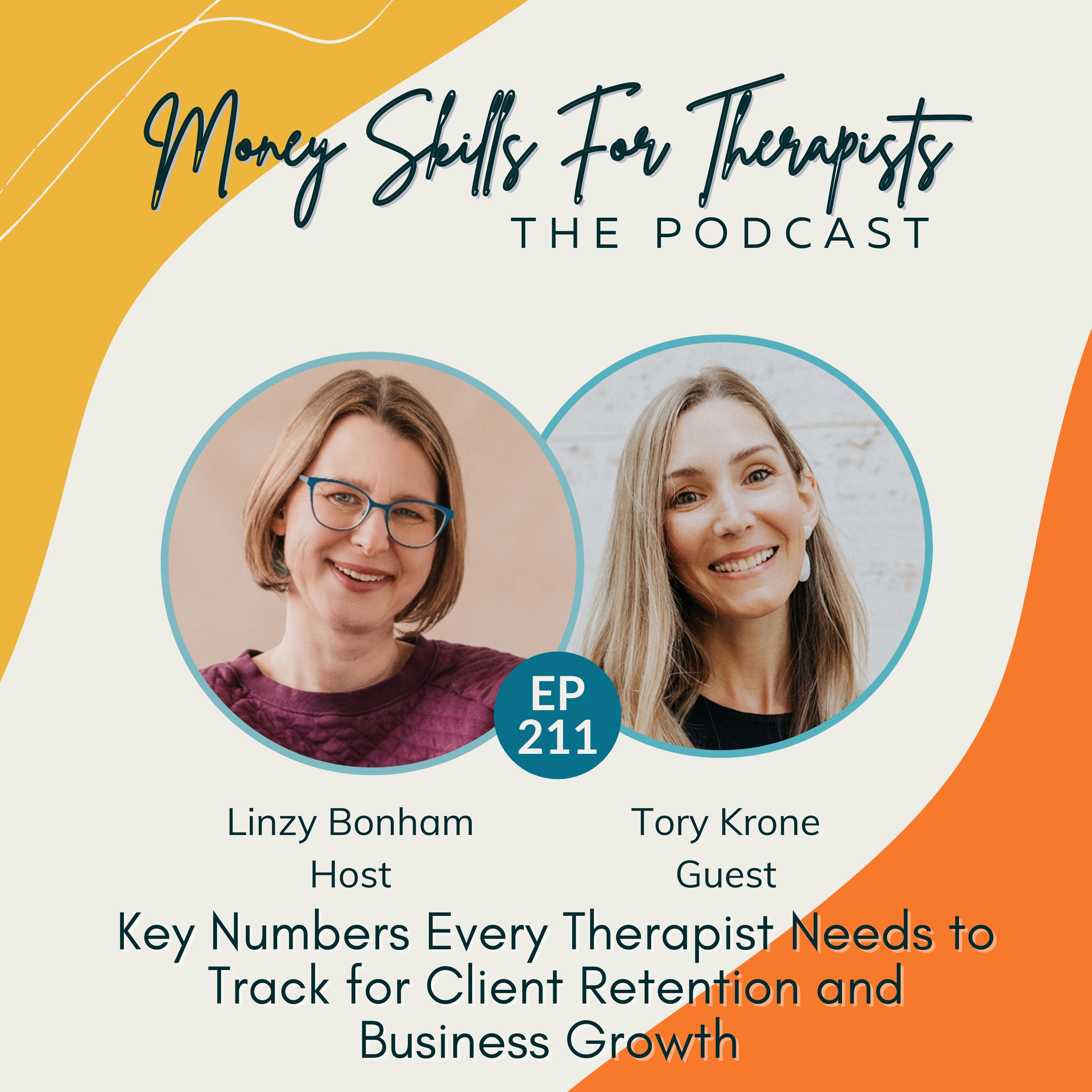
211: Key Numbers Every Therapist Needs to Track for Client Retention and Business Growth
Jun 200:40:29Tap to summarizeMany of us become therapists because we care deeply about people, not because we want to spend our days looking at business data. So, it makes sense if tracking metrics feels a little cold, overly analytical, or disconnected from the human side of the work you're doing.But the truth is, good data can actually support you in caring for both your clients and your clinicians more effectively.In this episode, I’m joined by Tory Krone, group practice owner and creator of PracticeVital, to talk about how the right numbers can help us understand what’s really happening inside a therapy practice. Together, we explore how tracking things like churn, retention, rebooking, and clinician productivity can move you out of guesswork and into clearer, steadier decision-making.Click here to learn more about PracticeVital — and get $30 off your first month when you sign up using the referral code MoneyN&B Ready to feel more calm and confident about your money? Do you feel confused, ashamed, or uncertain about your finances?Are you craving support to help shift your money mindset and transform your relationship with money?Are you ready to develop the skills and confidence you need to finally take control of your business finances and build a practice that actually takes care of you?If so, I’d love for you to join me for one of my free online workshops, designed specifically for private practice owners who feel stuck—whether it’s mindset blocks, avoidance, or the technical side of managing money.In just one hour together, you’ll learn practical tools, strategies, and next steps to move forward in your business (and your life) with clarity, intention, and ease.Click here to explore upcoming workshops and save your spot or register to get the replay.Using Data to See Patterns You Can’t Feel AloneTherapists are often highly intuitive. That intuition is a beautiful strength in clinical work, but it can only take you so far when you’re trying to get clear on client flow, practice performance, or the financial health of your business.By tracking the right numbers, you can begin to notice patterns that might otherwise stay hidden. Churn rates, retention, rebooking patterns, and referral quality offer important information about client fit, onboarding, expectations, and the overall client experience. Data doesn’t replace clinical judgment — it supports it.Sometimes small shifts in your practice, such as improving follow-up systems, setting clearer expectations during intake, or matching clients based on fit rather than simply availability, can make a meaningful difference. These practical adjustments can help clients stay engaged long enough to truly benefit from the care they came for.Creating More Stability Through Better Systems Many of the metrics Tory and I discuss are early signals that offer insight as to where a practice may need additional support, more clarity, or a better system before things become truly stressful.(00:04:02) Discovery of PracticeVital software(00:09:38) Tracking clinician productivity(00:10:25) Overly optimistic revenue projections(00:14:40) Introducing financial leadership tools(00:18:50) Analyzing referral quality(00:19:48) Attracting the right audience(00:25:15) Challenges of attracting therapy clients(00:32:24) Creating a safe space for clients(00:36:36) Importance of visually appealing dataStrong Practice Leadership Often Looks Surprisingly PracticalOne thing I really appreciate about this conversation is the reminder that good leadership is not only about vision, warmth, or emotional attunement. It’s also about creating reliable systems that help clients stay connected to care and help clinicians do their best work.That might mean normalizing recurring appointments, improving onboarding workflows, watching rebooking patterns, or noticing when a therapist on your team may need more support. Numbers will never tell the whole story of a practice, but they can help you ask better questions. And when you can ask better questions, you can respond to your business with more clarity, compassion, and confidence.About Linzy Bonham:Linzy Bonham is a therapist turned money coach who helps private practice owners and health professionals feel calm, confident, and in control of their finances through her podcast, free workshops and comprehensive programs: Money Skills for Therapists and Money Skills for Group Practice Owners.It all started when she saw her extremely skilled colleagues struggle with the money side of business. Some had even left private practice, or were avoiding starting one, because managing finances was just too stressful.So Linzy set out to support helpers and healers with developing peace of mind about their money. Since so many were never taught money skills, she focuses on the “how” of making the business side of private practice doable — and even super satisfying.Follow Linzy Bonham: About Page: https://moneyskillsfortherapists.com/aboutLinkedIn: https://www.linkedin.com/in/linzybonham/Instagram: https://www.instagram.com/moneyskillsfortherapists/About Tory Krone:Tory Krone is a licensed clinical therapist, group practice owner, and co-founder of PracticeVital. She has spent over a decade owning and operating Proactive Therapy, a multi-clinician group practice in Chicago, where she experienced firsthand the operational and financial complexities of running a sustainable therapy business.A graduate of Duke University and the University of Chicago, Tory brings both clinical depth and analytical rigor to her work with practice leaders. In 2023, after repeatedly encountering how difficult it was for practice owners to access clear, actionable data, she set out to solve the problem for herself—and for the field.What began as an internal dashboard for her own practice evolved into PracticeVital, the first automated analytics platform built specifically for therapy practices. Today, Tory helps over 500+ group practice owners move beyond guesswork, using data to make confident decisions that support growth, sustainability, and values-aligned leadership.Connect with Tory:If you’re a group practice owner who feels busy but still unsure about how healthy your practice actually is, check out PracticeVital. It’s a platform that gives practice leaders automated visibility into how their practice is performing—from overall practice health to clinician performance, client retention, and revenue trends across sessions and locations. You can learn more at www.practicevital.comEmail: tory@practicevital.comFacebook: https://www.facebook.com/share/g/17AeqeLPeV/Instagram: https://www.instagram.com/practicevital/
Transcribe →