Podcast
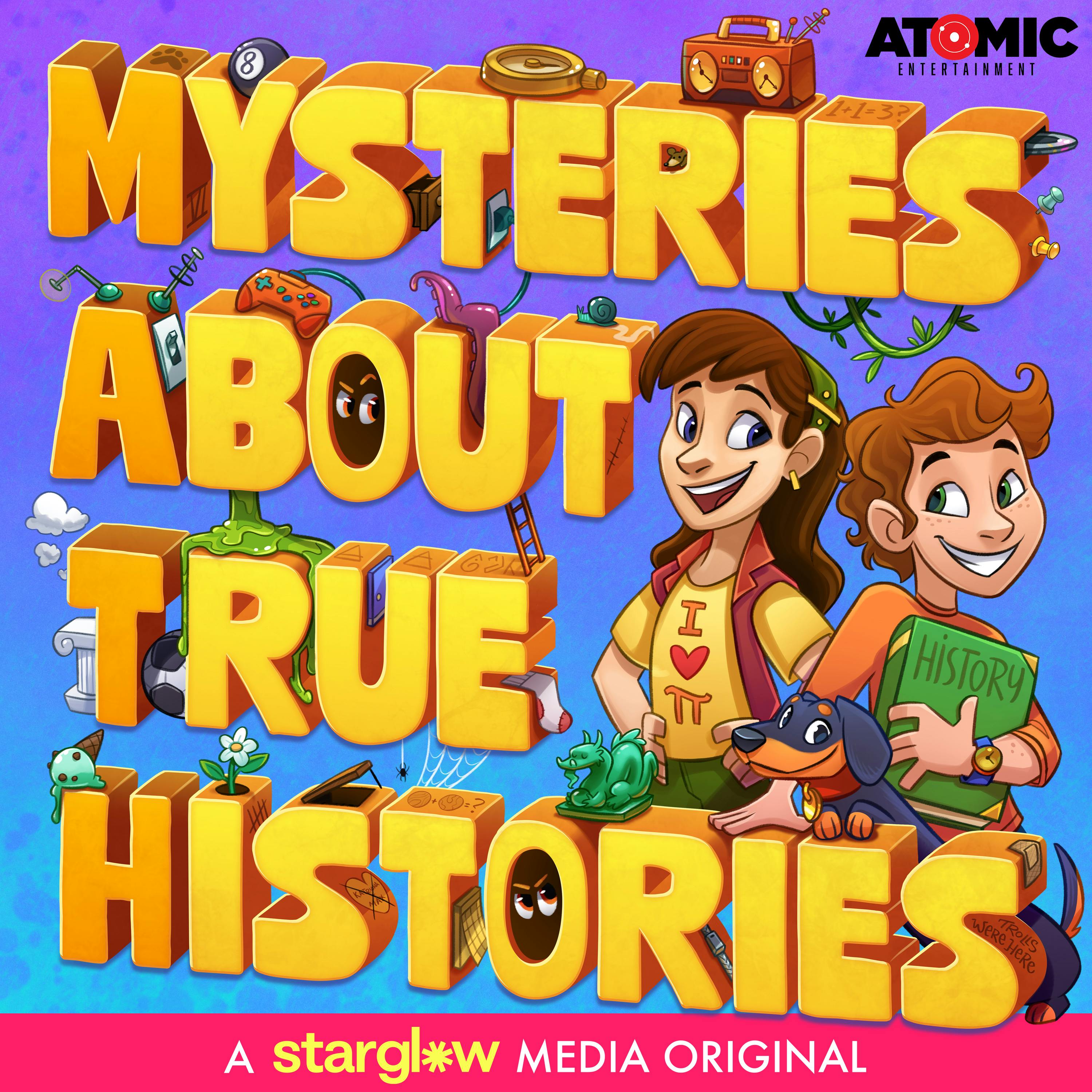
Mysteries About True Histories (M.A.T.H.)
Hosted by Starglow Media / Atomic Entertainment · EN
From the creators of Who Smarted? comes Mysteries About True Histories (aka M.A.T.H.), a podcast for kids where every episode promises an exhilarating mix of adventure, comedy, and educational exploration! Follow along as Max and Molly are recruited into a secret order of Problem Solvers who time travel while solving logic and math problems created by their arch nemeses, The Troublesome Trolls.
Tune in every Thursday for a brand new episode of Mysteries About True Histories!
This series is perfect for kids ages six and up. Even if your child hasn’t learned some of these concepts yet in school, the storytelling seamlessly plants the seeds for all kinds of math, history, geography and science lessons that will keep your little ones curious and excited to learn.
Max and Molly, the dynamic duo at the heart of our captivating story, are best friends with a passion for problem-solving. Every episode of M.A.T.H. takes our heroes to cool, new places throughout time and space (including the International Space Station) where they must solve riddles, puzzles and equations designed by the Trolls to cause chaos. By solving these interactive problems (that the listener can play along with) Max & Molly keep the Troublesome Trolls from eliminating things we all love... like ice cream!
From ancient civilizations to futuristic realms, Max and Molly traverse the ages, encountering historical figures, exploring distant lands, and unraveling the mysteries of the universe. Alongside Max and Molly, young adventurers will tackle a series of ingenious puzzles, brain-teasing riddles, and perplexing equations meticulously devised by The Troublesome Trolls.
But fear not, parents! While your kids are busy cracking codes and saving the day, they'll also be exercising their critical thinking skills, honing their math abilities, and expanding their knowledge of history, geography and science. It's educational entertainment at its finest – all wrapped up in a package of non-stop fun!
With each interactive challenge, kids will develop essential problem-solving skills, logical reasoning, and mathematical literacy – all while having a blast with Max & Molly – as well as their middle school rivals, Brad & Katrina, and Max's kooky Aunt Murgatroyd who is the mastermind behind it all! As our kids outsmart The Troublesome Trolls, they learn valuable lessons about teamwork, perseverance, confidence and the power of friendship.
M.A.T.H. is designed to ignite a lifelong love of learning in young minds. By weaving together elements of history, science, geography and mathematics in a captivating narrative, the podcast sparks curiosity and encourages exploration of the world around us. It's an immersive learning experience that transcends the confines of the classroom, inspiring kids to see the world through a new lens.
As parents, you'll love M.A.T.H. for its unique blend of entertainment and education. Not only does it provide an alternative to screen-time...
23episodes
Episodes
Newest firstAll episodes
Do, Re, Math…
Jan 1500:18:33Tap to summarizeEpisode Description: The Problem Solvers follow a musical clue back to 17th-century Istanbul, where math, music, and history collide at the workshop of legendary cymbal maker Avedis Zildjian. Using solfège, fractions, percentages, and number patterns hidden inside familiar melodies, the team unlocks a musical combination protecting a POG server. But teamwork — and patience — are tested as they race to shut it down before moving on to the next threat. Math Concepts: Percentages and fractions; Division and decimals; Number sequences and patterns; Repeated values and doubling (74 × 2 = 148); Logical problem solving using constraints. History/Geography Concepts: Solfège and musical scale degrees; Relationship between music and math; History of musical instruments (cymbals); Istanbul / Constantinople historical context; Cultural significance of music across time
Transcribe →Old Tech, New Tricks!
Jan 800:20:54Tap to summarizeEpisode Description: The Problem Solvers search for a hidden POG server in Oshkosh using Math, maps, and an unexpected clue from an old pneumatic tube system. As they calculate area, distance, and city blocks, tensions rise over trust, teamwork, and Charlene’s true motives. In the end, a forgotten underground system reveals a surprising connection between past technology and modern threats. Math Concepts: Percentages and probability; Area of squares & square roots; Square miles vs. square feet; Unit conversion (miles to feet); Estimation & rounding; Perfect squares (25, 49, 64, 81, 100)History/Geography Concepts: Pneumatic tube transport systems (19th-century technology); How information was moved before digital communication; Land area measurement of cities; Analog vs. digital security systems
Transcribe →No Money, Still Problems!
Dec 1800:19:25Tap to summarizeEpisode Description: To stop the POGs’ prediction network, Max and Molly realize they need help—and fast. However, they are torn on whether or not they can trust Charlene. To test her honesty, they recreate an experiment with a “lost” wallet stuffed with cash. Will Charlene pass the test? As math, probability, and human behavior collide, the Problem Solvers learn that trust might be the most valuable currency of all. Math Concepts: Ratios and fractions; Percent conversion; Probability and win–loss percentages in sports; Division and rounding; Estimation and Averages; Multiplication with large numbersHistory/Geography Concepts: Real-world behavioral science experiment on lost wallets (conducted across 40 countries); Quarantine and disease prevention (mono); The concept of global research studies and data collection
Transcribe →Sometimes the Soccer Ball Kicks You!
Oct 2300:18:37Tap to summarizeEpisode Description: After soccer practice, Max and Molly stumble onto a new mystery when Max’s soccer Coach hands out bizarre “Zen” playbooks filled with riddles and impossible strategies. As they calculate the odds of success on the field, the pair begins to suspect Coach might be a secret Mole. Math Concepts: • Probability and the Multiplication Rule;Regression to the Mean; Division and averaging (calculating goals per game and postseason stats):History/Geography Concepts: Concepts of Zen and Koans (paradoxical riddles meant to teach mindfulness or enlightenment); Sports strategy and probability in real-world applications
Transcribe →Mole Playing or Role-Playing?
Oct 1600:18:34Tap to summarizeEpisode Description: Max and Molly suspect their teachers, Mr. Avogadro and Mr. Zimmer, of plotting to change history—only to discover the two are secretly obsessed with role-playing games! Their investigation takes them back to 13th-century France, where they explore Carcassonne’s ancient walled city, stomp grapes, and calculate area, circumference, and distance using math. Math Concepts: Unit conversion (kilometers to miles); Circumference and radius of a circle; Area of a circle; Ratios and averages; Time and rate calculations History/Geography Concepts: The medieval walled city of Carcassonne, France (origins around 3500 BCE); French unification under the crown (mid-13th century)Pre-printing press communication (town criers, hand-copied letters)
Transcribe →A Wrinkle in Time Travel
Oct 900:18:35Tap to summarizeEpisode Description: Max and Molly suspect that Mr. Avogadro’s student book club may be a front for Mole recruitment. Using Math to calculate reading goals, averages, and even a new “Suspicion Number” system inspired by mathematician Paul Erdős, they try to narrow down suspects. But when they overhear Mr. A and Mr. Z talking about “burrows” and “alternate history,” the mystery deepens. Math Concepts: Division with remainders; Multiplication to find daily/weekly totals;; Application of averages;Fractions/percentages; Graph theory-inspired reasoningHistory/Geography Concepts: Misconceptions about animals (bats and moles’ eyesight/echolocation); Introduction to mathematician Paul Erdős and the Erdős Number System; Literature reference: A Wrinkle in Time by Madeleine L’Engle
Transcribe →A Hard Day’s Mole
Oct 200:16:46Tap to summarizeEpisode Description: Max and Molly follow a tip that the POGs’ delivery recruits are meeting up at a Beatles’ concert in Liverpool, 1960. There, they not only enjoy seeing the Fab Four rise to fame but also discover their old teammate Katrina has been unwittingly working for the enemy through a mysterious “Spoon” app. Can they convince her to become a ‘Mole inside the Moles’ before history takes another disastrous turn? Math Concepts: Subtraction; Division/Averages; Basic proportional reasoning History/Geography Concepts: The Beatles’ early career in Liverpool and rise to international fame; Historical events tied to Katrina’s deliveries (Watergate, Julius Caesar’s assassination, the Great Depression)
Transcribe →Molecraft!
Sep 2500:17:47Tap to summarizeEpisode Description: Max and Molly attempt to infiltrate the POGs by applying for a mysterious “Mole job” that sends them 2 million years back to Olduvai Gorge. There, they discover Homo habilis, early human tools, and the dangers of altering history—better known as “The Butterfly Effect.” Using Math to calculate volume, they dig a hole to bury a strange box. But could this simple action end up changing the future forever? Math Concepts: Volume formula: length × width × height (to determine hole depth);Large number comparisons (quadrillions vs trillions); Fractions, decimals, and multiplication; Time conversion (millions of years → human timeline).History/Geography Concepts: Olduvai Gorge in Tanzania as a key anthropological site; Discovery of early human fossils (Mary Leakey, Homo habilis). The Butterfly Effect in relation to history and consequences. Fossilization and preservation conditions (lava and ash deposits).
Transcribe →I Spy With My Little Eiffel
Sep 1900:18:13Tap to summarizeEpisode Description: Max and Molly are sent to Nazi-occupied Paris in 1941, where they team up with legendary entertainer and undercover spy Josephine Baker. Together, they climb the Eiffel Tower, use trigonometry to calculate distances, and smuggle secrets hidden in sheet music. Along the way, they learn how “hiding in plain sight” can be the most powerful disguise of all. Math Concepts: Subtraction with years (1941 – 1889 = 52 years since the Eiffel Tower was built); Division; Basic Trigonometry: (tangent ratio) to calculate the distance from the Eiffel Tower to Gare du Nord. History/Geography Concepts: Nazi occupation of Paris during World War II; Famous jazz singer/dancer Josephine Baker’s role as a performer and spy for the French Resistance; The Eiffel Tower: built for the 1889 World’s Fair, height of 330 meters, and its use as a lookout point; Gare du Nord railway station and train travel during the war;Espionage techniques, including invisible ink and hiding intelligence in sheet music
Transcribe →The Great Call of China!
Sep 1100:19:18Tap to summarizeEpisode Description: When a flyer leads Max and Molly to new POG activity, Aunt M sends them to the Great Wall of China in 1601. There, they discover that what locals think is a terrifying “monster” is actually a POG transmission antenna. With the Commander eager to take credit, Max and Molly must rescue a strange printout that deepens the koan mystery. Math Concepts: Time calculations (converting minutes → seconds, hours → minutes → seconds); Speed, distance, and pace (Molly’s run: 1.1 miles in 9:45 → pace calculations); Order of Operations (PEMDAS: Parentheses, Exponents, Multiplication, Division, Addition, Subtraction); Prime vs composite numbers (e.g., 9 as the first odd composite number); Ratios and unit conversions (seconds to minutes, minutes to hours)History/Geography Concepts: Geography: The Jiumenkou section of the Great Wall—unique as a bridge with nine arches spanning the Jiujiang River; History: Ming Dynasty China, 1601 CE; Cultural element: How myths and misunderstandings can grow around technology (locals mistaking a satellite dish for a monster); Philosophy: Koans (riddles used in Zen Buddhism to provoke deeper thought)
Transcribe →