Loading summary
Transcript1 lines
- [00:04]
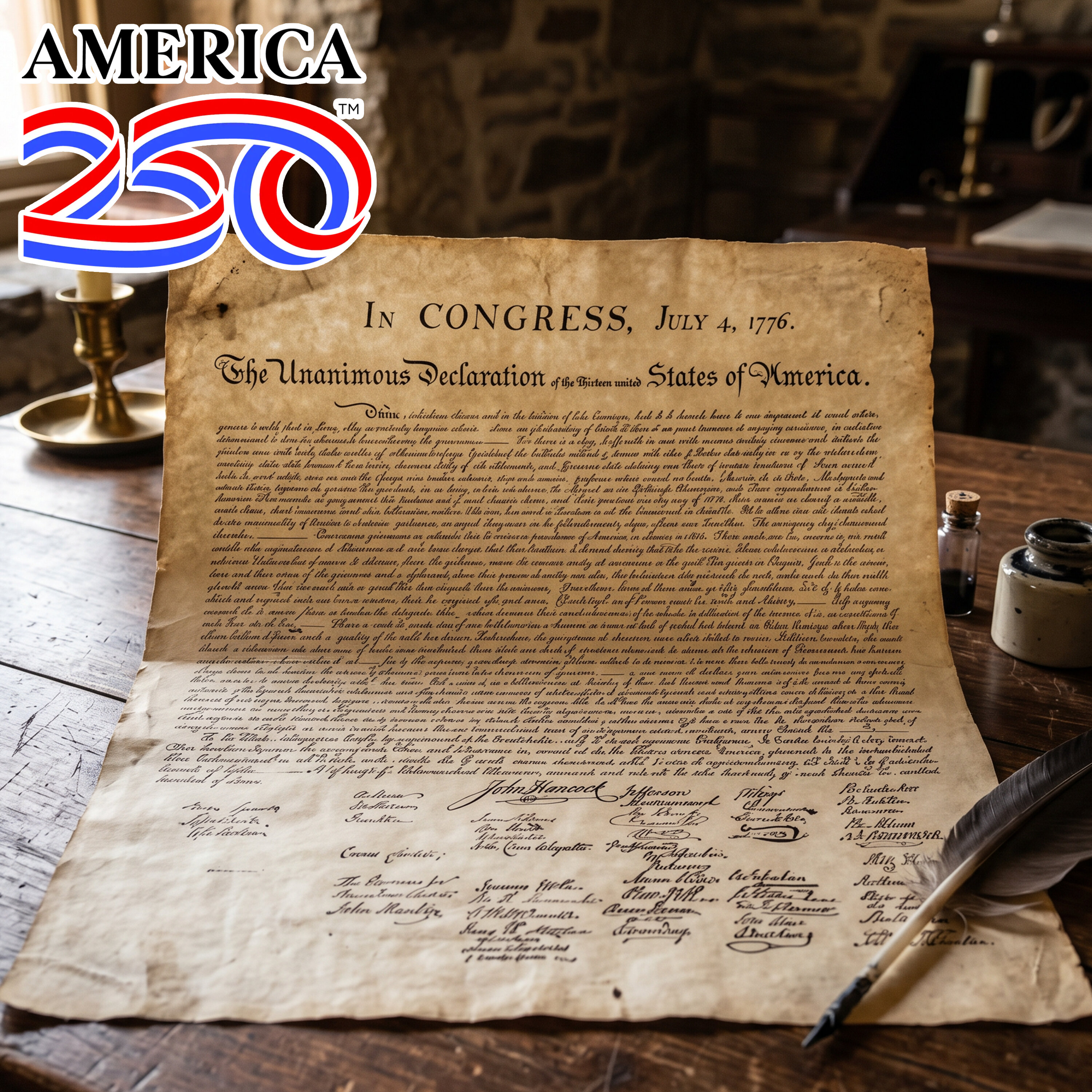
A
Welcome to Newt's World podcast on the iHeart Podcast Network. For the Fourth of July itself, I wanted to do something special and something which would bring together why we celebrate so deeply, the signing of the Declaration of Independence. I probably feel it a little more personally than some people because I was born in Harrisburg, and my relatives, when I was young, would routinely take me down to Philadelphia, and you'd be right there, and you would see where these people had come together, the courage they'd had. And frankly, even today, I'm astounded both at their universal wisdom and. And what they wrote and how they framed it, but also their personal courage. These 56 people are getting together, knowing that they are about to take on the most powerful empire in the world and, to paraphrase Martin Luther, the diet of worms. They can do no other. They have found themselves in a place where, given who they are and what they believe, they have to risk everything. So join me in this extraordinary day of history. Imagine Philadelphia, the summer of 1776. Hot, no air conditioning. Of course, people are really worried about what's going on inside the Pennsylvania State House. That's the plain brick building that we call Independence Hall. The windows are shut tight against eavesdroppers, even as the heat turns the place into an oven. So they're sitting here sweating. There are flies swarming around them. And of course, back then, as a matter of fact, of style, they're wearing wool coats. 56 delegates, the Second Continental Congress. They're sitting there, and they realize they are at a moment in history. This is a crossroads. If they do what they're about to, they're in a new world, and maybe a world where they win and maybe a world where they lose, but it will never again be the world they grew up in. Now, think about that. These are people who had always been loyal to Britain, who thought of themselves for most of their history as British, and who had been participants in the French and Indian War back in the 1750s and early 60s. And suddenly, inch by inch, they've been coming down a road that carried them to this moment. Now, it didn't happen overnight. They began thinking and talking about it in the 1760s. Momentum began building in the early 1770s. And then, in a moment of decision which totally blew up on the British, they decide to march on Lexington and Concord, Massachusetts, where there are weapons that have been gathered by the colonials, and the colonials have been practicing as a militia. Now, why does this matter? Because historically, the British army had routinely put down rebellions in Scotland as recently as 1744 at Culloden in Ireland, where family on the o' Doherty side was the last clan to rebel at Bunkrana in 1693. They knew what they were doing. They knew how to do it, but they had never faced disciplined, organized militia. And remember, these are folks who had inherited the lessons of fighting in the French and Indian war, which had lasted seven years. So the British go out, and they march on Lexington and Concord. This is the moment which leads, of course, to the famous ride of Paul revere saying, the British are coming. The British are coming, which brings the militia together. So when the British arrive, they are suddenly faced with armed, trained people, virtually all of whom, of course, were deer hunters, quite comfortable aiming and firing a rifle or a musket. And the British are defeated. They are forced back into Boston, losing troops all the way back because the militia follow them. The British then hunker down where the royal navy can protect them. They're in Boston. But then the colonial militia digs in on bunker hill above the city, and the British attack, and they're repulsed, and they attack, and they're repulsed. And finally, the British win the battle. But they have lost so many people that they realize, one, the colonials aren't going to quit. Two, they can't guarantee control of Boston harbor. Now, in the process, the continental congress, not yet ready to take the decisive step, nonetheless looks around and in sort of a magic moment, because, remember, these fights are occurring in Massachusetts and back then. It's a long way from Massachusetts to Georgia. And the culture of the colonies are different. They talk different. They have different economic interests. And so they say, how do we send somebody to Boston who would be willing to represent the entire colonial system to prove that it's not just new England? It's a very decisive moment. And by the way, the only person who happens to be wearing a Virginia militia colonel's uniform is a very tall George Washington who keeps saying to people, oh, I don't know that I could do this. And he wants to be drafted. He's not going to appear eager. And when he is drafted, he says, you know, I hope I'm worthy of doing this, but it's an enormous burden. And so Washington goes off as a Virginian to help people in Massachusetts and to do so in a way that begins to send a signal that all 13 colonies are going to be together. And in that period, you. You have an enormous increase in interest. Thomas Paine writes a remarkable pamphlet, probably the most widely read pamphlet in the colonies in this era, called common sense in which he outlines the case for independence. And then Richard Henry Lee of Virginia stands before the Congress on June 7, 1776, and introduces a resolution that these united colonies were, and by right ought to be free and independent states. They've been gradually working their way in that direction. They weren't ready. If they'd voted that day, I'm not sure it would have passed. They needed time to think about it. They needed time to talk about it. Some of the delegates wanted instructions from back home and sent messages back saying, what should we do? What do you want us to do to represent our particular colony? Now, the Congress then appointed five men to draft a document which is really aimed at the world. They want the world to understand, why are we doing this? What does it mean? And so they asked John Adams of Massachusetts, Benjamin Franklin of Pennsylvania, Roger Sherman of Connecticut, Robert Livingston of New York, and a young Virginia lawyer, Thomas Jefferson, who Adams asked to write the first draft because Jefferson had quite a reputation as a good wordsmith. Jefferson very deeply read, a very, very smart person, drew on the philosophy that was out there already. In many ways, the Americans were operating off of two really important traditions, the Whig opposition in Britain to the king and the sense of natural rights which had been developed, particularly during the Glorious Revolution, which brought King William and Anne over in the late 17th century. And so you have all of a sudden this intellectual framework which by the way, also shows up as part of the Scottish Enlightenment in a very famous book which to this day shapes thinking, and that is the wealth of nations, which is written by a Scotsman who is deeply part of this whole pattern of thinking about this. These people are thinking very profoundly. Their world has been shaken. The old concept that kings exist by divine right had clearly been broken up. After all, they had executed a King Charles the first during the English Civil War. They had replaced a King James II by bringing somebody in from Holland. So their very core fabric has been in turmoil. And they currently have German kings coming from the Hessian background who are running the country. So a German king and a British empire. And people are trying to figure out, well, what's the core principle here? And Jefferson was part of the group who had been thinking, reading, talking and writing. And two weeks time, that committee. John Adams of Massachusetts, Benjamin Franklin of Pennsylvania, Roger Sherman of Connecticut, Robert Livingston of New York and Thomas Jefferson. Together they craft a document, largely Jefferson, but with some key editing. And on the 2nd of July, Congress formally votes for independence. Two days later, on the 4th, it adopts the Declaration to explain why that's the Document I'm going to share with you in a minute because I think it's worth, on this 250th birthday, actually listening to and thinking about what they were doing. One of the lessons I learned over the years came from Abraham Lincoln, who always spoke very slowly because he wanted you to understand the last sentence before he started the next sentence. And when I share with you, I'm going to try to follow Lincoln's advice. Remember, while they adopted the words, they now have to sign it again. A time of people are riding by horseback and by buggy. So getting them back and forth. The actual signing took place mostly on August 2nd, and a few delegates added their names later. Every man who signed knew exactly what he was risking his life. Benjamin Franklin is said to have told the room that they must all hang together or they would all hang separately. Delegate Benjamin Rochlater wrote that signing felt like putting his name to his own death warrant. Think about that. I want to read what he said, because I want you to in your own mind, ask yourself, would you have had the courage to do this? Benjamin Rush says signing felt like putting his name to his own death warrant. If the rebellion failed, this document was a list of names for the gallows, the first group the British would have executed. So who were these 56amazingly courageous people? They weren't elected by the public at large. There was no national vote for independence. Each colony had its own provincial congress or legislative assembly, and it was that body which chose its delegates and sent them to Philadelphia, trusted to speak and to act on the colony's behalf. The men they sent were lawyers, merchants, farmers, physicians, a minister, a printer, even a musician. Most were prosperous and well educated, after all, had to be fairly prosperous because they're not busy working, they're busy policy, and they're able to go to Philadelphia and put themselves up and afford it. Most of them were well educated and in their 30s and 40s. Benjamin Franklin, at 70, was the oldest man to sign. And by the way, he would survive long enough to also be in the Constitutional convention. Edward Rutledge of South Carolina, only 26, was the youngest. A few, like Stephen Hopkins of Rhode island, signed despite physical infirmity. Hopkins, his hand trembling with palsy, is said to have remarked that his hand shook, but his heart did not. These weren't professional revolutionaries. They were men of property. In fact, they didn't particularly want revolution. They wanted stability. But they wanted stability without British judges and British armies and British kings telling them what to do. They had everything to lose. And as I Said they put their lives, their fortunes, their reputations on the line for an idea. And they trusted that future generations would decide whether the risk had been worth it. So I want to share with you now, and some of the language is archaic because this is, after all, a document written in the 1770s. But it's worth on this 250th birthday now actually listen to the document we talk about. In Congress. July 4, 1776. The unanimous declaration of the 13 United States of America. When, in the course of human events, it becomes necessary for one people to dissolve the political bands which have connected them with another, and to assume among the powers of the earth the separate and equal station to which the laws of nature and of nature's God entitle them. A decent respect to the opinions of mankind requires that they should declare the causes which impel them to the separation. We hold these truths to be self evident. That all men are created equal, that they are endowed by their Creator with certain unalienable rights, that among these are life, liberty, and the pursuit of happiness. That to secure these rights, Governments are instituted among men, deriving their just powers from the consent of the governed. That whenever any form of government becomes destructive of these ends, it is the right of the people to alter or or to abolish it, and to institute new government, laying its foundation on such principles and organizing its power in such form as to them shall seem most likely to affect their safety and happiness. Prudence indeed will dictate that governments, long established, should not be changed for light and transient causes. And accordingly all experience has shown that mankind are more disposed to suffer, while evils are sufferable, than to right themselves by abolishing the forms to which they are unaccustomed. But when a long train of abuses and usurpations, pursuing invariably the same object, evinces a design to reduce them under absolute despotism, it is their right, it is their duty, to throw off such government and to provide new guards for their future security. Such has been the patient sufferance of these colonies, and such is now the necessity which constrains them to alter their former systems of government. The history of the president, King of Great Britain, is a history of repeated injuries and usurpations, all having in direct object the establishment of an absolute tyranny over these states. To prove this, let facts be submitted to a candid world. He has refused his assent to laws the most wholesome and necessary for the public good. He has forbidden his governors to pass laws of immediate and pressing importance, unless suspended in their operation till his assent should be obtained. And when so suspended, he has utterly neglected to attend to them. He has refused to pass other laws for the accommodation of large districts of people. Unless those people would relinquish the right of representation in the legislature. A right inestimable to them and formidable to tyrants only. He has called together legislative bodies at places unusual, uncomfortable and distant from the depository of their public records. For the sole purpose of fatiguing them into compliance with his measures. He has dissolved representative houses repeatedly. For opposing with manly firmness his invasions on the rights of the people. He has refused for a long time after such dissolutions. To cause others to be elected. Whereby the legislative powers, incapable of annihilation. Have returned to the people at large for their exercise. The state remaining in the meantime exposed to all the dangers of invasion from without and convulsions within. He has endeavored to prevent the population of these states for that purpose. Obstructing the laws of naturalization for foreigners refusing to pass others to encourage their migration hither. And raising the conditions of new appropriations of lands. He has obstructed the administration of justice. By refusing his assent to laws for establishing judiciary powers. He has made judges dependent on his will alone. For the tenure of their offices and the amount in payment of their salaries. He has erected a more multitude of new offices. And sent hither swarms of officers to harass our people and eat out their substance. He has kept among us, in times of peace, standing armies without the consent of our legislatures. He has affected to render the military independent of and superior to the civil power. He has combined with others to subject us to a jurisdiction Foreign to our constitution and unacknowledged by our laws, Giving his assent to their acts of pretended legislation. For quartering large bodies of armed troops among us. For protecting them by a mock trial from punishment. For any murders which they should commit on the inhabitants of these states. For cutting off our trade with all parts of the world. For imposing taxes on us without our consent. For depriving us in many cases of the benefits of trial by jury. For transporting us beyond seas to be tried for pretended offenses. For abolishing the free system of English laws in a neighboring province. Establishing therein an arbitrary government and enlarging its boundaries so as to render it a one once an example and fit instrument. For introducing the same absolute rule into these colonies. For taking away our charters, abolishing our most valuable laws. And altering fundamentally the forms of our governments. For suspending our own legislatures and declaring themselves invested with power to legislate for us in all cases whatsoever. He has abdicated government here by declaring us out of his protection and waging war against us. He has plundered our seas, ravaged our coasts, burned our towns and destroyed the lives of our people. He is at this time transporting large armies of foreign mercenaries. To complete the works of death, desolation and tyranny. Already begun. With circumstances of cruelty and perfidy. Scarcely paralleled in the most barbarous ages. And totally unworthy the head of a civilized nation. He has constrained our fellow citizens taken captive on the high seas. To bear arms against their country, to become the executioners of their friends and brethren. Or to fall themselves by their hands. He has excited domestic insurrections amongst us. And has endeavored to bring on the inhabitants of our frontiers. The merciless Indian savages. Whose known rule of warfare Is an undistinguished destruction of all ages, sexes and conditions. Every stage of these oppressions we have petitioned for redress in the most humble terms. Our repeated petitions have been answered only by repeated injury. A prince whose character is thus marked by every act which may define a tyrant. Is unfit to be the ruler of a free people. Nor have we been wanting in attentions to our British brethren. We have warned them from time to time of attempts by their legislature. To extend and unwarrantable jurisdiction over us. We have reminded them of the circumstances of our emigration and settlement here. We have appealed to their native justice and magnanimity. And we have conjured them by the ties of our common kindred. To disavow these usurpations which would inevitably interrupt our connections and correspondence. These, they too, have been deaf to the voice of justice and of consanguinity. We must, therefore, acquiesce in the necessity which denounces our separation. And hold them as we hold the rest of mankind. Enemies in war and peace. Friends. We, therefore, the representatives of the United States of America in general Congress assembled, Appealing to the supreme judge of the world for the rectitude of our intentions, do, in the name and by authority of the good people of these colonies, Solemnly publish and declare that these united colonies are, and of right ought to be, free and independent states. That they are absolved from all allegiance to the British Crown. And that all political connection between them and the state of Great Britain is and ought to be totally dissolved. And that, as free and independent states, they have full power to levy war, conclude peace, contract alliances, establish commerce. And to do all other acts and things which independent states may of right do. And for the support of this Declaration with a firm reliance on the protection of Divine Providence. We mutually pledge to each other our lives, our fortunes and our sacred honor. That is the document we are celebrating. That is the document which changed the world, not just America. That is a document which is at the heart of freedom across the planet. That is a document which would lead Jefferson later to describe the empire of liberty and to say that all across the planet, voluntarily, on their own, people will seek to be free. They will seek to live in self government. And they will do so in many ways because of this particular declaration. It's worth taking just a minute to mention to you, the people who did in fact vote for this and sign it because their courage, their commitment, their idealism deserve our respect and deserve, on this 250th anniversary, to be recognized in public. From Georgia, Button Gwinnett, Lyman Hall, George Walton. From North Carolina, William Hooper, Joseph Hughes, John Penn. From South Carolina, Edward Rutledge, Thomas Hayward Jr. Thomas Lynch Jr. Arthur Middleton. From Massachusetts, John Hancock. From Maryland, Samuel Chase, William Paca, Thomas Stone, Charles Carroll of Carrollton. From Virginia, George Weth, Richard Henry Lee, Thomas Jefferson, Benjamin Harrison, Thomas Nelson Jr. Francis Lightfoot, Lee Carter Braxton. From Pennsylvania, Robert Morris, Benjamin Rush, Benjamin Franklin, John Morton, George Clymer, James Smith, George Taylor, James Wilson, George Ross. From Delaware, Cesar Rodney, George Reid, Thomas McKean. From New York, William Floyd, Philip Livingston, Francis Lewis, Lewis Morris. From New Jersey, Richard Stockton, John Witherspoon, Francis Hopkinson, John Hart, Abraham Clark. From New Hampshire, Josiah Bartlett, William Whipple. From Massachusetts, Samuel Adams, John Adams, Robert Treat Payne, Elbridge Gary. From Rhode Island, Stephen Hopkins, William Ellerly. From Connecticut, Roger Sherman, Samuel Huntington, William Williams, Oliver Walcott from New Hampshire, Matthew Thorn. Fifth. 56 men, one document and an idea bold enough to reshape the world. Not just that a people have the right to govern themselves, but that these people are endowed by their Creator so that their rights come directly from God. They just cut out the entire notion of the divine right of kings and replace it with the divine right of citizens. This idea 250 years ago, revolutionized how people thought about their relationship to power and how people thought about themselves. Because suddenly they were citizens endowed by their Creator. For two and a half centuries, we've argued, struggled, tested, sometimes improved, sometimes made a mess. Two and a half centuries of a nation that's never stopped reaching beyond the promise written on that document in Philadelphia. Even when at times it takes us years to live up to particular parts. So on this 4th of July, as we mark America's 250th birthday. Take a moment to remember the courage, the idealism, the boldness of those signers, the risk that they took, knowing that they were taking on the greatest empire in the world. They didn't know if their gamble would work, but they knew they couldn't avoid it. They knew that they couldn't live with themselves if they became slaves to the king. And that's why they thought they had to do it. Well, it's worked so far. It's still working clumsily, confusedly, sometimes frustratingly, but with greater freedom, with greater opportunity, a greater chance for people of all backgrounds, from all parts of the world to have a great future. That's 250 years of amazing progress. So I say to Every American, happy Fourth of July. I say to the country, happy 250th birthday. And here's to an even more exciting and bolder next 250 years. New World is produced by Gingrich360 and iHeartMedia. Our executive producer is Garnesy Sloan. Our researcher is Rachel Peterson. Special thanks to the team at Gingrich 360. If you've been enjoying Newtsworld, I hope you'll go to Apple Podcast and both rate us with five stars and give us a review so others can learn what it's all about. Join me on substack@gingrich360.net I'm Newt Gingrich. This is Newtwork.