Podcast
Newt's World
Hosted by Gingrich 360 · EN
Join Newt Gingrich, former U.S. Speaker of the House and Ph.D. historian, for the most diverse, informative, and entertaining podcast available. Every episode is an education.
171episodes
Episodes
Newest firstAll episodes
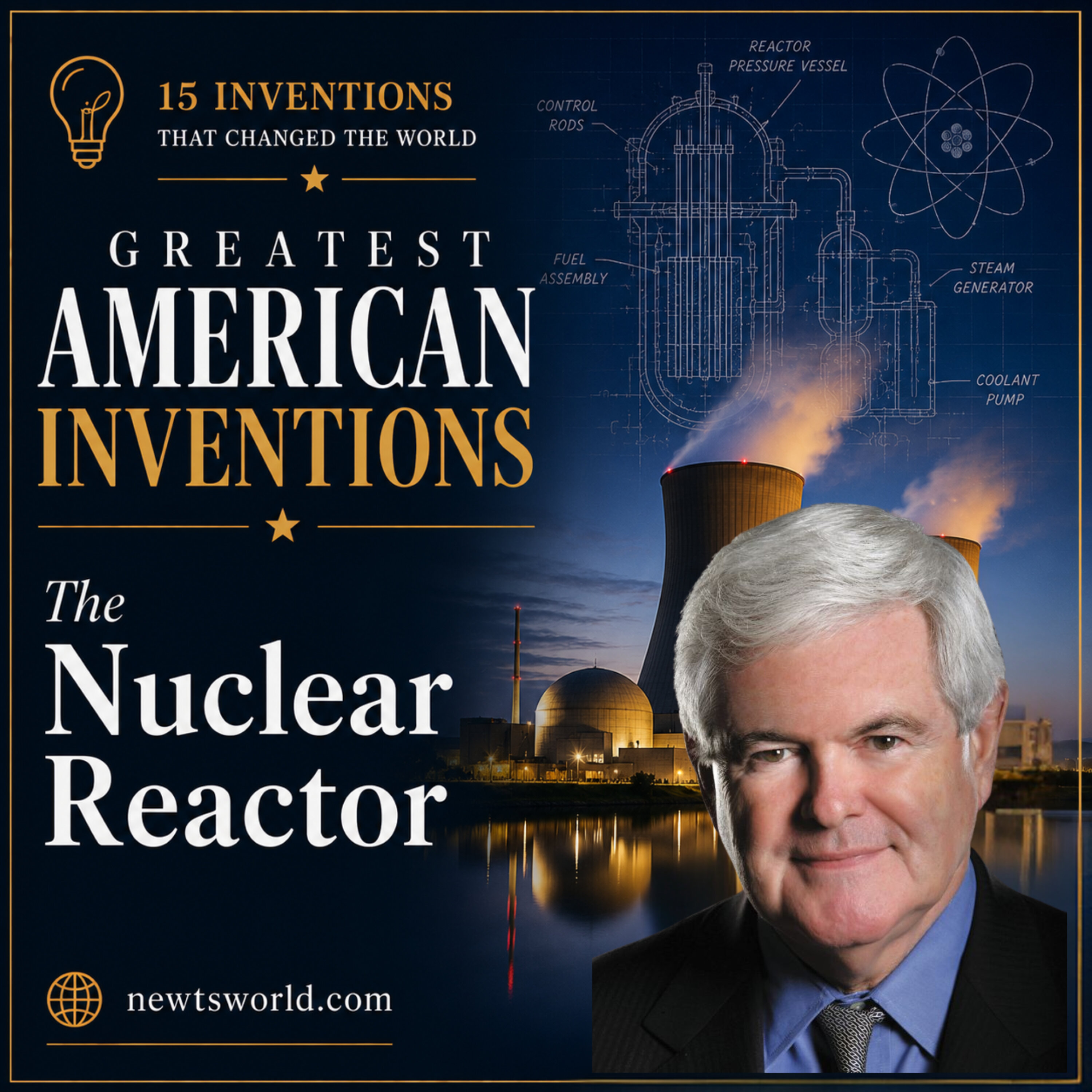
Episode 1024: Greatest American Inventions — The Nuclear Reactor
6d ago00:06:01Summary readyBeneath a football stadium at the University of Chicago on December 2, 1942, Enrico Fermi's team achieved the first self-sustaining nuclear chain reaction in history—producing just half a watt of power but proving a concept that would reshape the world. Newt traces the Manhattan Project's dual legacy: the atomic bombs that ended World War II, and the nuclear power plants that now generate clean electricity more safely than almost any other energy source, despite enduring public fear. This episode grapples honestly with an invention that carries both extraordinary promise and the shadow of annihilation.See omnystudio.com/listener for privacy information.
Summary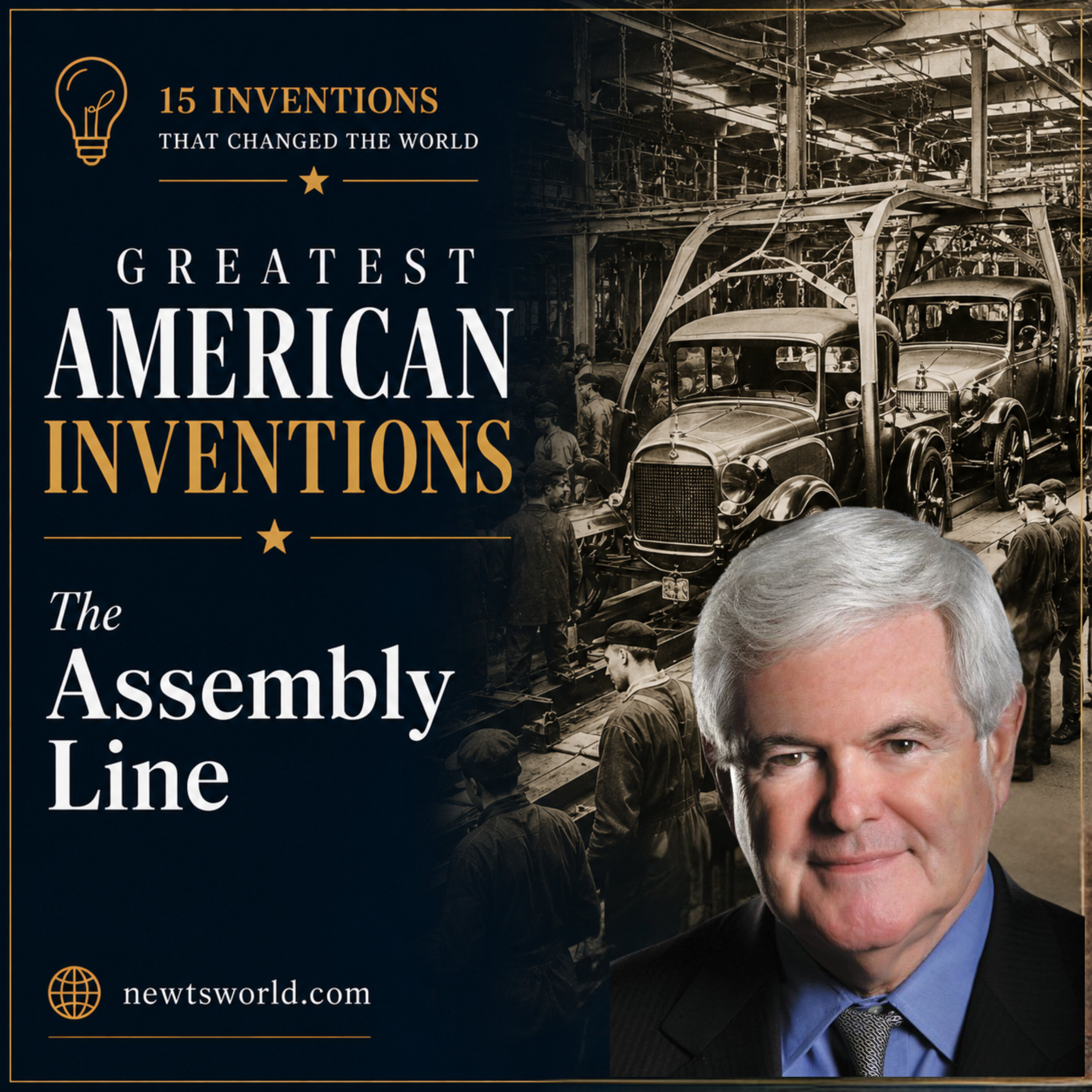
Episode 1023: Greatest American Inventions — The Moving Assembly Line
1w ago00:05:44Summary readyHenry Ford didn't invent the automobile—he invented a way to make it affordable. Newt examines how Ford's 1913 moving assembly line cut Model T production time from 12.5 hours to 93 minutes, and how Ford's controversial $5-a-day wage turned his own workers into customers, helping create the American middle class. But this episode doesn't shy away from complexity: the same system that built American prosperity was also dehumanizing for many workers, and Ford himself was a deeply flawed figure. It's a clear-eyed look at innovation's power—and its costs.See omnystudio.com/listener for privacy information.
Summary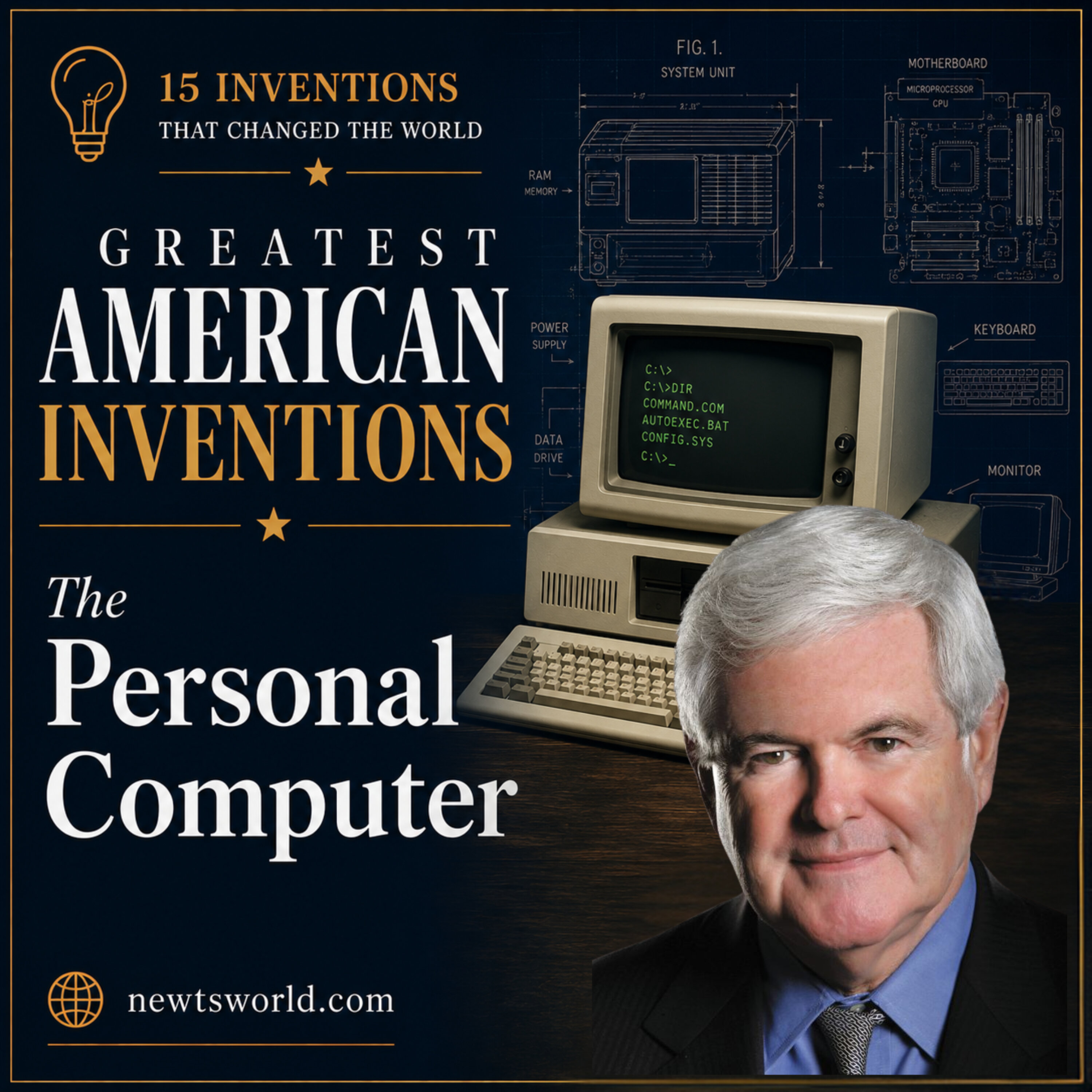
Episode 1022: Greatest American Inventions — The Personal Computer
1w ago00:05:53Summary readyFor thirty years, a computer was something only governments and corporations could own—an entire room of machinery. Newt tells how that changed in 1975, when a $439 kit computer on the cover of Popular Electronics inspired a Harvard student named Bill Gates and an HP engineer named Steve Wozniak to imagine something radical: a computer anyone could own. From Microsoft's garage-built software to Apple's Apple II to IBM's industry-legitimizing PC, this episode traces how outsiders—not the institutions running the computer industry—saw what was coming and put computing power directly into ordinary people's hands.See omnystudio.com/listener for privacy information.
Summary
Episode 1021: Greatest American Inventions — The Internet
1w ago00:06:12Summary readyOn the night of October 29, 1969, a UCLA student typed two letters into a Stanford-bound terminal before the system crashed—and the internet was born. Newt traces ARPANET's Cold War origins as a decentralized network built to survive nuclear attack, through Vint Cerf and Bob Kahn's TCP/IP protocol, to Tim Berners-Lee's World Wide Web. He argues the internet's true significance lies in a policy choice: the U.S. government built it, then let it go, handing an open network to the world rather than controlling it—a decision that unleashed more innovation than any planned alternative.See omnystudio.com/listener for privacy information.
Summary
Episode 1020: Greatest American Inventions — The Polio Vaccine
1w ago00:06:23Summary readyBefore 1955, polio closed swimming pools, filled hospital wards with iron lungs, and terrified American parents every summer. Newt tells the story of Dr. Jonas Salk, who defied scientific consensus with a killed-virus vaccine, tested it on 1.8 million children in the largest clinical trial in American history, and then refused to patent it. "Could you patent the sun?" he asked. Cases plummeted from 58,000 to near zero within years. It's a story about a scientist who chose humanity over royalties—and a reminder of what American science can achieve when purpose outweighs profit.See omnystudio.com/listener for privacy information.
Summary
Episode 1019: Greatest American Inventions — The Transistor
2w ago00:06:50Summary readyAt Bell Labs in December 1947, three scientists—John Bardeen, Walter Brattain, and William Shockley—demonstrated a tiny device that would outlast the vacuum tube and launch the digital age. Newt traces the transistor's evolution from a sliver of germanium into the integrated circuit and, eventually, chips containing over 100 billion transistors. Born from pure scientific curiosity rather than a commercial mandate, the transistor became the most sustained technological advance in history—Moore's Law—and the hidden engine behind every computer, phone, and satellite discussed later in this series. It's a powerful case for funding basic research.See omnystudio.com/listener for privacy information.
Summary
Episode 1018: Greatest American Inventions — The Electrical Power System
2w ago00:06:18Summary readyEvery invention in this series—the phone, the internet, the smartphone—depends on one foundational breakthrough. Newt unpacks the electrical power system's tangled origin story: Thomas Edison's Pearl Street Station, Nikola Tesla's alternating current, and George Westinghouse's bet that AC was the future. Their rivalry erupted into the "War of Currents," settled dramatically at the 1893 Chicago World's Fair. From there, electrification swept rural America, transforming domestic labor and daily life. It's the story of how competition and infrastructure investment built the invisible foundation on which the entire modern world now runs.See omnystudio.com/listener for privacy information.
Summary
Episode 1017: Greatest American Inventions — The Airplane
2w ago00:04:52Summary readyTwo bicycle mechanics from Ohio, with no college degrees and no government funding, beat every well-financed rival to achieve the impossible. On December 17, 1903, Orville Wright flew 120 feet in 12 seconds over the dunes of Kitty Hawk, North Carolina—and humanity's earthbound existence ended. Newt tells how Wilbur and Orville out-engineered the experts, building their own wind tunnel and testing over 200 wing shapes while a Smithsonian-backed rival failed twice with $50,000 in government money. Within a decade, aircraft reshaped war, travel, and commerce—proof that outsiders willing to do the work can rewrite the rules.See omnystudio.com/listener for privacy information.
Summary
Episode 1016: Greatest American Inventions — The Telephone
2w ago00:05:56Summary readyAlexander Graham Bell grew up obsessed with the human voice—his family taught elocution and speech to the deaf. That obsession led him, on March 10, 1876, to transmit the first intelligible words over a wire: "Mr. Watson, come here." Newt traces Bell's race against rival Elisha Gray, the birth of what became AT&T, and the telephone's explosive spread from 21 subscribers to millions within decades. More than a faster telegraph, the telephone rewired human expectations, making instant connection across distance the new normal—a standard every communication technology since has been measured against.See omnystudio.com/listener for privacy information.
Summary
Episode 1015: Greatest American Inventions — The Electric Telegraph
2w ago00:05:36Summary readyIn 1844, a painter named Samuel Morse and machinist Alfred Vail shattered the oldest limit on human civilization: the speed of information. Their electromagnetic telegraph sent messages by wire at the speed of electricity, ending an era when news traveled no faster than a horse or a ship. Host Newt opens his 15-part series, Greatest American Inventions: 1776 to 2026, with Morse's historic first transmission—"What hath God wrought"—and traces how the telegraph created the template every future network would follow: infrastructure, standards, and value that grows with scale. It's the origin story of modern markets, journalism, and connected America.See omnystudio.com/listener for privacy information.
Summary