Loading summary
Transcript25 lines
- [00:00]
A
This is an iHeart podcast.
- [00:02]
B
Guaranteed Human Amazon Health AI presents painful thoughts.
- [00:09]
A
Why did I search the Internet for answers to my cold sore problem?
- [00:13]
C
Now I'm stuck down a rabbit hole
- [00:15]
A
filled with images of alarmingly graphic sores in various stages of ooze. I can clear my search history, but I can never unsee that.
- [00:27]
B
Don't go down the rabbit hole. Amazon Health AI gets you the right care fast. Healthcare just got less painful.
- [00:35]
A
Healthcare can feel complicated. That's why Optum uses technology to connect the people and processes that make healthcare easier, more affordable and more effective. We're making it clearer for you to know exactly what your benefits cover and to help you better manage your health. We're coordinating care between your doctors and your technology. We believe better, simpler. Healthcare is always. That's healthy optimism. That's optim. Visit optum.com to learn more.
- [01:05]
C
Mom, can I have Lingokids? That Lingokids, please. When did we become the Lingokids house?
- [01:11]
A
No idea. Last week it was dinosaurs.
- [01:13]
C
This week it's Lingokids. Why Lingokids? Because it's the best thing ever. We can play games with astronauts, wild animals and superheroes. With more than 4,000 interactive games, songs and shows, LingoKids is the number one entertainment platform for young kids.
- [01:28]
A
So no dinosaurs and dinosaurs.
- [01:31]
B
Lingokids.
- [01:32]
C
Everything kids love, download it for free.
- [01:36]
D
Your vehicle doesn't just get you from here to there. It's a bridge to the people and places that matter most. It's how you show up for your family, your community and everyone else that depends on you. That's why for 125 years, Firestone has been building tires with one thing in to deliver products that are as reliable as you are. Firestone, always dependable since 1900.
- [02:09]
B
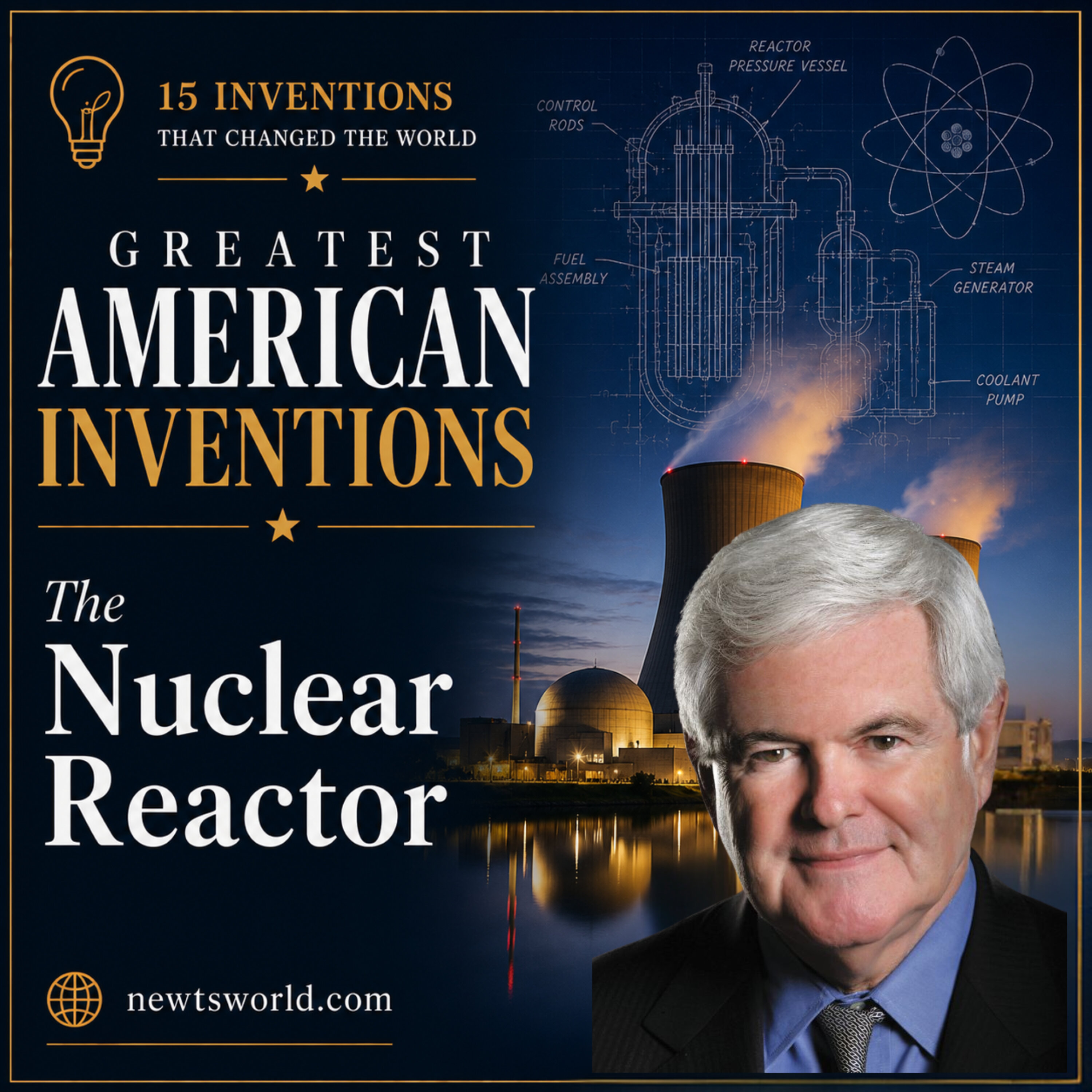
Welcome to Newt's World podcast on the iHeart Podcast Network, episode 10 of the Greatest American Inventions. Today's episode carries a weight the others don't. Every invention we've discussed has transformed the world for the better, with complications sometimes, but ultimately for the better. Today's invention is more ambiguous. It carries within it both enormous promise and the shadow of annihilation. The nuclear reactor. On the afternoon of December 2, 1942, between the west stands of Stagg Field, the football stadium at the University of Chicago, a team of scientists gathered around a structure they'd been assembling for weeks. Chicago pile number one, a stack of graphite blocks and uranium pellets designed to sustain a nuclear chain reaction. The man in charge was Enrico Fermi, Italian born, Nobel laureate, one of the greatest physicists of the century who had fled fascist Italy with his Jewish wife in 1938 and come to America. At 2 in the afternoon, Fermi ordered the final control rod withdrawn. Counters measuring neutron flux began clicking faster and faster. The clicking merged into a continuous roar. For 28 minutes, Chicago pile number one sustained the first self sustaining nuclear chain reaction in human history. It produced half a watt of power, barely enough to light a flashlight, but it proved the concept. Fermi sent a coded message. The Italian navigator has just landed in the new world. Chicago pile number one was part of the Manhattan Project, the secret program to develop atomic weapons before Nazi Germany could. The scientists involved were an extraordinary collection of minds, many of them European refugees who had fled fascism. Fermi, Leo Szilard, Edward Teller, Hans Beth, Niels Bohr visiting under a code name, and J. Robert Oppenheimer leading the weapons design at Los Alamos. The first nuclear weapon was tested in July 1945. In August, Atomic bombs fell on Hiroshima and Nagasaki, killing between 150,000 and 250,000 people and ending World War II. The ethical dimensions of those decisions have been debated ever since, and I suspect they'll be debated forever. But the reactor also gave us something else. Nuclear power. The first commercial nuclear power plant in the United States opened its shipping port, Pennsylvania in 1958. Eisenhower personally connected it to the grid. Nuclear plants use heat from fission to produce steam drive turbines, generate electricity with no carbon dioxide, no air pollution, and enormous energy from very small amounts of fuel, Nuclear power is by most measures the safest large scale electricity source that exists. Deaths per unit of energy produced are lower than coal, lower than natural gas, lower than oil, even lower, accounting for manufacturing than solar panels. The famous disasters, Three Mile Island, Chernobyl, Fukushima killed far fewer people than the routine operation of coal plants kills every year through air pollution. And yet nuclear power is deeply feared. It carries a psychological weight that other energy sources don't. After Three Mile island in 1979 and Chernobyl in 1986, public support collapsed. Plant construction essentially stopped. In the United States, a technology that might have provided clean, reliable, abundant electricity became politically untouchable. Now, in the context of climate change, the conversation is shifting again. Small modular reactors, safer, cheaper, more flexible than the plants of the 1970s are under development across the country. There's a growing recognition even among some environmentalists that getting to a zero carbon electric grid without nuclear power is extraordinarily difficult. Enrico fermi died in 1954 of stomach cancer at 53. The element fermium, number 100 on the periodic table is named for him. Woody demonstrated that December afternoon was a new world. One in which humanity had access to the energy locked inside the atom. A world that could be illuminated by it or destroyed by it. We are still figuring out how to live in it. Next time we go to orbit 12,500 miles above Earth, where a network of satellites quietly guides every navigation app on every smartphone on the entire planet. GPS. New World is produced by Gingrich360 and iHeartMedia. Our executive producer is Garnesy Sloan. Our researcher is Rachel Peterson. Special thanks to the team at Gingrich 360. If you've been enjoying Newts World, I hope you'll go to Apple Podcasts and both rate us with five stars and give us a review so others can learn what it's all about. Join me on substack@gingrich360.net I'm Newt Gingrich. This is Newtsworld.
- [08:07]
A
Healthcare can feel complicated. That's why Optum uses technology to connect the people and processes that make healthcare easier, more affordable, and more effective. We're making it clearer for you to know exactly what your benefits cover and to help you better manage your health. We're coordinating care between your doctors and your technology. We believe better, simpler healthcare is always possible. That's healthy optimism. That's optim. Visit optum.com to learn more.
- [08:37]
C
Dad Disney activities are on Lingokids what? Moana and Elsa and Marvel's Spider Man. All of them on Lingokids? Yes, dad on Lingokids. That's pretty cool. I know.
- [08:49]
A
You just lost them for the rest of the afternoon.
- [08:52]
C
Worth it. Full of fun activities inspired by Disney's Moana, Frozen Zootopia, Marvel's Spider man and more. Lingokids is where little ones discover more about favorite characters. Bingo cakes, everything kids love, download it for free.
- [09:09]
D
Real value shows up in reliability. You don't have to second guess. Like a set of Firestone All Season tires. They're designed to deliver confidence, inspiring wet weather, traction and a quieter ride no matter the road. Season after season. Firestone All Season tires for durability you can count on just like people count on you. Firestone always dependable since 1900
- [09:37]
A
people at work supported me while I was going through treatment. By not treating me like somebody who was going through treatment. Treatment sucks. Cancer sucks. Being engaged with work really helped to I just knew I was going to beat this day.
- [09:54]
C
Research shows there is a significant connection between the ability to continue to work and cancer recovery. We can make work a better place for healing.
- [10:04]
A
Learn more and sign the pledge at workingwithcancerpledge.
- [10:07]
C
Com.
- [10:07]
A
This is an iHeart podcast. Guaranteed Human.