Loading summary
Transcript4 lines
- [00:00]
A
This is an iHeart podcast. Guaranteed Human.
- [00:04]
B
Your whole neighborhood goes black in seconds except your house. The Patriot Power Generator 2200X from 4 Patriots keeps your lights on when the grid goes down. It's the most powerful generator 4 Patriots has ever built. 4 Patriots gives you backup power without gas fumes or a loud engine. Just lights, a cold fridge, and peace of mind when the power fails. Right now, save $500 and get two solar panels free. That means you can recharge twice as fast, but only while supplies last. Keep your lights on, your food cold, and your family calm when the grid goes down. Don't wait for the next blackout. Visit four patriots.com today. That's the number four P A T R I-O-T S.com and see why families trust. Four patriots to stay ready Foreign.
- [00:57]
C
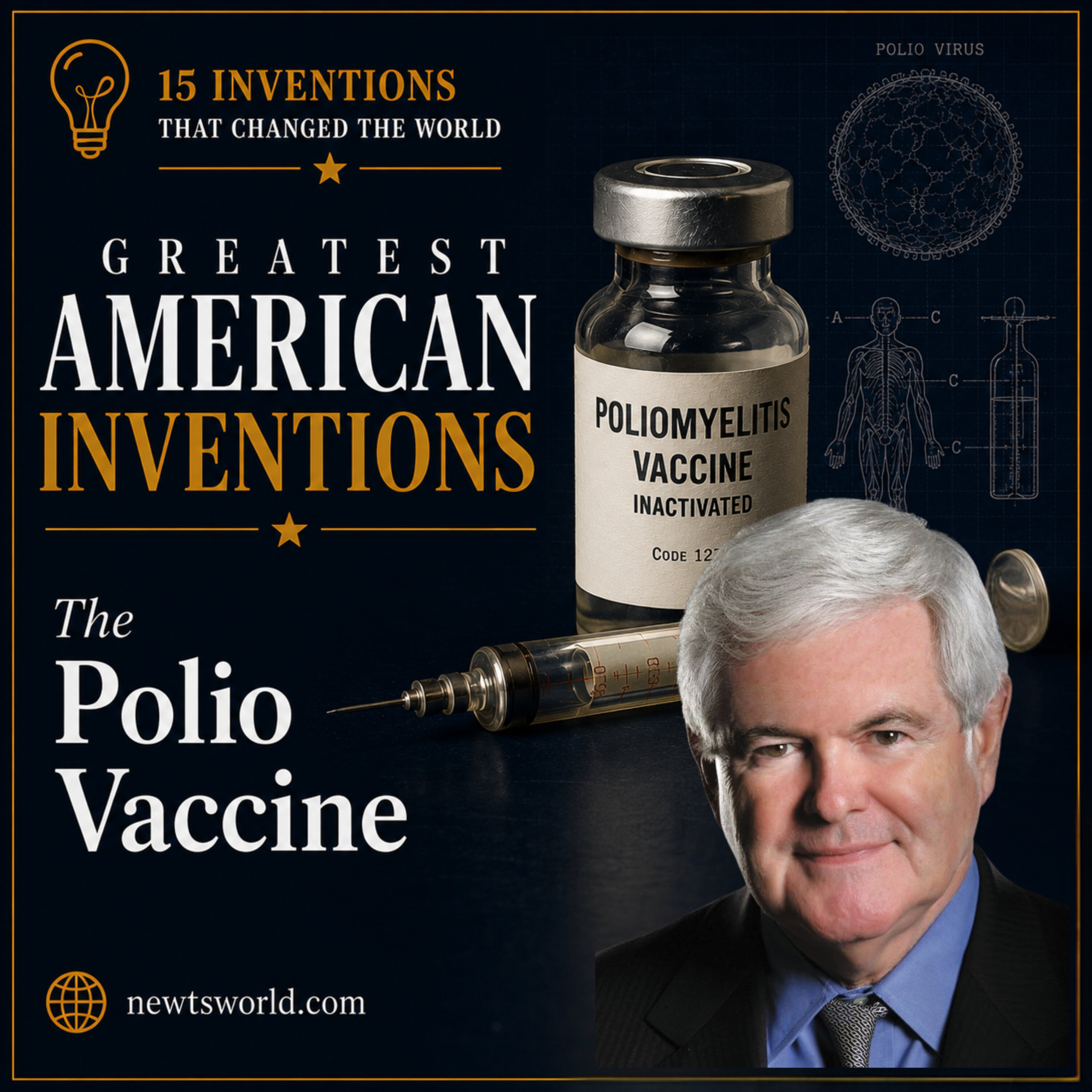
Welcome to Newts World podcast on the iHeart Podcast Network, episode six of the Greatest American Inventions. Today we're not talking about a device or a network or a machine. We're talking about a needle and the liquid it contained and the millions of children who held out their arms and were saved. The Polio Vaccine if you were born after 1960, you probably never known anyone who had polio. That absence is itself the measure of this invention's success. But if you were born before 1955, you almost certainly remember what summers were like when polio was real. Swimming pools closed, movie theaters emptied, parents kept children indoors. The Iron Lung, a metal cylinder that breathed for you when the virus had paralyzed your respiratory muscles, was a fixture of hospital wards in 1952, the worst outbreak in American history. Nearly 58,000 cases. 3,000 dead. More than 21,000 paralyzed. Jonas Salk would not accept this. Working at the University of Pittsburgh, he pursued what the scientific establishment considered the wrong approach a killed virus vaccine using an activated polio virus that could not cause disease but would still trigger an immune response. The leading researchers of the day believed only a live, weakened virus could produce lasting immunity. Salk disagreed, and he was right. His approach was methodical and meticulous, identifying which strains were circulating, finding ways to grow the virus in sufficient quantities, killing it reliably without destroying its ability to provoke immunity. By 1953, he was confident enough to inoculate himself and his own family. In 1954, the largest clinical trial in American history, 1.8 million children called polio pioneers, received either the salt vaccine or a placebo. On April 12, 1955, 10 years the day after President Roosevelt's death, the results were announced in Ann Arbor. Safe and effective in some trials, 90% efficacy against paralytic polio. Church bells rang across the country. Strangers embraced schools, let children out early. President Eisenhower, a man who had commanded the Allied forces in Europe and witnessed extraordinary things, reportedly broke down in tears when he met Salk at the White House. And then came the question every reporter wanted to ask. Who owns the patent on this vaccine? Salk looked puzzled. The people, he said, could you patent the sun? He had deliberately not patented the vaccine. He wanted it manufactured as widely and cheaply as possible, as quickly as possible. The royalties, had he patented, would have been worth billions. He gave it away. The results were swift and dramatic. 58,000 cases in 1952, fewer than 6,000 by 1957. Fewer than a thousand by 1961. Wild polio virus eliminated from the United States by 1979. Albert Sabin's oral vaccine, introduced in 1961, made immunization even easier. Taken on a sugar cube, no needle required, and accelerated the global campaign. Thanks to the Global Polio Eradication Initiative, launched in 1988, wild polio virus has been driven to the very edge of extinction worldwide. Salk's decision not to patent the vaccine speaks to a tradition in American science that I find deeply important. There's always been a tension between the commercial and the philanthropic in American innovation. Both traditions are legitimate. The profit motive drives enormous amounts of research. But Salk represents something different. The scientist who sees his work as fundamentally in the service of humanity, who looks at a child in iron lung and does not calculate. A royalty who looks at the sun and says, you cannot own this. That tradition, the Land Grant University publicly funded research discoveries shared with the world, is also deeply American. Salk died in 1995, still a working scientist pursuing research into AIDS. And the children who held out their arms in 1954 are in their 70s and 80s now. Many walk without braces. Many breathe without machines. They got to grow up and have children and grandchildren. Because Jonas Salk decided he could not patent the sun. Next time we move from medicine to military research into the night of October 29, 1969, when a graduate student typed two letters and accidentally changed the world. Newts World is produced by Gingrich 360 and iHeartMedia. Our executive producer is Garnes E. Sloan. Our researcher is Rachel Peterson. Special thanks to the team at Gingrich360. If you've been enjoying Newts World, I hope you'll go to Apple Podcasts and both rate us with five stars and give us a review so others can learn what it's all about. Join me on substack@gingrich360.net I'm Newt Gingrich. This is Newt's World.
- [07:16]
A
This is an iHeart podcast. Guaranteed Human.