Loading summary
Transcript51 lines
- [00:00]
Podcast Host
This is an iHeart podcast.
- [00:02]
Amazon Health AI Narrator
Guaranteed Human Amazon Health AI presents painful thoughts.
- [00:09]
Podcast Guest or Narrator
I. I can't stop scratching my downtown. Mm, yeah, but I'm not itching to go downtown and tell a receptionist I'm here to talk about my downtown. Some things you'd rather type than say out loud.
- [00:24]
Amazon Health AI Narrator
There's no question too embarrassing for Amazon Health AI. Chat your symptoms and get virtual care 24. 7 Healthcare just got less painful.
- [00:34]
Parent
Dad, Disney activities are on Lingokids.
- [00:38]
Child
What?
- [00:38]
Parent
Moana and Elsa and Marvel's Spider Man.
- [00:41]
Child
All of them on Lingokids.
- [00:42]
Parent
Yes, dad, on Lingokids.
- [00:45]
Child
That's pretty cool.
- [00:46]
Parent
I know.
- [00:47]
Podcast Host
You just lost them for the rest of the afternoon.
- [00:50]
Child
Worth it.
- [00:51]
Lingokids Advertiser
Full of fun activities inspired by Disney's Moana, Frozen Zootopia, Marvel's Spider man and more. Lingokids is where little ones discover more about favorite characters.
- [01:01]
Parent
Bingo. Kids.
- [01:02]
Child
Everything kids love. Download it for free.
- [01:06]
Firestone Advertiser
Your vehicle doesn't just get you from here to there. It's a bridge to the people and places that matter most. It's how you show up for your family, your community, and everyone else that depends on you. That's why for 125 years, Firestone has been building tires with one thing in mind. To deliver products that are as reliable as you are. Firestone, always dependable since 1900.
- [01:35]
Monday.com Narrator
This Monday.com ad was created by a team of people and AI agents. Reece, our content agent, wrote the copy based on our best practices, like mentioning Monday.com three times. That was the second. Johnny, our coordination agent, built the timeline and kept everyone aligned. Olivia, our human creative director, stayed in the loop because agents are great, but they don't always know when a joke lands. She had one note tell listeners it only takes minutes to build an agent. So minutes. Create your own AI agent. Today on Monday dot com.
- [02:09]
Newt Gingrich
Welcome to Newts World Podcast on the
- [02:11]
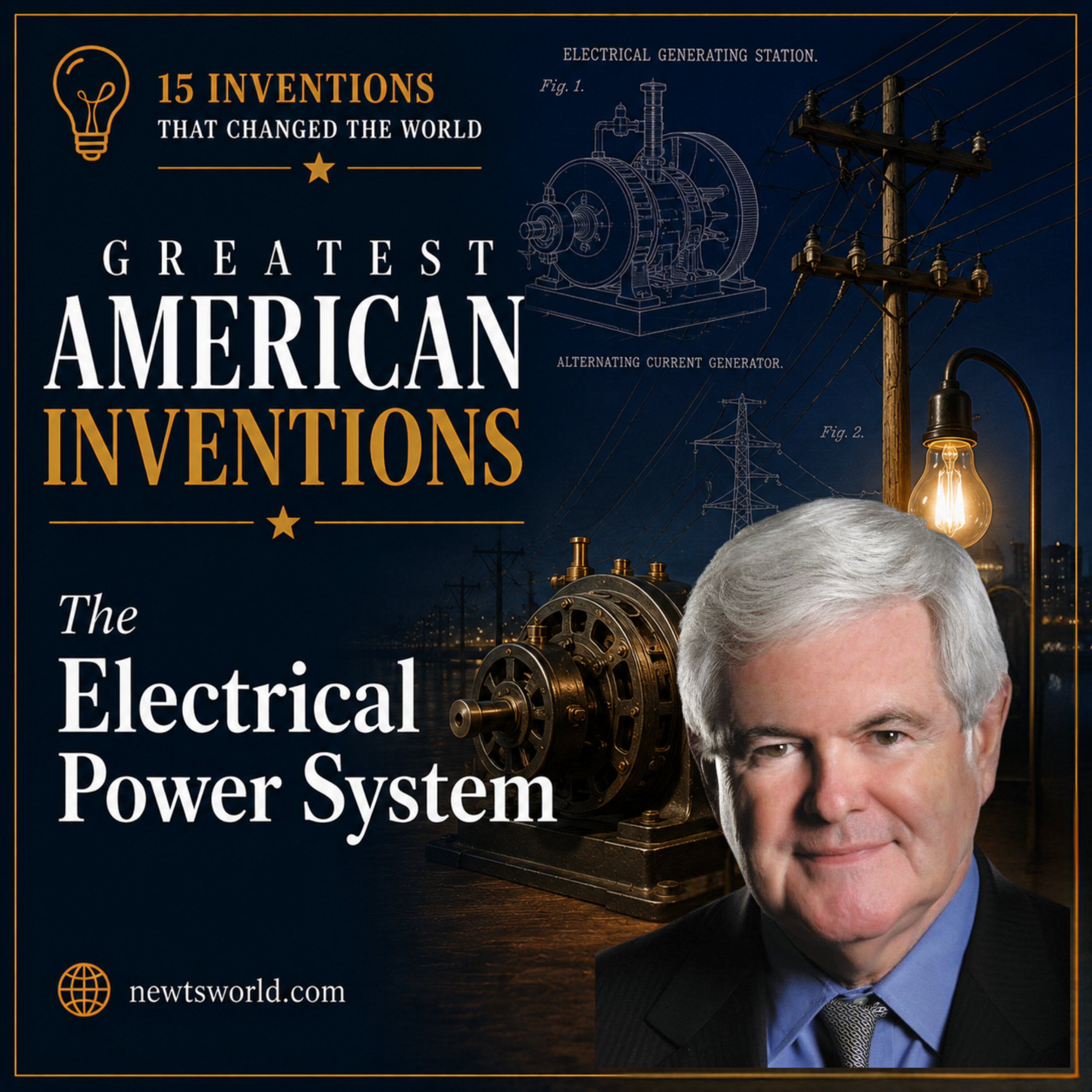
iHeart Podcast Network, episode four of the Greatest American Inventions. Today, we reach what I consider the single most consequential invention in this entire series. Because here's the truth. Every other invention we discuss. The telephone, the transistor, the Internet, gps, the smartphone. None of them work without it. This is the foundation on which the modern world is built. The electrical power system. The story is really three stories tangled together. Thomas Edison, Nikola Tesla, and George Westinghouse. And for a while, they were at war with each other. Edison opened the Pearl street station in lower Manhattan on September 4, 1882, the world's first commercial electrical power station. On opening day, it served 85 customers and powered 400 lamps. He had not just Invented a light bulb. He had invented the electrical utility. But Edison's system used direct current dc, and DC loses tremendous energy to resistance as it travels along a wire. His system could only serve customers within about a mile of a generating station. To electrify a city, you'd need generating stations every mile. That was expensive, complicated and limiting. Enter Nikola Tesla. Serbian born, a genius of the first order, who had once worked for Edison. Tesla had been developing alternating current ac. In AC systems, voltage can be transformed, stepped up for transmission over long distances, then stepped back down for use in homes. High voltage, low current, low energy loss. AC power can travel hundreds of miles. Tesla found a backer in George Westinghouse, a Pittsburgh industrialist who'd made his fortune inventing the railroad air brake and who saw immediately that AC was the future.
- [04:32]
What followed was the war of currents, one of the great technological battles in American history.
- [04:38]
Edison fought back hard.
- [04:40]
He organized public demonstrations, electrocuting animals with ac trying to convince the public it was dangerous. He lobbied against it, but the physics were against him. The contest was settled at the 1893 World's Fair in Chicago. Westinghouse underbid Edison by half to light
- [05:01]
the entire Exposition with AC Power.
- [05:05]
27 million people attended. They saw for the first time what a fully electrified world might look like. Buildings blazed with more than 100,000 light bulbs. The night was turned into day. Ha C had won. The rollout across America was one of the great infrastructure achievements in human history. By 1930, 2/3 of American homes had electric power. The Rural Electrification administration, created in 1935 under Franklin Roosevelt, extended power to farms and small towns that private utilities had ignored as unprofitable. When electricity came to rural America, it was genuinely transformative. Electric pumps replaced hand pumps. Electric refrigerators replaced iceboxes. The labor of running a household was reduced dramatically. And mostly it was women whose work was lightened. The electrification of America was, among other things, a revolution in human time. Why did the practical electrical power system emerge from America? The physics were understood in Europe. Michael Faraday, James Clerk Maxwell. The theoretical foundations were British. The answer has several parts scale. America in the late 19th century had an enormous appetite for practical solutions. Capital, sophisticated financial markets that could fund risky ventures. Culture, a particular reverence for inventors and entrepreneurs. And competition. The war of currents, which drove both sides to improve their technology and make their cage to customers. Competition made the electrical system better. That's worth remembering. I'll close with this. When historians debate the single most important technological development of the modern era. Electricity belongs very near the top. It is not merely a technology itself. It is the enabler of technology, the infrastructure on which everything else runs. Edison, Tesla and Westinghouse gave us more than light. They gave us the foundation of civilization as we know it. Next time, we head to build laboratories in New Jersey, where in 1947, three scientists create the tiny device that makes every digital technology possible. The transist.
- [07:48]
Newts World is produced by Gingrich 360 and iHeartMedia.
- [07:52]
Our executive producer is Garnesey Sloan.
- [07:54]
Our researcher is Rachel Peterson. Special thanks to the team at Gingrich360. If you've been enjoying Newts World, I
- [08:02]
hope you'll go to Apple Podcasts and both rate us with five stars and
- [08:06]
give us a review so others can learn what it's all about. Join me on substack@gingrich360.net I'm Newt Gingrich. This is Newt's World.
- [08:23]
Parent
Dad Disney activities are on Lingokids.
- [08:26]
Child
What?
- [08:27]
Parent
Moana and Elsa and Marvel's Spider man are on all of them.
- [08:30]
Child
On Lingokids.
- [08:31]
Parent
Yes, dad on Lingokids.
- [08:34]
Child
That's pretty cool.
- [08:35]
Parent
I know.
- [08:36]
Podcast Host
You just lost them for the rest of the afternoon.
- [08:39]
Child
Worth it.
- [08:40]
Lingokids Advertiser
Full of fun activities inspired by Disney's Moana, Frozen, Zootopia, Marvel's Spider man and more. Lingokids is where little ones discover more about favorite characters.
- [08:50]
Child
Lingokids everything kids love, download it for free.
- [08:55]
Firestone Advertiser
Real value shows up in reliability. You don't have to second guess. Like a set of Firestone All Season tires. They're designed to deliver confidence, inspiring wet weather, traction and a quieter ride no matter the road, season after season. Firestone All Season tires for durability you can count on, just like people count on you. Firestone always dependable since 1900.
- [09:24]
Cancer Patient
I think when you're diagnosed with cancer, you crave a semblance of normalcy and control. And so work allowed me to be me. So I think it's really important that companies stay flexible. Cancer in a diagnosis can be all consuming, but it doesn't have to be.
- [09:40]
Cancer Researcher
Research shows there is a significant connection between the ability to continue to work and cancer recovery. We can make work a better place
- [09:50]
Podcast Host
for healing, learn more and sign the pledge at working with cancerpledge. Com.
- [09:54]
Jack Armstrong
Why should you listen to Armstrong and Getty on demand? We're not boring. Lot of news is boring and tedious and depressing and makes you angry. You don't want to live your life like that. Hey, I'm Jack Armstrong.
- [10:06]
Lingokids Advertiser
He's Joe Getty.
- [10:06]
Jack Armstrong
We're Armstrong and Getty. We try to bring you the truth and help you figure out this crazy
- [10:10]
Child
modern world about something about a comedic tone.
- [10:16]
Jack Armstrong
We have a winner. Yes. Listen to Armstrong. You get it on Demand on the iHeartRadio app, Apple Podcasts, or wherever you get your podcasts.
- [10:24]
Podcast Host
This is an iHeart podcast. Guaranteed Human.