Loading summary
Transcript62 lines
- [00:00]
Podcast Host
This is an iHeart podcast.
- [00:02]
Amazon Health AI Advertiser
Guaranteed Human Amazon Health AI presents painful
- [00:08]
C
thoughts why did I search the Internet for answers to my cold sore problem? Now I'm stuck down a rabbit hole filled with images of alarmingly graphic sores in various stages of ooze. I can clear my search history, but I can never unsee that.
- [00:27]
Amazon Health AI Advertiser
Don't go down the rabbit hole. Amazon Health AI gets you the right care fast. Healthcare just got less painful.
- [00:34]
Monday.com Ad Narrator
This Monday.com ad was created by a team of people and AI agents. Reese, our content agent, wrote the copy based on our best practices, like mentioning Monday.com three times. That was the second. Johnny, our coordination agent, built the timeline and kept everyone aligned. Olivia, our human creative director, stayed in the loop because agents are great, but they don't always know when a joke lands. She had one note tell listener it only takes minutes to build an agent. So minutes. Create your own AI agent. Today on Monday.com mom, can I have Lingokids?
- [01:07]
Child 1
Dad, Lingokids, please.
- [01:08]
Parent 1
When did we become the Lingokids House?
- [01:11]
Parent 2
No idea. Last week it was dinosaurs.
- [01:13]
Child 1
This week it's Lingokids.
- [01:15]
Parent 1
Why Lingokids?
- [01:16]
Child 1
Because it's the best thing ever. We can play games with astronauts, wild animals and superheroes.
- [01:21]
Lingokids Advertiser
With more than 4,000 interactive games, songs and shows, LingoKids is the number one entertainment platform for young kids.
- [01:28]
Parent 2
So no dinosaurs and dinosaurs.
- [01:31]
Child 2
Lingokids.
- [01:32]
Parent 1
Everything kids love. Download it for free.
- [01:36]
McDonald's Ad Narrator
All new drinks are now at McDonald's
- [01:39]
McDonald's Ad Voice 1
with refreshers like the Strawberry Watermelon Refresher
- [01:42]
McDonald's Ad Voice 2
and the Mango Pineapple Refresher with popping Boba.
- [01:46]
McDonald's Ad Voice 1
To crafted sodas like the Sprite Berry
- [01:49]
McDonald's Ad Voice 2
Blast with berry flavors and cold foam.
- [01:53]
McDonald's Ad Narrator
Who knew ice cold drinks could be so fire six. All new drinks are here now at McDonald's.
- [02:03]
McDonald's Ad Disclaimer
Refreshers contain caffeine.
- [02:10]
Newt Gingrich
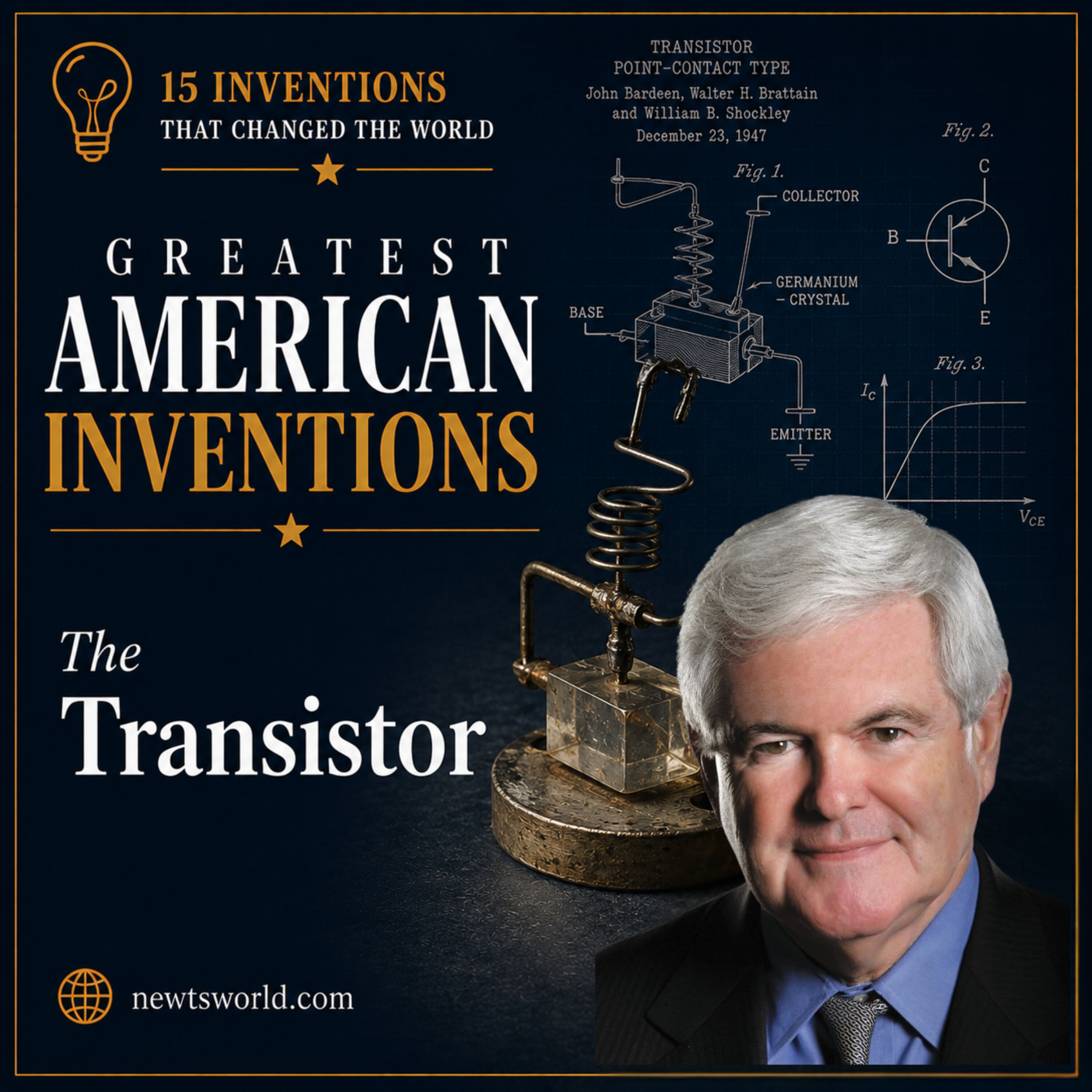
Welcome to Newts World podcast on the iHeart podcast network. The Greatest American Inventions Today's invention is the one that, more than any other, made the digital age possible. Without it, no computers, no smartphones, no Internet, no gps. It is the fundamental building block of every electronic device made in the last 75 years. And most people have never thought about it for a single second, even though they're surrounded by billions of them at every moment of every day. That is the transistor. Before the transistor, electronic circuits ran in vacuum tubes, glass bulbs with metal electrodes that could amplify or switch electrical signals. They worked. ENIAC, the first general purpose electronic computer, built in 1945, contained about 18,000 vacuum tubes. It weighed 30 tons, occupied 1800 square feet and consumed 150 kilowatts of power. And vacuum tubes burned out constantly. They were fragile, expensive, hot and large. At Bell telephone laboratories in Murray hill, New jersey, then one of the greatest scientific institutions in the world, A team assembled to work on solid state physics. The team was led by William Shockley with key collaborators John Bardeen, one of the most exceptional theoretical physicists of the century, and Walter Bratton, a gifted experimental physicist with a talent for making things actually work. On December 16, 1947, Bardian and Bratton demonstrated the first working transistor, A small piece of germanium with two gold foil contacts. It could amplify an electrical signal. Shockley, learning of their success, produced an improved design, the junction transistor, which became the basis for virtually all transistor technology that followed.
- [04:30]
Carvana Customer
All.
- [04:31]
Newt Gingrich
All three shared the Nobel Prize in Physics in 1956. The implications were immediately apparent to engineers, if not to the public. Here was a device that could do everything a vacuum tube could do, but solid state small, fast, cool, reliable and cheap. Bell labs, under pressure from the government, licensed the technology broadly, rather than keeping it proprietary. Any company could manufacture transistors, and they did. The first transistor radios appeared in 1954. Small, battery powered, fit in a shirt pocket. Rock and roll spread, partly because transistor radios made music mobile and personal for the first time. But the much larger development came in 1958, when Jack Kilby at Texas Instruments and Robert Noyce at Fairchild Semiconductor independently invented the integrated circuit, putting multiple transistors on a single piece of semiconductor with connections built in. Now you could put not just one transistor, but dozens, then hundreds, then millions, and then billions, onto a chip the size of a fingernail. Intel's first microprocessor in 1971, contained 2,300 transistors as powerful as the 30 ton ENIAC, smaller than a thumbnail. Today's most advanced chips contain more than 100 billion transistors operating at billions of cycles per second. Each transistor smaller than many viruses. And the cost per transistor has fallen so far, it is essentially zero. This progression, Moore's law, has continued for more than 50 years, the most sustained technological advance in history, all built on the transistor. Bardeen, remarkably, won a second Nobel prize for a completely different discovery, the theory of superconductivity, making him only one of four people in history to win the Nobel prize twice. But here's what I find most remarkable about this story. It was born of basic research. Not a military contract, not a crisis, not a specified commercial goal. Just fundamental scientific inquiry into how electrons behave in solid materials, funded by a private company that understood in a general way that understanding electrons would eventually lead to better communications. Bell Labs didn't know what they were looking for. They were just looking, and what they found changed everything. That's the argument for basic research. You cannot always know in advance what fundamental knowledge will produce. You fund the best minds, point them at the hardest problems, and trust that what they discover will matter. Bell Labs in its heyday has one of the greatest arguments for that philosophy that history has to offer. Next time we move from the laboratory to the syringe, from New Jersey to Pittsburgh, and meet a doctor who asks himself why should children have to be afraid of summer? The polio vaccine.
- [08:20]
Newts World Producer
Newts World is produced by Gingrich360 and iHeartMedia.
- [08:23]
Newt Gingrich
Our executive producer is Garnzee Sloan.
- [08:26]
Newts World Producer
Our researcher is Rachel Peterson. Special thanks to the team at Gingrich 360. If you've been enjoying Newts World, I
- [08:33]
Newt Gingrich
hope you'll go to Apple Podcasts and both rate us with five stars and
- [08:37]
Newts World Producer
give us a review so others can learn what it's all about. Join me on substack@gingrich360.net I'm Newt Gingrich. This is Newt's World.
- [08:56]
McDonald's Ad Narrator
All new drinks are now at McDonald's
- [08:59]
McDonald's Ad Voice 1
with refreshers like the Strawberry Watermelon Refresher
- [09:02]
McDonald's Ad Voice 2
and the Mango Pineapple Refresher with Popping Boba.
- [09:06]
McDonald's Ad Voice 1
To crafted sodas like the Sprite Berry
- [09:09]
McDonald's Ad Voice 2
Blast with berry flavors and cold foam.
- [09:12]
McDonald's Ad Narrator
Who knew ice cold drinks could be so fire
- [09:18]
Newt Gingrich
six?
- [09:19]
McDonald's Ad Narrator
All new drinks are here now at McDonald's.
- [09:23]
McDonald's Ad Disclaimer
Refreshers contain caffeine.
- [09:25]
Jack Armstrong
Why should you listen to Armstrong and Getty on Demand? We're not boring. A lot of news is boring and tedious and depressing and makes you angry. You don't want to live your life like that. Hey, I'm Jack Armstrong.
- [09:37]
Lingokids Advertiser
He's Joe Getty.
- [09:37]
Jack Armstrong
We're Armstrong and Getty. We try to bring you the truth and help you figure out this crazy
- [09:41]
McDonald's Ad Disclaimer
modern world about something about a comedic tone.
- [09:47]
Jack Armstrong
We have a winner. Yes. Listen to Armstrong and Yeti on Demand on the iHeartRadio app, Apple Podcasts, or wherever you get your podcasts.
- [09:56]
Parent 1
Evening. Buyer's remorse. Buy a new car. I'll be moving in. Let's get started.
- [10:03]
Carvana Customer
Sorry, I think there's been a mistake. I bought it from Carvana.
- [10:06]
Parent 1
You what?
- [10:07]
Carvana Customer
Yeah, Great price. I even have seven days to love it or return it.
- [10:10]
Parent 1
So there's no.
- [10:11]
Carvana Customer
No, no buyer's remorse. More like buyers rejoice.
- [10:15]
Parent 1
I guess I'll let myself out. Congratulations. I mean it.
- [10:20]
Carvana Customer
Buyers rejoice. Buy your car today on Carvana.
- [10:22]
Newt Gingrich
Limitations and exclusions may apply.
- [10:23]
Parent 2
See our 7 day return policy at
- [10:24]
McDonald's Ad Narrator
Carvana.com all new drinks are now at
- [10:28]
McDonald's Ad Voice 1
McDonald's with refreshers like the Strawberry Watermelon
- [10:32]
McDonald's Ad Voice 2
Refresher and the Mango Pineapple Refresher with Popping Boba.
- [10:36]
McDonald's Ad Voice 1
To crafted sodas like the Sprite Berry
- [10:39]
McDonald's Ad Voice 2
Blast with berry flavors and cold foam.
- [10:43]
McDonald's Ad Narrator
Who knew ice cold drinks could be so fire six? All new drinks are here now at McDonald's.
- [10:53]
McDonald's Ad Disclaimer
Refreshers contain caffeine.
- [10:55]
Podcast Host
This is an iHeart podcast. Guaranteed human.