Loading summary
Transcript28 lines
- [00:00]
A
This is an iHeart podcast. Guaranteed Human Introducing B of A Rewards A new loyalty program with rewards for every ambition. From cash back deals on brands you know and love to a credit card rewards bonus. From fueling up to rewards that fuel your goals. It all starts with a Bank of America checking account and grows from there. What would you like the power to do? Bank of America Open or enroll your account@bankofamerica.com B ofarewards bank of America Corporation. All rights reserved.
- [00:35]
B
Amazon Health AI presents painful thoughts I
- [00:40]
A
I can't stop scratching my downtown. Yeah, but I'm not itching to go downtown and tell a receptionist I'm here to talk about my downtown. Some things you'd rather type than say out loud.
- [00:54]
B
There's no question too embarrassing for Amazon Health AI. Chat your symptoms and get virtual care 24. 7 Healthcare just got less painful.
- [01:06]
C
Real value shows up in reliability. You don't have to second guess. Like a set of Firestone All Season tires. They're designed to deliver confidence, inspiring wet weather, traction and a quieter ride. No matter the road. Season after season. Firestone All Season tires for durability you can count on, just like people count on you. Firestone always dependable since 1900.
- [01:35]
D
Mom, can I have Lingokids? Dad? Lingokids, please.
- [01:39]
E
When did we become the Lingokids house?
- [01:41]
F
No idea. Last week it was dinosaurs.
- [01:43]
D
This week it's Lingokids.
- [01:45]
E
Why Lingokids?
- [01:46]
D
Because it's the best thing ever. We can play games with astronauts, wild animals and superheroes.
- [01:51]
E
With more than 4,000 interactive games, songs and shows, LingoKids is the number one entertainment platform for young kids.
- [01:58]
F
So no dinosaurs and dinosaurs.
- [02:02]
E
Everything kids love. Download it for free.
- [02:09]
G
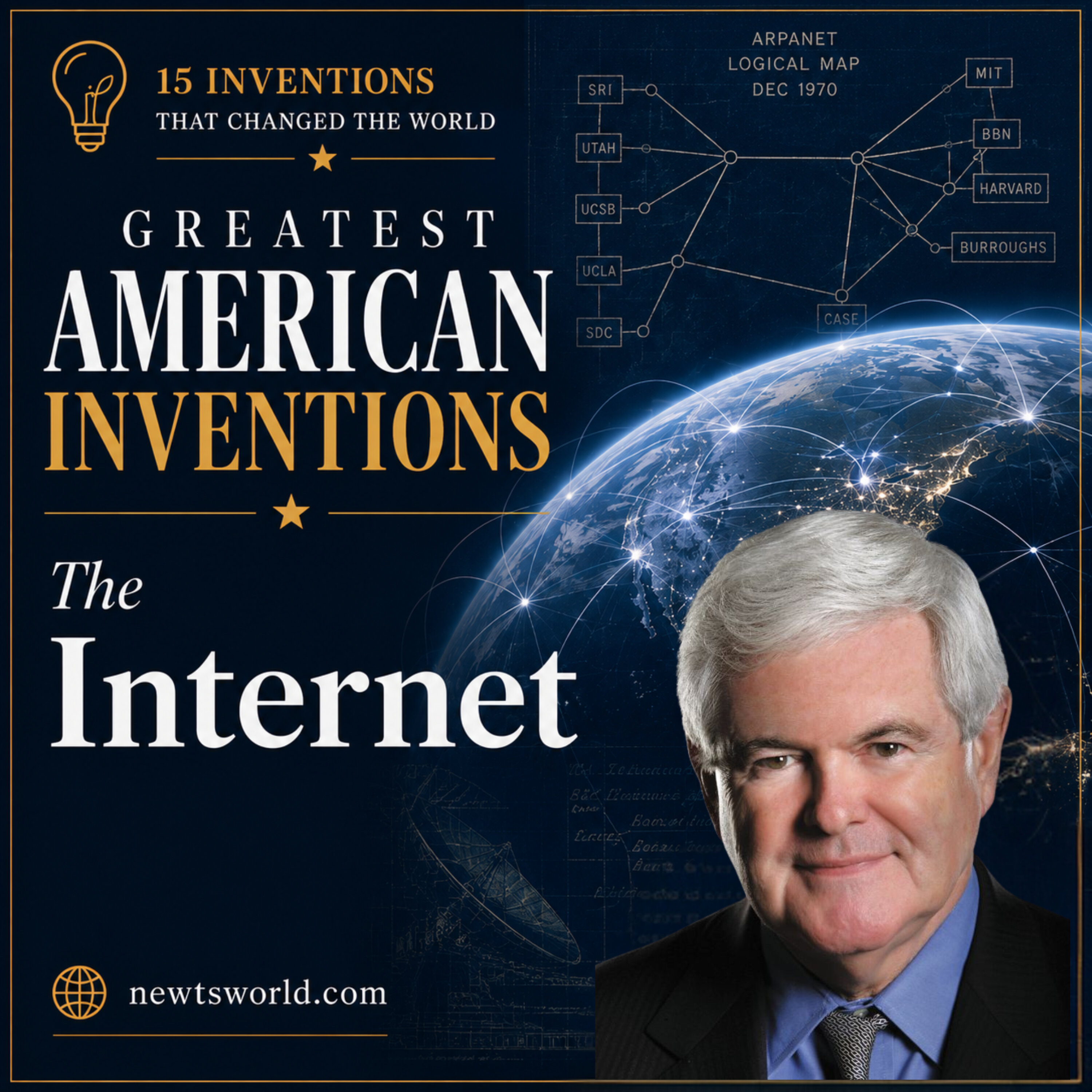
Welcome to Newts World podcast on the iHeart Podcast Network. Episode 7 of the Greatest American Inventions. Today's inventions done more to reshape daily life in the last 30 years than any other. And it began not in a garage or a university lab, but in the Pentagon. The Internet. On the night of October 29, 1969, a UCLA graduate student named Charlie Klein attempted to log into a computer at Stanford, 350 miles away over a network called Arpanet. He typed L. Stanford received it. He typed O. Stanford received it. He typed G. The system crashed. Those two letters, L and O, were the first message ever transmitted over what would become the Internet. Klein called Stanford on the telephone to report what happened. His colleague reportedly left. History doesn't always announce itself clearly. ARPANET was funded by the Defense Advanced Research Projects Agency. DARPA Cold War strategists worried That a nuclear attack could destroy centralized telephone switching centers. The solution? A network with no center, information broken into small packets, each finding its own path through whatever routes remained available. If one path was destroyed, packets would root around it. The concept was called packet switching, and it was the revolutionary idea at the heart of the Internet. In 1974, Vince Cerf and Bob Kahn published a paper describing TCP IP, the universal language of the Internet. Before it, different computer networks existed but couldn't talk to each other. TCP IP was the common tongue, a set of rules so simple and universal that any computer anywhere could use it. Serf and kahn called their vision an Internet, short for internetwork. Through the 1970s and 1980s, the Internet grew steadily, Largely confined to universities, government agencies, and research institutions. Email emerged. File sharing emerged. A small, enthusiastic community of scientists built the early Internet's culture. Open, collaborative, skeptical of authority. Then, in 1991, British scientist Tim berners Lee, working at cern in switzerland but building entirely on american infrastructure, Invented the world wide web. A system of pages linked by clickable hyperlinks, browsable by anyone. He made it free. The commercial Internet exploded in 1993. About 50 websites existed by 2000. 17 million companies were born. Amazon in 1994, eBay in 1995. Google in 1998. The.com boom was followed by the crash, but the technology kept growing. The survivors went on to become among the largest corporations in human history. I want to pause on something genuinely remarkable about the Internet's origins. It was a government project funded by the defense department, developed at universities, funded by government grants, built on protocols published openly for anyone to use. And then the government let it go. In the early 1990s, the National Science foundation gradually withdrew and allowed commercial providers to take over the Internet's backbone. The government did not try to own or control or monetize the infrastructure it had built. It handed it to the world. That decision, to make the Internet open and commercial rather than closed and government controlled, Is one of the most consequential policy choices in the history of technology. China built a government controlled Internet. America built an open one. The results speak for themselves. The open Internet, with all its chaos and creativity and disruption, Generated more innovation and wealth and human connection than any planned alternative could have. Today, 5 billion people are connected. A farmer in Kenya chucks commodity prices. A student in rural India takes a college course. A doctor in a remote clinic consults a specialist in London. A small business in Ohio sells to customers in Japan, all starting with two letters and a crash. Next time, Albuquerque, New Mexico, then a garage in Los Altos, California, where a handful of young people decide that a computer should be something anyone can own. The personal computer. Newts World is produced by Gingrich 360 and iHeartMedia. Our executive producer is Garnzi Sloan. Our researcher is Rachel Peterson. Special thanks to the team at Gingrich360. If you've been enjoying Newts World, I hope you'll go to Apple Podcasts and both rate us with five stars and give us a review so others can learn what it's all about. Join me on substack@gingrich360.net I'm Newt Gingrich. This is Newt's World.
- [08:19]
C
Real value shows up in reliability. You don't have to second guess. Like a set of Firestone All Season tires. They're designed to deliver confidence inspiring wet weather, traction and a quieter ride no matter the road. Season after season. Firestone All Season tires for durability you can count on just like people count on you. Firestone always dependable since 1900
- [08:47]
D
dad Disney activities are on Lingokids.
- [08:51]
E
What?
- [08:51]
D
Moana and Elsa and Marvel's Spider Man.
- [08:54]
E
All of them on Lingokids?
- [08:55]
D
Yes, dad on Lingokids.
- [08:58]
E
That's pretty cool.
- [08:59]
D
I know.
- [09:00]
F
You just lost them for the rest of the afternoon.
- [09:03]
E
Worth it. Full of fun activities inspired by Disney's Moana, Frozen Zootopia, Marvel's Spider man and more. Lingokids is where little ones discover more about favorite characters. Lingokids Everything kids love, download it for free.
- [09:18]
F
Healthcare can feel complicated. That's why Optum uses technology to connect the people and processes that make healthcare easier, more affordable, and more effective. We're making it clearer for you to know exactly what your benefits cover and to help you better manage your health. We're coordinating care between your doctors and your technology. We believe better, simpler healthcare is always possible. That's healthy optimism. That's Optum. Visit optum.com to learn more.
- [09:48]
B
High interest debt is one of the toughest opponents you'll face unless you power up with a Sofi personal loan. A Sofi personal loan could repackage your bad debt into one low fix right rate monthly payment. It's even got super speed since you could get the funds as soon as the same day you sign. Visit sofi.compower to learn more. That's s o f I.com p o w E R Loans originated By SoFi Bank NA Member FDIC Terms and conditions apply. NMLS 696891 this is an iHeart podcast.
- [10:21]
A
Guaranteed Human.