Loading summary
Transcript9 lines
- [00:00]
4imprint Announcer
This is an iHeart podcast guaranteed human fall's a time to plan ahead and ensure your brand shows up in ways that matter. 4imprint's promotional products work as hard as you do and make a lasting impression. From quality apparel including exclusive brands, to drinkware, tech and totes, they've got thousands of options to fit your brand and budget. Plus you get free samples, expert help and their 360 degree guarantee so you'll be four imprint certain everything shows up just right, right on time. Explore more at 4imprint for Imprint for
- [00:34]
Sleep Number Announcer
Certain Sleep Number's new collections are designed to adapt to the changing nature of your life and your sleep needs. Whether it's the personalized comfort of the Comfort Mode mattress, the targeted pressure relief of the Comfort Next mattress, or the climate collection that actively cools or warms to help you fall asleep and stay asleep.
- [00:52]
Armstrong and Getty
And now get early access to our biggest sale of the year. Save 25% on the new ComfortNext Luxe for a limited time only at a Sleep Number Store or sleepnumber.com
- [01:05]
Military Recruitment Announcer
America its faith, freedom and opportunity owed to a long line of warriors and an ethos that remains unwavering. Our bravest stand tall on the shoulders of giants, securing peace through strength. Now is the time to earn your place in the fight. Learn more@war.gov.
- [01:35]
Grainger Announcer
This is the story of the One As a maintenance engineer at a beverage manufacturing plant, he starts his day knowing every line is ready to run because Grainger delivers the industrial grade products he needs to keep mixers, conveyors, and packaging equipment moving. With Grainger's vast selection of bearings, belts and motors, he keeps operations running smoothly so nothing grinds to a halt. Call 1-800-GRAINGER Click grainger.com or just stop by Granger for the ones who get it done.
- [02:09]
Newt Gingrich
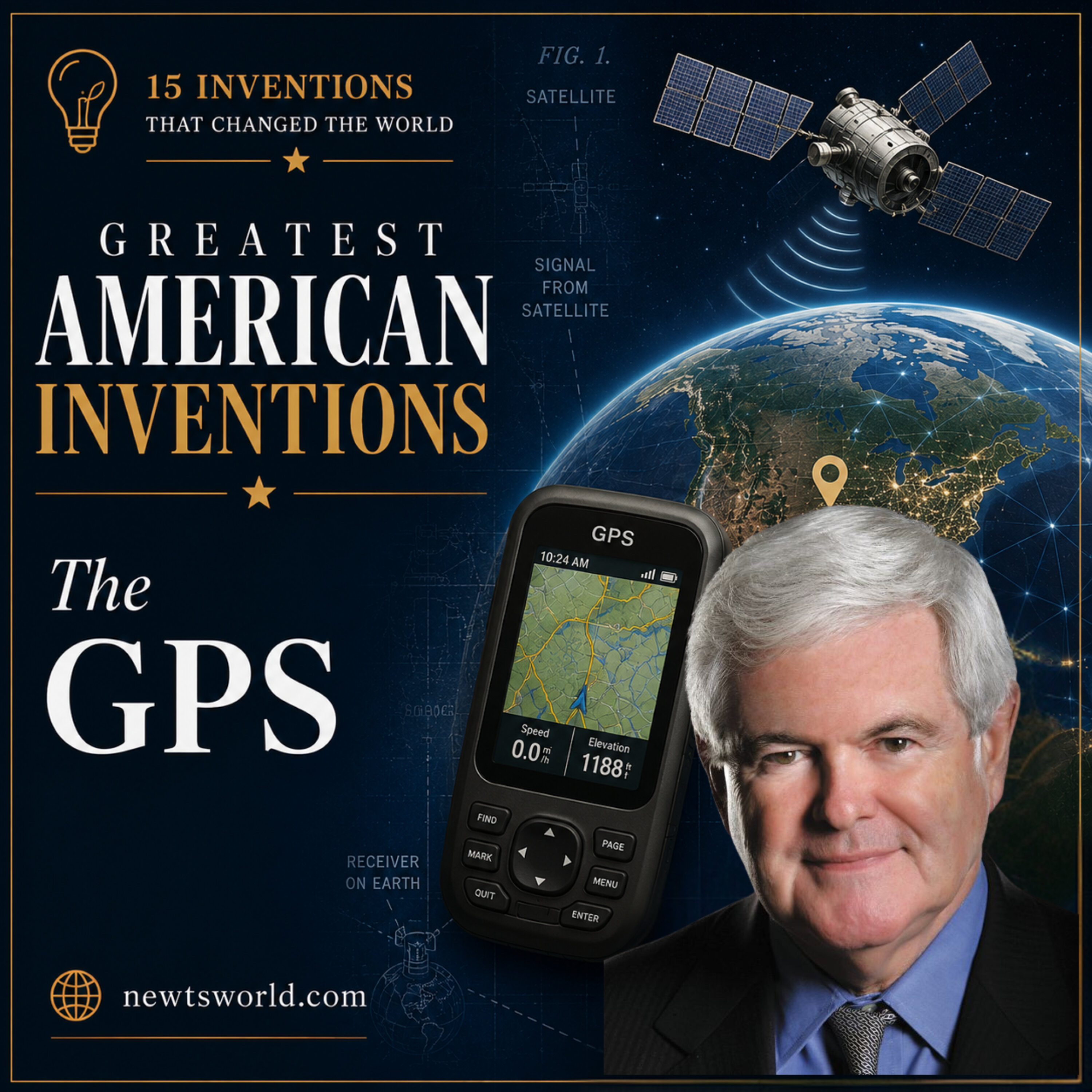
Welcome to Newts World Podcast on the iHeart Podcast Network, episode 11 of the Greatest American Inventions. Today's invention is one most Americans use every single day without thinking about it for a second. And it was a gift. A deliberate, expensive, strategic gift from the American government to every person on Earth. GPS the Global Positioning System is a network of 31 satellites orbiting 12,500 miles above Earth. Each broadcast a continuous radio signal containing two pieces of information the satellite's precise location and the precise time. A GPS receiver picks up signals from multiple satellites simultaneously. By measuring the tiny difference in arrival times, it calculates its distance from each satellite. With signals from four or more, it pinpoints its location in three dimensions latitude, longitude, altitude to within a few meters. The timing has to be accurate to billionths of a second. The satellites carry atomic clocks, and GPS receivers must account for effects predicted by Einstein's general relativity. Clocks in orbit tick at a slightly different rate than clocks on the ground. GPS is, among other things, a daily practical demonstration of Einstein's physics. The system was developed by the department of defense beginning in the early 1970s. First satellite launched in 1978. Full constellation operational in 1994. Total development costs roughly $12 billion. Designed as a military system for precision navigation and weapons guidance. But the decision that matters most in GPS history Was made not by an engineer. It was made by a president. On September 1, 1983, Soviet fighters shot down Korean Airlines Flight 007, which had strayed off course. All 269 people aboard were killed, in part because of a navigation error. President Reagan announced that once GPS was complete, it would be made freely available to civilian users worldwide. No charge, no license, no restrictions. The United States had spent billions building a navigation system and was now giving it to the entire world. Civilian applications took off slowly, then explosively. In 2000, President Clinton ordered the military degradation of the civilian signal removed, making civilian GPS as accurate as military. GPS chips rapidly shrank and fell in price by the mid 2000s. Stand alone navigation devices sold by the tens of millions. By 2010, GPS chips were standard in smartphones, and navigation apps like Google maps transformed how people move through the world. But navigation is the most visible application, not the most important one. Financial markets use GPS timing to synchronize transactions. The time stamping of trades requires microsecond accuracy, and GPS provides it. Without GPS timing, the modern financial system would not function. Cell networks use GPS to synchronize their towers. Aviation uses it for approach and landing. Farmers use it to plant with centimeter precision search and rescue teams locate people in distress. The National Institute of Standards and Technology estimated GPS contributes more than $1.5 trillion to the U.S. economy alone. Its global contribution is several times that. Its global contribution is several times that. GPS tells us something important about the relationship between government investment and technological progress. GPS could not have been built by the private sector in 1973. The cost was too high, the timeline too long, the payoff too uncertain. Only government could make that investment big. Government alone couldn't have generated the applications, the navigation apps, the agricultural tools, the financial systems that made GPS survival. Those required entrepreneurship, competition, and the creative energy of the private market. GPS is a story about the right relationship between government and the market. Government invests in foundational infrastructure. The private sector builds on it. And if the government is wise enough, as Reagan's administration was, to make that infrastructure openly available. The results can be extraordinary. One and a half trillion dollars in economic value from a gift. Next time, we go back to the street. A sidewalk in midtown Manhattan where in April 1973, an engineer made a phone call that would eventually connect 8 billion people. The mobile phone. Newts World is produced by Gingrich 360 and iHeartMedia. Our executive producer is Garnzi Sloan. Our researcher is Rachel Peterson. Special thanks to the team at Gingrich360. If you've been enjoying Newts World, I hope you'll go to Apple Podcasts and both rate us with five stars and give us a review so others can learn what it's all about. Join me on substack@gingrich360.net I'm Newt Gingrich. This is Newt's World.
- [08:19]
OnDeck Announcer
Ondeck is built to back small businesses like yours. Whether you're buying equipment, expanding your team or bridging cash flow gaps, OnDeck's loans up to $400,000 help make it happen. F Rated A by the Better Business Bureau and earning thousands of five star Trustpilot reviews, OnDeck delivers funding you can count on. Apply in minutes@ondeck.com depending on certain loan attributes. Your business loan may be issued by Ondeck or Celtic Bank. Ondeck does not lend in North Dakota. All loans an amount subject to lender approval.
- [08:49]
Armstrong and Getty
Why should you listen to Armstrong and Getty on demand? We're not boring. A lot of news is boring and tedious and depressing and makes you angry. You don't want to live your life like that. Hey, I'm Jack Armstrong. He's Joe Getty. We're Armstrong and Getty. We try to bring you the truth and help you figure out this crazy modern world about something about a comedic tone. We have a winner. Yes, listen to Armstrong and Yeti on Demand on the iHeartRadio app, Apple Podcasts or wherever you get your podcasts falls
- [09:19]
4imprint Announcer
a time to plan ahead and ensure your brand shows up in ways that matter. 4imprint's promotional products work as hard as you do and make a lasting impression. From quality apparel including exclusive brands, to drinkwear, tech and totes, they've got thousands of options to fit your brand and budget. Plus you get free samples, expert help and their 360 degree guarantee so you'll be four imprint certain everything shows up just right, right on time. Explore more@4imprint.com For Imprint for certain this is an I heart podcast. Guaranteed human.